
Puck, 1878-05-15 · page 13 of 16
Puck — May 15, 1878 — page 13: what you’re looking at
What you’re looking at
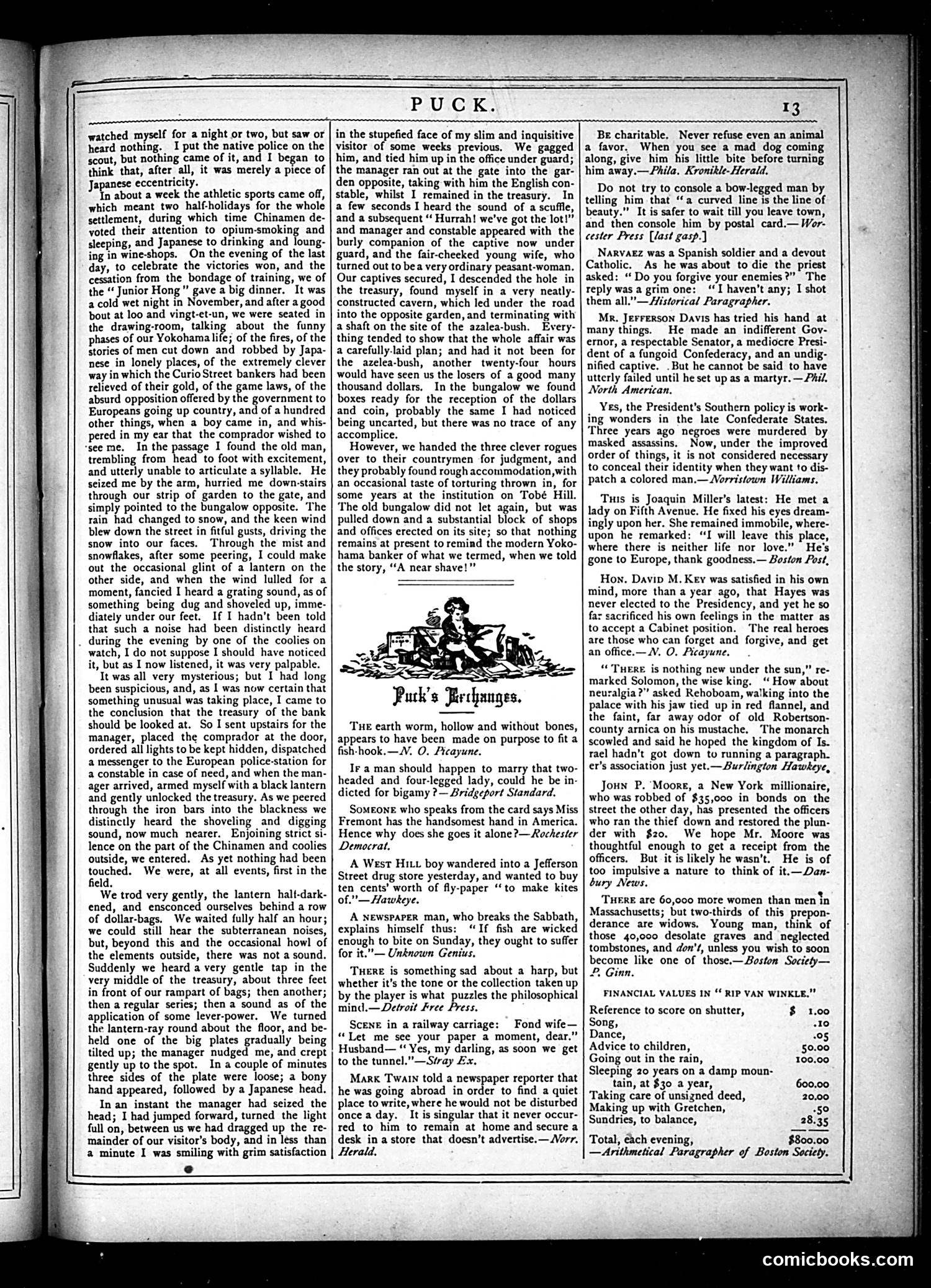
This page consists primarily of **text columns** with brief satirical commentaries on current events, rather than political cartoons. The small illustration titled **"Puck's Birthpanges"** depicts a chaotic scene—likely satirizing some contemporary political or social turmoil, though the specific event is unclear from this reproduction. The text sections mock various targets: Jefferson Davis's failed efforts; President Hayes's Southern policy and the murders of Black citizens three years prior; a man marrying for bigamy; and various human foibles. One entry mocks a newspaper man who breaks the Sabbath fishing. The final section lists "Financial Values in 'Rip Van Winkle'" as satire—assigning monetary amounts to virtues like advice to children ($55) and taking care of unsigned deeds ($20). Without clearer dates or bylines visible, specific political figures remain difficult to identify with certainty.
📄 Transcribed text from this page (OCR, searchable)
Machine-transcribed from the original scan — historical spelling and the odd misread are preserved.
13 watched myself for a night or two, but saw or heard nothing. I put the native police on the scout, but nothing came of it, and I began to think that, after all, it was merely a piece of Japanese eccentricity. In about a week the athletic sports came off, which meant two half-holidays for the whole settlement, during which time Chinamen de- yoted their attention to opium-smoking and sleeping, and Japanese to drinking and loung- ing in wine-shops. On the evening of the last day, to celebrate the victories won, and the cessation from the bondage of training, we of the “ Junior Hong” gave a big dinner. It was acold wet night in November, and after a good bout at loo and vingt-et-un, we were seated in the drawing-room, talking about the funny phases of our Yokohama life; of the fires, of the stories of men cut down and robbed by Japa- nese in lonely places, of the extremely clever way in which the Curio Street bankers had been relieved of their gold, of the game laws, of the absurd opposition offered by the government to Europeans going up country, and of a hundred other things, when a boy came in, and whis- pered in my ear that the comprador wished to ‘see me. In the passage I found the old man, trembling from head to foot with excitement, and utterly unable to articulate a syllable. He seized me by the arm, hurried me down-stairs through our strip of garden to the gate, and simply pointed to the bungalow opposite. ‘The rain had changed to snow, and the keen wind blew down the street in fitful gusts, driving the snow into our faces. Through the mist and snowflakes, after some peering, I could make out the occasional glint of a lantern on the other side, and when the wind lulled for a moment, fancied I heard a grating sound, as of something being dug and shoveled up, imme- diately under our feet. If I hadn’t been told that such a noise had been distinctly heard . during the evening by one of the coolies on watch, I do not suppose I should have noticed it, but as I now listened, it was very palpable. It was all very mysterious; but I had long been suspicious, and, as I was now certain that something unusual was taking place, I came to the conclusion that the treasury of the bank should be looked at. So I sent upstairs for the manager, placed the comprador at the door, ordered all lights to be kept hidden, dispatched a messenger to the European police-station for a constable in case of need, and when the man- ager arrived, armed myself with a black lantern and gently unlocked the treasury. As we peered through the iron bars into the blackness we distinctly heard the shoveling and digging sound, now much nearer. Enjoining strict si- lence on the part of the Chinamen and coolies outside, we entered. As yet nothing had been touched We were, at all events, first in the eld. We trod very gently, the lantern halt-dark- ened, and ensconced ourselves behind a row of dollar-bags. We waited fully half an hour; we could still hear the subterranean noises, but, beyond this and the occasional howl of the elements outside, there was not a sound. Suddenly we heard a very gentle tap in the very middle of the treasury, about three feet in front of our rampart of bags; then another; then a regular series; then a sound as of the application of some lever-power. We turned the lantern-ray round about the floor, and be- held one of the big plates gradually being tilted up; the manager nudged me, and crept gently up to the spot. In a couple of minutes three sides of the plate were loose; a bony hand appeared, followed by a Japanese head. In an instant the manager had seized the head; I had jumped forward, turned the light full on, between us we had dragged up the re- mainder of our visitor's body, and in léss than a minute I was smiling with grim satisfaction in the stupefied face of my slim and inquisitive visitor of some weeks previous. We gagged him, and tied him up in the office under guard; the manager ran out at the gate into the gar- den opposite, taking with him the English con- stable, whilst I remained in the treasury. In a few seconds I heard the sound of a scuffle, and a subsequent “ Hurrah! we've got the lot!”” and manager and constable appeared with the burly companion of the captive now under guard, and the fair-cheeked young wife, who turned out to bea very ordinary peasant-woman. Our captives secured, I descended the hole in the treasury, found myself in a very neatly- constructed cavern, which led under the road into the opposite garden, and terminating with a shaft on the site of the azalea-bush. Every- thing tended to show that the whole affair was a carefully-laid plan; and had it not been for the azelea-bush, another twenty-four hours would have seen us the losers of a good many thousand dollars, In the bungalow we found boxes ready for the reception of the dollars and coin, probably the same I had noticed being uncarted, but there was no trace of any accomplice. However, we handed the three clever rogues over to their countrymen for judgment, and they probably found rough accommodation, with an occasional taste of torturing thrown in, for some years at the institution on Tobé Hill. The old bungalow did not let again, but was pulled down and a substantial block of shops and offices erected on its site; so that nothing remains at present to remind the modern Yoko- hama banker of what we termed, when we told the story, “A near shave!” — A> Puck's Frchanges. ‘THE earth worm, hollow and without bones, appears to have been made on purpose to fit a fish-hook.—V. O. Picayune. Ir a man should happen to marry that two- headed and four-legged lady, could he be in- dicted for bigamy ?— Bridgeport Standard. Someone who speaks from the card says Miss Fremont has the handsomest hand in America. Hence why does she goes it alone?—Zochester Democrat, A West Hitt boy wandered into a Jefferson Street drug store yesterday, and wanted to buy ten cents’ worth of fly-paper ‘to make kites of."— Hawkeye, A NEwspaPER man, who breaks the Sabbath, explains himself thus: “If fish are wicked enough to bite on Sunday, they ought to suffer for it."— Unknown Genius. Tuere is something sad about a harp, but whether it’s the tone or the collection taken up by the player is what puzzles the philosophical mind.—Detroit Free Press. Scene in a railway carriage: Fond wife— “Let me sce your paper a moment, dear.” Husband— ‘Yes, my darling, as soon we get to the tunnel.” —Stray Ex. Mark Twain told a newspaper reporter that he was going abroad in order to find a quiet place to write, where he would not be disturbed once a day. It is singular that it never occur- red to him to remain at home and secure a desk ina store that doesn’t advertise.—orr. Herald. Be charitable. Never refuse even an animal a favor. When you see a mad dog coming along, give him his little bite before turning him away.— Phila, Kronikle-Herald, Do not try to console a bow-legged man by telling him that ‘a curved line is the line of beauty.” It is safer to wait till you leave town, and then console him by postal card.— Wor- cester Press [last gasp.) Narvaez was a Spanish soldier and a devout Catholic. As he was about to die the priest asked: “ Do you forgive your enemies?” The reply was a grim one: ‘I haven't any; I shot them all.”— Historical Paragrapher. Mr. Jerrerson Davis has tried his hand at many things. He made an indifferent Gov- ernor, a respectable Senator, a mediocre Presi- dent of a fungoid Confederacy, and an undig- nified captive. .But he cannot be said to have utterly failed until he set up as a martyr. —Phi/, North American, Yes, the President’s Southern policy is work- ing wonders in the late Confederate States. Three years ago negroes were murdered by masked assassins. Now, under the improved order of things, it is not considered necessary to conceal their identity when they want to dis- patch a colored man.— Norristown Williams. Tus is Joaquin Miller's latest: He met a lady on Fifth Avenue. He fixed his eyes dream- ingly upon her. She remained immobile, where- upon he remarked: “I will leave this place, where there is neither life nor love.” He's gone to Europe, thank goodness.— Boston Post, Hon. Davip M. Key was satisfied in his own mind, more than a year ago, that Hayes was never elected to the Presidency, and yet he so faz sacrificed his own feelings in the matter as to accept a Cabinet position. ‘The real heroes are those who can forget and forgive, and get an office.—. O. Picayune, “ Tuere is nothing new under the sun,” re- marked Solomon, the wise king. ‘“ How about neuralgia?” asked Rehoboam, walking into the palace with his jaw tied up in red flannel, and the faint, far away odor of old Robertson- county arnica on his mustache. The monarch scowled and said he hoped the kingdom of Is. rael hadn't got down to running a paragraph. er’s association just yet.—Burlington Hawkeye, Joun P. Moore, a New York millionaire, who was robbed of $35,000 in bonds on the street the other day, has presented the officers who ran the thief down and restored the plun- der with $20. We hope Mr. Moore was thoughtful enough to get a receipt from the officers. But it is likely he wasn’t. He is of too impulsive a nature to think of it.—Dan- bury News. ‘THERE are 60,000 more women than men In Massachusetts; but two-thirds of this prepon- derance are widows. Young man, think of those 40,000 desolate graves and neglected tombstones, and don't, unless you wish to soon become like one of those.—Boston Society— ?. Ginn. FINANCIAL VALUES IN “‘ RIP VAN WINKLE.” Reference to score on shutter, $ Song, Dance, Advice to children, Going out in the rain, Sleeping 20 years on a damp moun- tain, at $30 a year, Taking care of unsigned deed, Making up with Gretchen, Sundries, to balance, Total, each evening, $800.00 —Anithmetical Paragrapher of Boston Society. 1,00 +10 105 50.00 100.00 comicbooks.com