
Puck, 1878-05-15 · page 4 of 16
Puck — May 15, 1878 — page 4: what you’re looking at
What you’re looking at
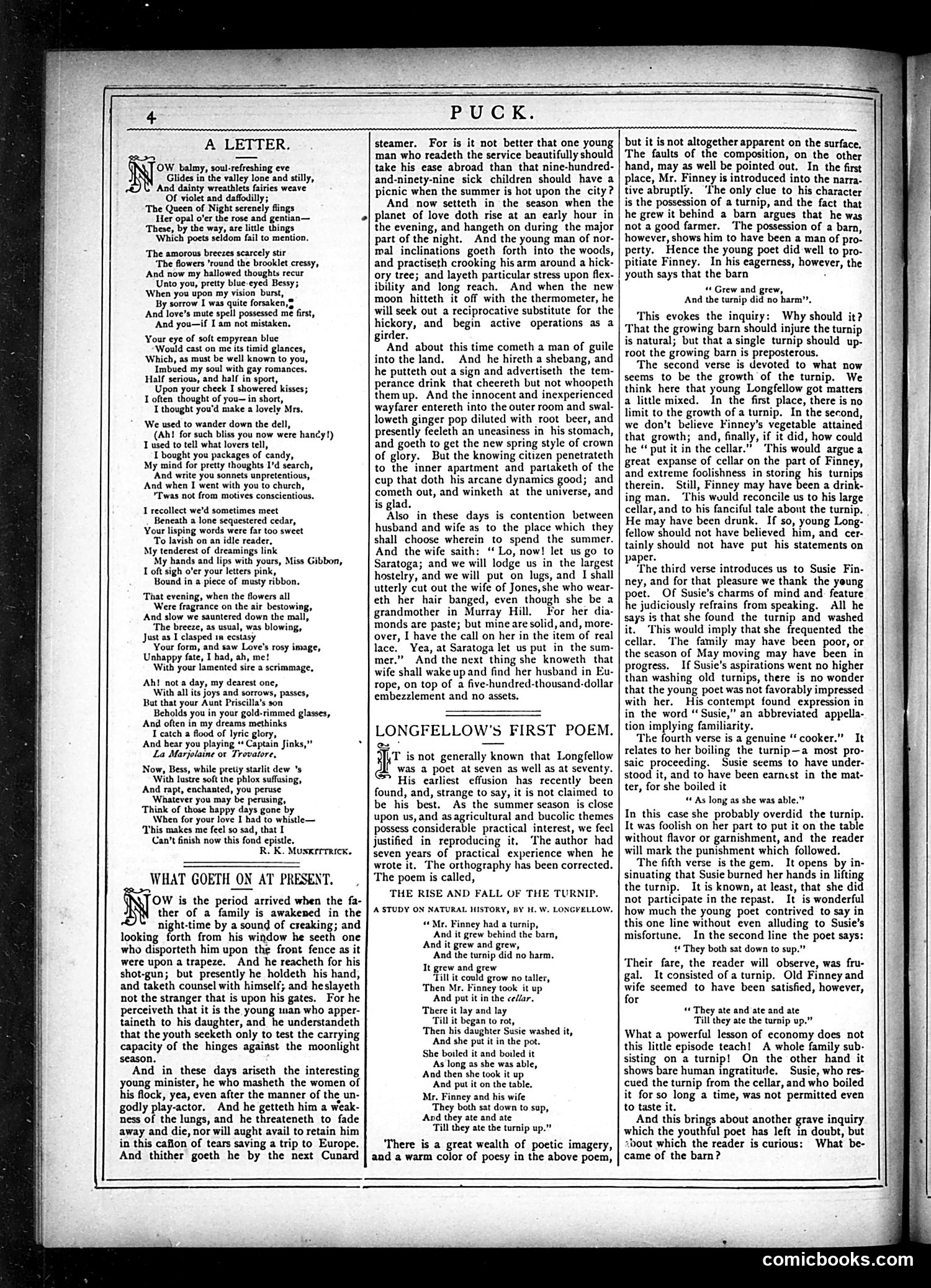
This page contains literary content rather than political cartoons. It features "A Letter" (a poem), "Longfellow's First Poem" (discussing the poet's early work), and "What Goeth On at Present" (a satirical prose piece about family life). "What Goeth On at Present" appears to be domestic satire centering on a family dispute. A father arrives home to find his wife has taken their children to the country without permission. The narrative mocks the husband's indignation and the wife's independent decision-making—she went to Saratoga Springs despite his objection, leaving him to discover the empty house. The piece satirizes marital tensions and shifting household authority, presenting the wife's autonomous choice as both comedic and somewhat scandalous for the era. The overall page emphasizes literary humor over topical political satire.
📄 Transcribed text from this page (OCR, searchable)
Machine-transcribed from the original scan — historical spelling and the odd misread are preserved.
A LETTER. ‘OW balmy, soul-refreshing eve Glides inthe valley lone and stilly, And dainty wreathlets fairies weave Of violet and daffodilly ; ‘The Queen of Night serenely fings Her opal o'er the rose and gentian— These, by the way, are little things Which poets seldom fail to mention. ‘The amorous breczes scarcely stir ‘The flowers ’round the brooklet cressy, ‘And now my hallowed thoughts recur Unto you, pretty blue-eyed Bessy; When you upon my vision burst, By sorrow I was quite forsaken, ‘And love’s mute spell possessed me first, ‘And you—if I am not mistaken, Your eye of soft empyrean blue ‘Would cast on me its timid glances, Which, as must be well known to you, Imbued my soul with gay romances. Half serious, and half in sport, Upon your cheek I showered kisses; Toften thought of you in short, I thought you'd make a lovely Mrs, We used to wander down the dell, (Ah! for such bliss you now were hancy!) I used to tell what lovers tell, I bought you packages of candy, My mind for pretty thoughts I'd search, ‘And write you sonnets unpretentious, ‘And when I went with you to church, "Twas not from motives conscientious. I recollect we'd sometimes meet Beneath a lone sequestered cedar, Your lisping words were far too sweet To lavish on an idle reader, My tenderest of dreamings link ‘My hands and lips with yours, Miss Gibbon, I off sigh o'er your letters pink, Bound in a piece of musty ribbon. That evening, when the flowers all Were fragrance on the air bestowing, And slow we sauntered down the mall, ‘The breeze, as usual, was blowing, Just as I clasped in ecstasy Your form, and saw Love's rosy image, Unhappy fate, I had, ah, met With your lamented sire a scrimmage, Ah! not a day, my dearest one, With all its joys and sorrows, passes, Bat that your Aunt Priscilla’s son Beholds you in your gold-rimmed glasses, And often in my dreams methinks T catch a flood of lyric glory, ‘And bear you playing “* Captain Jinks,” . La Marjolaine or Trovatore, Now, Bess, while pretiy starlit dew 's With lustre soft the phlox suffusing, And rapt, enchanted, you peruse Whatever you may be perusing, Think of those happy days gone by When for your love I had to whistle— This makes me feel so sad, that I Can’t finish now this fond epistle. R. K. Muskerreicr. WHAT GOETH _ON AT PRESENT. OW is the period arrived when the fa- ther of a family is awakened in the night-time by a sound of creaking; and looking forth from his window he seeth one who disporteth him upon the front fence as it were upon a trapeze. And he reacheth for his shot-gun; but presently he holdeth his hand, and taketh counsel with himself; and heslayeth not the stranger that is upon his gates. For he perceiveth that it is the young man who apper- taineth to his daughter, and he understandeth that the youth seeketh only to test the carrying capacity of the hinges against the moonlight season. And in these days ariseth the interesting young minister, he who masheth the women of his flock, yea, even after the manner of the un- godly play-actor. And he getteth him a weak- ness of the lungs, and he threateneth to fade away and die, nor will aught avail to retain him in this cafion of tears saving a trip to Europe. And thither goeth he by the next Cunard steamer. For is it not better that one young man who readeth the service beautifully shoul take his ease abroad than that nine-hundred- and-ninety-nine sick children should have a picnic when the summer is hot upon the city? And now setteth in the season when the planet of love doth rise at an early hour in the evening, and hangeth on during the major part of the night. And the young man of nor- mal inclinations goeth forth into the woods, and practiseth crooking his arm around a hick- ory tree; and layeth particular stress upon flex- ibility and long reach. And when the new moon hitteth it off with the thermometer, he will seek out a reciprocative substitute for the hickory, and begin active operations as a girder. And about this time cometh a man of guile into the land. And he hireth a shebang, and he putteth out a sign and advertiseth the tem- perance drink that cheereth but not whoopeth them up. And the innocent and inexperienced wayfarer entereth into the outer room and swal- loweth ginger pop diluted with root beer, and presently feeleth an uneasiness in his stomach, and goeth to get the new spring style of crown of glory. But the knowing citizen penetrateth to the inner apartment and partaketh of the cup that doth his arcane dynamics good; and cometh out, and winketh at the universe, and is glad. Also in these days is contention between husband and wife as to the place which they shall choose wherein to spend the summer. And the wife saith: ‘“ Lo, now! let us go to Saratoga; and we will lodge us in the largest hostelry, and we will put on lugs, and I shall utterly cut out the wife of Jones, she who wear- eth her hair banged, even though she be a grandmother in Murray Hill, For her dia- monds are paste; but mine are solid, and, more- over, I have the call on her in the item of real lace. Yea, at Saratoga let us put in the sum- mer.” And the next thing she knoweth that wife shall wake up and find her husband in Eu- rope, on top of a five-hundred-thousand-dollar embezzlement and no assets, LONGFELLOW’'s FIRST POEM. [ — sf, is not generally known that Longfellow was a poet at seven as well as at seventy. His earliest effusion has recently been found, and, strange to say, it is not claimed to be his best. As the summer season is close upon us, and as agricultural and bucolic themes possess considerable practical interest, we feel justified in reproducing it, ‘The author had seven years of practical experience when he wrote it. The orthography has been corrected. The poem is called, THE RISE AND FALL OF THE TURNIP. A STUDY ON NATURAL HISTORY, BY H.W. LONGFELLOW. CA “ Mr. Finney had a turnip, And it grew behind the barn, And it grew and grew, ‘And the turnip did no harm. It grew and grew Till it could grow no taller, Then Mr. Finney took it up ‘And put it in the cedar. ‘There it lay and lay Till it began to rot, Then his daughter Susie washed it, ‘And she put it in the pot. She boiled it and boiled it As long as she was able, And then she took it up ‘And put it on the table. Mr. Finney and his wife They both sat down to sup, And they ate and ate Till they ate the turnip up.” ‘There is a great wealth of poetic imagery, and a warm color of pocsy in the above poem, but it is not altogether apparent on the surface, The faults of the composition, on the other hand, may as well be pointed out. In the first place, Mr. Finney is introduced into the narra- tive abruptly. ‘The only clue to his character is the possession of a turnip, and the fact that he grew it behind a barn argues that he was not a good farmer. ‘The possession of a barn, however, shows him to have been a man of pro- petty, Hence the young poet did well to pro- pitiate Finney. In his eagerness, however, the youth says that the barn . « Grew and grew, And the turnip did no harm”, This evokes the inquiry: Why should it? ‘That the growing barn should injure the turnip is natural; but that a single turnip should up- root the growing barn is preposterous. The second verse is devoted to what now seems to be the growth of the turnip. We think here that young Longfellow got matters a little mixed. In the first place, there is no limit to the growth of a turnip. In the second, we don’t believe Finney’s vegetable attained that growth; and, finally, if it did, how could he “ put it in the cellar.” This would argue a great expanse of cellar on the part of Finney, and extreme foolishness in storing his turni, therein. Still, Finney may have Been a drink. ing man. ‘This would reconcile us to his large cellar, and to his fanciful tale about the turnip, He may have been drunk. If so, young Long- fellow should not have believed him, and cer- tainly should not have put his statements on paper. ‘The third verse introduces us to Susie Fin- ney, and for that pleasure we thank the young poet. Of Susie’s charms of mind and. feature he judiciously refrains from speaking. All he says is that she found the turnip and washed it. This would imply that she frequented the cellar. The family may have been poor, or the season of May moving may have been in progress. If Susie's aspirations went no higher than washing old turnips, there is no wonder that the young poet was not favorably impressed with her. His contempt found expression in in the word “Susie,” an abbreviated appella- tion implying familiarity. The fourth verse is a genuine “cooker.” It relates to her boiling the turnip—a most pro- saic proceeding. Susie seems to have under- stood it, and to have been earnest in the mat- ter, for she boiled it * As long as she was able.” In this case she probably overdid the turnip. It was foolish on her part to put it on the table without flavor or garnishment, and the reader will mark the punishment which followed. The fifth verse is the gem. It opens by in- sinuating that Susie burned her hands in lifting the turnj It is known, at least, that she did not participate in the repast. It is wonderful how much the young poet contrived to say in this one line without even alluding to Susie’s misfortune, In the second line the poet says: {* They both sat down to sup.”” Their fare, the reader will observe, was fru- gal. It consisted of a turnip, Old Finney and wife seemed to have been satisfied, however, for « They ate and ate and ate Till they ate the turnip up.” What a powerful lesson of economy does not this little episode teach! A whole family sub- sisting on a turnip! On the other hand it shows bare human ingratitude. Susie, who res- cued the turnip from the cellar, and who boiled it for so long a time, was not permitted even to taste it. And this brings about another grave inquiry which the youthful poet has left in doubt, but ‘bout which the reader is curious: What be- came of the barn? comicbooks.com