
Puck, 1878-05-15 · page 11 of 16
Puck — May 15, 1878 — page 11: what you’re looking at
What you’re looking at
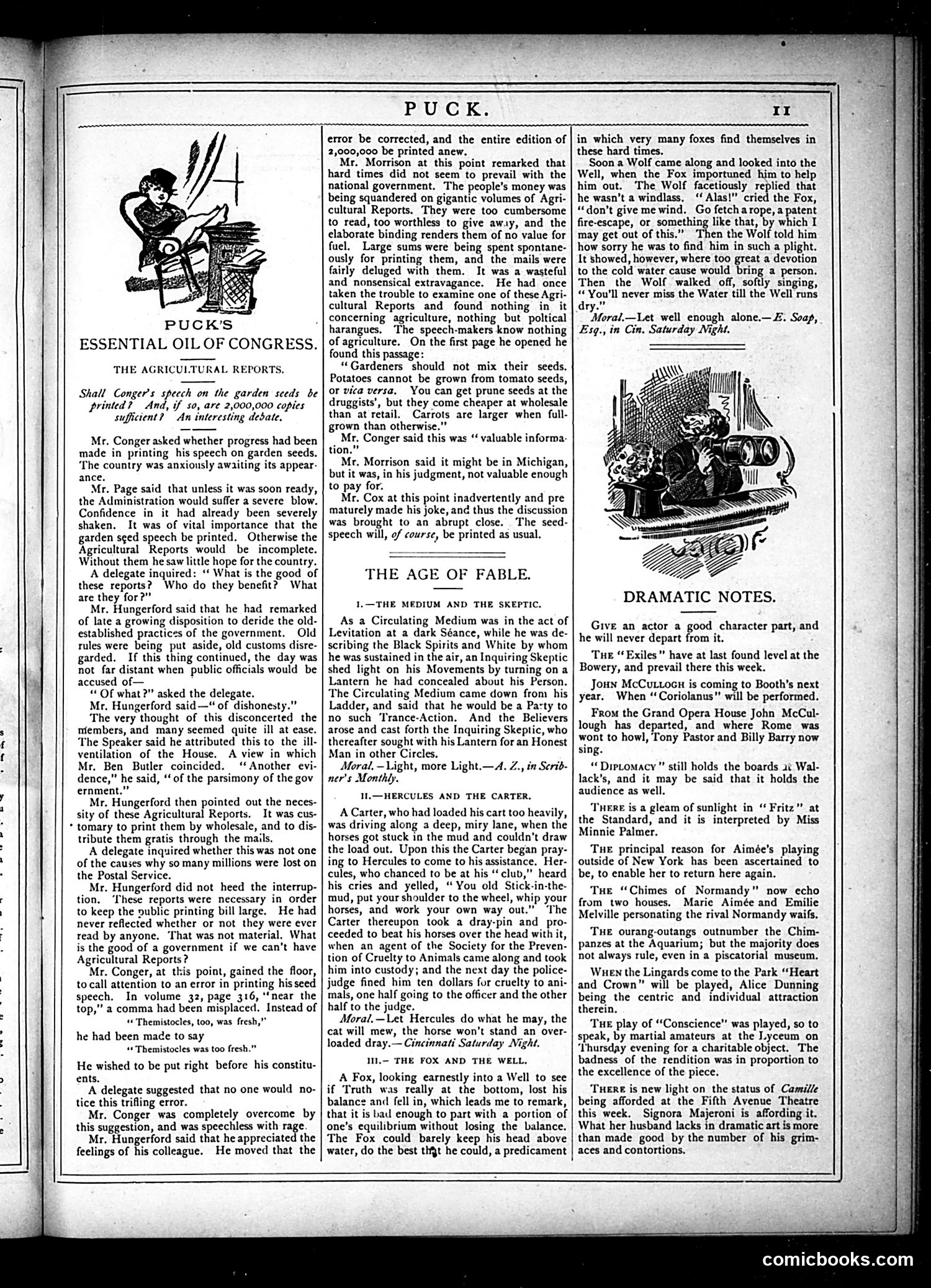
This page contains **two separate sections**: a political satire article titled "Puck's Essential Oil of Congress: The Agricultural Reports" and unrelated theater reviews under "Dramatic Notes." The main cartoon/article mocks Congressional debate over agricultural reports. It features speakers (Conger, Morrison, Cox, Hungerford, and Huller) arguing about whether printing expensive government agricultural reports serves any practical purpose. The satire critiques government waste and inefficiency—the reports are expensive to produce, poorly used, and represent typical Congressional time-wasting on minutiae while broader issues go unaddressed. The illustration shows Puck's trademark mischievous sprite character observing the foolish proceedings, embodying the magazine's satirical stance toward legislative absurdity.
📄 Transcribed text from this page (OCR, searchable)
Machine-transcribed from the original scan — historical spelling and the odd misread are preserved.
PUCK. PUCK’S ESSENTIAL OIL OF CONGRESS. THE AGRICUL! URAL REPORTS, Shall Conger’s speech on the garden seeds be printed? And, if s0, are 2,000,000 copies sufficient? An interesting debate. Mr. Conger asked whether progress had been made in printing his speech on garden seeds. ‘The country was anxiously awaiting its appear- ance. Mr. Page said that unless it was soon ready, the Administration would suffer a severe blow. Confidence in it had already been severely shaken. It was of vital importance that the garden sged speech be printed. Otherwise the Agricultural Reports would be incomplete. Without them he saw little hope for the country. A delegate inquired: ‘ What is the good of these reports? Who do they benefit? What are they for?” Mr. Hungerford said that he had remarked of late a growing disposition to deride the old- established practices of the government. Old rules were being put aside, old customs disre- garded. If this thing continued, the day was not far distant when public officials would be accused of— “ Of what?” asked the delegate. Mr. Hungerford said—* of dishonesty.” The very thought of this disconcerted the members, and many seemed quite ill at ease. The Speaker said he attributed this to the ill- ventilation of the House. A view in which Mr. Ben Butler coincided. ‘Another evi- dence,” he said, “of the parsimony of the gov ernment.” Mr. Hungerford then pointed out the neces- sity of these Agricultural Reports. It was cus- * tomary to print them by wholesale, and to dis- tribute them gratis through the mails. A delegate inquired whether this was not one of the causes why so many millions were lost on the Postal Service. Mr. Hungerford did not heed the interrup- tion, ‘These reports were necessary in order to keep the oublic printing bill large. He had never reflected whether or not they were ever read by anyone. ‘That was not material. What is the good of a government if we can’t have Agricultural Reports? ‘Mr. Conger, at this point, gained the floor, tocall attention to an error in printing his seed speech. In volume 32, page 316, ‘near the top,” a comma had been misplaced. Instead of « Themistocles, too, was fresh,” he had been made to say «* Themistocles was too fresh.” He wished to be put right before his constitu- ents. A delegate suggested that no one would no- tice this trifling error. Mr. Conger was completely overcome by this suggestion, and was speechless with rage. Mr. Hungerford said that he appreciated the feelings of his colleague. He moved that the error be corrected, and the entire edition of 2,000,000 be printed anew. Mr. Morrison at this point remarked that hard times did not seem to prevail with the national government. The people's money was being squandered on gigantic volumes of Agri- cultural Reports. They were too cumbersome to read, too worthless to give away, and the elaborate binding renders them of no value for fuel. Large sums were being spent spontane- ously for printing them, and the mails were fairly deluged with them. It was a wasteful and nonsensical extravagance. He had once taken the trouble to examine one of these Agri- cultural Reports and found nothing in it concerning agriculture, nothing but poltical harangues. The speech-makers know nothing of agriculture. On the first page he opened he found this passage: “Gardeners should not mix their seeds. Potatoes cannot be grown from tomato seeds, or vica versa, You can get prune seeds at the druggists’, but they come cheaper at wholesale than at retail. Carrots are larger when full- grown than otherwise.” Mr. Conger said this was ‘‘ valuable informa- tion.” Mr. Morrison said it might be in Michigan, but it was, in his judgment, not valuable enough to pay for. Mr. Cox at this point inadvertently and pre maturely made his joke, and thus the discussion was brought to an abrupt close. The seed- speech will, of course, be printed as usual. THE AGE OF FABLE. 1.—THE MEDIUM AND THE SKEPTIC. As a Circulating Medium was in the act of Levitation at a dark Séance, while he was de- scribing the Black Spirits and White by whom he was sustained in the air, an Inquiring Skeptic shed light on his Movements by turning on a Lantern he had concealed about his Person. The Circulating Medium came down from his Ladder, and said that he would be a Pasty to no such ‘Trance-Action. And the Believers arose and cast forth the Inquiring Skeptic, who thereafter sought with his Lantern for an Honest Man in other Circles. Moral, —Light, more Light.—A. Z., in Serib- ner’s Monthly. 11,—HERCULES AND THE CARTER. A Carter, who had loaded his cart too heavily, was driving along a deep, miry lane, when the horses got stuck in the mud and couldn't draw the load out. Upon this the Carter began pray- ing to Hercules to come to his assistance. Her- cules, who chanced to be at his “club,” heard his cries and yelled, “ You old Stick-in-the- mud, put your shoulder to the wheel, whip your horses, and work your own way out.” ‘The Carter thereupon took a dray-pin and _pro- ceeded to beat his horses over the head with it, when an agent of the Society for the Preven- tion of Cruelty to Animals came along and took him into custody; and the next day the police- judge fined him ten dollars for cruelty to ani- mals, one half going to the officer and the other half to the judge. Moral,—Let Hercules do what he may, the cat will mew, the horse won't stand an over- loaded dray.— Cincinnati Saturday Night. 11l,- THE FOX AND THE WELL. A Fox, looking earnestly into a Well to see if Truth was really at the bottom, lost his balance and fell in, which leads me to remark, that it is bad enough to part with a portion of one’s equilibrium without losing the balance. The Fox could barely keep his head above water, do the best thgt he could, a predicament in which very many foxes find themselves in these hard times. Soon a Wolf came along and looked into the Well, when the Fox importuned him to help him out. The Wolf facetiously replied that he wasn’t a windlass. ‘ Alas!” cried the Fox, “don’t give me wind. Go fetch a rope, a patent fire-escape, or something like that, by which I may get out of this.” Then the Wolf told him how sorry he was to find him in such a plight. It showed, however, where too great a devotion to the cold water cause would bring a person. Then the Wolf walked off, softly singing, “You'll never miss the Water till the Well runs dry.” Moral.—Let well enough alone.—£. Soap, Esq., in Cin, Saturday Night. HU .: ZA DRAMATIC NOTES. Give an actor a good character part, and he will never depart from it. Tue “Exiles” have at last found level at the Bowery, and prevail there this week. Joun McCutocu is coming to Booth’s next year. When “Coriolanus”’ will be performed. From the Grand Opera House John McCul- lough has departed, and where Rome was wont to howl, Tony Pastor and Billy Barry now sing. “ Dirtomacy ” still holds the boards 2i Wal- lack’s, and it may be said that it holds the audience as well. ‘Tuere is a gleam of sunlight in “Fritz” at the Standard, and it is interpreted by Miss Minnie Palmer. Tue principal reason for Aimée’s playing outside of New York has been ascertained to be, to enable her to return here again. Tue “Chimes of Normandy” now echo from two houses. Marie Aimée and Emilie Melville personating the rival Normandy waifs. THE ourang-outangs outnumber the Chim- panzes at the Aquarium; but the majority does not always rule, even in a piscatorial museum. Wuen the Lingards come to the Park “Heart and Crown” will be played, Alice Dunning being the centric and individual attraction therein. Tue play of “Conscience” was played, so to speak, by martial amateurs at the Lyceum on ‘Thursday evening for a charitable object. The badness of the rendition was in proportion to the excellence of the piece. ‘Tuere is new light on the status of Camille being afforded at the Fifth Avenue Theatre this week. Signora Majeroni is affording it. What her husband lacks in dramatic art is more than made good by the number of his grim- aces and contortions. comicbooks.com