
Puck, 1878-05-15 · page 5 of 16
Puck — May 15, 1878 — page 5: what you’re looking at
What you’re looking at
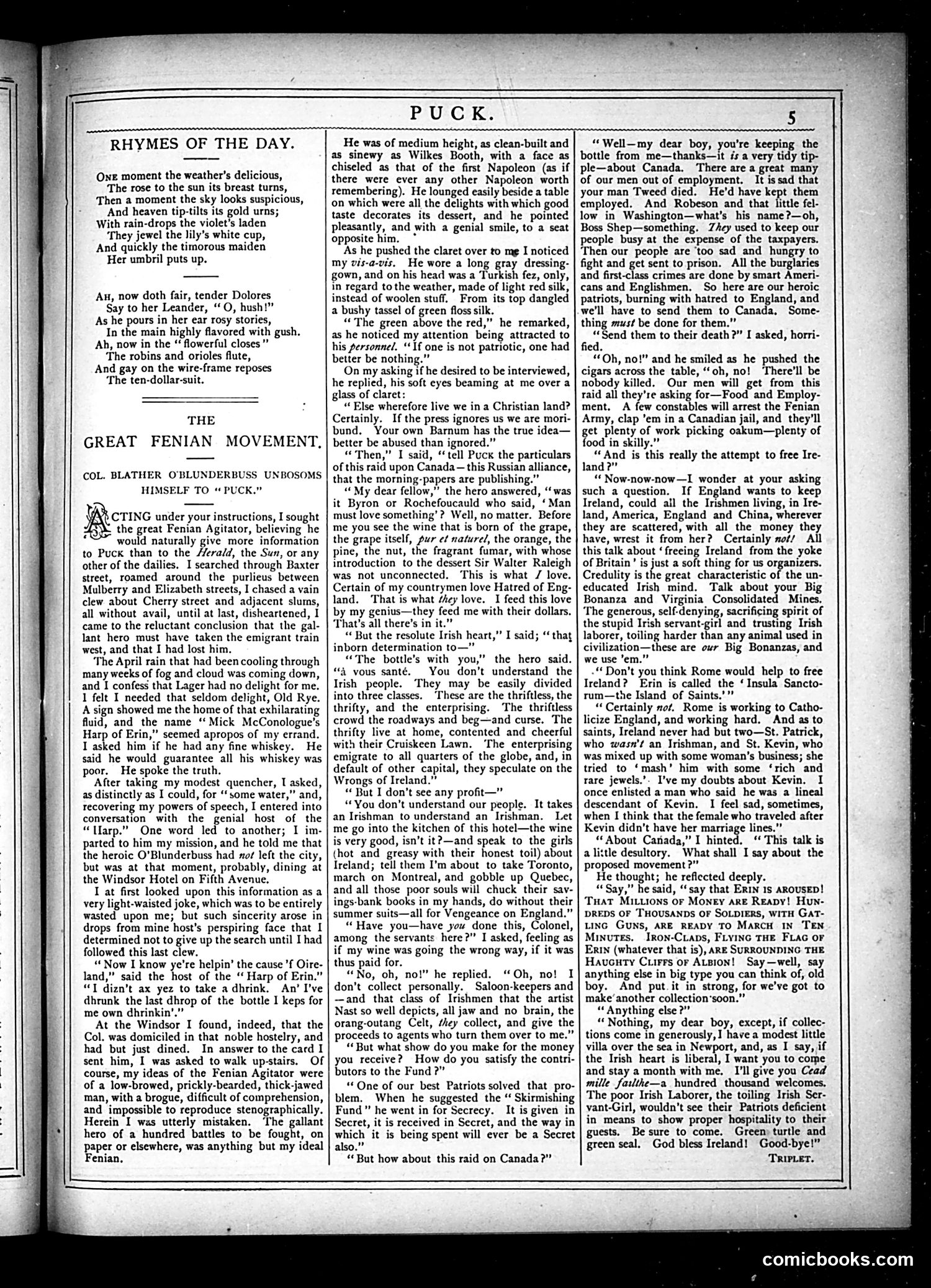
This page contains a satirical article titled "THE GREAT FENIAN MOVEMENT" by Col. Blather O'Lunderbus, discussing Irish nationalist activities and proposed emigration to Canada. The piece mockingly presents an Irish character's boastful plans to organize Irish people ("Big Bonanzas and Virginia Consolidated Mines") while critiquing their actual effectiveness. The satire targets: - Irish-American organizing and recruitment efforts - Perceived Irish-American ineffectiveness despite grandiose rhetoric - The contrast between bombastic talk and practical results - Irish stereotypes (drinking, poor planning, lack of discipline) The article appears positioned as satirizing both Irish nationalist ambitions and American attitudes toward Irish immigrants during what appears to be a period of Fenian Brotherhood activity (likely 1860s-70s). The humor relies on ethnic caricature typical of Victorian-era Puck.
📄 Transcribed text from this page (OCR, searchable)
Machine-transcribed from the original scan — historical spelling and the odd misread are preserved.
PUCK. RHYMES OF THE DAY. One moment the weather's delicious, The rose to the sun its breast turns, Then a moment the sky looks suspicious, And heaven tip-tilts its gold urns; With rain-drops the violet’s laden ‘They jewel the Jily’s white cup, And quickly the timorous maiden Her umbril puts up. Au, now doth fair, tender Dolores Say to her Leander, ‘O, hush!” As he pours in her ear rosy stories, In the main highly flavored with gush. Ah, now in the “ flowerful closes” The robins and orioles flute, And gay on the wire-frame reposes ‘The ten-dollar-suit. THE GREAT FENIAN MOVEMENT, COL. BLATHER O'BLUNDERBUSS UNBOSOMS HIMSELF TO “ PUCK.” @, CTING under your instructions, I sought the great Fenian Agitator, believing he would naturally give more information to Puck than to the Hera/d, the Sun, or any other of the dailies. I searched through Baxter street, roamed around the purlieus between Mulberry and Elizabeth streets, I chased a vain clew about Cherry street and adjacent slums, all without avail, until at last, disheartened, I came to the reluctant conclusion that the gal- lant hero must have taken the emigrant train west, and that I had lost him. ‘The April rain that had been cooling through many weeks of fog and cloud was coming down, and I confess that Lager had no delight for me. 1 felt I needed that seldom delight, Old Rye. A sign showed me the home of that exhilarating fluid, and the name ‘ Mick McConologue’s Harp of Erin,” seemed apropos of my errand. I asked him if he had any fine whiskey. He said he would guarantee all his whiskey was poor. He spoke the truth. After taking my modest quencher, I asked, as distinctly as I could, for ‘some water,” and, recovering my powers of speech, I entered into conversation with the genial host of the “arp.” One word led to another; I im- parted to him my mission, and he told me that the heroic O'Blunderbuss had zof left the city, but was at that moment, probably, dining at the Windsor Hotel on Fifth Avenue, I at first looked upon this information as a very light-waisted joke, which was to be entirely wasted upon me; but such sincerity arose in drops from mine host's perspiring face that I determined not to give up the search until I had followed this last clew. “ Now I know ye're helpin’ the cause 'f Oire- land,” said the host of the ‘ Harp of Erin,” “T dizn’t ax yez to take a dhrink. An’ I’ve dhrunk the last dhrop of the bottle I keps for me own dhrinkin’.” At the Windsor I found, indeed, that the Col. was domiciled in that noble hostelry, and had but just dined. In answer to the card I sent him, I was asked to walk up-stairs. Of course, my ideas of the Fenian Agitator were of a low-browed, prickly-bearded, thick-jawed man, with a brogue, difficult of comprehension, and impossible to reproduce stenographically. Herein I was utterly mistaken. The gallant hero of a hundred battles to be fought, on paper or elsewhere, was anything but my ideal Fenian, He was of medium height, as clean-built and as sinewy as Wilkes Booth, with a face as chiseled as that of the first Napoleon (as if there were ever any other Napoleon worth remembering). He lounged easily beside a table on which were all the delights with which good taste decorates its dessert, and he pointed pleasantly, and with a genial smile, to a seat opposite him. * As he pushed the claret over to mg I noticed my vis-a-vis. He wore a long gray dressing- gown, and on his head was a Turkish fez, only, in regard to the weather, made of light red silk, instead of woolen stuff, From its top dangled a bushy tassel of green floss silk. “‘The green above the red,” he remarked, as he noticed my attention being attracted to his personnel. ‘If one is not patriotic, one had better be nothing.” On my asking if he desired to be interviewed, he replied, his soft eyes beaming at me over a glass of claret: “Else wherefore live we in a Christian land? Certainly. If the press ignores us we are mori- bund. Your own Barnum has the true idea— better be abused than ignored.” “Then,” I said, ‘tell Puck the particulars of this raid upon Canada— this Russian alliance, that the morning-papers are publishing.” “My dear fellow,” the hero answered, “was it Byron or Rochefoucauld who said, ‘Man must love something’? Well, no matter. Before me you see the wine that is born of the grape, the grape itself, pur ef naturel, the orange, the pine, the nut, the fragrant fumar, with whose introduction to the dessert Sir Walter Raleigh was not unconnected. This is what / love. Certain of my countrymen love Hatred of Eng- land. That is what ¢hey love. I feed this love by my genius—they feed me with their dollars. ‘That’s all there's in it.” “But the resolute Irish heart,” I said; “that inborn determination to—” “The bottle’s with you,” the hero said. “4 vous santé. You don’t understand the Irish people. They may be easily divided into three classes. These are the thriftless, the thrifty, and the enterprising. The thriftless crowd the roadways and beg—and curse. The thrifty live at home, contented and cheerful with their Cruiskeen Lawn. ‘The enterprising emigrate to all quarters of the globe, and, in default of other capital, they speculate on the Wrongs of Ireland.” « But I don’t see any profit—” “You don’t understand our people. It takes an Irishman to understand an Irishman. Let me go into the kitchen of this hotel—the wine is very good, isn’t it?—and speak to the girls (hot and greasy with their honest toil) about Ireland; tell them I’m about to take Toronto, march on Montreal, and gobble up Quebec, and all those poor souls will chuck their sav- ings-bank books in my hands, do without their summer suits—all for Vengeance on England.” “Have you—have you done this, Colonel, among the servants here?" I asked, feeling as if my wine was going the wrong way, if it was thus paid for. “No, oh, no!” he replied. “Oh, no! I don’t collect personally. Saloon-kcepers and —and that class of Irishmen that the artist Nast so well depicts, all jaw and no brain, the orang-outang Celt, “hey collect, and give the proceeds to agents who turn them over to me.”” “But what show do you make for the money you receive? How do you satisfy the contri- butors to the Fund ?” “One of our best Patriots solved that pro- blem. When he suggested the “ Skirmishing Fund” he went in for Secrecy. It is given in Secret, it is received in Secret, and the way in which it is being spent will ever be a Secret also.” “But how about this raid on Canada?” “Well—my dear boy, you're keeping the bottle from me—thanks—it és a very tidy tip- ple—about Canada. There are a great many of our men out of employment. It is sad that your man Tweed died. He'd have kept them employed. And Robeson and that little fel- low in Washington—what’s his name?—oh, Boss Shep—something. ZAcy used to keep our people busy at the expense of the taxpayers. Then our people are ‘too sad and hungry to fight and get sent to prison. All the burglaries and first-class crimes are done by smart Ameri- cans and Englishmen. So here are our heroic patriots, burning with hatred to England, and we'll have to send them to Canada, Some- thing must be done for them.” “Send them to their death ?” I asked, horri- fied. “Oh, no!” and he smiled as he pushed the cigars across the table, ‘oh, no! There'll be nobody killed. Our men will get from this raid all they're asking for—Food and Employ- ment, A few constables will arrest the Fenian Army, clap ‘em in a Canadian jail, and they'll get plenty of work picking oakum—plenty of food in skilly.”” “And is this really the attempt to free Ire- land?” “ Now-now-now—I wonder at your asking such a question. If England wants to keep Ireland, could all the Irishmen living, in Ire- land, America, England and China, wherever they are scattered, with all the money they have, wrest it from her? Certainly noft/ All this talk about ‘freeing Ireland from the yoke of Britain’ is just a soft thing for us organizers. Credulity is the great characteristic of the un- educated Irish mind. Talk about your Big Bonanza and Virginia Consolidated Mines. The generous, self-denying, sacrificing spirit of the stupid Irish servant-girl and trusting Irish laborer, toiling harder than any animal used in civilization—these are our Big Bonanzas, and we use ’em.”” -* Don’t you think Rome would help to free Ireland? Erin is called the ‘ Insula Sancto- rum—the Island of Saints.’”” “Certainly not, Rome is working to Catho- licize England, and working hard. And as to saints, Ireland never had but two—St. Patrick, who wasn’t an Irishman, and St. Kevin, who was mixed up with some woman’s business; she tried to ‘mash’ him with some ‘rich and rare jewels.’. I’ve my doubts about Kevin. I once enlisted a man who said he was a lineal descendant of Kevin. I feel sad, sometimes, when I think that the female who traveled after Kevin didn’t have her marriage lines.” “About Cariada,” I hinted. ‘ This talk is a little desultory. What shall I say about the proposed movement?” He thought; he reficcted deeply. “Say,” he said, “say that ERIN 1s AROUSED! Tuat Mittions or Money are Reapy! Hun- DREDS OF THOUSANDS OF SOLDIERS, WITH GAT- Linc GUNS, ARE READY TO MARCH IN TEN Minutes. Iron-Craps, Fiyinc THE FLAG or Enrtn (whatever that is), ARE SURROUNDING THE Havucuty Cirrs or ALBION! Say—well, say anything else in big type you can think of, old boy. And put. it in strong, for we’ve got to make’ another collection’soon.”” “ Anything else?” “Nothing, my dear boy, except, if collec- tions come in generously,I have a modest little villa over the sea in Newport, and, as I say, if the Irish heart is liberal, 1 want you to come and stay a month with me. I'll give you Cead mille fatlthe—a hundred thousand welcomes, The poor Irish Laborer, the toiling Irish Ser- yant-Girl, wouldn't see their Patriots deficient in means to show proper hospitality to their guests. Be sure to come. Green) turtle and green seal. God bless Ireland! Good-bye!” ‘TRIPLET. comicbooks.com