A complete issue · 17 pages · 1878
Puck — March 6, 1878
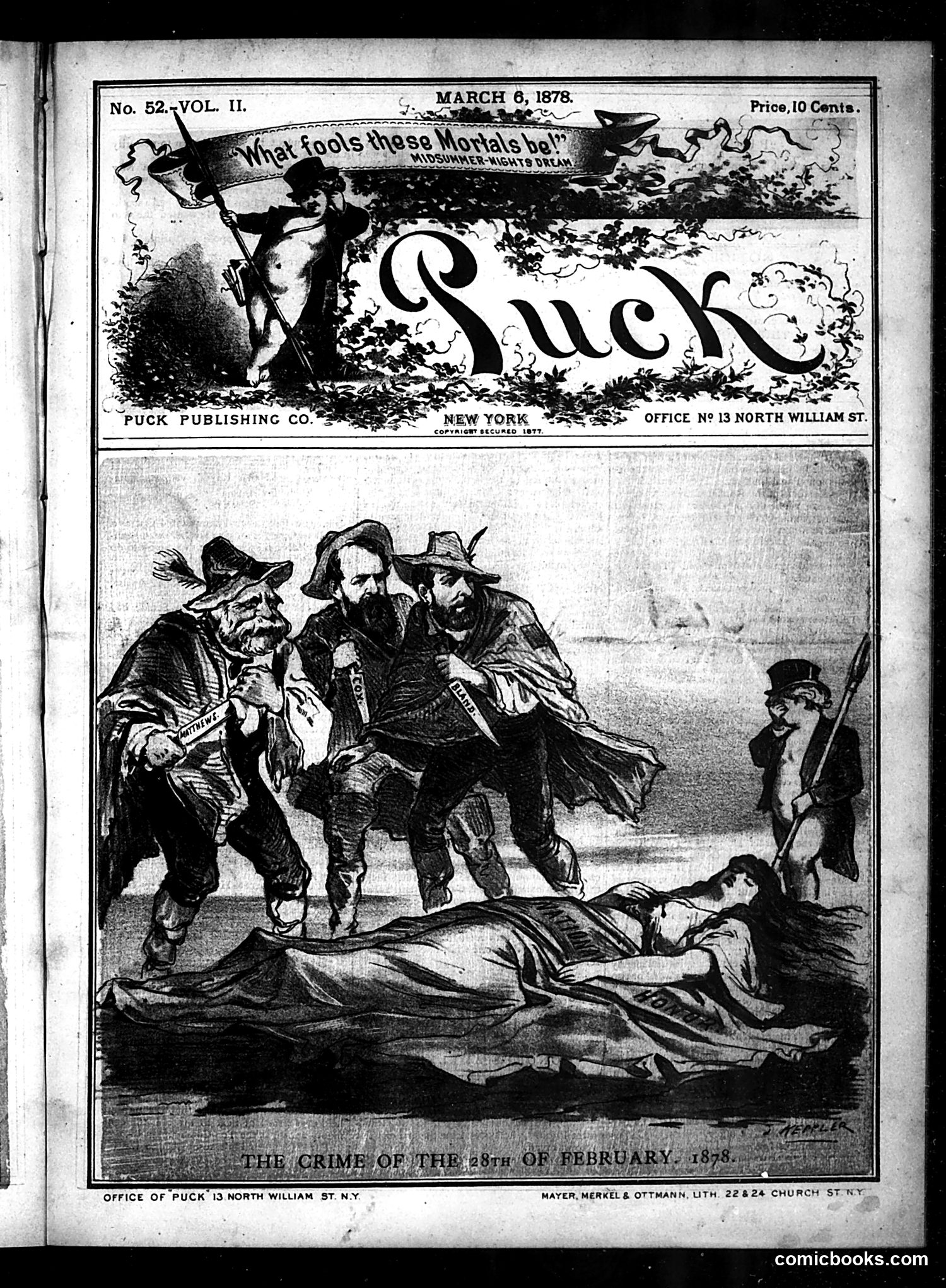
This satirical cartoon illustrates "The Crime of the 28th of February, 1878"—likely referencing a significant political or criminal incident from that date. The image depicts three menacing figures in period costume standing over a prone body, suggesting either a murder or political assassination depicted as a crime. The title banner asks "What tools these Mortals be!"—a reference to Shakespeare's *The Tempest*, suggesting the perpetrators are mere instruments or puppets rather than autonomous actors. Without additional context identifying the specific historical event, figures, and political figures involved, the precise meaning remains unclear, though the composition indicates Puck was criticizing whoever committed or was responsible for this February 28th incident as morally culpable.
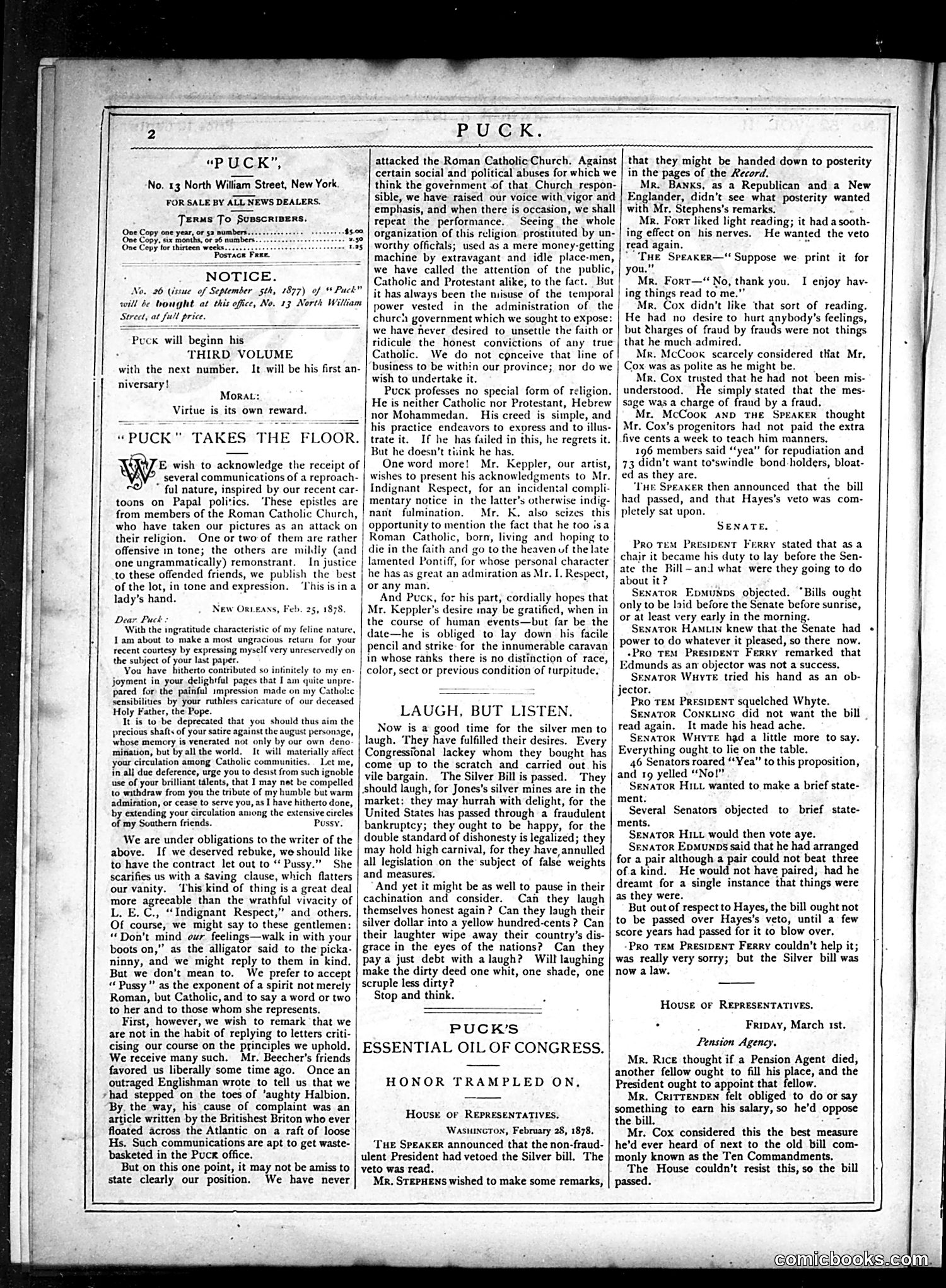
This page contains satirical commentary on the **Silver Bill debate in Congress**. The main cartoon criticizes senators laughing about the bill's passage despite its controversial nature regarding currency policy. The satire mocks **wealthy silver mine owners** ("silver men") who profited from the legislation, questioning the morality of laughing while the nation's finances faced serious consequences. The text pointedly asks: can they "laugh" while potentially harming the country? Key figures referenced include **President McKinley** (who vetoed the bill), **Senator Edmunds**, **Senator Whyte**, and other unnamed senators engaged in parliamentary debate. The central complaint is that politicians treated a serious economic measure as a joke rather than addressing its genuine impact on national interests—a classic Puck approach of exposing hypocrisy in governance.
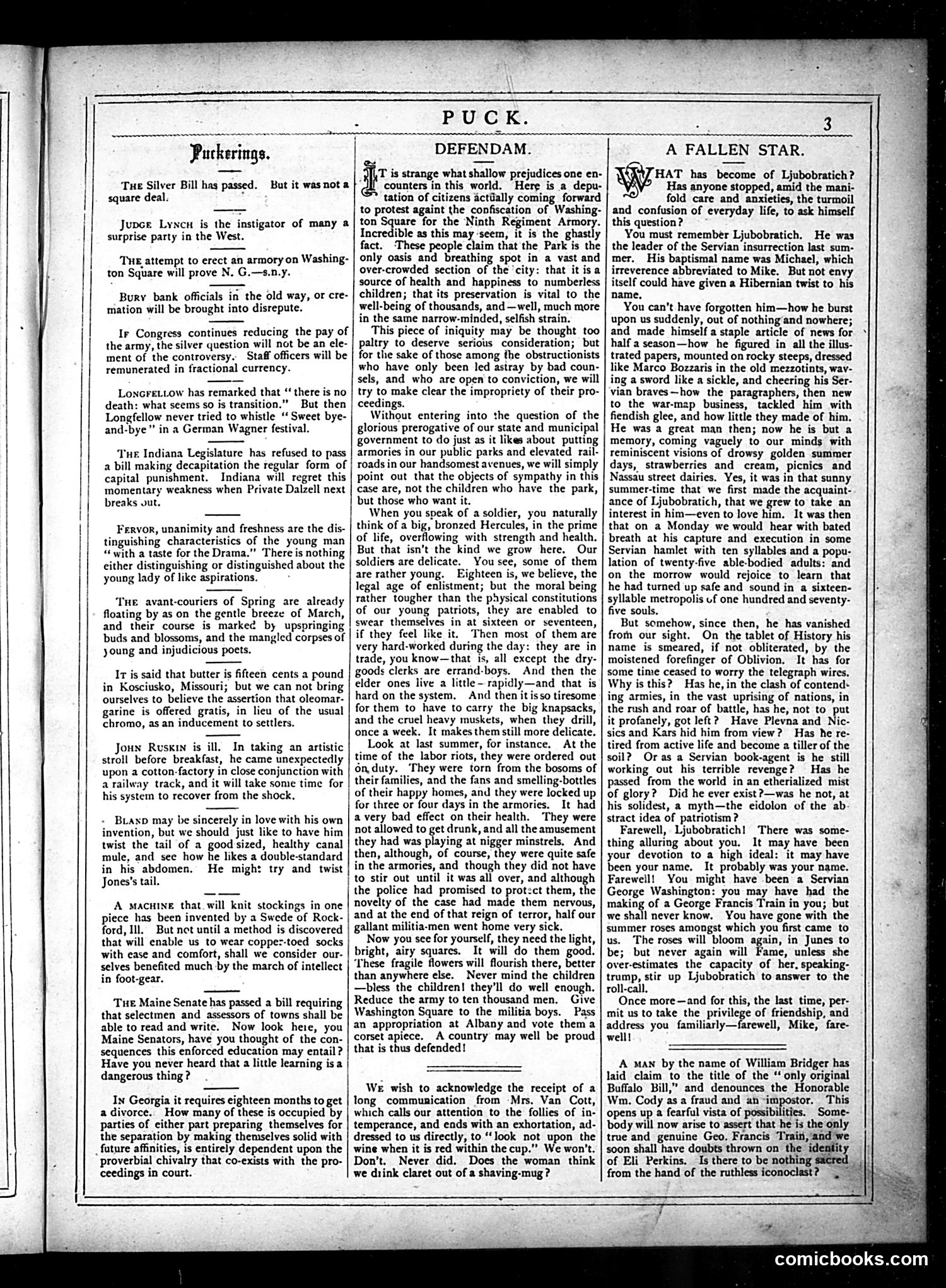
This page contains three distinct satirical sections rather than a unified cartoon. "Purkerings" offers brief political commentary on recent events: the Silver Bill's passage, Judge Lynch's role in Western violence, and criticism of Washington Square park conditions. "Defendam" mocks shallow civic prejudices and argues for sympathy toward soldiers, noting their youth and physical strain. "A Fallen Star" appears to be a narrative piece about Ljubobratich, a Serbian insurgent leader, critiquing his decline from prominence and questioning whether he represents genuine patriotism or merely self-interested rebellion. The overall tone suggests Puck's characteristic late-19th-century skepticism toward both political institutions and public figures claiming moral authority.
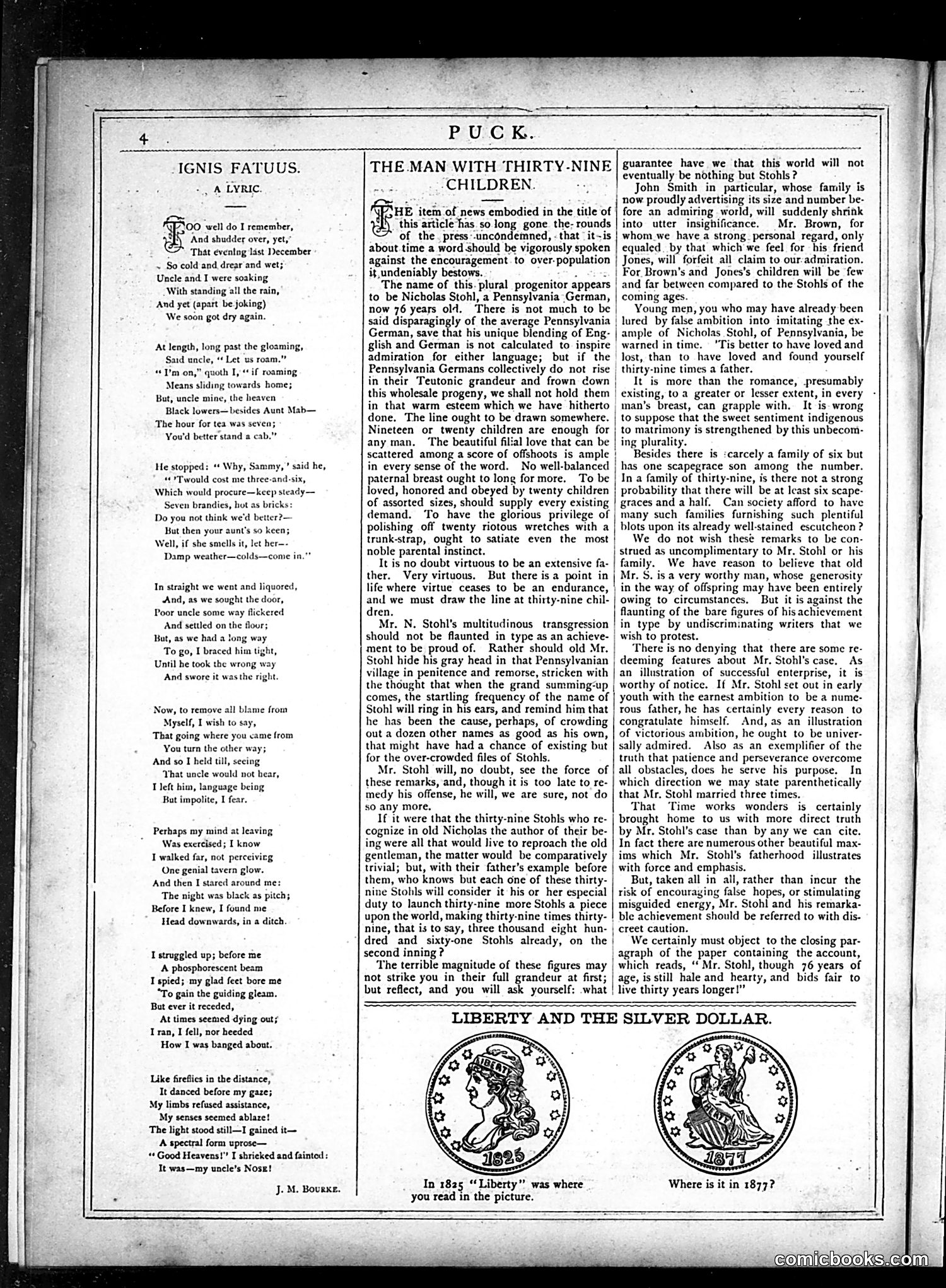
This satirical article mocks Nicholas Stohl, a Pennsylvania German immigrant, now 76 years old, who fathered an enormous family. The piece argues against over-population while grudgingly acknowledging Stohl's "achievement." The satire criticizes the notion that having many children—especially thirty-nine—represents virtue or something to admire. The author suggests that while Stohl may deserve "every reason to be universally admired," his example actually demonstrates reckless irresponsibility rather than virtue. The implicit argument: uncontrolled reproduction strains resources and society, making Stohl's prolific fathering not admirable but cautionary. The accompanying coins at page bottom appear unrelated to this article—a separate feature about currency.
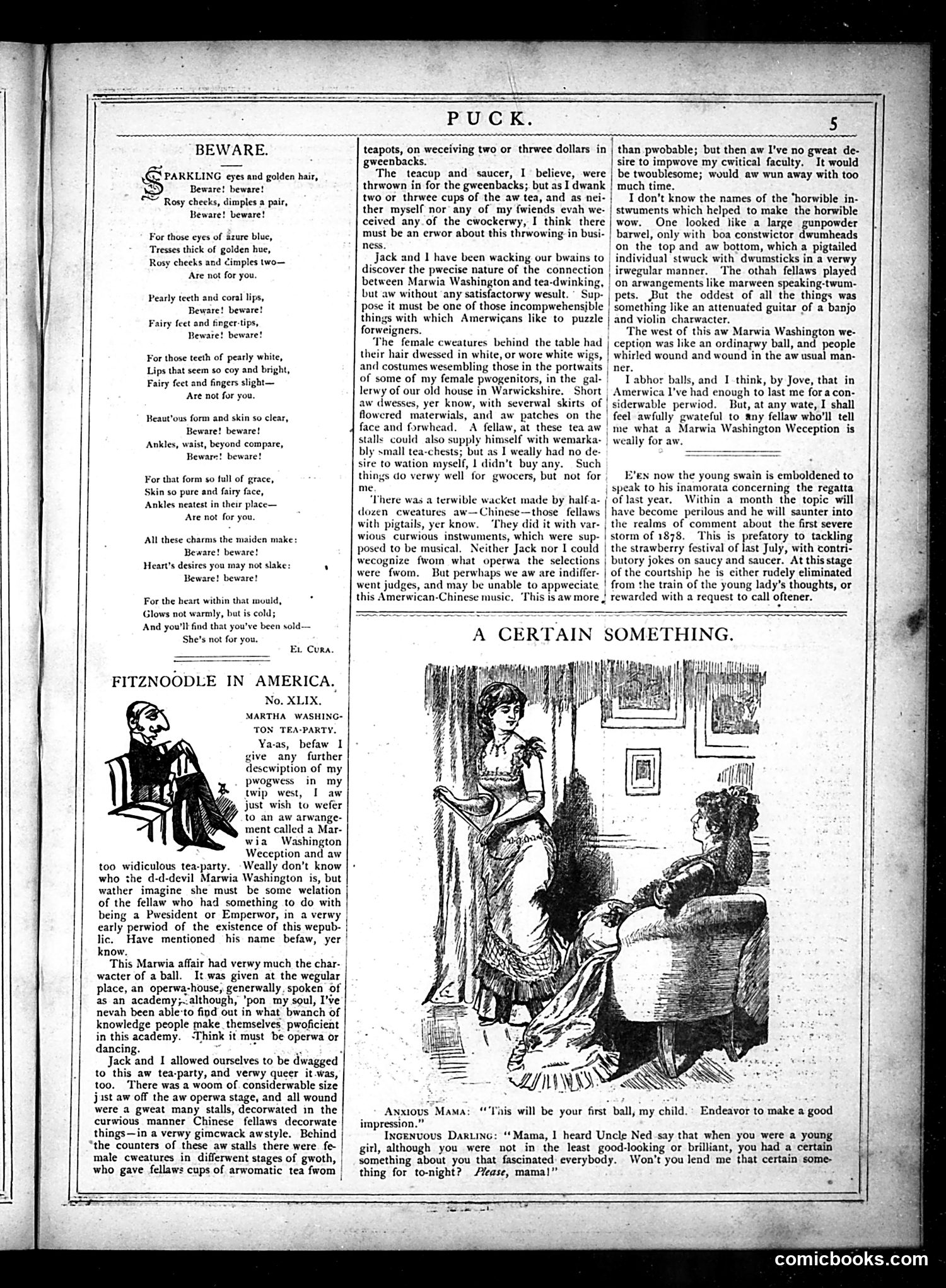
The page contains two distinct pieces: **"Beware"** (left): A poem warning about various deceptive appearances—sparkling eyes hiding false hearts, rosy cheeks masking deceit. The satirical target is unclear from the image alone. **"Fitznoodle in America, No. XLIX"** and **"A Certain Something"** (center/right): The main cartoon depicts a young woman (labeled "Anxious Mama" and "Horrendous Darling") preparing for her first ball. The satire mocks upper-class social pretensions—the mother frets about her daughter's appearance and social impression, while the daughter admits hearing unflattering remarks about her looks. The humor targets maternal anxiety and the superficiality of debutante culture and "coming out" traditions in Gilded Age America.
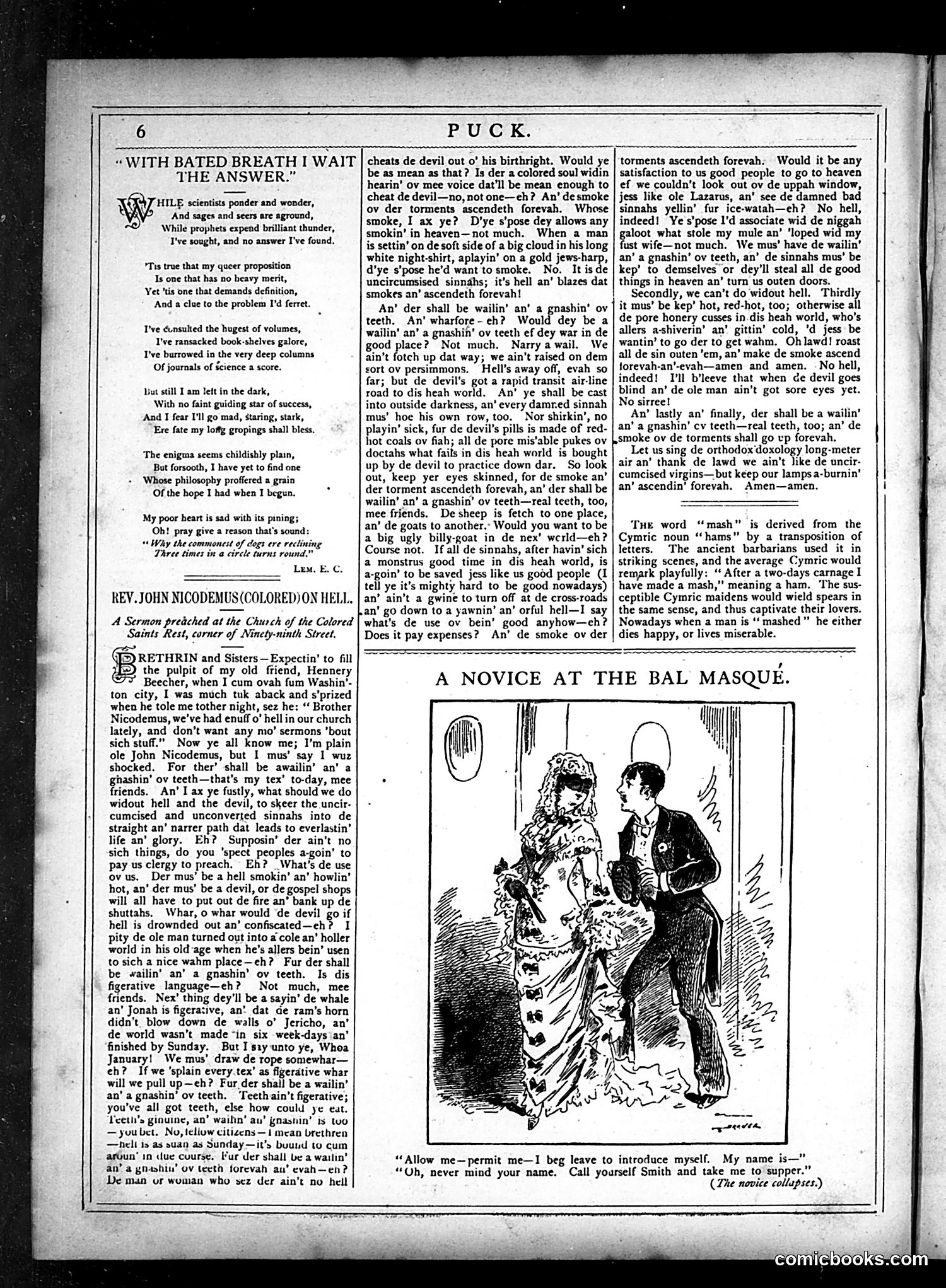
This cartoon depicts a social comedy at a masked ball. A well-dressed man in formal attire approaches a woman in an elaborate feathered costume. The caption reads: "Allow me—permit me—I beg leave to introduce myself. My name is—" to which she replies, "Oh, never mind your name. Call yourself Smith and take me to supper." The joke satirizes the pretension and anonymity of high-society masquerade balls. The woman's indifference to the man's actual identity—suggesting he simply adopt a common name—mocks both the artificiality of such events and the superficiality of upper-class social encounters. The "novice" referenced in the title appears to be the earnest gentleman, unaware that formality and genuine introductions are irrelevant in this social setting.
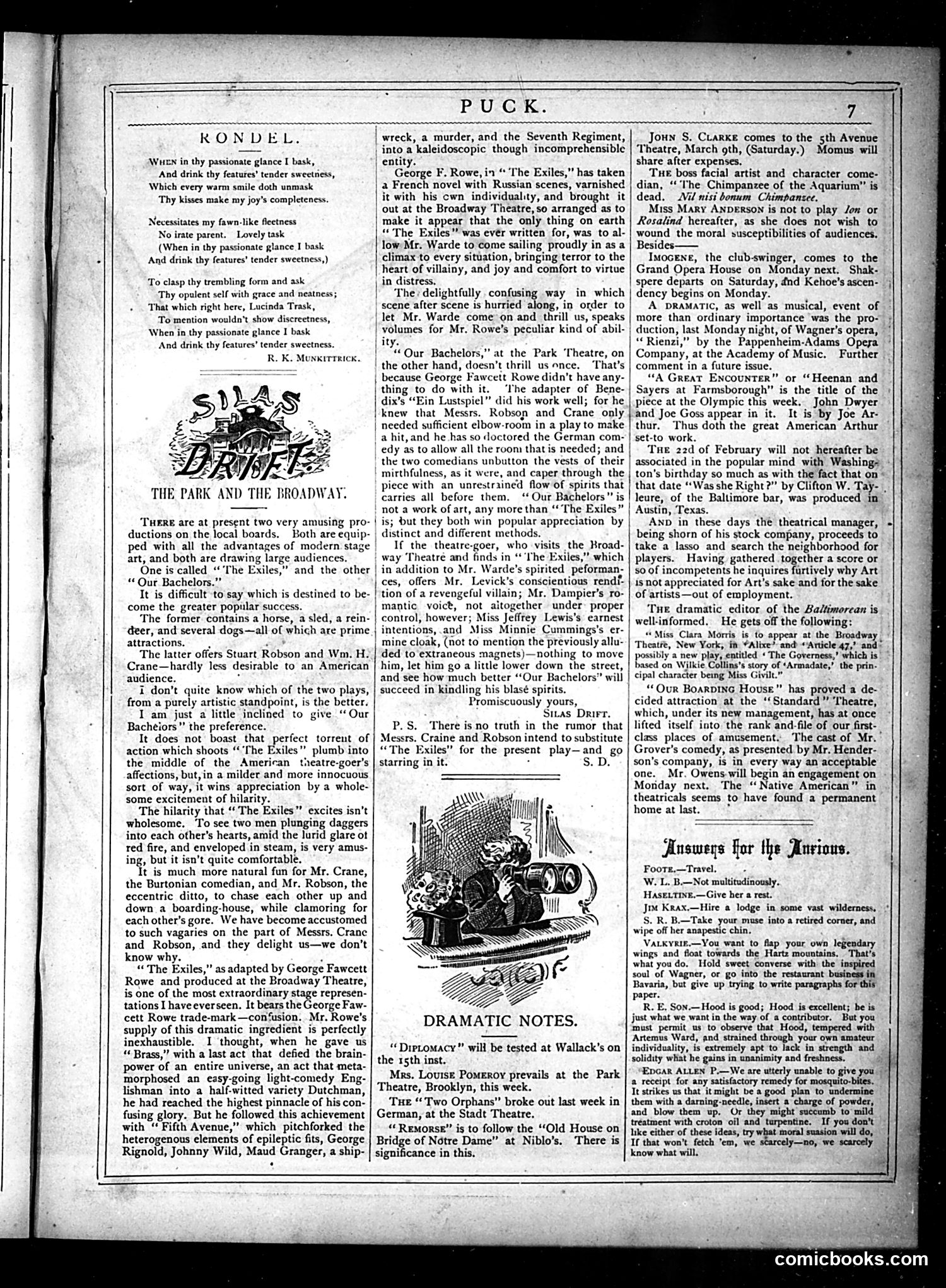
This page contains theater reviews and dramatic notes rather than political cartoons. The main illustrated content shows two decorative vignettes—one labeled "SILAS DEPOT" depicting a stagecoach scene, and another showing what appears to be theatrical equipment or props. The text discusses contemporary Broadway productions, including George F. Rowe's "The Exiles," "Our Bachelors" at the Park Theatre, and other performances. The "Answers for the Curious" section at bottom right addresses reader questions about theatrical matters. The satirical humor is theatrical rather than political—mocking aspects of contemporary stage productions and performances. This appears to be entertainment criticism and gossip rather than social or political commentary.
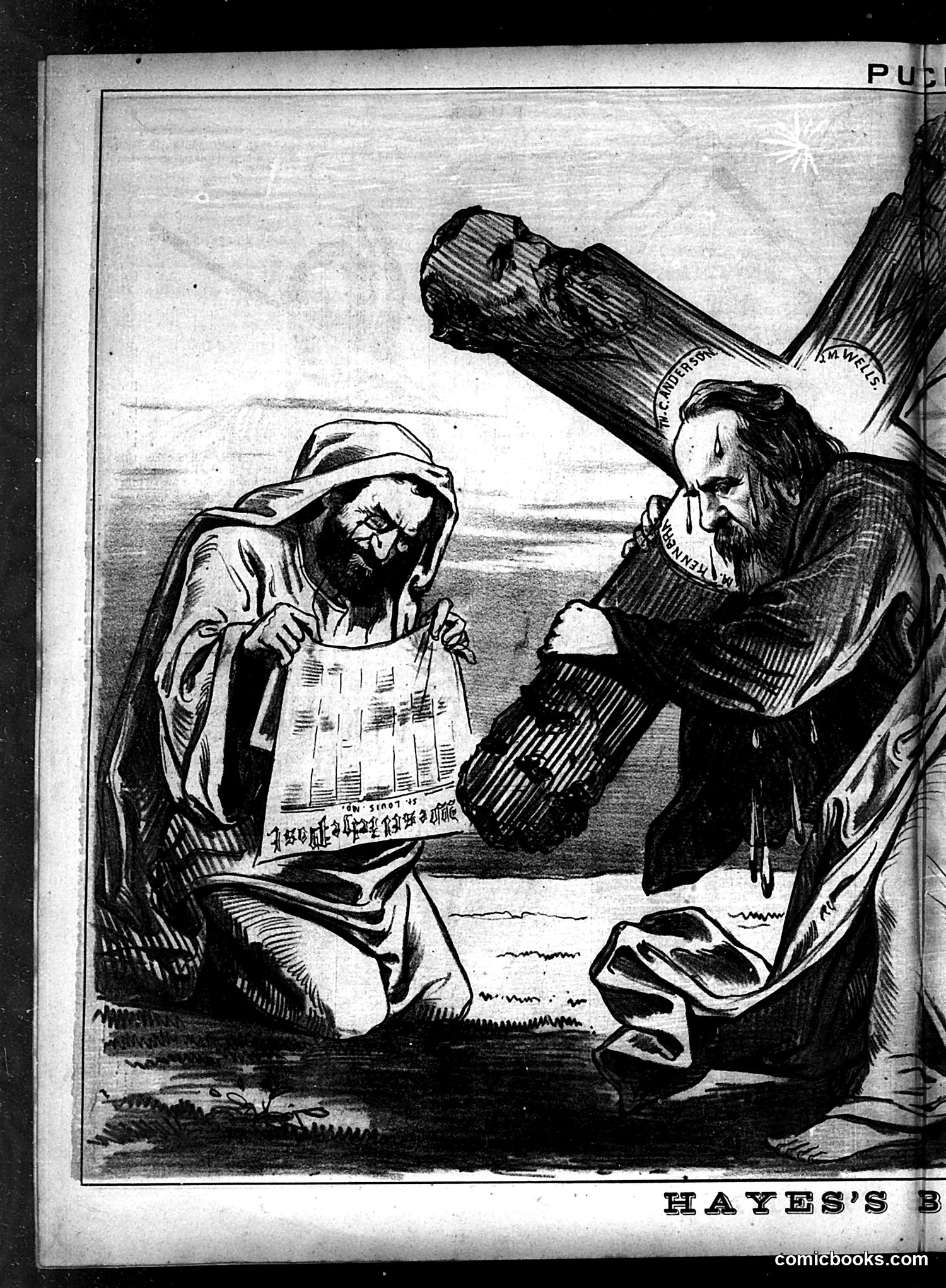
This appears to be a political cartoon from Puck magazine satirizing President Rutherford B. Hayes (indicated by the caption "Hayes's B"). The image shows two figures examining or discussing a large document or billboard. One figure wears a hat and hooded garment, while the other is bearded and formally dressed. The cartoon likely comments on Hayes's political positions or public statements during his presidency (1877-1881). The document they're examining suggests the cartoon critiques either Hayes's policies, his public pronouncements, or perhaps his relationship with particular constituencies or political allies. Without additional context or clearer text, the specific policy or event referenced remains unclear, though the satirical tone is evident from the exaggerated caricatures and composition.
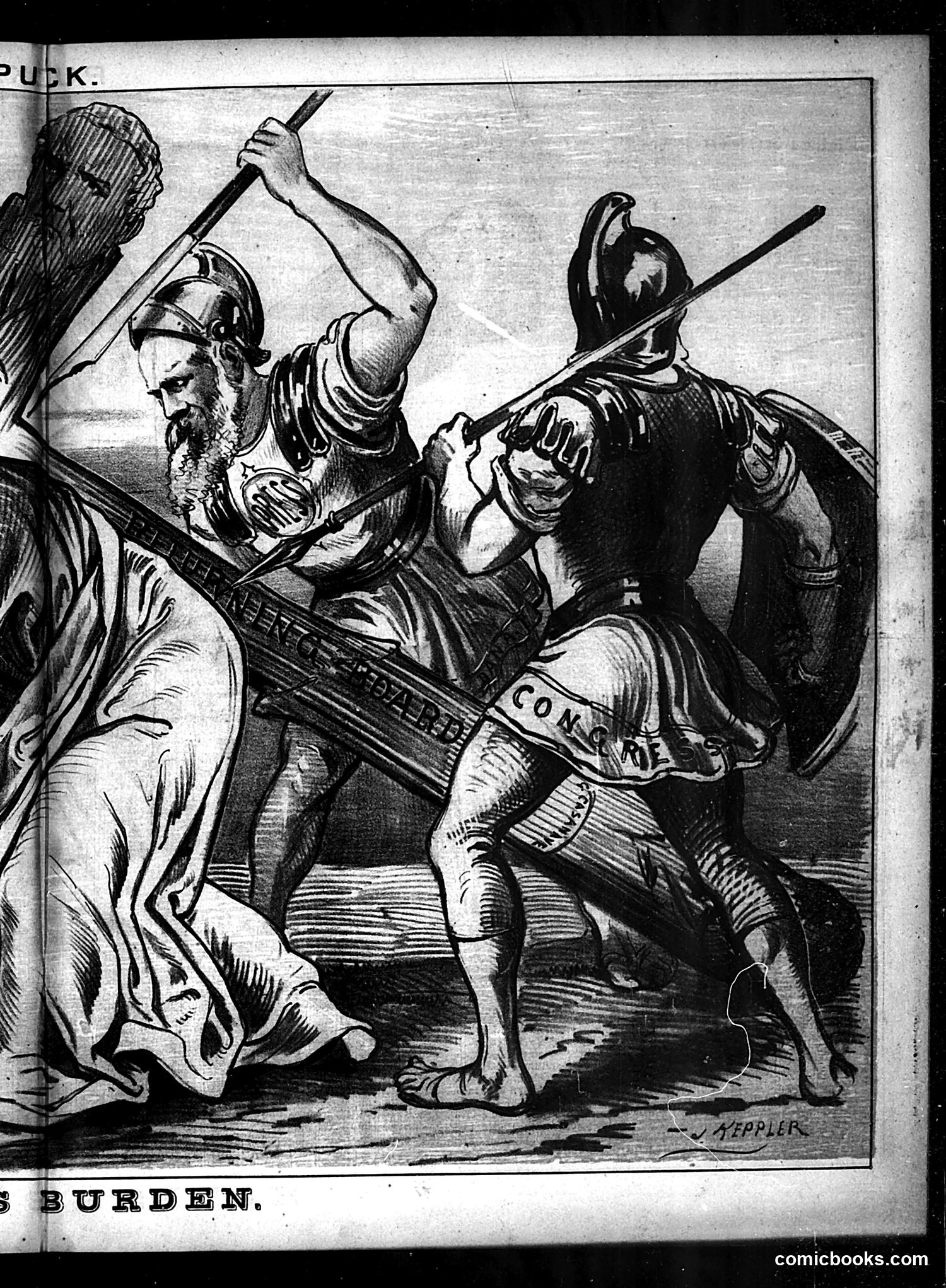
This cartoon depicts a military conflict scene with three armored figures engaged in combat. The text labels visible are "PUCK" (top), "BURDEN" (bottom), and what appears to be "CONQUER" on one figure's clothing. The scene shows soldiers with period armor and weapons in violent struggle. Based on the Puck magazine context—a satirical publication—this likely represents a contemporary political conflict or international dispute presented through military metaphor. However, without clearer identification of the specific figures, dates, or additional context text, I cannot definitively identify which historical conflict or political situation this cartoons satirizes. The artistic style and composition suggest late 19th or early 20th-century American political commentary, but the specific satirical point remains unclear from the image alone.
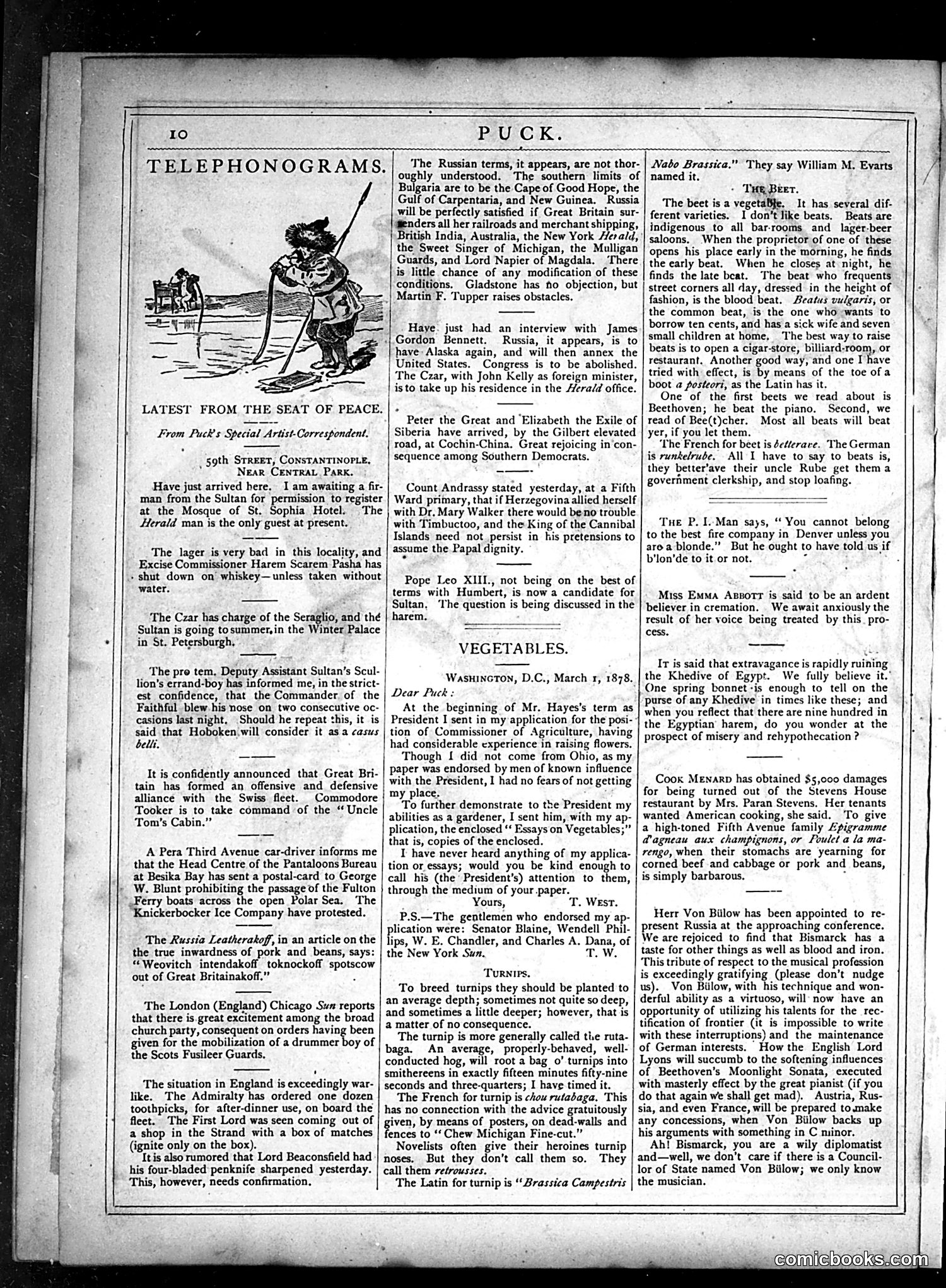
This cartoon depicts a **telegraph operator in Constantinople** reporting on international tensions. The illustration shows a man at a telegraph station during what appears to be a conflict in the Ottoman Empire region. The accompanying text references Russian interests in the Balkans, discussions about annexing territory to the United States, and diplomatic tensions involving Count Andrassy regarding Herzegovina and relations with the Ottoman Empire and Britain. The satire appears to mock the chaotic diplomatic situation in the Eastern Question—the 19th-century power struggle over Ottoman territorial collapse. The "seat of peace" is ironic, as the telegraph is transmitting reports of conflict and competing imperial ambitions rather than peaceful resolution.
This page contains two distinct literary works, not political cartoons: 1. **"A Teacher Taught"** — a one-act comedy adapted from French, featuring dialogue between characters named Kate and The Professor. The satire concerns a professor's romantic pursuit of a student (Kate), with witty banter about education, class, and romantic pretense. The humor targets pedantry and the professor's self-deception about his appeal. 2. **"Lovel"** — an English story by Mrs. Francis G. Faithfull, beginning Chapter IV. This appears to be serialized fiction about a woman named Gertrude and romantic entanglement. This is a **literature/fiction page**, not a political cartoon section. Puck magazine included both satirical visual cartoons and written comedic literature.
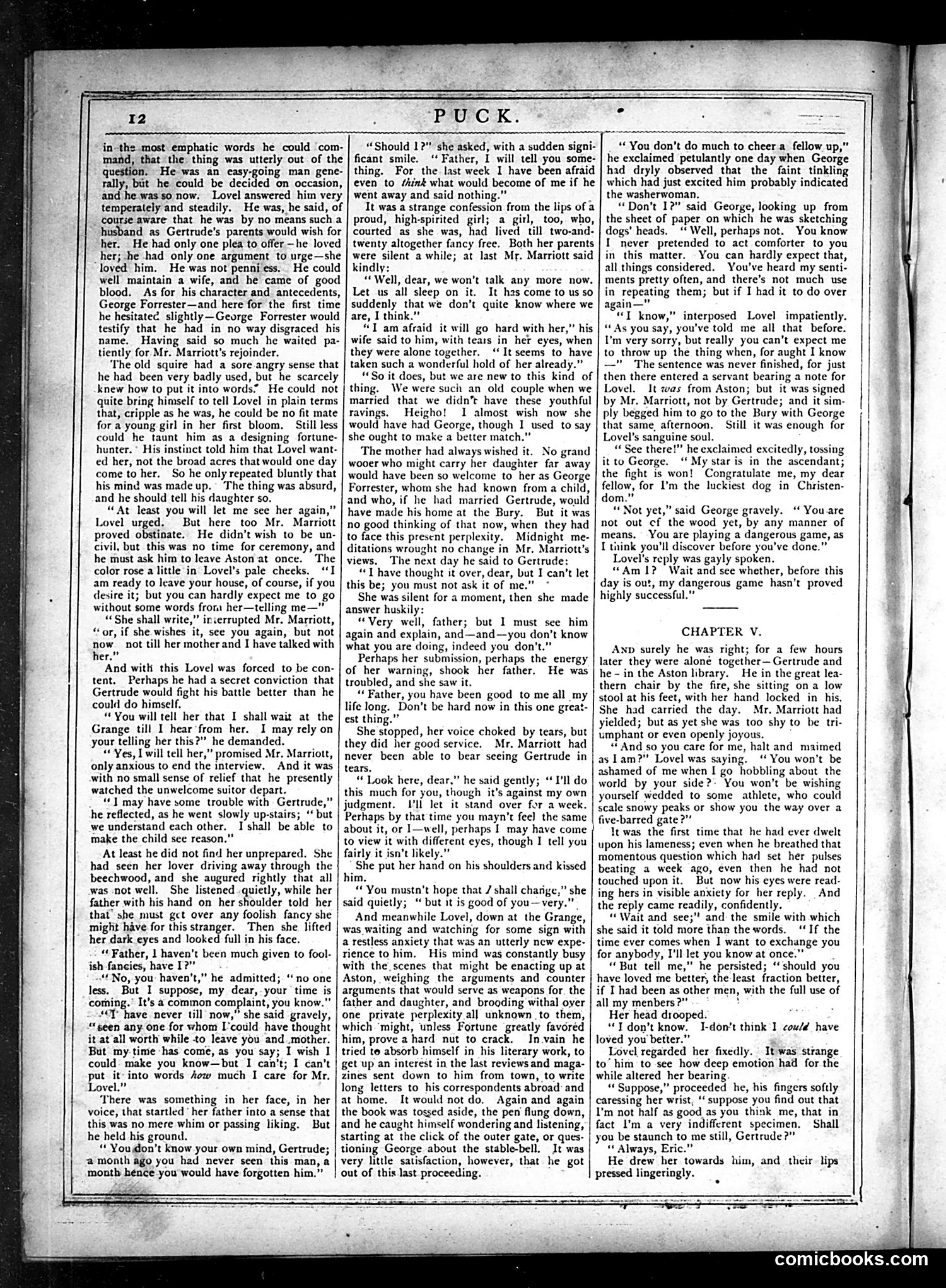
This page consists primarily of text from what appears to be a serialized story or novella titled "PUCK" (page 12), not a political cartoon. The narrative discusses romantic entanglements and family drama involving characters named Gertrude, Mr. Marriott, George, and Lovel, with dialogue about marriage prospects and social expectations. Chapter V begins partway through, continuing the domestic plot. There is no visible political or social satire apparent on this page—it's literary fiction rather than editorial commentary or caricature. The content reflects early 20th-century attitudes about courtship, parental authority, and women's limited agency in marriage decisions, but this appears to be narrative storytelling rather than satirical commentary on those social structures.
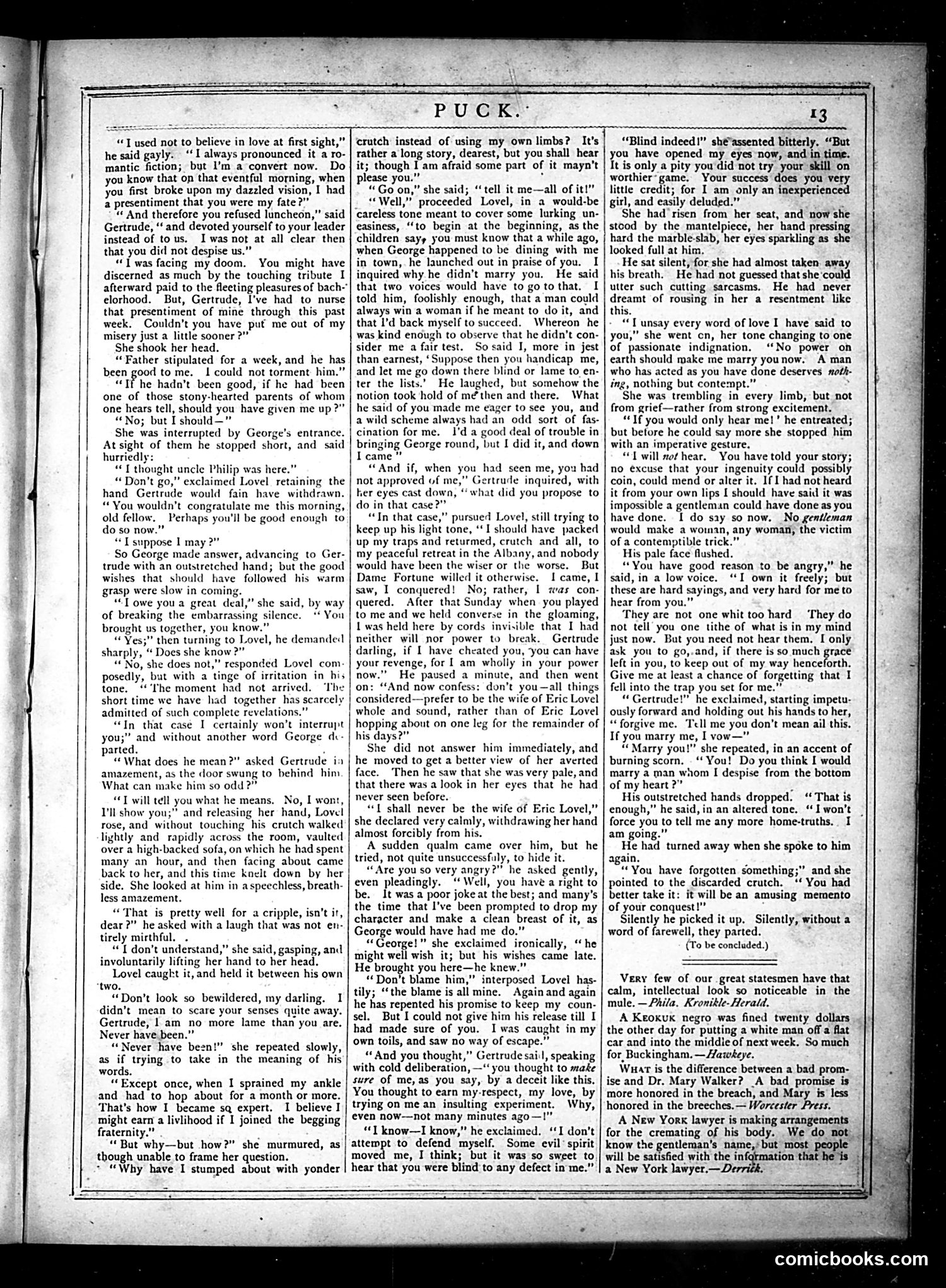
This page from *Puck* magazine consists primarily of serialized fiction—a romantic narrative between characters named Gertrude and Lovel. The extensive dialogue-driven text occupies the full page, with no visible political cartoons or satirical illustrations. The story appears to be a melodramatic romance involving relationship conflict, with Lovel defending himself against Gertrude's accusations of infidelity and deception. The narrative includes domestic drama and emotional confrontations typical of Victorian-era fiction. Without visible cartoon illustrations or clear political/social references in the text itself, this page appears to be entertainment content rather than political satire. *Puck* regularly published fiction alongside its satirical cartoons, and this represents the former category.
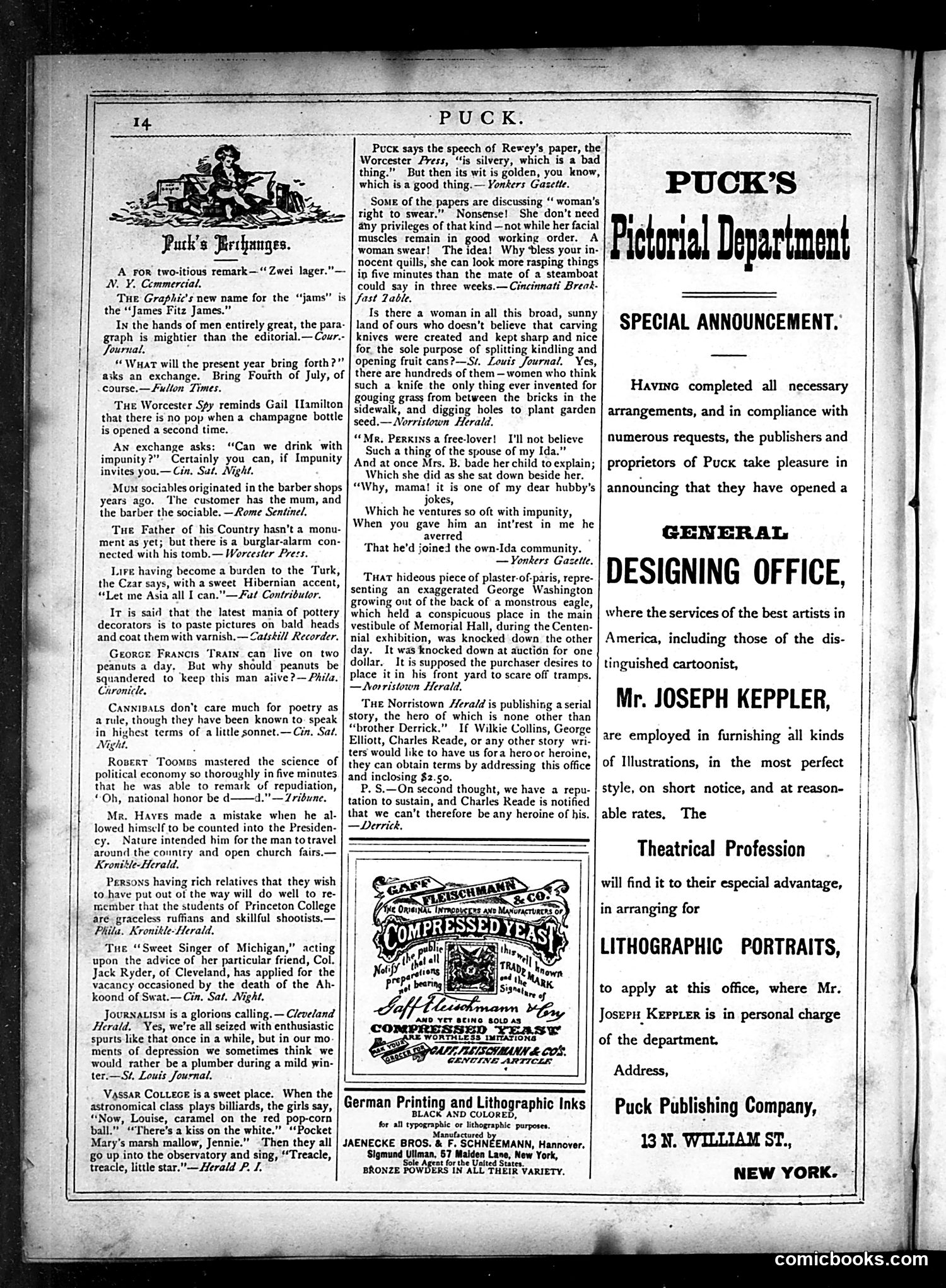
This page is primarily **advertising and announcements** rather than political satire. The main content announces Puck's new "General Designing Office" employing cartoonist Joseph Keppler to provide illustrations for theatrical productions and lithographic portraits. The left column contains **"Puck's Brinqrings,"** brief satirical commentary on contemporary topics: women's rights debates, local politics (references to "James Fitz James" and the Worcester Spy), and cultural observations. These are joke-notes rather than developed cartoons. An advertisement for "Compressed Yeast" appears centrally, and another for "German Printing and Lithographic Inks" at bottom. The page functions as a **business announcement mixed with short satirical quips**—typical of Puck's format blending humor with commercial promotion.
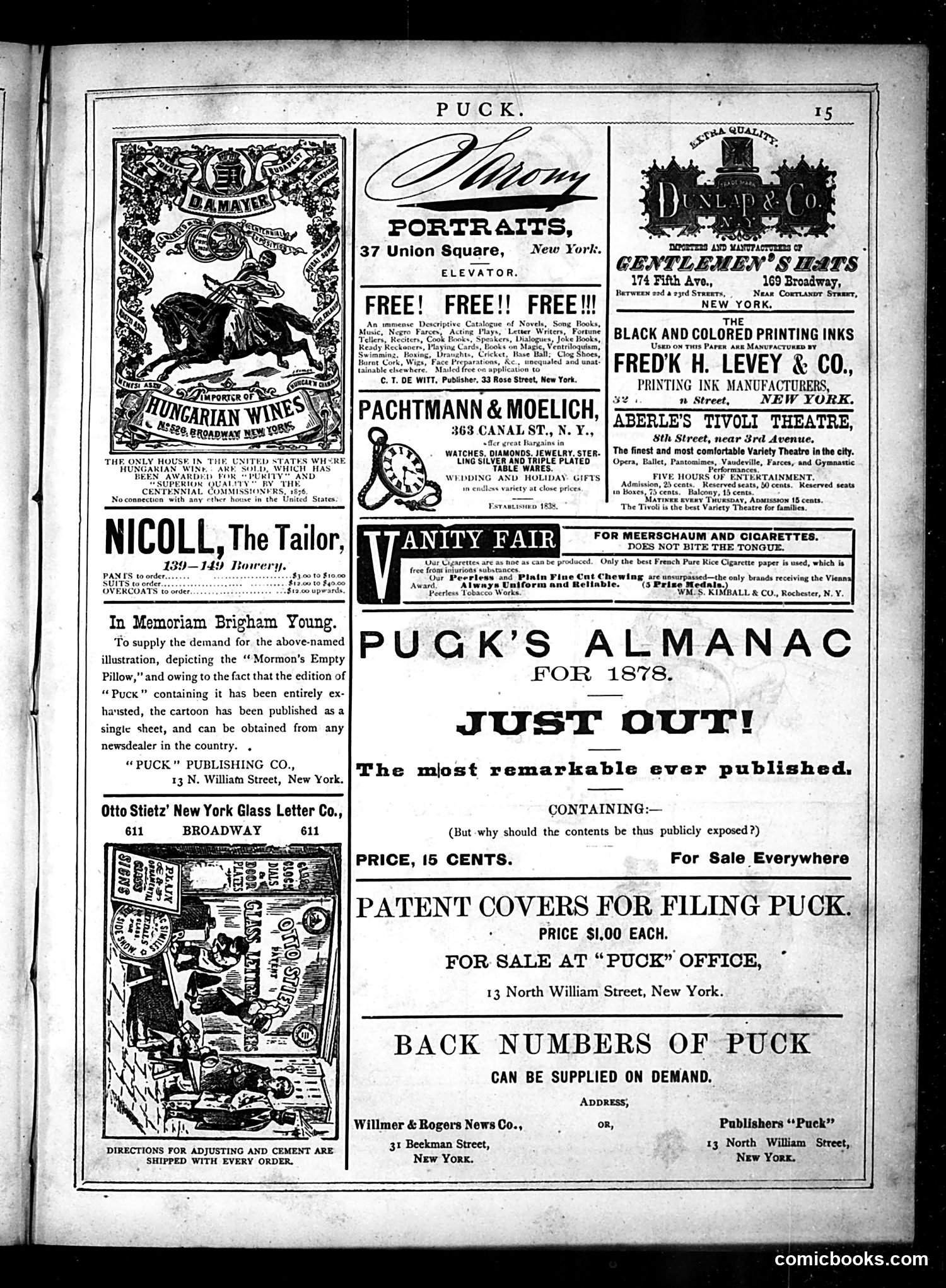
This is primarily an **advertising page** from Puck magazine's 1878 almanac issue, not a political cartoon page. The central content advertises Puck's Almanac for 1878 (priced 15 cents), claiming it's "the most remarkable ever published" while humorously questioning why its contents should be publicly exposed. The page features typical period advertisements: tailors, hat makers, portrait studios, printing companies, and theatrical venues. There's a memorial notice for Brigham Young and promotional material for Otto Stiehl's Glass Letter Company. The only illustrative element with satirical intent is a small engraved advertisement showing cluttered domestic scenes, promoting adjustable glass letter storage. **No specific political figures or events are referenced.** This is essentially a 19th-century advertising page with minimal editorial content.
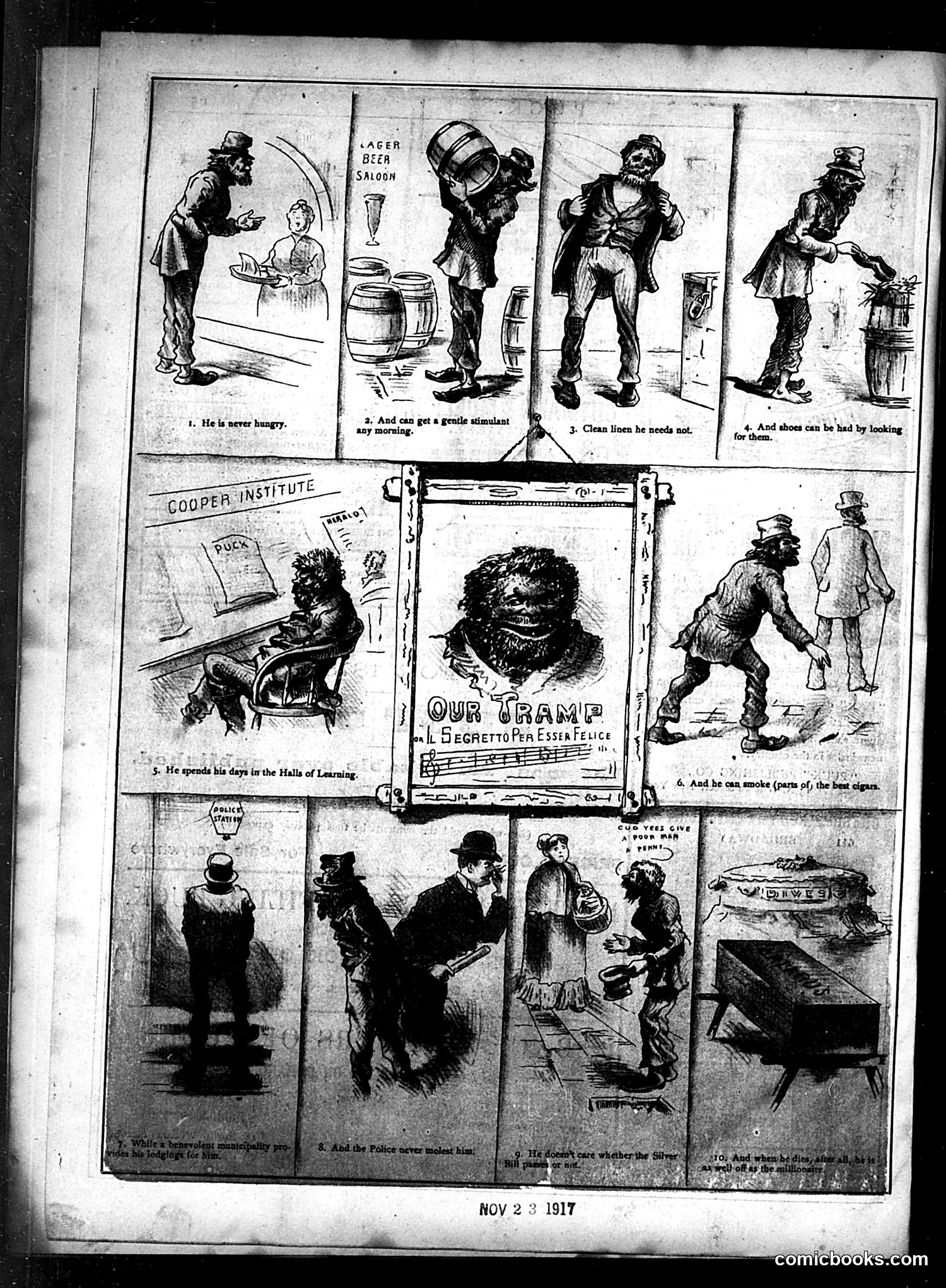
This Puck page satirizes homelessness and poverty through a character study titled "Our Tramp" (subtitle: "L Degretto Per Esser Felice" - Italian, roughly "The Right to Be Happy"). The sequential panels depict a vagrant's daily existence: he's never hungry (panel 1), gets genteel treatment (2), needs no clean clothes (3), finds shoes by looking (4), spends time in libraries (5), avoids police (6), doesn't worry about valuables (7), and dies peacefully, returning to nature (10). The satire appears to mock both the romanticization of poverty and society's indifference to homelessness. The character's contentment is presented ironically—what society deems "happiness" for the poor is actually deprivation dressed as virtue. Published during WWI-era America, it critiques class inequality and social hypocrisy.