
Puck, 1878-03-06 · page 4 of 17
Puck — March 6, 1878 — page 4: what you’re looking at
What you’re looking at
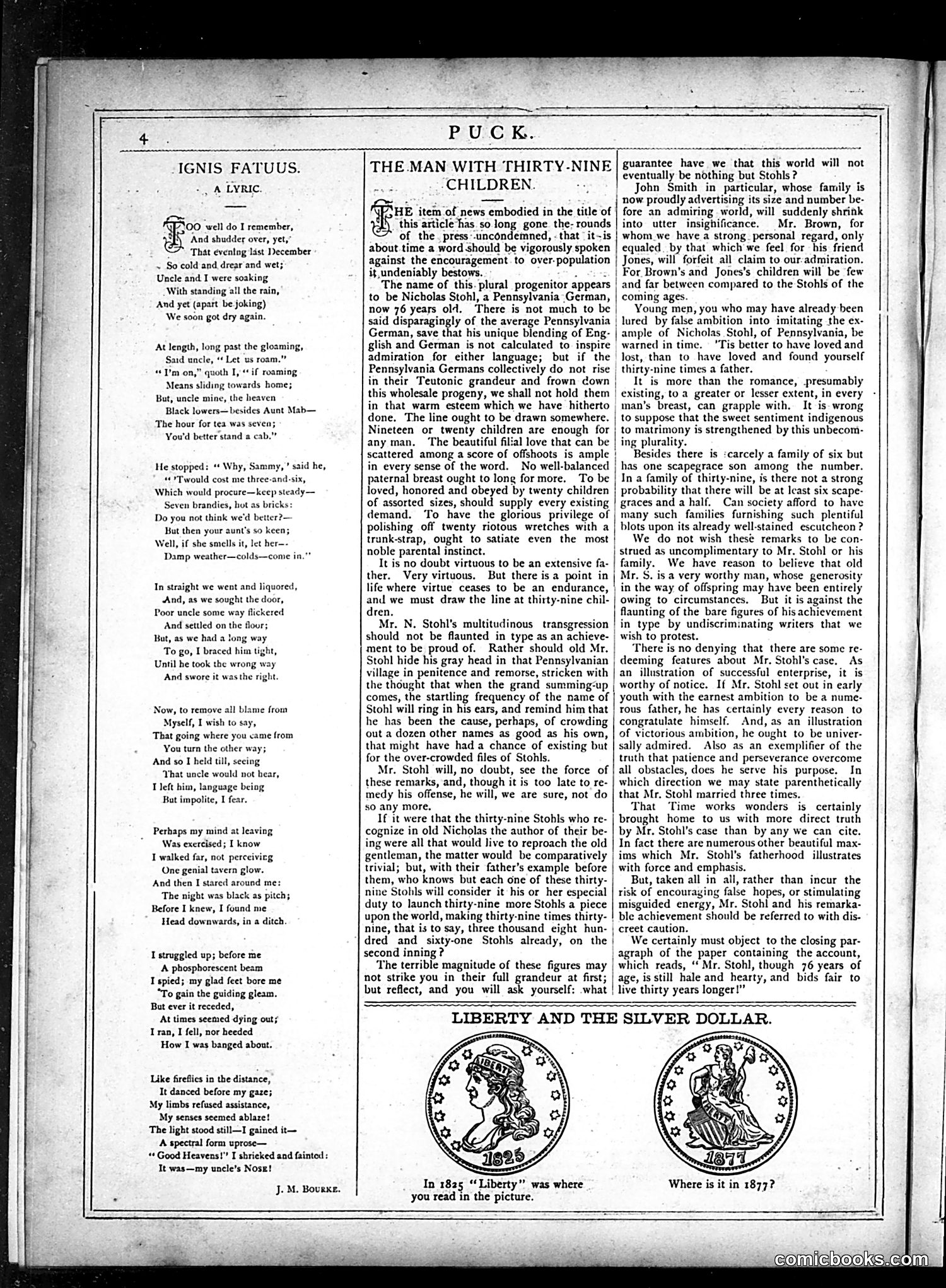
This satirical article mocks Nicholas Stohl, a Pennsylvania German immigrant, now 76 years old, who fathered an enormous family. The piece argues against over-population while grudgingly acknowledging Stohl's "achievement." The satire criticizes the notion that having many children—especially thirty-nine—represents virtue or something to admire. The author suggests that while Stohl may deserve "every reason to be universally admired," his example actually demonstrates reckless irresponsibility rather than virtue. The implicit argument: uncontrolled reproduction strains resources and society, making Stohl's prolific fathering not admirable but cautionary. The accompanying coins at page bottom appear unrelated to this article—a separate feature about currency.
📄 Transcribed text from this page (OCR, searchable)
Machine-transcribed from the original scan — historical spelling and the odd misread are preserved.
PUCK. IGNIS FATUUS. | A LYRIC. N00 well do I remember, And shudder over, yet,” ‘That evening list December ~ So cold and drear and wet; Uncle and I were soaking With standing all the rain, And yet (apart be joking) We soon got dry again. At length, long past the gloaming, Said uncle, “¢ Let us roam.” “Dm on,” quoth I, «if roaming Means sliding towards home; But, uncle mine, the heaven Black lowers—besides Aunt Mab— ‘The hour for tea was seve You'd better stand a cab.” He stopped: “ Why, Sammy,” said he, + Twould cost me three-and-six, Which would procure—keep steady— Seven brandies, hot as bricks: Do you not think we'd better?— But then your aunt's so keen; Well, if she smells it, let her—- Damp weather—colds—come in.” In straight we went and liquored, And, as we sought the door, Poor uncle some way flickered And settled on the floor; Bat, as we had a long way To go, I braced him tight, Until he took the wrong way And swore it wasthe right. Now, to remove all blame from Myself, I wish to say, That going where you came from You turn the other way; And so I held till, seeing ‘That uncle would not hear, Tleft him, language being But impolite, I fear. Perhaps my mind at leaving Was exercised; I know I walked far, not perceivicg One genial tavern glow. And then I stared around me: ‘The night was black as pitch; Before I knew, I found me Head downwards, in a ditch I struggled up; before me A phosphorescent beam I spied; my glad feet bore me “To gain the guiding gleam. But ever it receded, At times seemed dying outs Iran, I fell, nor heeded How I was banged about. Like firefics in the distance, It danced before my gaze; My limbs refused assistance, My senses seemed ablaze! The light stood still—I gained it— A spectral form uprose— ** Good Heavens!” I shrieked and fainted : It was—my uncle's Nose! J. M. Bourxe. THE.MAN WITH THIRTY- NINE | Be CHILDREN HE item of news s embodied i in the title of this article has. so. long gone the; rounds of the. press --uncondemned, - that "it-is about time a word should be vigorously spoken against the encouragement to over: population it undeniably bestows. The name of this. plural progenitor appears to be Nicholas Stohl, a Pennsylvania German, now 76 years old. ‘There is not much to be said disparaging! ly of the average Pennsylvania | German, save that his unique blending of Eng- glish and German is not calculated to inspire admiration for either language; but if the Pennsylvania Germans collectively do not rise in their Teutonic grandeur and frown down this wholesale progeny, we shall not hold them in that warm esteem which we have hitherto done. The line ought to be drawn somewhere. Nineteen or twenty children are enough for any man, The beautiful filial love that can be scattered among a score of offshoots is ample in every sense of the word. No well-balanced paternal breast ought to long for more. To be loved, honored and obeyed by twenty children of assorted sizes, should supply every existing demand. To have the glorious privilege of polishing off twenty riotous wretches with a trunk-strap, ought to satiate even the most noble parental instinct. It is no doubt virtuous to be an extensive fa- ther. Very virtuous. But there is a point in life where virtue ceases to be an endurance, and we must draw the line at thirty-nine chil- dren. Mr. N, Stohl’s multitudinous transgression should not be flaunted in type as an achieve- ment to be Stohl hide his gray head in that Pennsylvanian village in penitence and remorse, stricken with the thought that when the grand summing-up comes, the startling frequency of the name of Stohl will ring in his ears, and remind him that he has been the cause, perhaps, of crowding out a dozen other names as good as his own, that might have had a chance of existing but for the over-crowded files of Stohls. Mr. Stohl will, no doubt, see the force of these remarks, and, though it is too late to re- medy his offense, he will, we are sure, not do so any more, If it were that the thirty-nine Stobls who re- cognize in old Nicholas the author of their be- ing were all that would live to reproach the old gentleman, the matter would be comparatively trivial; but, with their father’s example before | them, ‘who knows but each one of these thirty- nine Stohls will consider it his or her especial duty to launch thirty-nine more Stohls a piece upon the world, making thirty-nine times thirty- nine, that is to say, three thousand eight hun- | dred and sixty-one Stohls already, on the second inning ? The terrible magnitude of these figures may | not strike you in their full but reflect, and you will as randeur at first; proud of. Rather should old Mr. | yourself: what | guarantee ae we that this world will not eventually be nothing but Stohls? John Smith in particular, whose family is | now proudly advertising its size and number be- fore an admiring world, will suddenly shrink into utter insighificance. Mr. Brown, for whom we have a strong personal regard, only equaled. by that which'we feel for his friend | Jones, will forfeit all claim to our-admiration. =. | For Brown's and Jones's children will be few and far between compared to the Stohls of the coming ages. | Young men, you who may have already been | lured by false ambition into imitating the ex- | ample of Nicholas Stohl, of Pennsylvania, be warned in time. Tis better to have loved and lost, than to have loved and found yourself thirty-nine times a father. It is more than the romance, .presumably existing, to a greater or lesser extent, in every man’s breast, can grapple with, It is. wrong to suppose that the sweet sentiment indigenous | to matrimony is strengthened by this unbecom- ing plurality. | Besides there is :carcely a family of six but | has one scapegrace son among the number. In a family of thirty-nine, is there not a strong probability that there will be at Icast six scape- graces and a half. Can society afford to have many such families furnishing such plentiful blots upon its already well-stained escutcheon ? We do not wish these remarks to be con- strued as uncomplimentary to Mr. Stohl or his family. We have reason to believe that old | Mr. S. is a very worthy man, whose generosity in the way of offspring may have been entirely owing to circumstances. But it is against the flaunting of the bare figures of his achievernent in type by undiscriminating writers that we wish to protest. There is no denying that there are some re- deeming features about Mr. Stohl's case, As an illustration of successful enterprise, it is worthy of notice. If Mr, Stohl set out in early youth with the earnest ambition to be a nume- rous father, he has certainly every reason to congratulate himself. And, as an illustration of victorious ambition, he ought to be univer- sally admired. Also as an exemplifier of the truth that patience and perseverance overcome all obstacles, does he serve his purpose. In which direction we may state parenthetically that Mr. Stohl married three times. That ‘Time works wonders is certainly brought home to us with more direct truth by Mr. Stohl’s case than by any we can cite. In fact there are numerous other beautiful max- ims which Mr. Stohl’s fatherhood illustrates with force and emphasis. But, taken all in all, rather than incur the risk of encouraging false hopes, or stimulating misguided energy, Mr. Stohl and his remarka- ble achievement should be referred to with dis- creet caution. We certainly must object to the closing par- agraph of the paper containing the account, which reads, “ Mr. Stohl, though 76 years of | age, is still hale and hearty, and bids fair to live thirty years longer!” LIBERTY AND THE SILVER DOLLAR. In 1825 “Liberty” was where you read in the picture.