
Puck, 1878-03-06 · page 10 of 17
Puck — March 6, 1878 — page 10: what you’re looking at
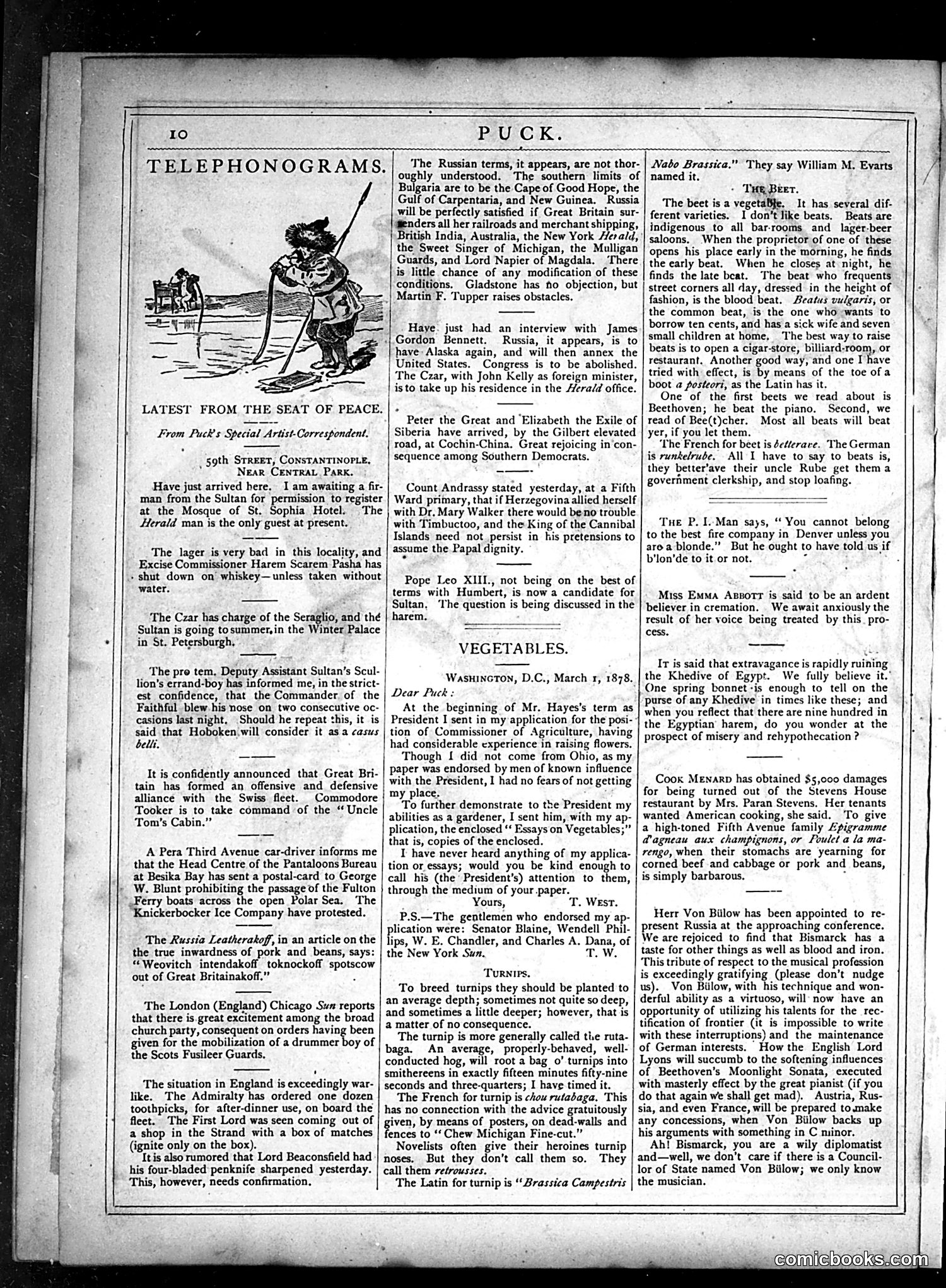
What you’re looking at
This cartoon depicts a **telegraph operator in Constantinople** reporting on international tensions. The illustration shows a man at a telegraph station during what appears to be a conflict in the Ottoman Empire region. The accompanying text references Russian interests in the Balkans, discussions about annexing territory to the United States, and diplomatic tensions involving Count Andrassy regarding Herzegovina and relations with the Ottoman Empire and Britain. The satire appears to mock the chaotic diplomatic situation in the Eastern Question—the 19th-century power struggle over Ottoman territorial collapse. The "seat of peace" is ironic, as the telegraph is transmitting reports of conflict and competing imperial ambitions rather than peaceful resolution.
📄 Transcribed text from this page (OCR, searchable)
Machine-transcribed from the original scan — historical spelling and the odd misread are preserved.
—— —— a —— Sr ee ee a LETT PUCK. LATEST FROM THE SEAT OF PEACE. From Puck's Special Artist-Correspondent. , soth Stee) CONSTANTINOPLE, NEAR CENTRAL Park. Have just arrived here, I am awaiting a fir- man from the Sultan for permission to register at the Mosque of St. Sophia Hotel. The Herald man is the only guest at present. The lager is very bad in this locality, and Excise Commissioner Harem Scarem Pasha has » shut down on’ whiskey—unless taken without water. ‘The Czar has charge of the a and thé Sultan is going tosummer,in the Winter Palace in St. Petersburgh, The pro tem, Deputy Assistant Sultan’s Scul- | lion’s errand-boy has informed me, in the strict- est confidence, that the Commander, of the Faithful blew. his nose on two consecutive oc- casions last night, Should he repeat this, it is said that Hoboken will consider it asa casus belli. It is confidently announced that Great Bri- tain has formed an offensive and defensive alliance with the Swiss fleet. Commodore Tooker is to take command, of the “Uncle Tom's Cabin.” A Pera Third Avenue car-driver informs me that the Head Centre of the Pantaloons Bureau at Besika Bay has sent a postal-card to George W. Blunt prohibiting the passage of the Fulton Ferry boats across the open Polar Sea. The “Knickerbocker Ice Company have protested. The Russia Leatherakofy, in an article on the the true inwardness of pork and beans, says: “Weovitch intendakoff toknockoff ser ad out of Great Britainakoff.” The London (England) Chicago Sun reports that there is.great excitement among the broad church party, consequent on orders having been given for the mobilization of a drummer boy of the Scots Fusileer Guards. ‘The situation in England is exceedingly war- like. The Admiralty has ordered one dozen toothpicks, for after-dinner use, on board the fleet. The First Lord was seen coming out of a shop in the Strand with a box of matches (ignite only on the box). Itis also rumored that Lord Beaconsfield had his four-bladed penknife sharpened yesterday. This, however, needs confirmation, The Russian terms, it appears, are not thor- oughly understood. The southern limits of Bulgaria are to be the Cape of Good Hope, the Gulf of Carpentaria, and New Guinea. Russia will be perfectly satisfied if Great Britain sur- genders all her railroads and merchant shipping, | British India, Australia, the New York Herald, the Sweet Singer of Michi an, the Mulligan Guards, and Lord Napier of Magdala. ‘There is little’ chance of any modification of these conditions. Gladstone has fo objection, but _| Martin'F. Tupper raises obstacles. Haye. just had an interview with James Gordon Bennett. Russia, it appears, is to have: Alaska again, and will then annex the United States. Congress is to be abolished. The Czar, with John Kelly as foreign minister, isto take up his residence in the Hera/d office. Peter the Great and ‘Elizabeth the Exile of Siberia have arrived, by the Gilbert elevated road, at Cochin-China. Great rejoicing in‘con- sequence among Southern Democrats. Count Andrassy stated yesterday, at a Fifth Ward primary, that if Herzegovina allied herself with Dr, Mary Walker there would beno trouble with Timbuctoo, and the King of the Cannibal Islands need not persist in his pretensions to assume the Papal dignity. Pope Leo XIII., not being on the best of terms with Humbert, is now a candidate for Sultan, The question is being discussed in the harem. VEGETABLES. WasuincTon, D.C., March 1, 1878. Dear Puck: At the beginning of Mr. Hayes's term as President I sent in my application for the posi- tion of Commissioner of Agriculture, having had considerable experience in raising flowers. Though I did not come from Ohio, as my paper was endorsed by men of known influence with the President, I had no fears of not getting | my place. To further demonstrate to the President my abilities as a gardener, I sent him, with my ap- plication, the enclosed “ Essays on Vegetables;” that is, copies of the enclosed. T have never heard anything of my applica- tion or essays; would you be kind enough to call his (the President's) attention to them, through the medium of your.paper. Yours, T. West. P.S.—The gentlemen who endorsed my ap- plication were: Senator Blaine, Wendell Phil- lips, W. E. Chandler, and Charles A. panes of the New York Sun. . Ww. Turnips, To breed turnips they should be planted to an average depth; sometimes not quite so deep, and sometimes a little deeper; however, that is a matter of no consequence. The turnip is more generally called the ruta- baga. An average, properly-behaved, well- conducted hog, will root a bag o’ turnips into smithereens in exactly fifteen minutes fifty-nine seconds and three-quarters; I have timed it. The French for turnip is chou rutabaga. ‘This has no connection with the advice gratuitously iven, by means of posters, on dead-walls and fences to “‘ Chew Michigan Fine-cut.” Novelists often give their heroines turnip noses. But they don’t call them so. They call them retrousses. ‘The Latin for turnip is “Brassica Campestris Nabo Brassica.” They say William M. Eyarts named it. + THe Beer. The beet is a vegetaBe. It has several dif- ferent varieties. I don’t like beats. Beats are indigenous to all bar-rooms and lager-beer saloons. When the proprietor of one of these opens his place early in the morning, he finds the early beat. When he closes at night, he finds the late beat. The beat who frequents street corners all day, dressed in the height of fashion, is the blood beat. Beatus vulgaris, or the common beat, is the one who <wants to borrow ten cents, and has a sick wife and seven small children at home, The best way to raise beats is to open a cigar-store, billiard-rooi restaurant. Another good way, and one Ihave tried with effect, is by means of the toe ofa boot a fosteori, as the Latin has it. One of the first beets we read about is Beethoven; he beat the piano. Second, we read of Bee(t)cher. Most all beats will beat yer, if you let them. ‘The French for beet is deéerave. The German is runkelrube. All I have to say to beats is, they better’ave their uncle Rube get them a goverfiment clerkship, and stop loafing. ‘Tue P. I.-Man says, “ You cannot belong to the best fire company in Denver unless you aro a blonde.” b'lon'de to it or not. Miss Emma Appott is said to be an ardent believer in cremation. We await anxiously the result of her voice being treated by this. pro- cess. Ir is said that extravagance is rapidly ruining the Khedive of Egypt. We fully believe it.” One spring bonnet -is enough to tell on the purse of any Khedive in times like these; and when you reflect that there are nine hundred in the Egyptian’ harem, do you wonder at the prospect of misery and rehypothecation ? Cook Menarp has obtained $5,000 damages for being turned out of the Stevens House restaurant by Mrs. Paran Stevens. Her tenants wanted American cooking, she said. To give a high-toned Fifth Avenue family Zpigramme @agneau aux champignons, or Poulet a la ma- rengo, when their stomachs are yearning for corned beef and cabbage or pork and beans, is simply barbarous. Herr Von Billow has been appointed to re- present Russia at the approaching conference. We are rejoiced to find that Bismarck has a taste for other things as well as blood and iron. This tribute of respect to the musical profession is exceedingly gratifying (please don’t nudge us). Von Biilow, with his technique and won- derful ability as a virtuoso, will now have an opportunity of utilizing his talents for the rec- tification of frontier (it is impossible to write with these interruptions) and the maintenance of German interests. How the English Lord Lyons will succumb to the softening influences of Beethoven’s Moonlight Sonata, executed with masterly effect by the great pianist (if you do that again we shall get mad). Austria, Rus- sia, and even France, will be prepared tounake any concessions, when Von Biilow backs up his arguments with something in C minor. Ab! Bismarck, you are a wily diplomatist and—well, we don’t care if there is a Council- lor of State named Von Billow; we only know the musician. But he ought to have told us if comichnoolks.coun