
Puck, 1878-03-06 · page 12 of 17
Puck — March 6, 1878 — page 12: what you’re looking at
What you’re looking at
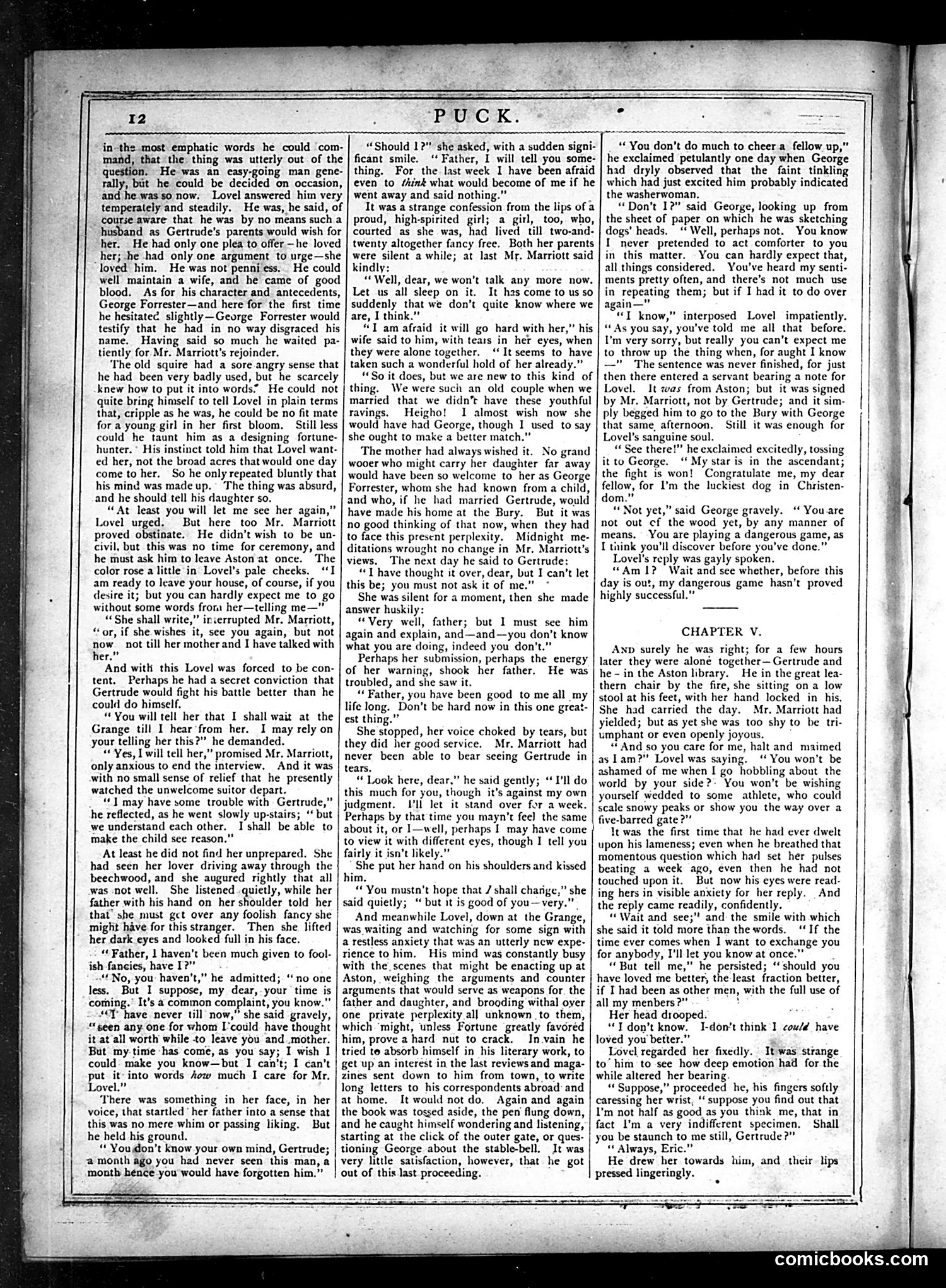
This page consists primarily of text from what appears to be a serialized story or novella titled "PUCK" (page 12), not a political cartoon. The narrative discusses romantic entanglements and family drama involving characters named Gertrude, Mr. Marriott, George, and Lovel, with dialogue about marriage prospects and social expectations. Chapter V begins partway through, continuing the domestic plot. There is no visible political or social satire apparent on this page—it's literary fiction rather than editorial commentary or caricature. The content reflects early 20th-century attitudes about courtship, parental authority, and women's limited agency in marriage decisions, but this appears to be narrative storytelling rather than satirical commentary on those social structures.
📄 Transcribed text from this page (OCR, searchable)
Machine-transcribed from the original scan — historical spelling and the odd misread are preserved.
12 ‘PUCK. in-the most emphatic words he could ‘com- mand, that the: thing was utterly out of the question. He was an easy-going man gene- rally, but he could be decided on occasion, he.wasso now. Lovel answered him very temperately and steadily. He was, he said, of _ course aware that he was by no means such a husband as Gertrude’s parents would wish for her. He had only one plea to offer —he loved her;-he had only one argument to urge—she loved him. He was not penni'ess. He could well maintain a wife, and he came of good blood. As for his character and antecedents, George Forrester—and here for the first time he hesitated slightly—George Forrester would testify that he had in no way disgraced his name. Having said so much he waited pa- tiently for Mr. Marriott's rejoinder. ‘The old squire had a sore angry sense that he had been very badly used, but he scarcely knew how to put it into words” He could not quite bring himself to tell Lovel in plain terms that, cripple as he was, he could be no fit mate for a young girl in her first bloom. Still less could he taunt him as a designing fortune- hunter. * His instinct told him that Lovel want- ed her, not the broad acres that would one day come to her. So he only repeated bluntly that his mind was made up. The thing was absurd, and he should tell his daughter so. “At least you will let me see her again,” Lovel urged. But here too Mr. Marriott proved obstinate. He didn’t wish to be un- civil, but this was no time for ceremony, and he must ask him to leave Aston at once. The color rose a little in Lovel’s pale cheeks. ‘I am ready to leave your house, of course, if you desire it; but you can hardly expect me to go without some words from her—telling me—" “She shall write,” inierrupted Mr. Marriott, “or, if she.wishes it, see you again, but not now not till her mother and I have talked with her.” And with this Lovel was forced to be con- tent. Perhaps he had a secret conviction that Gertrude would fight his battle better than he could do himself. “You will tell her that I shall wait at the Grange till 1 hear ‘from her. I may rely on your telling her this?” he demanded. “Yes, Iwill tell her,” promised Mr. Marriott, only anxious to end the interview. And it was with no small sense of relief that he presently watched the unwelcome suitor depart. “1 may have some trouble with Gertrude,” he reflected, as he went slowly up-stairs; ‘ but we understand each other, I shall be able to make the child see reason.” At least he did not find her unprepared. She had seen her lover driving away through the beechwood, and she augured rightly that all was not well. She listened quietly, while her father with his hand on her shoulder told her that’ she must get over any foolish fancy she might have for this stranger. Then she lifted her dark eyes and looked full in his face. “Father, 1 haven't been much given to fool- ish fancies, have 1?” “No, you: haven't,” he admitted; “no one less. But I suppose, my dear, your time is corning.” It’s a common complaint, you know.” “Y have never till now,” she said gravely, “seen any one for whom I'could have thought it at all worth while to leave you and mother. But my-time -has comé, as you say; I wish I could. ‘make you know—but I can’t; I can’t put it: into words Aow much I care for Mr. Lovel.” here was something in her face, in her voice, that startled ‘her father into a sense that this was no mere whim or passing liking. But he held his ground. “ Youydon’t know your own mind, Gertrude; ‘a month ago you had never seen this man, a month hence you would have forgotten him.”” “Should 1?" she asked, with a sudden signi- ficant smile. ‘Father, I will tell you some- thing. For the last week I have been afraid even to ¢hink what would become of me if he went away and said nothing.” It was a strange confession from the lips of a proud, high-spirited girl; a girl, too, who, courted as she was, had lived till two-and- twenty altogether fancy free. Both her parents were silent a while; at last Mr. Marriott said kindly: “Well, dear, we won't talk any more now, Let us all sleep on it. It h2s come to us so suddenly that we don't quite know where we are, I think.” “Tam afraid it will go hard with her,” his wife said to him, with teas in her eyes, when they were alone together. “It seems to have taken such a wonderful hold of her already.” “So it does, but we are new to this kind of thing. We were such an old couple when we married that we didn’t have these youthful ravings. Heigho! 1 almost wish now she would have had George, though I used to say she ought to make a better match.” The mother had always wished it. No grand wooer who might carry her daughter far away would have been so welcome to her as George Forrester, whom she had known from a child, and who, if he had married Gertrude, would have made his home at the Bury. But it was no good thinking of that now, when they had to face this present perplexity. Midnight me- ditations wrought no change in Mr. Marriott’s views. The next day he said to Gertrude: “T have thought it over, dear, but I can't let this be; you must not ask it of me.” She was silent for a moment, then she made answer huskily: “Very well, father; but I must see him again and explain, and—and—you don’t know what you are doing, indeed you don’t.” Perhaps her submission, perhaps the energy of her warning, shook her father. He was troubled, and she saw it. “ Father, you have been good to me all my life long. Don’t be hard now in this one great- est thing.” She stopped, her voice choked by tears, but they did her good service. Mr. Marriott had never been able to bear seeing Gertrude in tears, “Look here, dear.” he said gently; “I'll do this much for you, though it’s against my own judgment. 1’ll let it stand over for a week. Perhaps by that time you mayn't feel the same about it, or 1—well, perhaps 1 may have come to view it with different eyes, though I tell you fairly it isn’t likely.” She put her hand on his shoulders and kissed him, “You mustn’t hope that / shall charge,” she said quietly; ‘but it is good of you—very.” And meanwhile Lovel, down at the Grange, was waiting and watching for some sign with a restless anxiety that was an utterly new expe- rience to him. His mind was constantly busy with the scenes that might be enacting up at Aston, weighing the arguments and counter arguments that would serve as weapons for. the father and daughter, and brooding withal oyer one private perplexity all unknown to them, which ‘might, unless Fortune greatly favoréd him, prove a hard nut to crack. In.vain he tried to absorb himself in his literary work, to get up an interest in the last reviews and maga- zines sent down to him from town, to write long letters to his correspondents abroad: and at home. It would not do. Again and again the book was tossed aside, the pen flung down, and he caught himself wondering and listening, starting at the click of the outer gate, or ques- tioning George about the stable-bell. Jt was very little satisfaction, however, that he got out of this last proceeding. ‘© You don’t do much to cheer a fellow up,” he exclaimed petulantly one day when George had dryly observed that the faint tinkling which had just excited him probably indicated the washerwoman. “Don’t 1?” said George, looking up from the sheet of paper on which he was sketching dogs’ heads. “Well, perhaps not. You know I never pretended to act comforter to you in this matter. You can hardly expect that, all things considered. You've heard my senti- ments pretty often, and there’s not much use in repeating them; but if I had it to do over again—" “I know,” interposed Lovel impatiently. ‘As you say, you've told me all that before. I'm very sorry, but really you can’t expect me to throw up the thing when, for aught I know —"" The sentence was never finished, for just then there entered a servant bearing a note for Lovel. It was from Aston; but it was signed by Mr. Marriott, not by Gertrude; and it sim- ply begged him to go to the Bury with George that same, afternoon. Still it was enough for Lovel’s sanguine soul. “ See there!” he exclaimed excitedly, tossing it to George. ‘ My star is in the ascendant; the fight is won! Congratulate me, my dear fellow, for I’m the luckiest dog in Christen- dom.” “Not yet,” said George gravely. “ You.are not out cf the wood yet, by any manner of means. You are playing a dangerous game, as I think you'll discover before you've done.” Lovel’s reply was gayly spoken. “Am 1? Wait and see whether, before this day is out, my dangerous game hasn't proved highly successful." CHAPTER V. Ayp surely he was right; for a few hours later they were aloné together—Gertrude and he - in the Aston library. He in the great lea- thern chair by the fire, she sitting on a low stool at his feet, with her hand locked in his. She had carried the day. Mr. Marriott had yielded; but as yet she was too shy to be tri- umphant or even openly joyous. “And so you care for me, halt and maimed as 1am?” Lovel was saying. ‘ You won't be ashamed of me when I go hobbling about the world by your side?: You won't be wishing yourself wedded to some athlete, who could scale snowy peaks or show you the way over a five-barred gate?” It was the first time that he had ever dwelt upon his lameness; even when he breathed that momentous question which had set her pulses beating a week ago, éven then he had not touched upon it. But now his eyes were read- ing hers in visible anxiety for her reply. And the reply came readily, confidently, “Wait and see; and: the smile with which she said it told more than the words. ‘If the time ever comes when I want to exchange you for anybody, I'll let you know at once.” “But tell’ me,” he persisted; “should you have loved me better, the least fraction better, if I had been as other men, with the full use of all my menbers?” Her head drooped. “I don’t know. I-don’t think I cou/d have loved you better.” Lovel regarded her fixedly. | It was strange to him to see how deep emotion had for the while altered her bearing “ Suppose,” proceeded he, his fingers softly caressing her wrist, ‘‘ suppose you find out that I'm not half as good as you think me, that in fact I'm a very indifferent specimen, Shall you be staunch to me still, Gertrude?” “ Always, Eric.” He drew her towards him, and their lips pressed lingeringly. “comicbooks.com