
Puck, 1878-03-06 · page 6 of 17
Puck — March 6, 1878 — page 6: what you’re looking at
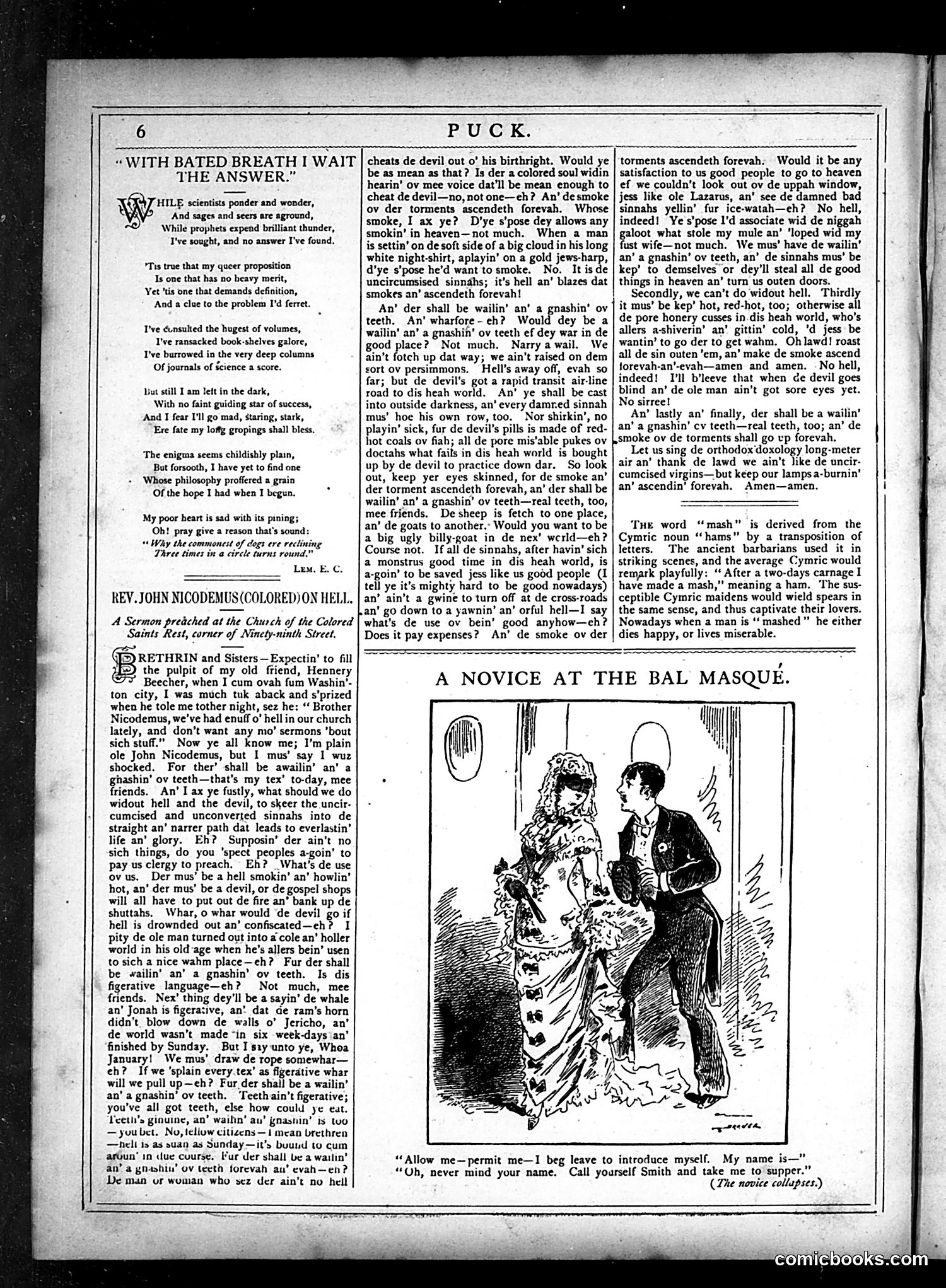
What you’re looking at
This cartoon depicts a social comedy at a masked ball. A well-dressed man in formal attire approaches a woman in an elaborate feathered costume. The caption reads: "Allow me—permit me—I beg leave to introduce myself. My name is—" to which she replies, "Oh, never mind your name. Call yourself Smith and take me to supper." The joke satirizes the pretension and anonymity of high-society masquerade balls. The woman's indifference to the man's actual identity—suggesting he simply adopt a common name—mocks both the artificiality of such events and the superficiality of upper-class social encounters. The "novice" referenced in the title appears to be the earnest gentleman, unaware that formality and genuine introductions are irrelevant in this social setting.
📄 Transcribed text from this page (OCR, searchable)
Machine-transcribed from the original scan — historical spelling and the odd misread are preserved.
PUCK. WITH BATED BREATH I WAIT THE ANSWER.” HILE scientists ponder and wonder, ‘And sages and seers are aground, While prophets expend brilliant thunder, T've sought, and no answer I've found. 'Tis true that my queer proposition Is one that has no heavy merit, Yet 'tis one that demands definition, And a clue to the problem I'd ferret. I’ve éunsulted the hugest of volumes, I've ransacked book-shelves galore, I’ve burrowed in the very deep columns Of journals of Science a score. ut still I am lett in the dark, With no faint guiding star of success, And I fear I'll go mad, staring, stark, Ere fate my loffg gropings shall bless. ‘The enigma seems childishly plain, But forsooth, I have yet to find one Whose philosophy proffered a grain Of the hope I had when I begun. My poor heart is sad with its pining; Oh! pray give a reason that’s sound: “\ Why the commonest of dogs ere reclining Three times in a circle turns round.” Les. E. C. REY. JOHN NICODEMUS (COLORED) ON HELL. A Sermon predched at the Church of the Colored Saints Rest, corner of Ninety-ninth Street. \[ RETHRIN and Sisters—Expectin’ to fill the pulpit of my old friend, Hennery Beecher, when I cum ovah fum Washin’- ton city, I was much tuk aback and s’prized when he tole me tother night, sez he: ‘‘ Brother Nicodemus, we've had enuff o’ hell in our church lately, and don’t want any mo’ sermons bout sich stuff.” Now ye all know me; I'm plain ole John Nicodemus, but I mus’ say I wuz shocked. For ther’ shall be awailin’ an’ a ghashin’ ov teeth—that’s my tex’ to-day, mee friends. An’ I ax ye fustly, what should we do widout hell and the devil, to skeer the uncir- cumcised and unconverted sinnahs into de straight an’ narrer path dat leads to everlastin’ life an’ glory. Eh? Supposin’ der ain't no sich things, do you ‘spect peoples a-goin’ to pay us clergy to preach. Eh? What's de use ov us. Der mus’ be a hell smokin’ an’ howlin’ hot, an’ der mus’ be a devil, or de gospel shops will all have to put out de fire an’ bank up de shuttahs, Whar, o whar would ‘de devil go if hell is drownded out an’ confiscated—eh? I pity de ole man turned out into a cole an’ holler world in his old-age when he's allers bein’ usen to sich a nice wahm place—eh? Fur der shall be wailin’ an’ a gnashin’ ov teeth. Is dis figerative language—eh? Not much, mee friends. Nex’ thing dey'll be a sayin’ de whale an’ Jonah is figerative, an‘ dat de ram’s horn didn’t. blow down de walls o’ Jericho, an’ de world wasn’t made “in six week-daysian’ ‘finished by Sunday. But I siy unto ye, Whoa January! We mus’ draw de rope somewhar— eh? If we 'splain every.tex’ as figerdtive whar will we pull up—eh? Fur der shall be a wailin’ an’ a gnashin’ ov teeth. Teeth ain't figerative; you've all got teeth, else how could ye eat. Teeth’s ginuine, an’ waihn’ au’ gnasnin’ is tuo —you bet. No, teliow citizens — 1 mean brethren hell is as suan as Sunday—it’> bound to cum arQun’ in due course, Fur der shall be a wailin’ an’ a gnashin’ ov teeth forevah au’ evah—en? De man or woman who sez der ain't no hell cheats de devil out o' his birthright. Would ye be as mean as that? Is der a colored soul widin hearin’ ov mee voice dat’ll be mean enough to cheat de devil—no, not one—eh? An’ desmoke ov der torments ascendeth forevah. Whose smoke, I ax ye? Dye s'pose dey allows any smokin’ in heaven—not much. When a man is settin’ on de soft side of a big cloud in his long white night-shirt, aplayin’ on a gold jews harp, d’ye s'pose he'd want to smoke. No. It isde uncircumsised sinnahs; it’s hell an’ blazes dat smokes an’ ascendeth forevah! An’ der shall be wailin’ an’ a gnashin’ ov teeth. An’ wharfore-eh? Would dey be a wailin’ an’ a gnashin’ ov teeth ef dey war in de good place? Not much. Narry a wail. We ain’t fotch up dat way; we ain’t raised on dem sort ov persimmons. Hell’s away off, evah so far; but de devil's got a rapid transit air-line road to dis heah world. An’ ye shall be cast into outside darkness, an’ every damred sinnah mus’ hoe his own row, too. Nor shirkin’, no playin’ sick, fur de devil's pills is made of red- hot coals ov fiah; all de pore mis‘able pukes ov doctahs what fails in dis heah world is bought up by de devil to practice down dar. So look out, keep yer eyes skinned, for de smoke an’ der torment ascendeth forevah, an’ der shall be wailin’ an’ a gnashin’ ov teeth—real teeth, too, mee friends. De sheep is fetch to one place, an’ de goats to another.» Would you want to be a big ugly billy-goat in de nex’ werld—eh? Course not. If all de sinnahs, after havin’ sich a monstrus good time in dis heah world, is a-goin’ to be saved jess like us good people (I tell ye it’s mighty hard to be good nowadays) an’ ain't a gwine to turn off at de cross-roads Lan’ go down to a yawnin’ an’ orful hell—I say what's de use ov bein’ good anyhow—ch? Does it pay expenses? An’ de smoke ov der torments ascendeth forevah. Would it be any satisfaction to us good people to go to heaven ef we couldn't look out ov de uppah window, jess like ole Lazarus, an’ see de damned bad sinnahs yellin’ fur ice-watah—eh? No hell, indeed! Ye s’pose I'd associate wid de niggah galoot what stole my mule an’ 'loped wid my fust wife—not much. We mus’ have de wailin’ an’ a gnashin’ ov teeth, an’ de sinnahs mus’ be kep’ to demselves or dey'll steal all de good things in heaven an’ turn us outen doors. Secondly, we can’t do widout hell. Thirdl it mus’ be kep’ hot, red-hot, too; otherwise all de pore honery cusses in.dis heah world, who's allers a-shiverin’ an’ gittin’ cold, 'd jess be wantin’ to go der to get wahm. Oh lawd! roast all de sin outen’em, an’ make de smoke ascend forevah-an’-evah—amen and amen. No hell, indeed! I'll b’leeve that when de devil goes blind an’ de ole man ain’t got sore eyes yet. No sirree! An’ lastly an’ finally, der shall be a wailin’ an’ a gnashin’ cv teeth—real teeth, too; an’ de smoke ov de torments shall go up forevah. Let us sing de orthodox ‘doxology long-meter air an’ thank de lawd we ain't like de uncir- cumcised virgins—but keep our lamps a-burnin’ an’ ascendin’ forevah. Amen—amen. ‘Tue word “mash” is derived from the Cymric noun “hams” by a transposition of letters. The ancient barbarians used it in striking scenes, and the average Cymric would remark playfully: “ After a two-days carnage I have made a mash,” meaning a ham. The sus- ceptible Cymric maidens would wield spears in the same sense, and thus captivate their lovers. Nowadays when a man is ‘‘ mashed” he either dies happy, or lives miserable. “Allow me—permit me—I beg leave to introduce myself. “Ob, never mind your name. Call yourself Smith and take me to supper.” A NOVICE AT THE BAL MASQUE. Wy My name is—” (Tie novice collapses.)