
Puck, 1878-03-06 · page 2 of 17
Puck — March 6, 1878 — page 2: what you’re looking at
What you’re looking at
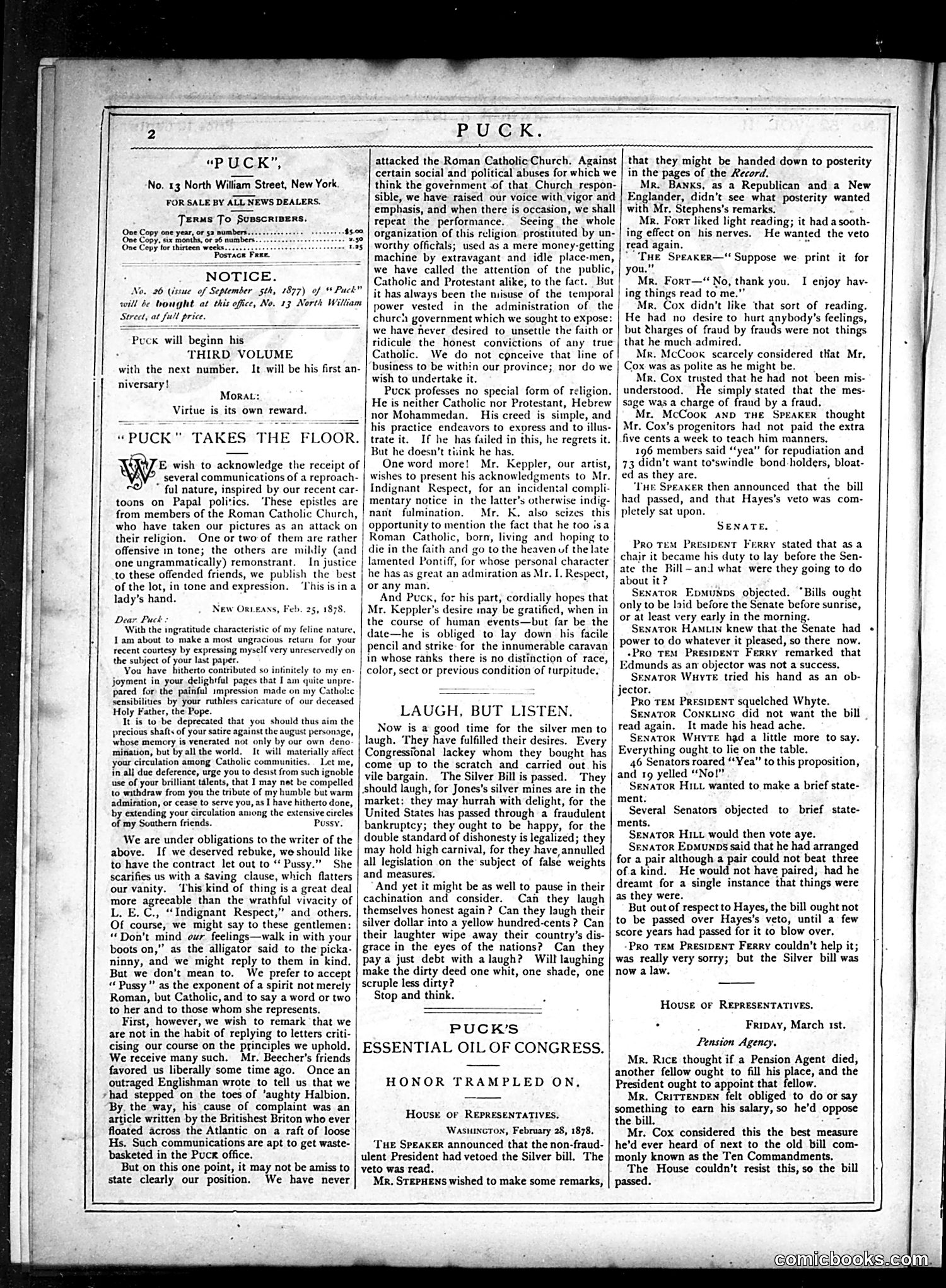
This page contains satirical commentary on the **Silver Bill debate in Congress**. The main cartoon criticizes senators laughing about the bill's passage despite its controversial nature regarding currency policy. The satire mocks **wealthy silver mine owners** ("silver men") who profited from the legislation, questioning the morality of laughing while the nation's finances faced serious consequences. The text pointedly asks: can they "laugh" while potentially harming the country? Key figures referenced include **President McKinley** (who vetoed the bill), **Senator Edmunds**, **Senator Whyte**, and other unnamed senators engaged in parliamentary debate. The central complaint is that politicians treated a serious economic measure as a joke rather than addressing its genuine impact on national interests—a classic Puck approach of exposing hypocrisy in governance.
📄 Transcribed text from this page (OCR, searchable)
Machine-transcribed from the original scan — historical spelling and the odd misread are preserved.
ee PUCK. “PUCK”, ‘No. 13 North William Street, New York. FOR SALE BY ALL NEWS DEALERS. Terms To Supscripers. ‘Ove Copy one year, or s2 numbers... ‘One Gopy. six months, oF 26 numbers. One Copy tor thirteen weeks. Post) 435 : NOTICE. No. 26 (issue of September sth, 1877) of “Pack” will be bought at this office, No. 13 North William Strect, at full price. Puck will begin his : THIRD VOLUME with the next number. It will be his first an- niversary! Morat: Virtue is its own reward. PUCK" TAKES THE FLOOR. ful nature, inspired by our recent car- toons on Papal politics. ‘These epistles are from members of the Roman Catholic Church, who have taken our pictures as an attack on their religion. One or two of them are rather offensive in tone; the others are mildly (and one ungrammatically) remonstrant. In justice to these offended friends, we publish the best of the lot, in tone and expression. ‘his isina lady's hand. New Or1eans, Feb. 25, 1878. Dear Puck : With the ingratitude characteristic of my feline nature, Lam about to make a most ungracious return for your recent courtesy by expressing myself very unreservedly on the subject of your last paper. : You have hitherto contributed so infinitely to my en- pared for the painful impression made on my Cathol:e sensibilities by your ruthless caricature of our deceased Holy Father, the Pope. It is to be deprecated that you should thus aim the precious shafts of your satire against the august personage, whose memory is venerated not only by our own deno mination, but by all the world. It will materially affect your circulation among Catholic communities. Let me, in all due deference, urge you to desist from such ignoble use of your brilliant talents, that I may net be compelled to withdraw from you the tribute of my humble but warm admiration, or cease to serve you, as I have hitherto done, by extending your circulation among the extensive circles of my Southern friends. Pussy. We are under obligations to the writer of the above. If we deserved rebuke, we should like to have the contract let out to “ Pussy.” She scarifies us with a saving clause, which flatters our vanity. ‘This kind of thing is a great deal more agreeable than the wrathful vivacity of L. E.C., “Indignant Respect,” and others. Of course, we might say to these gentlemen: “Don’t mind our feelings—walk in with your boots on,” as the alligator said to the picka- ninny, and we might reply to them in kind. But we don’t mean to. We prefer to accept « Pussy " as the exponent of a spirit not merely Roman, but Catholic, and to say a word or two to her and to those whom she represents. First, however, we wish to remark that we are not in the habit of replying to letters criti- cising our course on the principles we uphold. We receive many such. Mr. Beecher’s friends favored us liberally some time ago. Once an outraged Englishman wrote to tell us that we rhad stepped on the toes of ‘aughty Halbion, By, the way, his cause of complaint was an article written by the Britishest Briton who ever floated across the Atlantic on a raft of loose Hs. Such communications are apt to get waste- basketed in the Puck office. But on this one point, it may not be amiss to state clearly our position, We have never a E wish to acknowledge the receipt of | | several communications of a reproach- joyment in your delightful pages that I am quite unpre- | attacked the Roman CatholicChurch. Against certain social and political abuses for which we think the government of that Church respon- sible, we have raised our voice with vigor and emphasis, and when there is occasion, we shall repeat the performance. Seeing the whole organization of this religion prostituted by un- worthy offictals; used as a mere money-getting machine by extravagant and idle place-men, we have called the attention of the public, Catholic and Protestant alike, to the fact. But it has always been the misuse of the temporal po vested in the administration of the churci government which we sought to expose: we have never desired to unsettle the faith or ridicule the honest convictions of any true Catholic. We do not conceive that line of business to be within our province; nor do we | wish to undertake it. Puck professes no special form of religion. He is neither Catholic nor Protestant, Hebrew nor Mohammedan. His creed is simple, and his practice endeavors to express and to il trate it. If he has failed in this, he regrets it. But he doesn’t tiiink he has. One word more! Mr. Keppler, our artist, vishes to present his acknowledgments to Mr. Indignant Respect, for an incidental compli- mentary notice in the latter's otherwise indig- nant fulmination. Mr. K. also scizes this opportunity to mention the fact that he too isa Roman Catholic, born, living and hoping to die in the faith and go to the heaven of the late lamented Pontiff, for whose personal character | he has as great an admiration as Mr. I. Respect, or any man. | And Puck, for his part, cordially hopes that Mr. Keppler’s desire may be gratified, when in the course of human events—but far be the date—he is obliged to lay down his facile pencil and strike: for the innumerable caravan in whose ranks there is no distinction of race, color, sect or previous condition of turpitude, LAUGH, BUT LISTEN. Now is a good time for the silver men to laugh. They have fulfilled their desires. Every Congressional lackey whom they bought has come up to the scratch and carried out. his vile bargain. The Silver Bill is passed. They should laugh, for Jones's silver mines are in the market: they may hurrah with delight, for the United States has passed through a fraudulent bankruptcy; they ought to be happy, for the double standard of dishonesty is legalized; they may hold high carnival, for they have, annulled all legislation on the subject of false weights and measures. And yet it might be as well to pause in their cachination and consider. Cah they laugh themselves honest again? Can they laugh their silver dollar into a yellow hundred-cents ? Can their laughter wipe away their country’s dis- grace in the eyes of the nations? Can they pay a just debt with a laugh? Wilf laughing make the dirty deed one whit, one shade, one scruple less dirty? Stop and think. PUCK’S ESSENTIAL OIL OF CONGRESS. | HONOR TRAMPLED ON, House or REPRESENTATIVES. Wasincton, February 28, 1878, ‘Tue Speaker announced that the non-fraud- ulent President had vetoed the Silver bill. The veto was read. Mr. STEPHENS wished to make some remarks, that they might be handed down to posterity in the pages of the Record. Mr. BANKs, as a Republican and a New Englander, didn’t see what posterity wanted with Mr, Stephens’s remarks. : Mr. Fort liked light reading; it had asooth- ing effect on his nerves. He wanted the veto read again. 3 ““Tue Speaker— Suppose we print it for you.” Mr. Fort—“ No, thank you. ing things read to me.” Mr. Cox didn’t like ‘that sort of reading. He had no desire to hurt anybody's feelings, but tharges of fraud by frauds were not things that he much admired. Mr. McCook scarcely considered tat Mr, Cox was as polite as he might be. Mr. Cox trusted that he had not been mis- understood. He simply stated that the mes- sage was a charge of fraud by a fraud. Mr. McCook anp THE SPEAKER thought Mr. Cox’s progenitors had not paid the extra five cents a week to teach him manners. 196 members said “yea” for repudiation and 73 didn’t want to’swindle bond-holders, bloat- ed as they are. F Ie Speaker then announced that the bill had passed, and that Hayes’s veto was com- pletely sat upon. I enjoy hav- SENATE, Pro TEM Presipent Ferry stated that asa chair it became his duty to lay before the Sen- ate the Rill—and what were they going to do | about it? Senator EpmuNnps objected. “Bills ought only to be laid before the Senate before sunrise, or at least very early in the morning. Senator HaMLin knew that the Senate had power to do whatever it pleased, so there now. +Pro Tem Presipent Ferry remarked that munds as an objector was not a success. NATOR WuyTE tried his hand as an ob- jector. PRo TEM PRESIDENT squelched Whyte. Senator Conkuinc did not want the bill read again. It made his head ache. Senator Wuyte had a little more to say. Everything ought to lie on the table. 46 Senators roared “Yea” to this proposition, and 19 yelled “No!” SenaTor Hitt wanted to make a brief state- ment. Several Senators objected to brief state- ments. SENATOR Hitt would then vote aye. SeNaToR Epmunps said that he had arranged for a pair although a pair could not beat three ofakind. He would not have paired, had he dreamt for a single instance that things were as they were. But out of respect to Hayes, the bill ought not to be passed over Hayes's veto, until a few score years had passed for it to blow over. Pro Tem Presipent Ferry couldn't help it; was really very sorry; but the Silver bill was now a law. House oF REPRESENTATIVES, . Fripay, March ist. Pension Agency. Mr. Rice thought if a Pension Agent died, another fellow ought to fill his place, and the President ought to appoint that fellow. Mr. CritTENDEN felt obliged to do or say something to earn his salary, so he'd oppose the bill. a Mr. Cox considered this the best measure he'd ever heard of next to the old bill com- monly known as the Ten Commandments. The House couldn't resist this, so the bill passed. (Comichooks!co!