
Puck, 1878-03-06 · page 7 of 17
Puck — March 6, 1878 — page 7: what you’re looking at
What you’re looking at
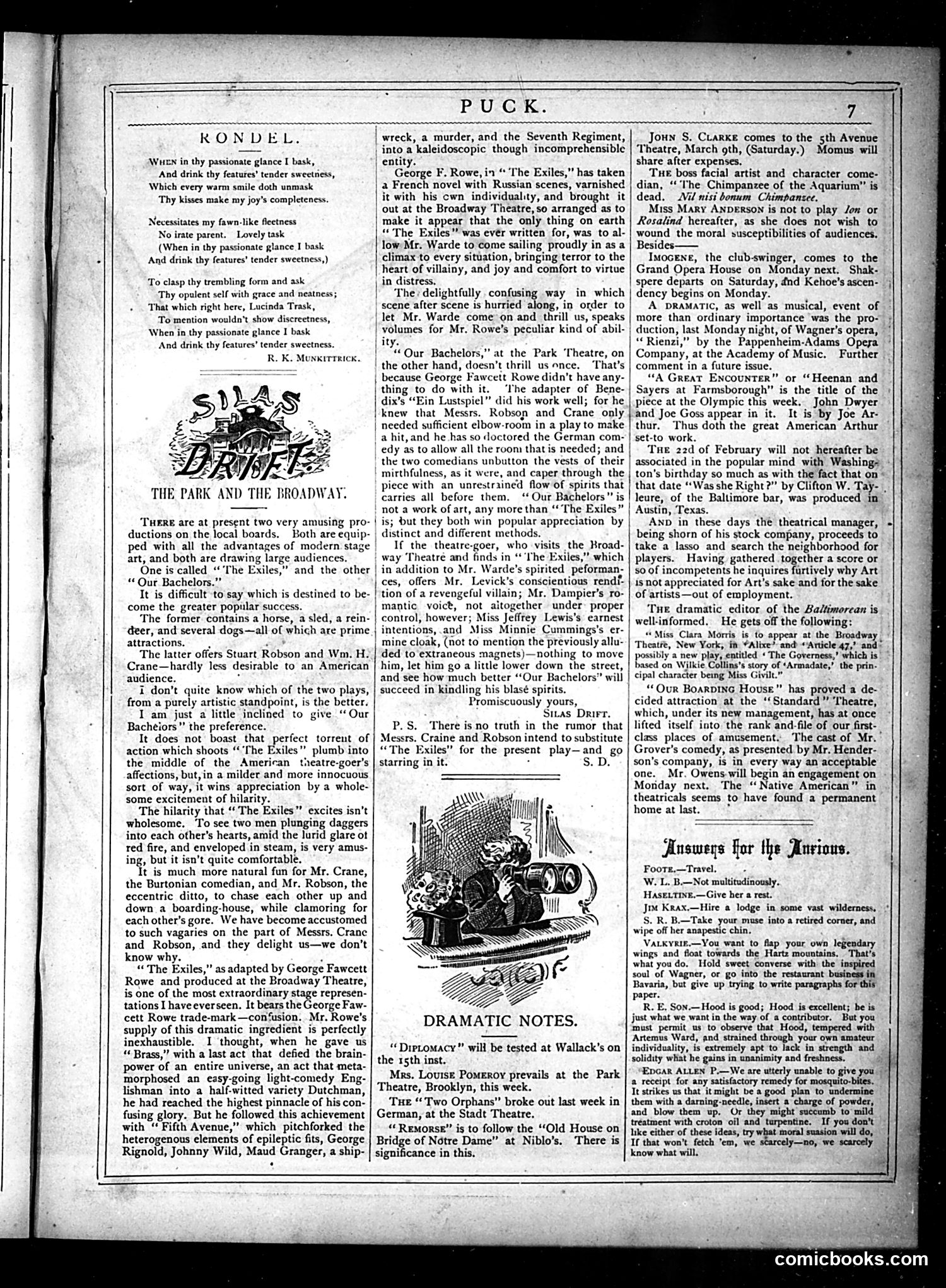
This page contains theater reviews and dramatic notes rather than political cartoons. The main illustrated content shows two decorative vignettes—one labeled "SILAS DEPOT" depicting a stagecoach scene, and another showing what appears to be theatrical equipment or props. The text discusses contemporary Broadway productions, including George F. Rowe's "The Exiles," "Our Bachelors" at the Park Theatre, and other performances. The "Answers for the Curious" section at bottom right addresses reader questions about theatrical matters. The satirical humor is theatrical rather than political—mocking aspects of contemporary stage productions and performances. This appears to be entertainment criticism and gossip rather than social or political commentary.
📄 Transcribed text from this page (OCR, searchable)
Machine-transcribed from the original scan — historical spelling and the odd misread are preserved.
PUCK. RONDEL. Wuen in thy passionate glance I bask, And drink thy features’ tender sweetness, Which every warm smile doth unmask Thy kisses make my joy’s completeness. Necessitates my fawn-like fieetness No irate parent. Lovely task (When in thy passionate glance I bask And drink thy features’ tender sweetness,) To clasp thy trembling form and ask Thy opulent self with grace and neatness; ‘That which right here, Lucinda Trask, To mention wouldn't show discreetness, When in thy passionate glance I bask And drink thy features’ tender sweetness. Mowxirrrick. | needed sufficient elbow-room in a play to make | edy as to allow all the room: that is needed; and THE PARK AND THE BROADWAY. ‘Tuere are at present two very amusing pro- | ductions on the local boards. Both are equip- ped with all the advantages of modern stage art, and both are drawing large audiences. One is called “ ‘The Exiles,” and the other | “Our Bachelors.” It is difficult to say which is destined to be- come the greater popular success. The former contains a horse, a sled, a rein- deer, and several dogs—all of which are prime attractions. The latter offers Stuart Robson and Wm. H.- Crane—hardly less desirable to an American audience. I don’t quite know which of the two plays, from a purely artistic standpoint, is the better. I am just a little inclined to give ‘Our Bacheiors”" the preference. It does not boast that perfect torrent of action which shoots ‘The Exiles” plumb into the middle of the American theatre-goer’s affections, but,in a milder and more innocuous sort of way, it wins appreciation by a whole- some excitement of hilarity. The hilarity that “ The Exiles” excites isn’t wholesome. ‘To see two men plunging daggers into each other's hearts, amid the lurid glare ot red fire, and enveloped in steam, is very amus- ing, but it isn’t quite comfortable. tt is much more natural fun for Mr. Crane, the Burtonian comedian, and Mr. Robson, the eccentric ditto, to chase each other up and down a boarding-house, while clamoring for each other’s gore. We have become accustomed to such vagaries on the part of Messrs. Crane and Robson, and they delight us—we don't know why. “The Exiles,” as adapted by George Fawcett Rowe and produced at the Broadway Theatre, is one of the most extraordinary stage represen- tations I haveeverseen. It bears the George Faw- cett Rowe trade-mark —con‘usion. Mr. Rowe's supply of this dramatic ingredient is perfectly inexhaustible. I thought, when he gave us “ Brass,” with a last act that defied the brain- power of an entire universe, an act that meta- morphosed an easy-going light-comedy Eng- lishman into a half-witted variety Dutchman, he had reached the highest pinnacle of his con- fusing glory. But he followed this achievement with “ Fifth Avenue,” which pitchforked the | the other hand, doesn’t thrill us once. heterogenous elements of epileptic fits, George Rignold, Johnny Wild, Maud Granger, a ship- wreck, a murder, and the Seventh Regiment, into a kaleidoscopic though incomprehensible entity. George F. Rowe, in “ The Exiles,” has taken a French novel with Russian scenes, varnished it with his cwn individuality, and brought it out at the Broadway Theatre, so arranged as to make it appear that the only thing on earth “ The Exiles’ was evér written for, was to al- low Mr. Warde to come sailing proudly in as a climax to every situation, bringing terror to the heart of villainy, and joy and comfort to virtue in distress, ‘The: delightfully confusing way in which scene after scene is hurried along, in order to let Mr. Warde come on and thrill us, speaks volumes for Mr. Rowe’s peculiar kind of abil- | * at the Park ‘Theatre, on That's because George Fawcett Rowe didn’t have any- thing to do with it. ‘he adapter of Bene- dix’s “Ein Lustspiel” did his work well; for he knew that Messrs. Robson and Crane only ye “Our Bachelors, a hit, and he has so doctored the German com- | the two comedians unbutton the vests of their mirthfulness, as it were, and caper through the piece with an unrestrained flow of spirits that carries all before them. ‘ Our Bachelors” is not a work of art, any more than “The Exiles” | is; but they both win popular appreciation by | distinct and different methods. If the theatre-goer, who visits the Broad- way ‘Theatre and finds in ‘The Exiles,” which in addition to Mr. Warde’s spirited _peforman- ces, offers Mr. Levick’s conscientious rendi- tion of a revengeful villain; Mr. Dampier’s ro- mantic voict, not aitogether under: proper control, however; Miss Jeffrey Lewis's earnest intentions, and Miss Minnie Cummings's er- mine cloak, (not to mention the previously allu- ded to extraneous magnets)—nothing to move him, let him go a little lower down the street, and see how much better “Our Bachelors” will succeed in kindling his blasé spirits. | Promiscuously yours, Stas Drier. P.S. There is no truth in the rumor that Messrs. Craine and Robson intend to substitute “The Exiles” for the present play an and, 0 starring in it. DRAMATIC NOTES. “Diptomacy” will be tested at Wallack’s on the 15th inst. Mrs. Louise Pomeroy prevails at the Park Theatre, Brooklyn, this week. Tue ‘Two Orphans” broke out last week in German, at the Stadt Theatre. “Remorse” is to follow the ‘‘Old House on Joun S. Crarke comes to the 5th Avenue ‘Theatre, March oth, (Saturday.) Momus will share after expenses, Tue boss facial artist and character come- dian, “‘‘The Chimpanzee of the Aquarium” is dead, Nil nisi bonum Chimpansee, Miss Mary Anperson is not to play Jon or Rosalind hereafter, as she does not wish to wound the moral susceptibilities of audiences, Besides—— Imocene, the club-swinger, comes to the Grand Opera House on Monday next. Shak- spere departs on Saturday, dnd Kehoe’s ascen- dency begins on Monday. A DRamaTic, as well as musical, event of © more than ordinary importance ‘was the pro- duction, last Monday night, of Wagner's opera, “Rienzi,” by the Pappenheim-Adams Opesa Company, at the Academy of Music. Further comment in a future issue. “(A Great Encounter” or “Heenan and Sayers at Farmsborough” is the title of the + piece at the Olympic this week. John Dwyer and Joe Goss appear in it. It is by Joe Ar- thur. Thus doth the great American Arthur set-to work. ‘Tne 22d of February will not hereafter be associated in the popular mind with Washing> ton’s birthday so much as with the fact that on « that date ‘Was she Right?” by Clifton W. Tay- , leure, of the Baltimore bar, was produced in Austin, Texas. Anp in these days thé theatrical manager, -| being shorn of his stock company, proceeds to take a lasso and search the neighborhood for players. Having gathered together a score or so of incompetents he inquires furtively why Art is not appreciated for Art’s sake and for the sake of artists—out of employment. ‘Tne dramatic editor of the Baltimorean is well-informed. He gets off the following: “Miss Clara Morris is to appear at the Broadway ‘Theatie, New York, it *Altce! and -“Article:ay,? ands possitily a new play, entitled ‘ The Governess,” which is based on Wilkie Collins's story of ‘Armadate,’ the prin- cipal character being Miss Givilt.” “Our BoarpinG House” has proved a de- cided attraction at the ‘‘Standard” ‘Theatre, which, under its new management, has at once lifted itself into the rank and-file of our first- class places of amusement. The cast of Mr.’ Grover’s comedy, as presented by Mr. Hender- son's company, is in every way an acceptable one. Mr. Owens-will begin an engagement on Moriday next. The “Native American” in theatricals seems to have found a permanent home at last. Answers for the Anrious. Foors.—Travel. —- w. Not multitudinously. Hasetixe.—Give her a rest. Jn Krax.—Hire a lodge in some vast wilderness, S. R, B—Take your muse into a retired corner, and wipe off her anapestic chin, Vatxyriz.—You want to flap your own legendary wings and float towards the Hartz mountains. ‘That's what you do. Hold sweet converse with: the inspired soul of Wagner, or go into the restaurant business in Bavaria, but give up trying to write paragraphs for this. Paper. R. E, Son.—Hood is good; Hood is excellent; he is just what we want in the way of a contributor. But you must permit us to observe that Hood, tempered with Artemus Ward, and strained through your own amateur individuality, is extremely apt to lack in strength and solidity what he gains in unanimity and freshness. EDGAR ALLEN P.—We are utterly unable to give a receipt for any satisfactory remedy for poeed ueh ee It strikes us that itmight be a good plan to undermine them with a darning-needle, insert 2 charge of powder, and blow them up. Or they might succumb to mild treatment with croton oil and turpentine. If you don't ~ like either of these ideas, try what moral suasion will do, Bridge of Notre Dame” at Niblo’s. There is significance in this. If that won't fetch ‘em, we starcely—no, we scarcely know what will. comicbooks.com