
Puck, 1878-03-06 · page 11 of 17
Puck — March 6, 1878 — page 11: what you’re looking at
What you’re looking at
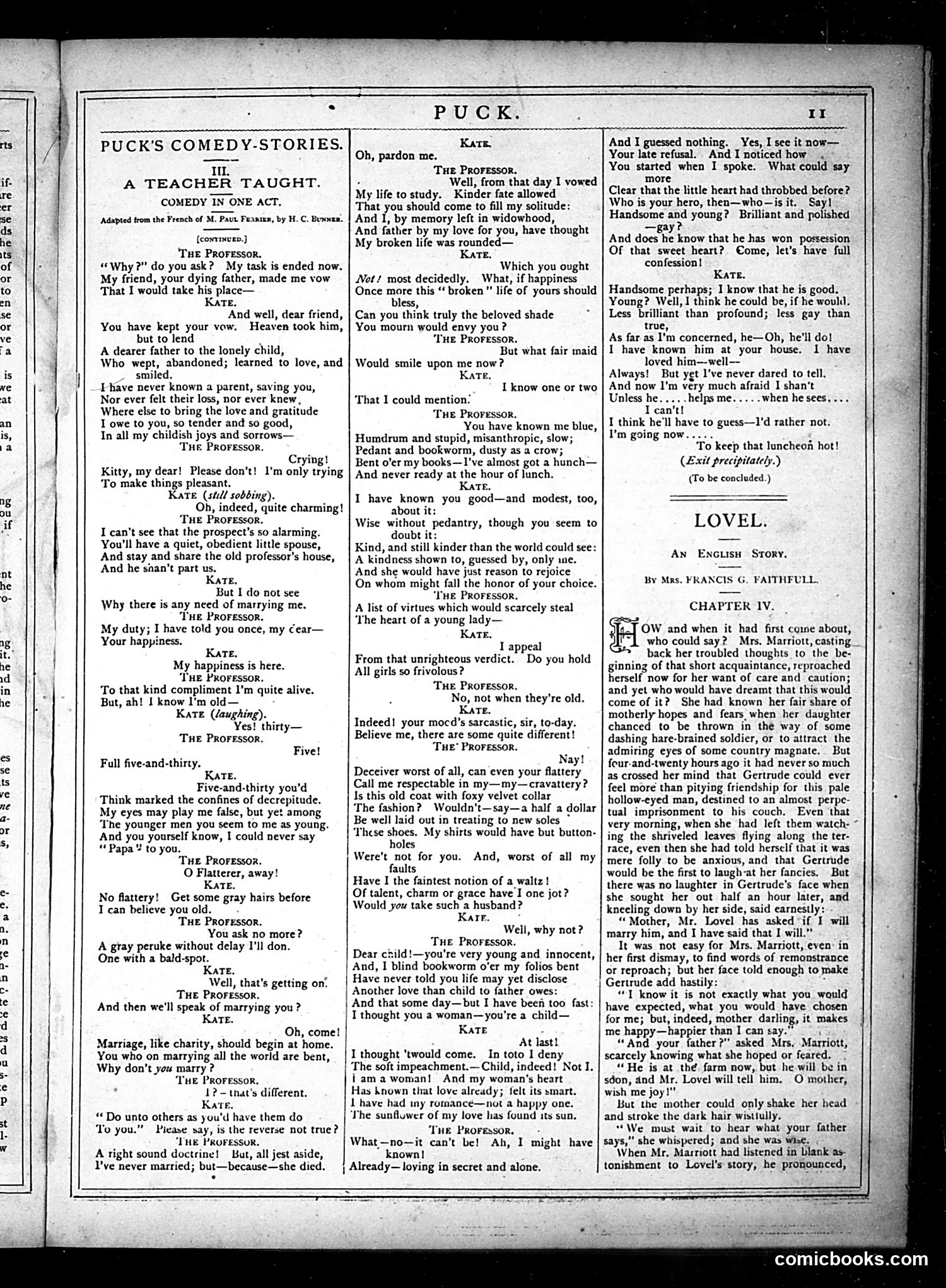
This page contains two distinct literary works, not political cartoons: 1. **"A Teacher Taught"** — a one-act comedy adapted from French, featuring dialogue between characters named Kate and The Professor. The satire concerns a professor's romantic pursuit of a student (Kate), with witty banter about education, class, and romantic pretense. The humor targets pedantry and the professor's self-deception about his appeal. 2. **"Lovel"** — an English story by Mrs. Francis G. Faithfull, beginning Chapter IV. This appears to be serialized fiction about a woman named Gertrude and romantic entanglement. This is a **literature/fiction page**, not a political cartoon section. Puck magazine included both satirical visual cartoons and written comedic literature.
📄 Transcribed text from this page (OCR, searchable)
Machine-transcribed from the original scan — historical spelling and the odd misread are preserved.
at an is, a 1g it.” id in he PUCK PUCK’S COMEDY-STORIES. TL A TEACHER TAUGHT. COMEDY 1 IN ONE ACT, Adapted trom the French of M. Paut Fexsuzr, by H.C. Buxxar. {commmmven.] ‘THE PROFESSOR. “Why ?” do you ask? ~My task is ended now. My friend, your dying father, made me vow ‘That I would take his place— Kate. And well, dear friend, You have kept your vow. Heaven took him, but to lend A dearer father to the lonely child, Who wept, abandoned; learned to love, and smiled. Fhave never known a parent, saving you, Nor ever felt their loss, nor ever knew, Where else to bring the love and gratitude I owe to you, so tender and so good, In all my childish joys and sorrows— Tue PRorEessor. Crying! Kitty, my dear! Please don’t! I'm only trying ‘To make things pleasant. Kate (stl sobbing). Oh, indeed, quite charming! ‘THE PROFESSOR. I can't see that the prospect’s so alarming. You'll have a quiet, obedient little spouse, And stay and share the old professor's house, And he snan’t part us. Kate. But I do not see Why there is any need of marrying me. ‘THe PRoFEssoR. My duty; I have told you once, my cear— Your happiness. Kate. My happiness is here. ‘THe PROFESSOR. To that kind compliment I’m quite alive. But, ah! 1 know I’m old— Kate (laughing). Yes! thirty— THe PROFESSOR. Five! Full five-and-thirty. Kate. Five-and-thirty you'd Think marked the confines of decrepitude. My eyes may play me false, but yet among ‘The younger men you seem to me as young. And you yourself know, I could never say “Papa to you. THE PRorEssor. O Flatterer, away! Kate. No flattery! Get some gray hairs before I can believe you old. Tue Proressor. You ask no more? A gray peruke without delay I’ll don. One with a bald-spot. Kate. Well, that’s getting on’ THE PRoFEssor. And then we'll speak of marrying you ? Karte. Oh, come! Marriage, like charity, should begin at home. You who on marrying all the world are bent, Why don’t you marry ? ‘Tne PRoressor. 1?-tnat's different. Kate. “Do unto others as you'd have them do To you.” Please say, is the reverse not true? ‘THE PROFESSOR. A right sound doctrine! But, all jest aside, I've never married; but—because—she died. Kare. Oh, pardon me. THE PRoFEssor. : Well, from that day I vowed My life to study. Kinder fate allowed That you should come to fill my solitude: And I, by memory left in widowhood, ‘And father by my love for you, have thought My broken life was rounded— Kate. Which you ought Not! most decidedly. What, if happiness Once more this “ broken” life of yours should bless, Can you think truly the beloved shade You mourn would envy you ? ‘THE PROFESSOR. But what fair maid Would smile upon me now? Kate. I know one or two That I could mention: ‘THE PRoressor. You have known me blue, Humdrum and stupid, misanthropic, slow; Pedant and bookworm, dusty as a crow; Bent o’er my books—I've almost got a hunch— And never ready at the hour of lunch. Kate. I have known you good—and modest, too, about it: Wise without pedantry, though you seem to doubt it: Kind, and still kinder than the world could see: A kindness shown to, guessed by, only ie. And she would have just reason to rejoice On whom might fall the honor of your choice. ‘THE PROFESSOR. A list of virtues which would scarcely steal ‘The heart of a young lady— Kate. I appeal From that unrighteous verdict. Do you hold All girls so frivolous? Tue Proressor. No, not when they’re old. Kate. Indeed! your mocd’s sarcastic, sir, to-day. Believe me, there are some quite different! ‘THE’ PROFESSOR. Nay! Deceiver worst of all, can'even your flattery Call me respectable in my—my—cravattery? Is this old coat with foxy velvet collar ‘The fashion? Wouldn’t—say—a half a dollar Be well laid out in treating to new soles * ‘These shoes. My shirts would have but button- holes Were’t not for you. faults Have I the faintest notion of a waltz! Of talent, charm or grace have I one jot? Would you take such a husband? Karr. And, worst of all my Well, why not? THE PRoressor. Dear child!—you're very young and innocent, And, I blind bookworm o'er my folios bent Have never told you life may yet disclose Another love than child to father owes: And that some day—but I have been too fast: I thought you a woman—you're a child— Kate a At last! I thought 'twould come. In toto I deny The soft impeachment.— Child, indeed! NotI. i ama woman! And my woman's heart Has hnown that love already; felt its smart. 1 have had iny romance—not a happy one. ‘The sunflower of my love has found its sun. ‘Tue Proressor. ‘ What —no—it can't be! Ah, I might have known! Already—loying in secret and alone. And I guessed nothing. Yes, I see it now— Your late refusal. And I noticed how . You started when I spoke. What could say more Clear that the little heart had throbbed before? Who is your hero, then—who—is it. Say! Handsome and young? Brilliant and polished —ga And does he know that he has won possession OF that sweet heart? Come, let's have full confession! Kate. Handsome perhaps; I know that he is good. Young? Well, I think he could be, if he would. Less brilliant than profound; less gay than true, As far as I'm concerned, he—Oh, he'll do! I have known him at your house. I have loved him—well— Always! But ygt I've never dared to tell. And now I'm very much afraid I shan’t Unless he..... helps me..... when he sees. ... I can’t! I think he'll have to guess—I'd rather not. I'm going now..... To keep that luncheon hot! (Exit precipitately.) (To be concluded.) LOVEL. An ENGLIsH Story. By Mrs. FRANCIS G. FAITHFULL, CHAPTER IV. aL OY, and when it had first coine about, who could say? Mrs. Marriott, casting__ back her troubled thoughts to the be- ginning of that short acquaintance, reproached herself now for her want of care and caution; and yet who would have dreamt that this would come of it? She had known her fair share of motherly hopes and fears. when her daughter chanced to be thrown in the way of some dashing hare-brained soldier, or to attract the admiring eyes of some country magnate, But four-and-twenty hours ago it had never so much as crossed her mind that Gertrude could ever feel more than pitying friendship for this pale hollow-eyed man, destined to an almost perpe- tual imprisonment to his couch. Even that very morning, when she had left them watch- ing the shriveled leaves flying along the ter- race, even then she had told herself that it was mere folly to be anxious, and that Gertrude would be the first to laugh-at her fancies. But there was no laughter in Gertrude’s face when she sought her out half an hour later, and kneeling: down by her side, said earnestly: “Mother, Mr. Lovel has asked °if I marry him, and I have-said that I will.” It was not easy for Mrs. Marriott, even: in her first dismay, to find words of remonstrance or reproach; but her face told enough to make Gertrude add hastily: “T know it is not exactly what you would have expected, what you would have chosen for me; but, indeed, mother darling, it makes me happy—happier than I can say. “And your father?” asked Mrs, Marriott, scarcely knowing what she hoped or feared. “He is at the. farm now, but he will be in sdon, dnd Mr. Lovel will tell him. O mother, wish me joy!" But the mother could only shake her head and stroke the dark hair wisttully. must wait to hear what your father says,” she whispered; and she was Wise. When Mr. Marriott had listened in blank as- tonishment to Lovel’s story, he pronounced, will comicbooks.com