
Puck, 1878-03-06 · page 3 of 17
Puck — March 6, 1878 — page 3: what you’re looking at
What you’re looking at
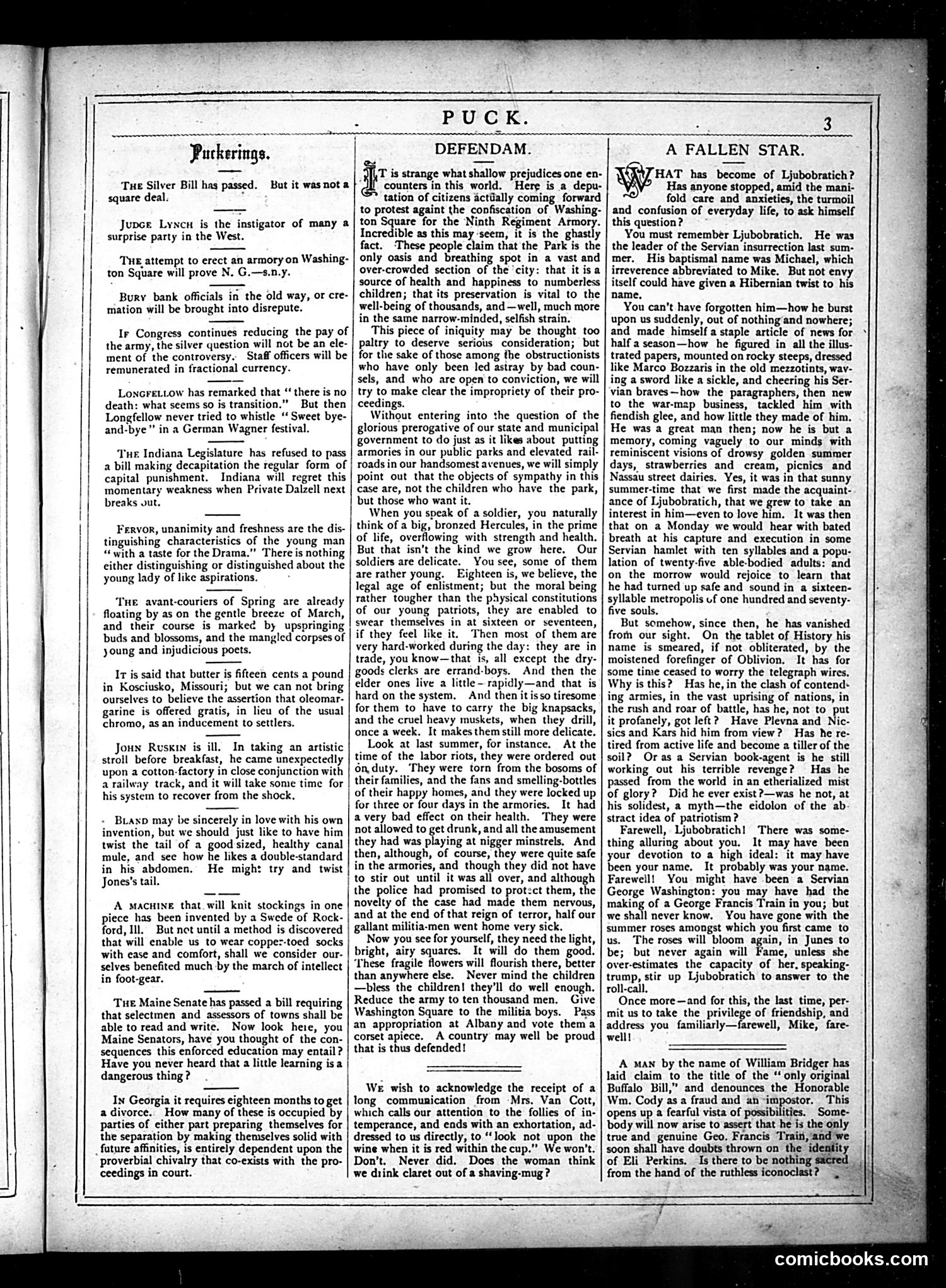
This page contains three distinct satirical sections rather than a unified cartoon. "Purkerings" offers brief political commentary on recent events: the Silver Bill's passage, Judge Lynch's role in Western violence, and criticism of Washington Square park conditions. "Defendam" mocks shallow civic prejudices and argues for sympathy toward soldiers, noting their youth and physical strain. "A Fallen Star" appears to be a narrative piece about Ljubobratich, a Serbian insurgent leader, critiquing his decline from prominence and questioning whether he represents genuine patriotism or merely self-interested rebellion. The overall tone suggests Puck's characteristic late-19th-century skepticism toward both political institutions and public figures claiming moral authority.
📄 Transcribed text from this page (OCR, searchable)
Machine-transcribed from the original scan — historical spelling and the odd misread are preserved.
PUCK. : 3 Puckerings. ‘Tue Silver Bill has passed. But it was nota square deal. 2 Jupce Lynxcu is the instigator of many a surprise party in the West. THE attempt to erect an armory on Washing- ton Square will prove N. G.—s.n.y. Bury bank officials in the old way, or cre- mation will be brought into disrepute. Ir Congress continues reducing the pay of the army, the silver question will not be an ele- ment of the controversy. Staff officers will be remunerated in fractional currency. Loncrettow has remarked that ‘there is no death: what seems so is transition.” But then Longfellow never tried to whistle “‘ Sweet bye- and-bye” in a German Wagner festival. ‘Tue Indiana Legislature has refused to pass a bill making decapitation the regular form of capital punishment. Indiana will regret this momentary weakness when Private Dalzell next breaks out. Fervor, unanimity and freshness are the dis- tinguishing characteristics of the young man “with a taste for the Drama.” There is nothing either distinguishing or distinguished about the young lady of like aspirations. ‘THe avant-couriers of Spring are already floating by as on the gentle breeze of March, and their course is marked by upspringing buds and blossoms, and the mangled corpses of young and injudicious poets. Ir is said that butter is fifteen cents a pound in Kosciusko, Missouri; but we can not bring ourselves to believe the assertion that oleomar- garine is offered gratis, in lieu of the usual chromo, as an inducement to settlers. Joun Ruskin is ill. In taking an artistic stroll before breakfast, he came unexpectedly upon a cotton-factory in close conjunction with arailway track, and it will take some time for his system to recover from the shock, Bianb may be sincerely in love with his own invention, but we should just like to have him twist the tail of a good sized, healthy canal mule, and see how he likes a double-standard in his abdomen, He might try and twist Jones’s tail. A MACHINE that. will knit stockings in one piece has been invented by a Swede of Rock- ford, Ill. But not until a method is discovered that will enable us to wear coppez-toed socks with ease and comfort, shall we consider our- selves benefited much by the march of intellect in foot-gear. Tue Maine Senate has passed a bill requiring that selectmen and assessors of towns shall be able to read and write. Now look hete, you Maine Senators, have you thought of the con- sequences this enforced education may entail? Have you never heard that a little learning is a dangerous thing ? In Georgia it requires eighteen months to get a divorce. How many of these is occupied by parties of either part preparing themselves for the separation by making themselves solid with _future affinities, is entirely dependent upon the proverbial chivalry that co-exists with the pro- ceedings in court. DEFENDAM. .T is strange what shallow prejudices one en- counters in this world. Here is a depu- tation of citizens actiially coming forward to protest againt the confiscation of Washing- ton Square for the Ninth Regiment Armory. Incredible as this may -seem, it is the ghastly fact. These people claim that the Park is the only oasis and breathing spot in a vast and over-crowded section of the ‘city: that it isa source of health and happiness to numberless children; that its preservation is vital to the well-being of thousands, and—well, much more in the same narrow-minded, selfish strain. This piece of iniquity may be thought too paltry to deserve serious consideration; but for the sake of those among the obstructionists who have only been led astray by bad coun- sels, and who are open to conviction, we will try to make clear the impropriety of their pro- ceedings. Without entering into the question of the glorious prerogative of our state and municipal government to do just as it likes about putting armories in our public parks and elevated rail- roads in our handsomest avenues, we will simply point out that the objects of sympathy in this case are, not the children who have the park, but those who want it. When you speak of a soldier, you naturally think of a big, bronzed Hercules, in the prime of life, overflowing with strength and health. But that isn’t the kind we grow here. Our soldiers are delicate. You see, some of them are rather young. Eighteen is, we believe, the legal age of enlistment; but the moral being rather tougher than the physical constitutions of our young patriots, they are enabled to swear themselves in at sixteen or seventeen, if they feel like it. Then most of them are very hard-worked during the day: they are in trade, you know—that is, all except the dry- goods clerks are errand-boys. And then the elder ones live a little-rapidly—and that is hard on the system, And then it isso tiresome for them to have to carry the big knapsacks, and the cruel heavy muskets, when they drill, once a week. It makes them still more delicate. Look at last summer, for instance. At the time of the labor riots, they were ordered out Onduty. ‘They were torn from the bosoms of their families, and the fans and smelling-bottles of their happy homes, and they were locked up for three or four days in the armories. It had avery bad effect on their health. They were not allowed to get drunk, and all the amusement they had was playing at nigger minstrels. And then, although, of course, they were quite safe in the armories, and though they did not have to stir out until it was all over, and although the police had promised to protect them, the novelty of the case had rade them nervous, and at the end of that reign of terror, half our gallant militia-men went home very sick. Now you sce for yourself, they need the light, bright, airy squares. It will do them good. ‘These fragile flowers will flourish there, better than anywhere else. Never mind the children —bless the children! they'll do well enough. Reduce the army to ten thousand men. Give Washington Square to the militia boys. Pass an appropriation at Albany and vote them a corset apiece. A country may well be proud that is thus defended! We wish to acknowledge the receipt of a long communication from Mrs. Van Cott, which calls our attention to the follies of in- A FALLEN STAR. MYT HAT has become of Ljubobratich? Has anyone stopped, amid the mani- fold care and anxieties, the turmoil and confusion of everyday life, to ask himself this question? You must remember Ljubobratich. He was the leader of the Servian insurrection last sum- mer. His baptismal name was Michael, which irreverence abbreviated to Mike. But not envy itself could have given a Hibernian twist to his name, You can’t have forgotten him—how he burst upon us suddenly, out of nothing‘and nowhere; and made himself a staple article of news for half a season—how he figured in all the illus- trated papers, mounted on rocky steeps, dressed like Marco Bozzaris in the old mezzotints, wav- ing a sword like a sickle, and cheering his Ser- vian braves—how the paragraphers, then new to the war-map business, tackled him with fiendish glee, and how little they made of him. He was a great man then; now he is but a memory, coming vaguely to our minds with reminiscent visions of drowsy golden summer days, strawberries and cream, picnics and Nassau street dairies. Yes, it was in that sunny summer-time that we first made the acquaint- ance of Ljubobratich, that we grew to take an interest in him—even to love him. It was then that on a Monday we would hear with bated breath at his capture and execution in some Servian hamlet with ten syllables and a popu- lation of twenty-five able-bodied adults: and on the morrow would rejoice to learn that he had turned up safe and sound in a sixteen- syllable metropolis uf one hundred and seventy- five souls, But somehow, since then, he has vanished from our sight. On the tablet of History his name is smeared, if not obliterated, by the moistened forefinger of Oblivion, It has for some time ceased to worry the telegraph wires. Why is this? Has he, in the clash of contend: ing armies, in the vast uprising of nations, in the rush and roar of battle, has he, not to it profanely, got left? Have Plevna and Nic- sics and Kars hid him from view? Has he re- tired from active life and become a tiller of the soil? Oras a Servian book-agent is he still working out his terrible revenge? Has he passed from the world in an etherialized mist of glory? Did he ever exist ?—was he not, at his solidest, a myth—the eidolon of the ab stract idea of patriotism? Farewell, Ljubobratich! There was some- thing alluring about you. It may have been your devotion to a high ideal: it may have been your name. It probably was your name. Farewell! You might have been a Servian George Washington: you may have had the making of a George Francis Train in you; but we shall never know. You have gone with the summer roses amongst which you first came to us. The roses will bloom again, in Junes to be; but never again will Fame, unless she over-estimates the capacity of her, speaking- trump, stir up Ljubobratich to answer to the roll-call. Once more—and for this, the last time, per- mit us to take the privilege of friendship, and address you familiarly—farewell, Mike, fare- welll A Man by the name of William Bridger has laid claim to the title of the ‘ only original Buffalo Bill,” and denounces the Honorable Wm. Cody as a fraud and an~impostor. This opens up a fearful vista of possibilities. Some- temperance, and ends with an exhortation, ad- dressed to us directly, to ‘‘look not upon the wine when it is red within the cup.” We won't. Don’t. Never did. Does the woman think we drink claret out of a shaving-mug? body will now arise to assert that he is the only true and genuine Geo. Francis Traiti,"and'we soon shall have doubts thrown on the identity of Eli Perkins. Is there to be nothing sac from the hand of the ruthless iconoclast? comicbooks.com