
A complete issue · 16 pages · 1878
Puck — February 20, 1878
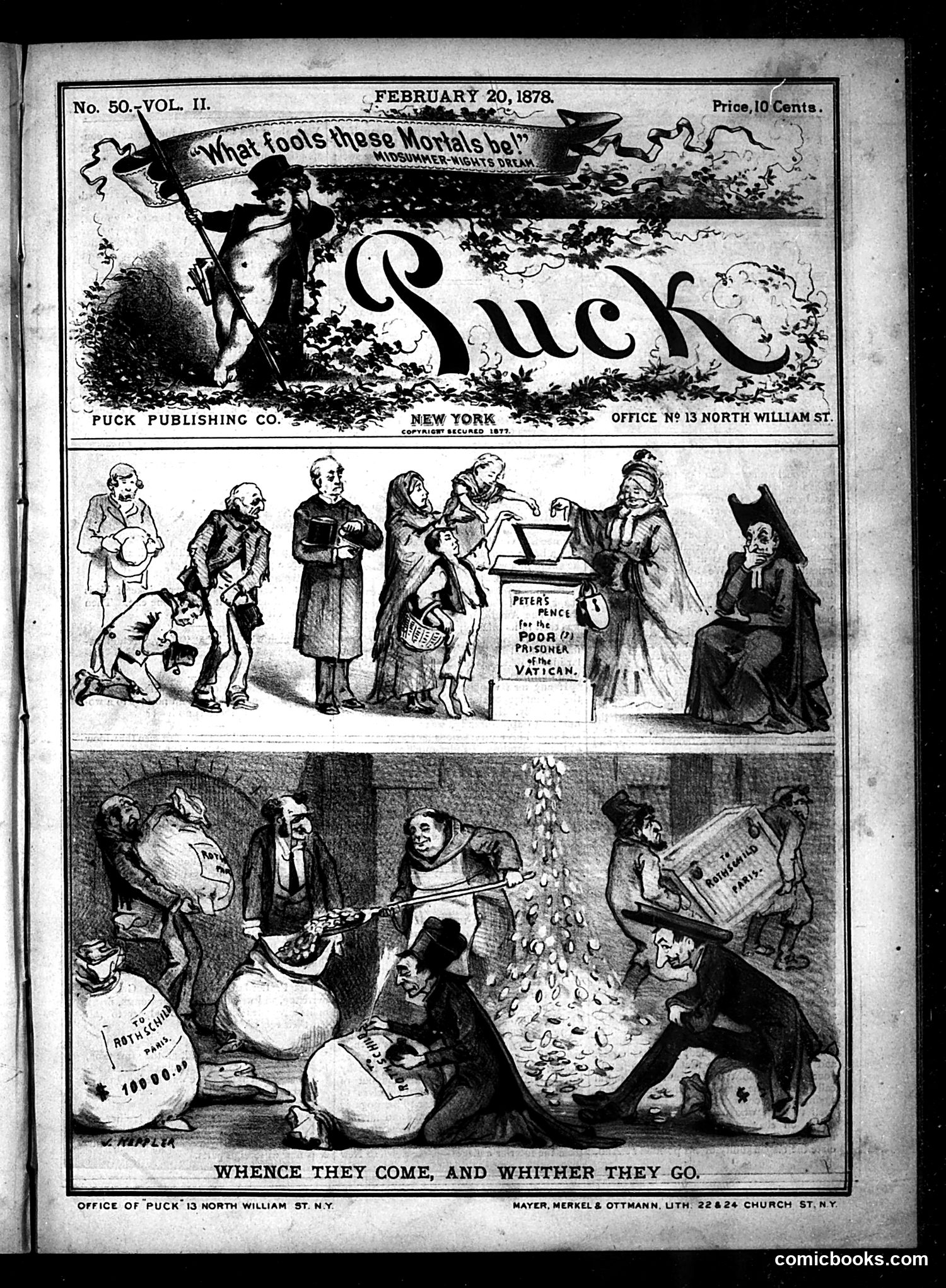
This satirical cartoon criticizes charity and almsgiving practices of the era. The top panel shows various figures—likely wealthy donors and church officials—contributing to "Peter's Pence for the Poor Prisoners of the Vatican," a papal charity collection. The bottom panel, titled "Whence They Come, and Whither They Go," depicts the actual fate of these donations. Money flows from wealthy contributors through middlemen and corrupt officials, ultimately enriching the Catholic Church hierarchy rather than reaching poor prisoners as promised. The cartoon appears to mock both the Church's solicitation tactics and donors' naivety, suggesting charitable contributions were systematically diverted. The satirical point: benevolent-sounding fundraising masked financial exploitation and institutional self-enrichment.
This page is primarily **editorial content and advertisements** rather than political cartoons. The main pieces include: **"Where is the Pope?"** — An editorial expressing uncertainty about the Pope's location and criticizing Puck's own previous illustration as misleading. The editors discuss the Pope's historical significance and debate whether depicting religious figures accurately matters to readers. **"Puckerings"** — A column of brief satirical observations on contemporary life, including jibes at drinking habits, marriage, education at elite colleges (Yale, Harvard, Columbia), and social pretension. The **advertising section** promotes Puck's Almanac (10,000+ copies sold) and subscription rates. No specific political figures or dated events are clearly referenced. The tone is generally satirical toward American social institutions and human foibles rather than partisan politics.
This page contains two distinct pieces: 1. **"Apple-Seeds"** (left column): A poem with accompanying illustration about a woman counting apple seeds while reciting a romantic rhyme. This is a folk divination practice where girls would count seeds to supposedly predict their romantic future. The poem plays on traditional courtship rituals and feminine superstition. 2. **"The Benevolent Protective Order of Hat-Checks"** (center/right): A humorous essay satirizing the proliferation of hat-check services at social venues like balls. The author mocks how hat-check attendants have become ubiquitous, charging fees and allegedly losing or damaging patrons' hats. The satire targets both the commercialization of minor services and the incompetence of workers handling customers' property. The "Answers for the Curious" section provides miscellaneous advice responses.
This page contains no political cartoon. Instead, it features "Mythology on the Half-Shell V: Pelias," a serialized fictional story presented in two columns of dense text. The narrative is a humorous, modernized retelling of the Greek myth of Pelias and Jason. It satirizes upper-class society by depicting classical mythological characters—Medea, Jason, Pelias, and his daughters—dealing with contemporary domestic concerns: household budgets, servants' wages, marital disputes, and social propriety. The satire lies in applying mundane Victorian-era anxieties to ancient Greek heroes, creating comedy through anachronistic contrast. References to "Corinth," "royal palace," and classical mythology are juxtaposed against petty bourgeois concerns like household accounts and social embarrassment. This is humor through literary parody rather than visual satire.
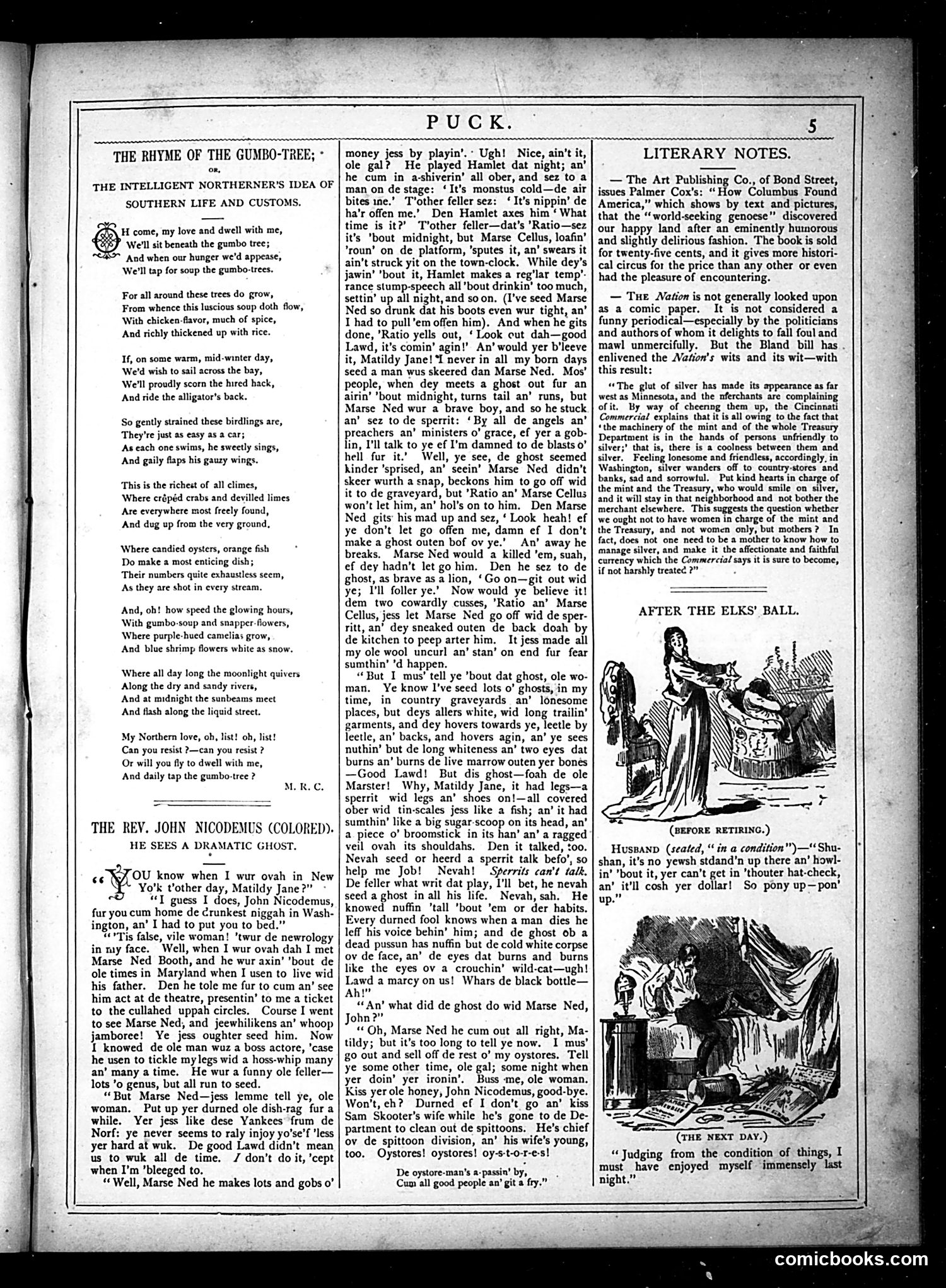
This page from *Puck* contains primarily **literary and humorous content** rather than political satire: **Main Features:** - "The Rhyme of the Gumbo-Tree": A dialect poem mocking Southern speech patterns and customs, written in exaggerated vernacular - "The Rev. John Nicodemus (Colored): He Sees a Dramatic Ghost": A comedic story featuring a Black minister encountering a ghost, filled with period racial stereotypes and dialect humor - "After the Elks' Ball": A brief illustrated comic depicting social aftermath scenes **The Satire:** The humor relies on **racial caricature and dialect comedy** typical of late 19th/early 20th-century American publications. Rather than political commentary, it traffics in stereotypical portrayals of African American speech and behavior for entertainment purposes. The illustrations support these dialect-heavy narratives with period-appropriate imagery.
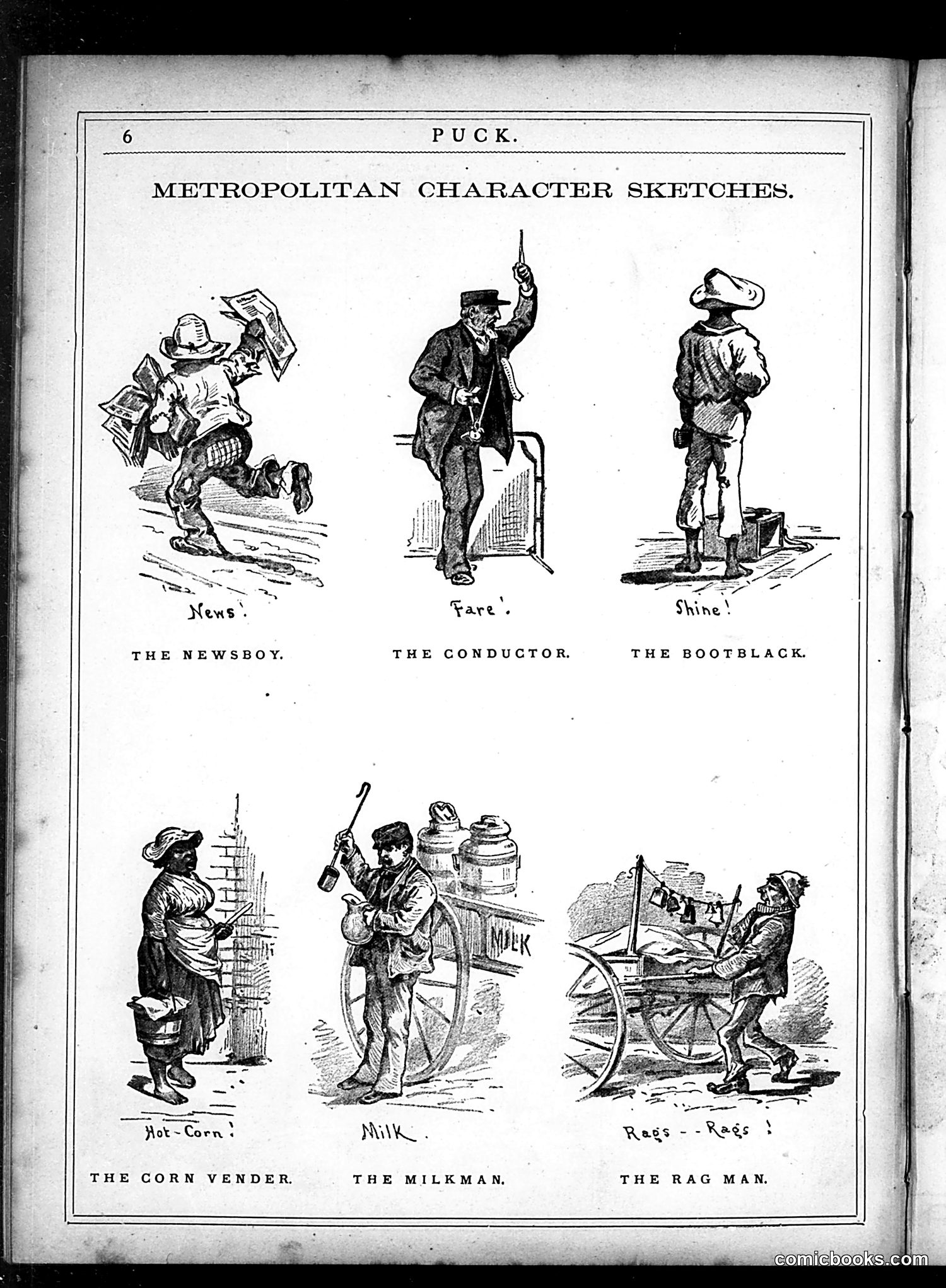
This page presents six working-class street vendors common in late 19th-century American cities. Each sketch depicts a distinct urban occupation: the Newsboy hawking papers, the Conductor (likely streetcar or transit worker), the Bootblack shining shoes, the Corn Vender selling hot corn, the Milkman with his delivery cart, and the Rag Man collecting discarded textiles. Rather than political satire, these are social sketches capturing metropolitan life. They satirize or gently mock the distinctive character types and street cries ("Hot Corn!" "Rags—Rags!") that defined urban commerce. The page documents working-class occupations that have largely disappeared, offering Puck readers recognizable street characters and their stereotyped appearances and mannerisms.
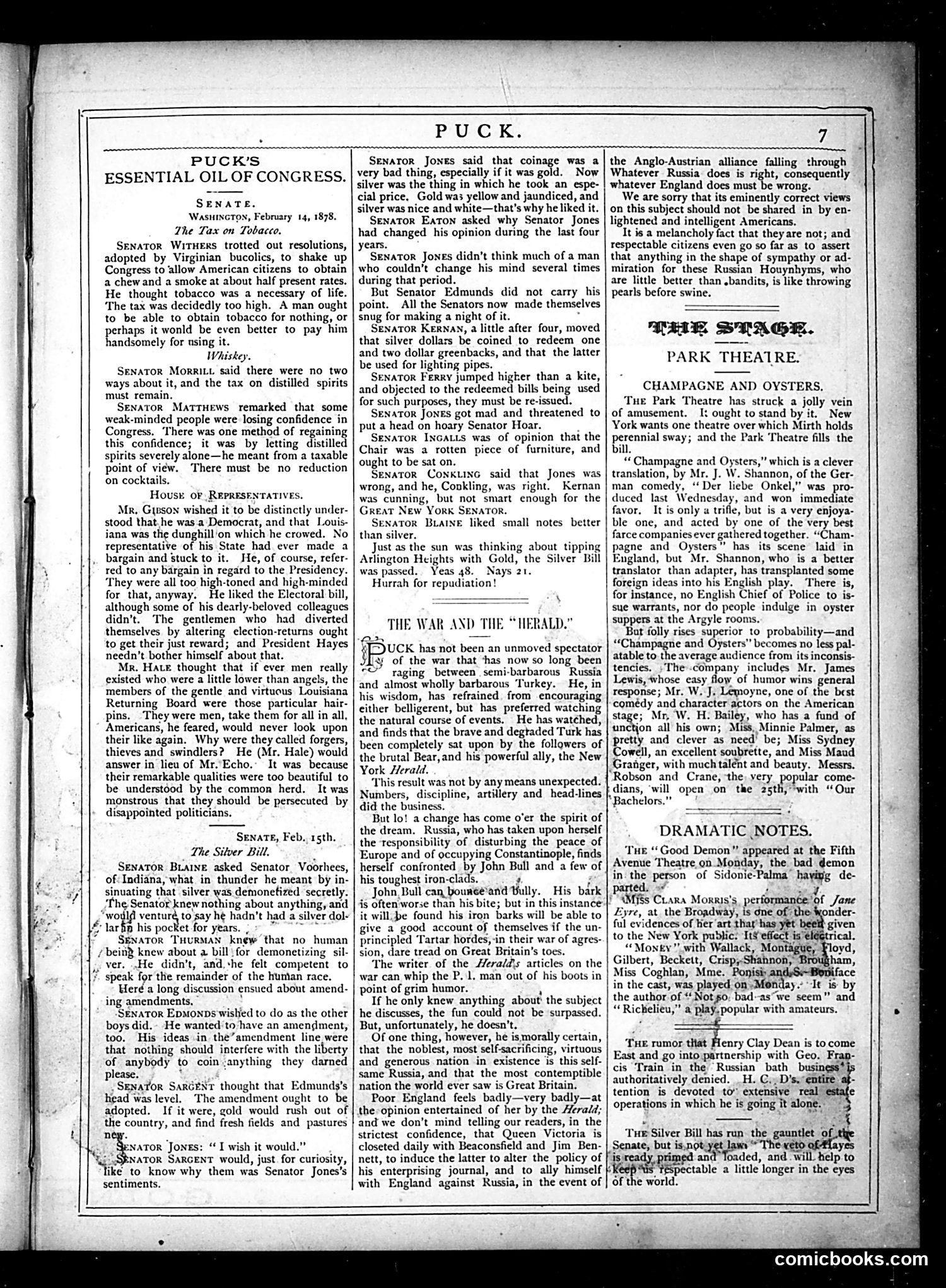
This page contains Senate debate transcripts rather than cartoons. The "Essential Oil of Congress" section satirizes senators' speeches on currency and tobacco policy. Key figures mocked include **Senator Whitman** (Virginia), criticized for contradictory positions on coinage; **Senator Jones**, lampooned for changing his mind on gold policy; and **Senator Kernan**, described as unintelligent. The satire targets senators' inconsistency, verbose rhetoric, and perceived dim-wittedness. References to "The Silver Bill" and currency debates reflect the 1890s monetary policy controversies dividing American politics. The page also reviews theatrical performances and mentions the ongoing Russia-Turkey conflict, contextualizing the geopolitical concerns of 1898.
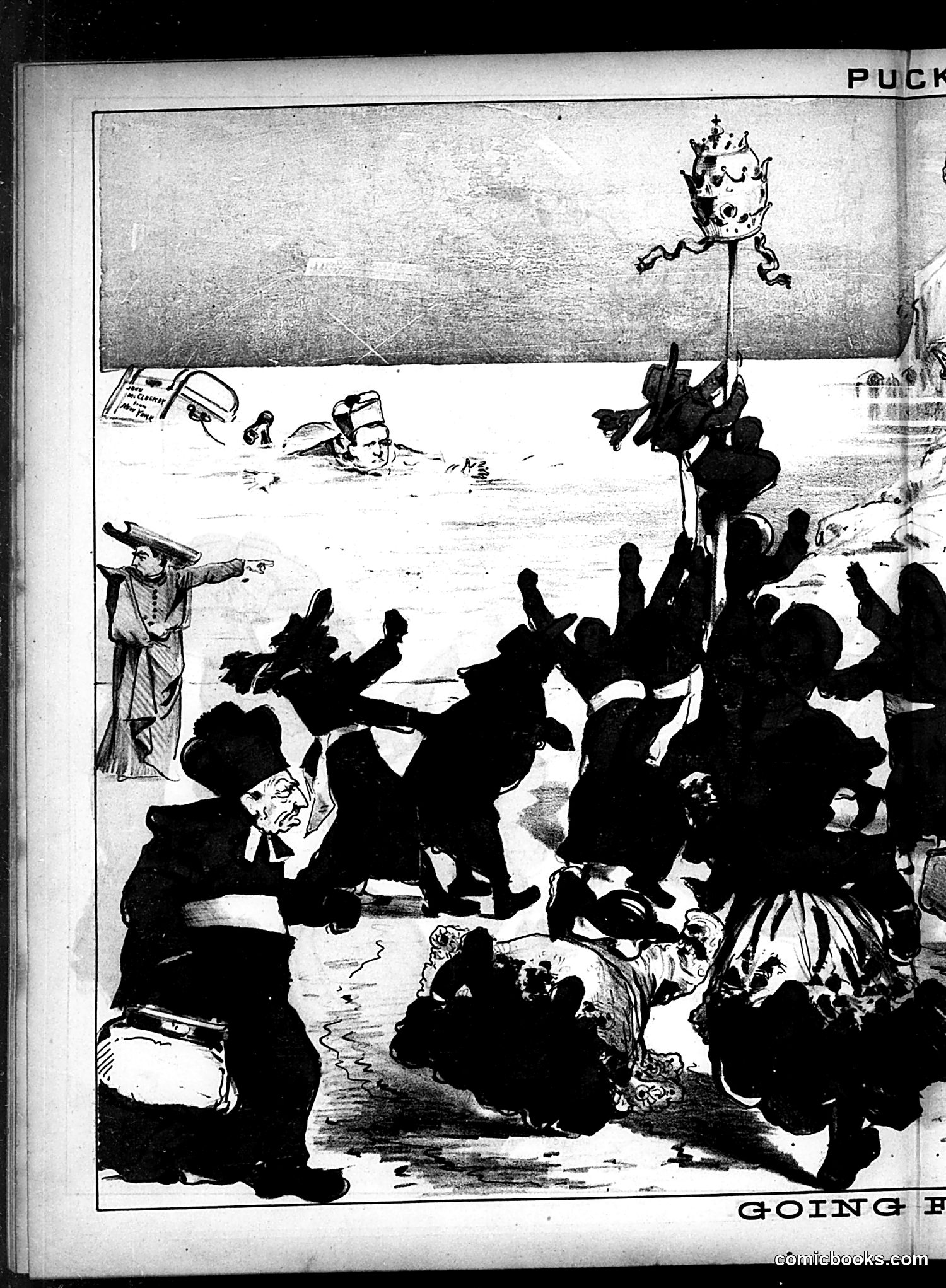
This Puck cartoon appears to depict a chaotic crowd scene with silhouetted figures gathered around a pole topped with a crowned, caricatured head. On the left, a figure in robes points dramatically, suggesting he's directing or commanding the crowd's attention. The imagery suggests a satirical commentary on mob behavior, possibly crowd manipulation or mass hysteria. The crowned head on the pole likely represents a political figure or symbolic authority being mocked or displayed. The contrast between the commanding figure on the left and the silhouetted masses suggests commentary on how leaders sway public opinion or incite crowds. Without visible text identifying specific individuals or dates, the exact political reference remains unclear, though the visual language indicates satire of populism, mob rule, or autocratic leadership.
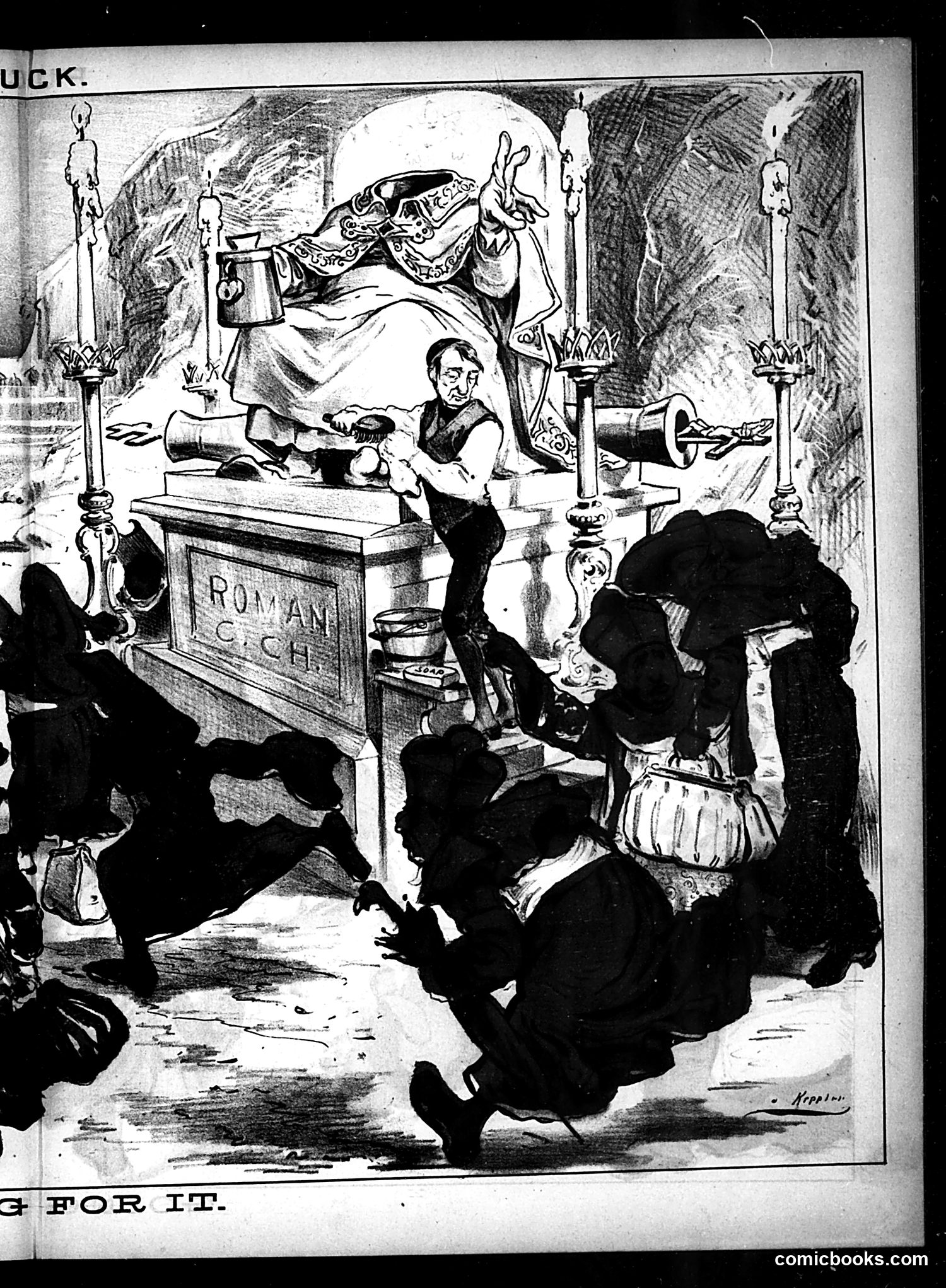
This Puck cartoon depicts a Roman Catholic mass or religious ceremony. A priest stands at an altar labeled "ROMAM C[ATHOLIC]," conducting what appears to be a mock or satirical religious service before an audience of seated worshippers shown in silhouette. The skeleton or death figure looming above the altar suggests the cartoon is critiquing Catholicism itself—likely attacking Catholic practices, authority, or influence as spiritually hollow or associated with death/decay. The animated priest's exaggerated gestures emphasize the performative nature of the ritual. Without additional context or visible captions explaining the specific political moment, the exact target is unclear, but this reflects common 19th-century American anti-Catholic sentiment prevalent in Protestant-dominated satirical publications.
This page contains political commentary and humor rather than a single unified cartoon. The main article "Fitznoodle in America" (No. XLVII) appears to satirize a European visitor's observations of American peculiarities and social customs. The text mocks how foreigners find American society strange, particularly regarding class distinctions and social behaviors. The illustrations show what appear to be genre scenes of American life that would seem odd to a foreign observer. At bottom, "Saint Peter and the Pope" presents a brief humorous dialogue about locks and keys, likely satirizing Catholic ecclesiastical authority or papal pretensions through wordplay. The page exemplifies *Puck's* approach: using foreign perspectives to critique American society while simultaneously mocking European attitudes toward America.
This page presents a serialized comedy story titled "Keramics," adapted from French by H.C. Bunner. The narrative concerns a Brazilian widow, the Baron de Montrichard, and complications arising from a marriage proposal involving Miss Leighton. The humor relies on romantic entanglement and misunderstanding: a man proposes to Miss Leighton but discovers she's already married to someone else. The widow (apparently the Baron's former lover) becomes involved, creating jealousy and confusion about identities and intentions. The satire targets Victorian social conventions around courtship, marriage, and propriety—particularly how respectable society navigates romantic scandal. The Brazilian setting and European characters suggest cosmopolitan European drawing-room comedy rather than specifically American political satire. This is serialized fiction rather than a political cartoon.
This page contains **no political cartoon or satire**. Instead, it's a literary installment from Puck magazine—specifically the opening of a serialized story titled "**LOVEL: An English Story**" by Mrs. Francis G. Faithfull. The page presents Chapter I of what appears to be a domestic fiction narrative involving characters named Jack, Gertrude, and others in an English country setting. The text focuses on romantic and social drama rather than political commentary. The left column concludes previous satirical content (references to "Keramics" and dialogue about collectors), but the bulk of this particular page is devoted to serialized fiction—a common feature in magazines of this era to attract and retain readers.
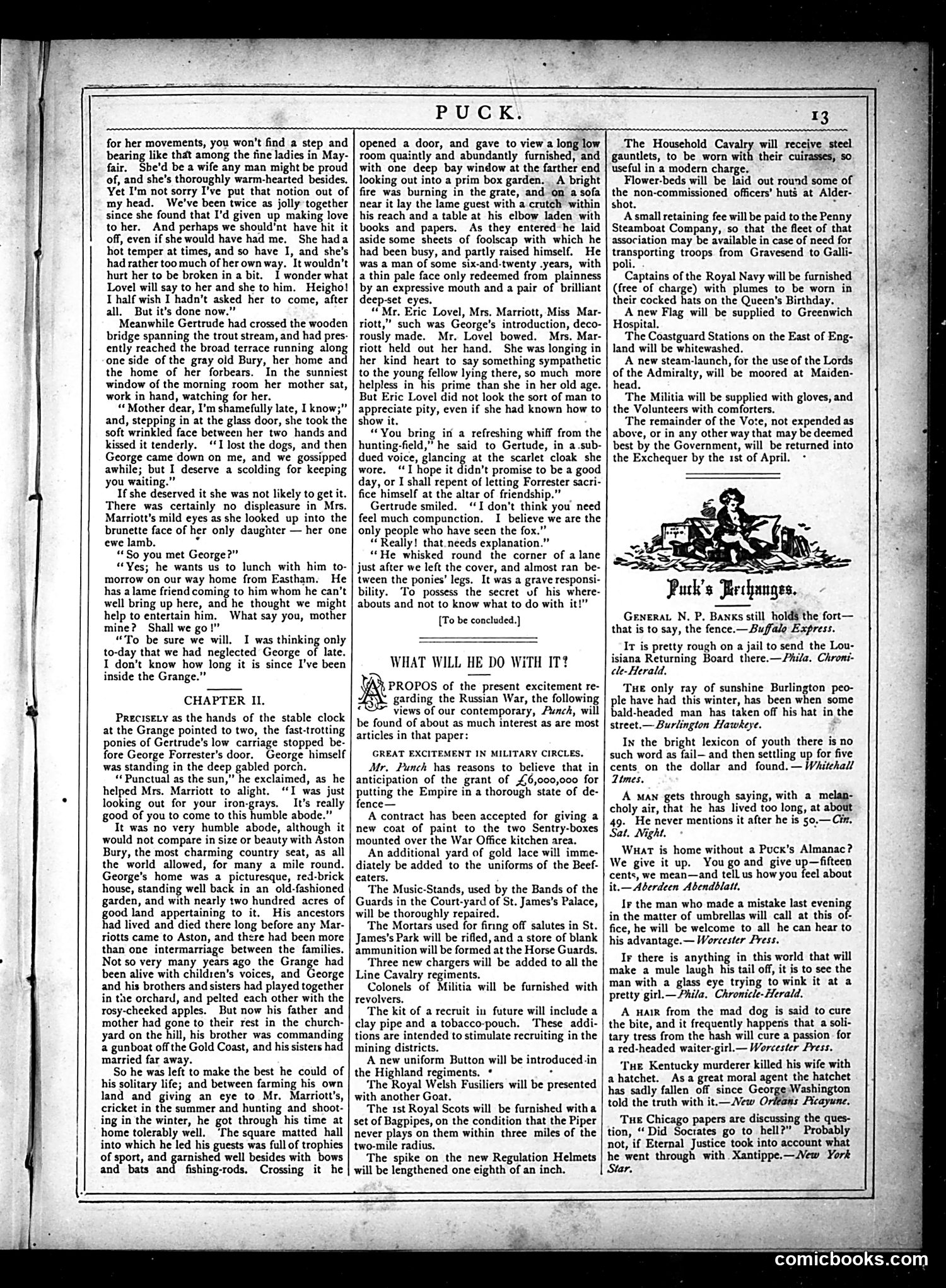
The visible cartoon and accompanying text satirize contemporary British military and governmental inefficiency. The section "What Will He Do With It?" references proposals affecting military operations—including provisions for paint, uniforms for Household Cavalry, and supplies for new regiments and militia units. The cartoons mock bureaucratic absurdity through humorous anecdotes in "Puck's Artjapes," critiquing everything from military recruitment to administrative incompetence. One piece jokes about a man's confusion after being hit by an umbrella in the street, while another mocks the notion that a Puck's Almanac could substitute for practical knowledge. The overall tone suggests frustration with governmental red tape and military mismanagement during what appears to be a period of military expansion or reorganization.
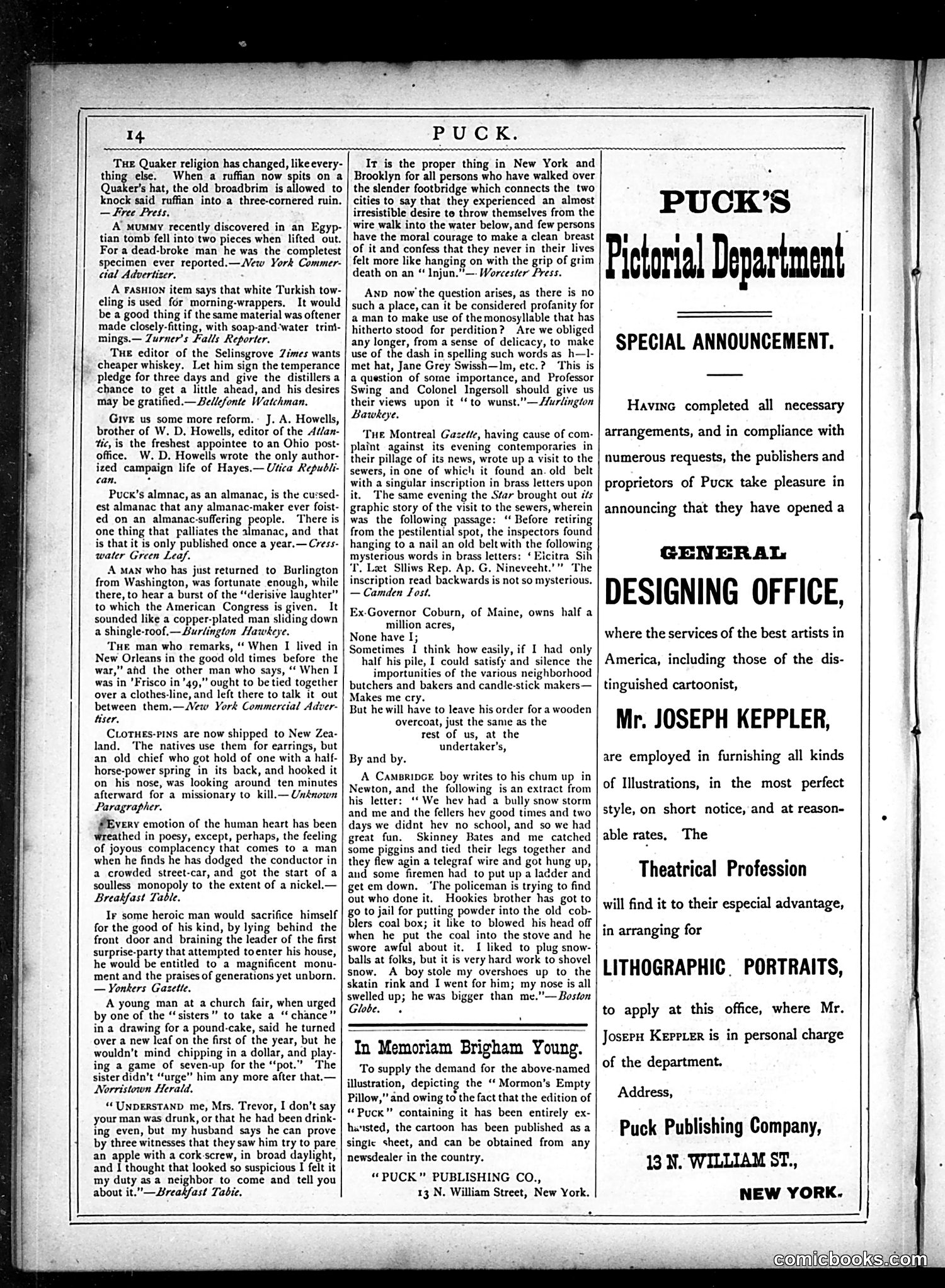
This page is primarily **advertising and announcements** rather than political satire. The right side features a prominent notice announcing that Puck has opened a "General Designing Office" employing the cartoonist **Joseph Keppler** to provide illustrations for theatrical productions and other clients, offering lithographic portraits at reasonable rates. The left side contains various brief humor items and anecdotes—typical filler content for the magazine—touching on subjects like Quaker religious practices, Turkish fashion, and everyday observations about New York life. There is **no visible main political cartoon** on this page. It appears to be a house advertisement and miscellaneous humor column rather than satirical commentary on current events.
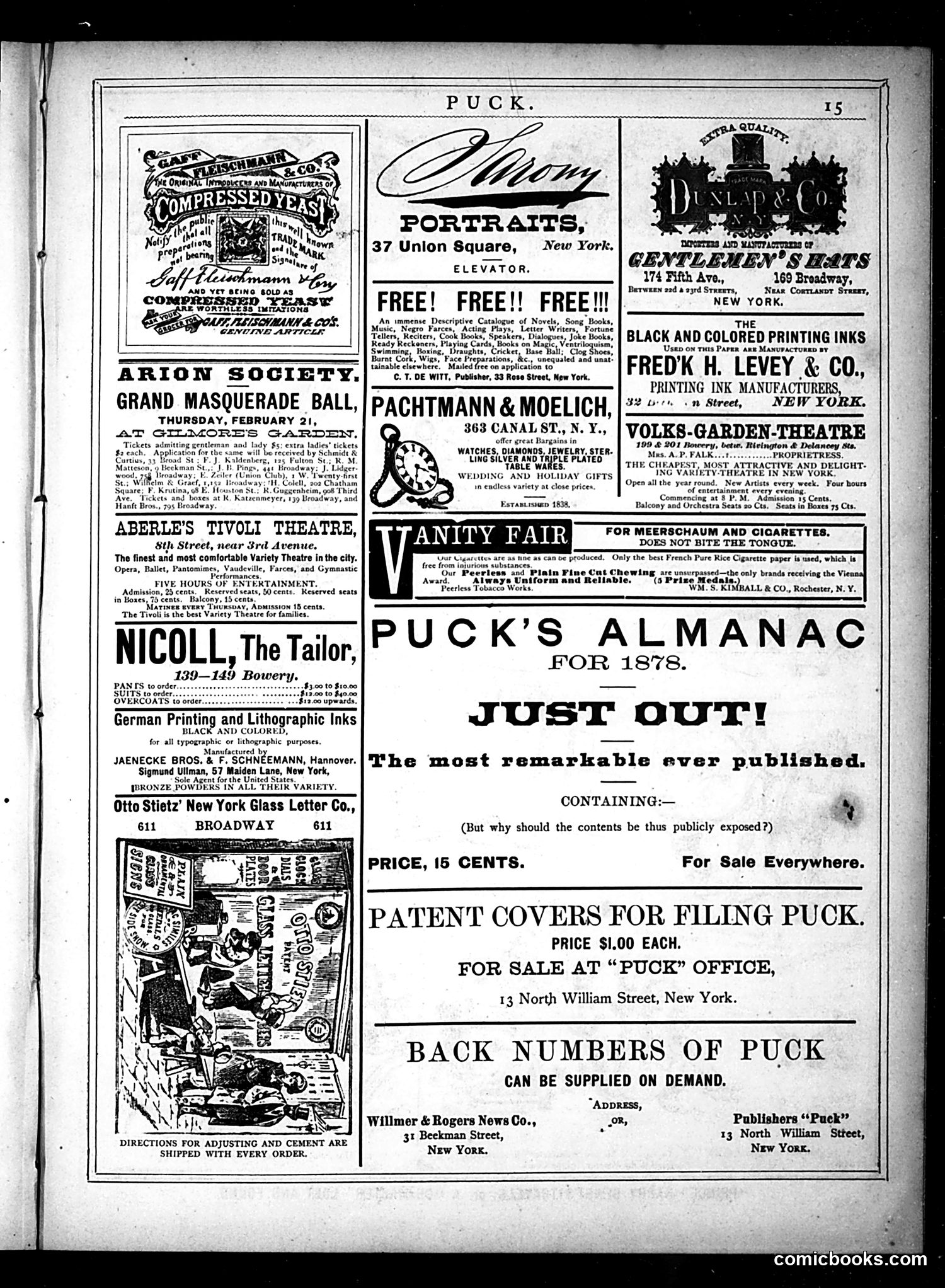
This page is primarily **advertising and promotional content** for Puck magazine itself and various New York businesses (1878). It includes ads for: - **Puck's Almanac for 1878** (newly released, 15 cents) - Patent filing covers for Puck (priced $1.00) - Back issue availability - Various commercial services (tailors, theaters, printing companies, jewelry stores) The page contains **no visible political cartoons or satirical commentary**. The only illustration is a small decorative graphic from Otto Stielz's Glass Letter Company advertising their product. This appears to be a back cover or filler page from the magazine, serving primarily commercial purposes rather than editorial or satirical content. The focus is on selling Puck's merchandise and promoting New York area businesses through paid advertisements.
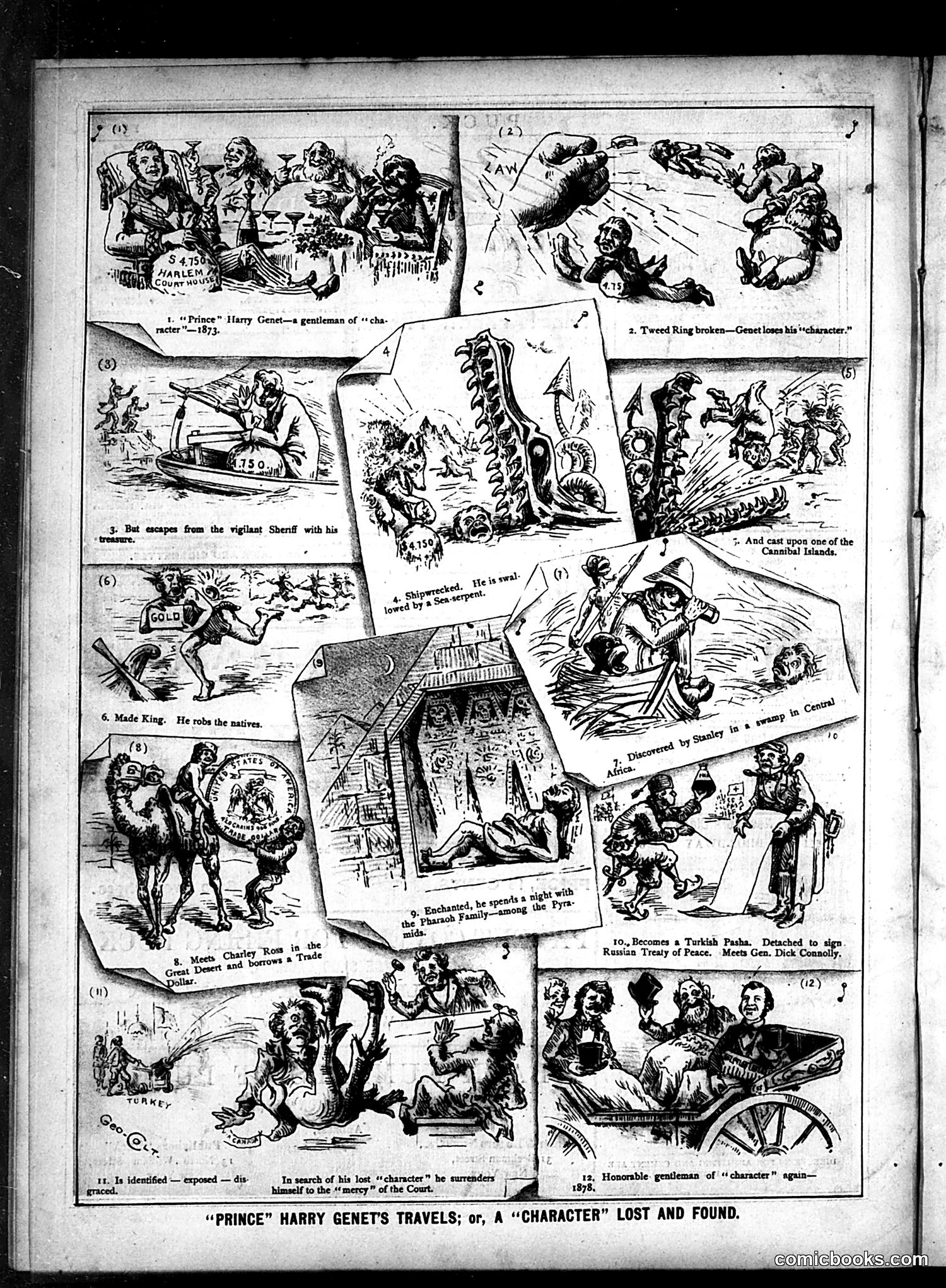
This is a sequential narrative comic strip satirizing a figure identified as "Prince" Harry Genet, described as "a gentleman of 'character'" (1873). The twelve-panel story traces Genet's misadventures: he escapes a sheriff, breaks a "tweed ring," flees various locations, gets shipwrecked, is cast ashore in the Cannibal Islands, and is discovered by an African explorer. The satire appears to mock a real person's dubious reputation and social pretensions, using his surname "character"—suggesting moral failings or notoriety. The exotic settings and escalating absurdity parody penny-dreadful adventure narratives while commenting on contemporary scandals. The title's wordplay on "character" drives the joke: Genet has *lost* his good character and must be *found* and reclaimed by society.