
Puck, 1878-02-20 · page 10 of 16
Puck — February 20, 1878 — page 10: what you’re looking at
What you’re looking at
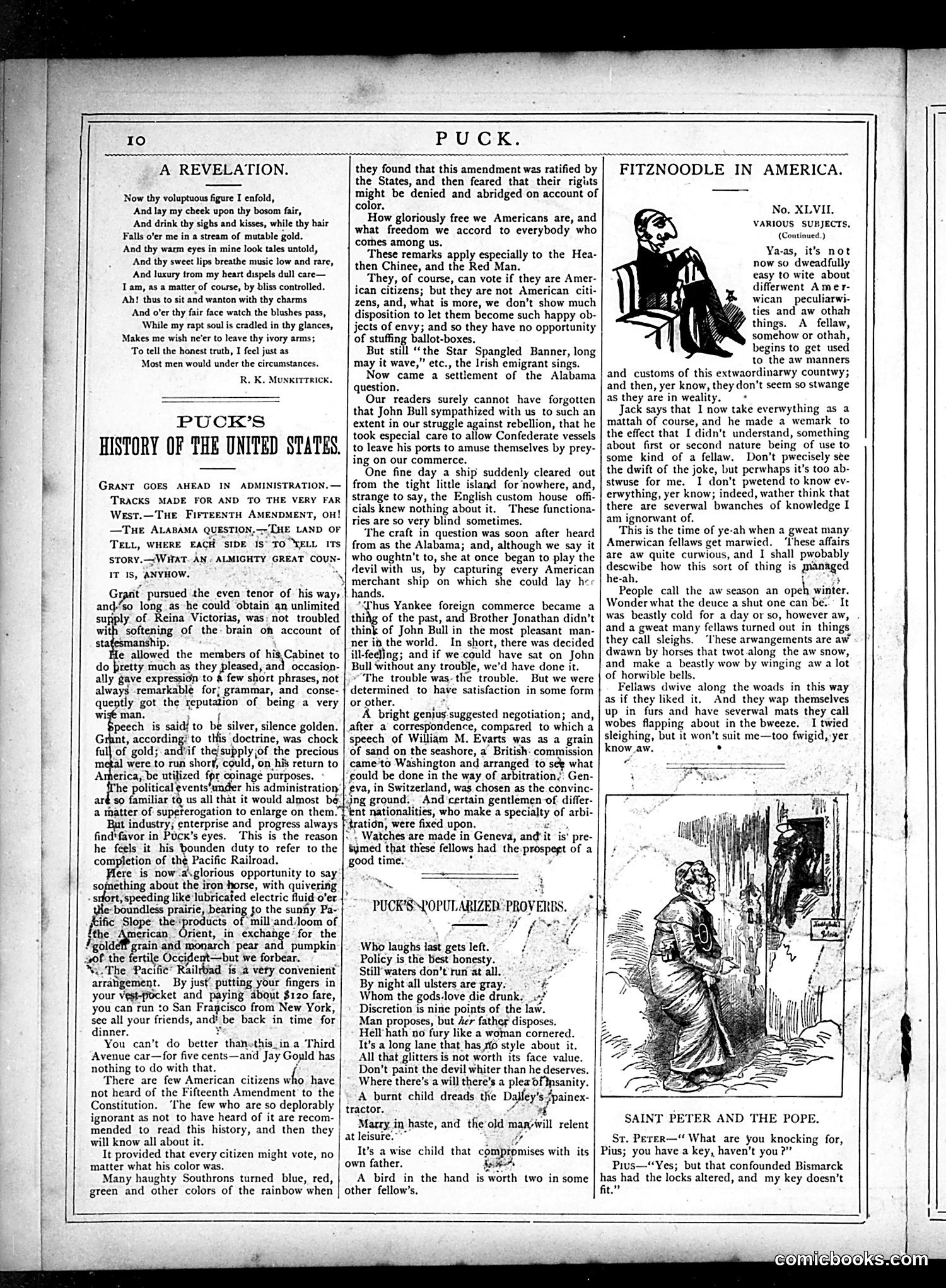
This page contains political commentary and humor rather than a single unified cartoon. The main article "Fitznoodle in America" (No. XLVII) appears to satirize a European visitor's observations of American peculiarities and social customs. The text mocks how foreigners find American society strange, particularly regarding class distinctions and social behaviors. The illustrations show what appear to be genre scenes of American life that would seem odd to a foreign observer. At bottom, "Saint Peter and the Pope" presents a brief humorous dialogue about locks and keys, likely satirizing Catholic ecclesiastical authority or papal pretensions through wordplay. The page exemplifies *Puck's* approach: using foreign perspectives to critique American society while simultaneously mocking European attitudes toward America.
📄 Transcribed text from this page (OCR, searchable)
Machine-transcribed from the original scan — historical spelling and the odd misread are preserved.
—————— p fo} PUCK. A REVELATION. Now thy voluptuous figure I enfold, ‘And lay my cheek upon thy bosom fair, And drink thy sighs and kisses, while thy hair Falls o'er me in a stream of mutable gold. ‘And thy warm eyes in mine look tales untold, And thy sweet lips breathe music low and rare, And luxury from my heart dispels dull care— Iam, as a matter of course, by bliss controlled. Ah! thus to sit and wanton with thy charms ‘And o'er thy fair face watch the blushes pass, While my rapt soul is cradled in thy glances, Makes me wish ne'er to leave thy ivory arms; To tell the honest truth, I feel just as Most men would under the circumstances. R. K. MUNKITTRICK, PUCK’S HISTORY OF THE UNITED STATES. GRANT GOES AHEAD IN ADMINISTRATION.— ‘TRACKS MADE FOR AND TO THE VERY FAR West.—THE FirTeEeENTH AMENDMENT, OH! —THE ALABAMA QUESTION,—~THE LAND OF TELL, WHERE EACH SIDE 1s° TO YELL ITs STORY.— WHAT. AN, ALMIGHTY GREAT COUN- IT 1S, ANYHOW. ‘ Grant pursued the even tenor of his way, and-so long as he could obtain an unlimited supply of Reina Victorias, was: not troubled with softening of the- brain on account of stafesmanship. ‘ e allowed the members of hisCabinet to do pretty much as they pleased, and occasion- ally gave expressidn'to @ few short phrases, not always remarkable for; grammar, and conse- quently got the reputation of being a very wig man. { fresh is said{ to be silver, silence golden. Grant, according? 'to tHis doctrine, was chock full of gold; and’if the supply;of the precious metal were to run short, could, on his return to America, be utilized fpr coinage purposes. ‘he political events‘under his administration’ aré so familiar tQ us all that it would almost be- But industry; enterprise and progress always find*favor in Puck’s eyes. This is the reason he feels it his bounden duty to refer to the completion of the Pacific Railroad. Here is now-a\glorious opportunity to say sofcething about the iron horse, with quivering 31 tHe- boundless prairie, bearing to the sunny Pa- Kific Slope the ‘products of mill'and/loom of the erican. Orient, in exchange for the fgoldef grain and monarch pear and pumpkin sof the fertile Occidemt—but we forbear. Ny. The Pacific Railrbad is a very convenient arrahgement. By just’ putting your fingers in your Vest-fiocket and paying about $120 fare, you can run to San Francisco from New York, see all your friends, and! be back in time for dinner. x You can’t do better thanethis_in a Third ‘Avenue car—for five cents—and Jay Gould has nothing to do with that, j There are few American citizens who have not heard of the Fifteenth Amendment to the Constitution. ‘he few who are so deplorably ignorant as not to have heard of it are recom- mended to read this history, and then they | will know all about it. It provided that every citizen might vote, no matter what his color was. Many haughty Southrons turned blue, red, } merchant ship on which she could lay her a matter of supeferogation to enlarge on them.’ ent nationalities, who make a specialty of arbi- tration, were fixed upon. aan Watches are made in Geneva, andit is' pre- symed that these fellows had the.prospegt of a rt, speeding like lubricafed electric fluid o'er |’ they found that this amendment was ratified by the States, and then feared that their rigits might be denied and abridged on account of color. How gloriously free we Americans are, and what freedom we accord to everybody who cothes among us. These remarks apply especially to the Hea- then Chinee, and the Red Man. They, of course, can vote if they are Amer- ican citizens; but they are not American citi- zens, and, what is more, we don’t show much disposition to let them become such happy ob- jects of envy; and so they have no opportunity of stuffing ballot-boxes. But still “the Star Spangled Banner, long may it wave,” etc., the Irish emigrant sings. Now came a settlement of the Alabama question. Our readers surely cannot have forgotten that John Bull sympathized with us to such an extent in our struggle against rebellion, that he took especial care to allow Confederate vessels to leave his ports to amuse themselves by prey- ing on our commerce. One fine day a ship suddenly cleared out from the tight little island for ‘nowhere, and, strange to say, the English custom house offi- cials knew nothing about it. These functiona- ries are so very blind sometimes. The craft in question was soon after heard from as the Alabama; and, although we say it who oughtn'’t to, she at once began to play the devil with us, by capturing every American hands. ‘hus Yankee foreign commerce became a thid of the past, and Brother Jonathan didn’t think of John Bull in the most pleasant man- ner it the world. In short, there was decided ill-feeling; and if we could have sat on John Bull without any trouble, we’d have done it. The trouble was. the trouble. But we were determined to have satisfaction in some form or other. itt A bright genjus:suggested negotiation; and, after a correspondence, compared to which a speech of William M. Evarts was as a grain of sand on the seashore, a British: commission came’to Washington and arranged to seg what ‘gould be done in the way of arbitration’: Gen- ¢va, in Switzerland, was chosen as the convinc- ing ground. And certain gentlemen of differ- good time. ~ PUCK'S POPULARIZED. PROVERBS. ‘ 7 Who laughs last gets left. / Policy is the best honesty. Still’waters don’t run at all. By night all ulsters are gray. Whom the gods-love die drunk, Discretion is nine points of the law. Man proposes, but Aer father disposes. Hell’hath no fury like a woman cornered. It’s a long lane that has x0 style about it. All that glitters is not worth its face value. Don’t paint the devil whiter than he deserves. Where there’s a will there’s a plez df Insanity. A burnt child dreads the Dalfey's /painex- tractor. A ¥ Marry in haste, and the’old manyivill relent at leisure.”*” on It’s a wise child that comprpmises with its own father. A bird in the hand is worth two in some J FITZNOODLE IN AMERICA. No. XLVII. VARIOUS SUBJECTS. (Continued.) Ya-as, it’s not now so dweadfully easy to wite about differwent Amer- wican _ peculiarwi- ties and aw othah things. A fellaw, somehow or othah, begins to get used to the aw manners and customs of this extwaordinarwy countwy; and then, yer know, they don’t seem so stwange as they are in weality. Jack says that 1 now take everwything as a mattah of course, and he made a wemark to the effect that I didn’t understand, something about first or second nature being of use to some kind of a fellaw. Don't pwecisely see the dwift of the joke, but perwhaps it’s too ab- stwuse for me. I don’t pwetend to know ev- erwything, yer know; indeed, wather think that there are severwal bwanches of knowledge I am ignorwant of. This is the time of ye-ah when a gweat many Amerwican fellaws get marwied. ‘These affairs are aw quite curwious, and I shall pwobably descwibe how this sort of thing is managed he-ah. \ , People call the aw season an opeh winter. Wonder what the deuce a shut one can be. It was beastly cold for a day or so, however aw, and a gweat many fellaws turned out in things they call sleighs. ‘These arwangements are aw’ dwawn by horses that twot.along the aw snow, and make a beastly wow by winging aw a lot of horwible bells. Fellaws dwive along the woads in this way as if they liked it. And they wap themselves up in furs and have severwal mats they call wobes flapping about in the bweeze. I twied sleighing, but it won't suit me—too fwigid, yer know.aw. . SAINT PETER AND THE POPE, Sr. Perer— What are you knocking for, Pius; you have a key, haven’t you ?” Pivs—‘Yes; but that confounded Bismarck has had the locks altered, and my key doesn’t green and other colors of the rainbow when other fellow’s. fit.”