
Puck, 1878-02-20 · page 11 of 16
Puck — February 20, 1878 — page 11: what you’re looking at
What you’re looking at
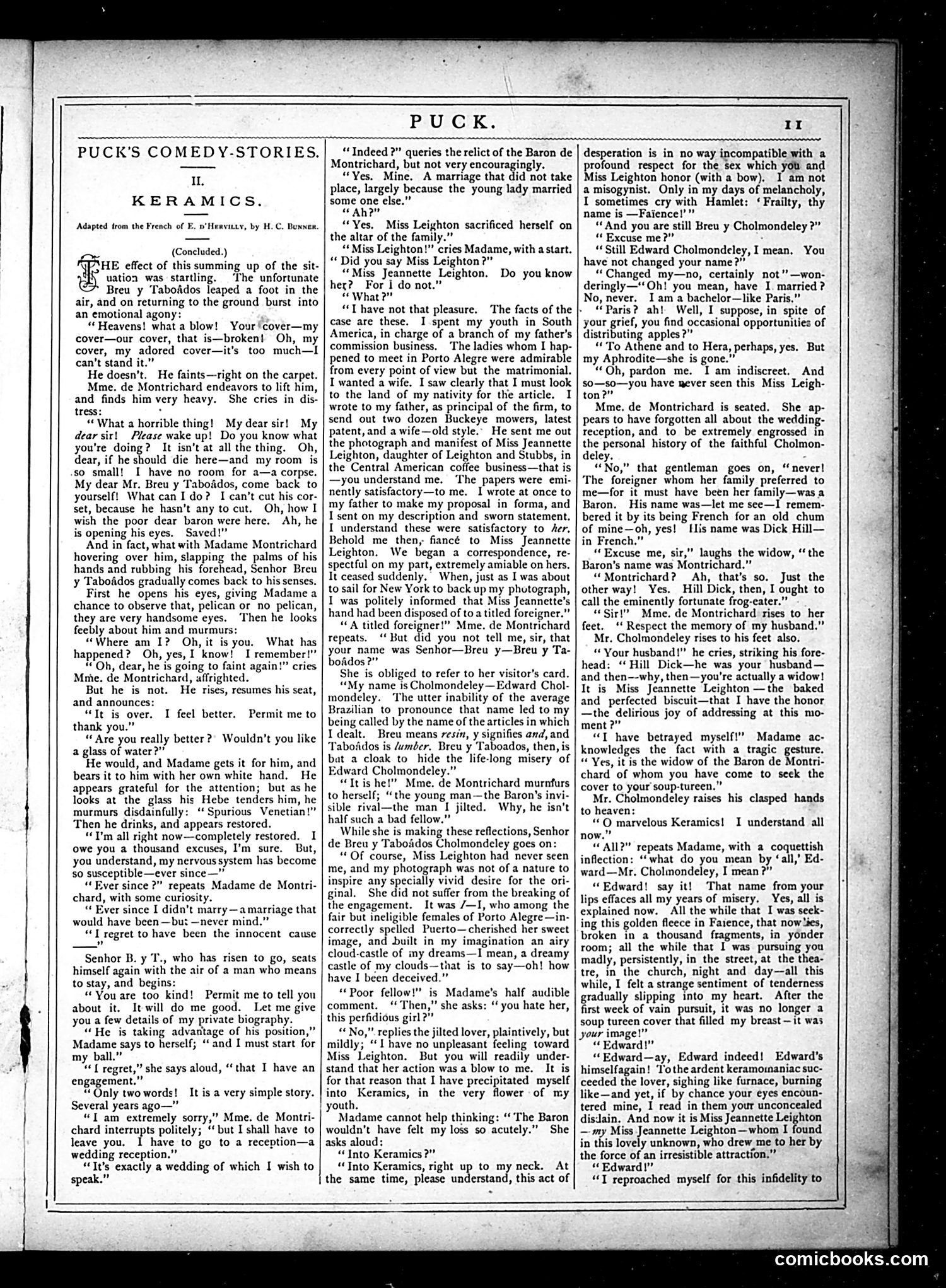
This page presents a serialized comedy story titled "Keramics," adapted from French by H.C. Bunner. The narrative concerns a Brazilian widow, the Baron de Montrichard, and complications arising from a marriage proposal involving Miss Leighton. The humor relies on romantic entanglement and misunderstanding: a man proposes to Miss Leighton but discovers she's already married to someone else. The widow (apparently the Baron's former lover) becomes involved, creating jealousy and confusion about identities and intentions. The satire targets Victorian social conventions around courtship, marriage, and propriety—particularly how respectable society navigates romantic scandal. The Brazilian setting and European characters suggest cosmopolitan European drawing-room comedy rather than specifically American political satire. This is serialized fiction rather than a political cartoon.
📄 Transcribed text from this page (OCR, searchable)
Machine-transcribed from the original scan — historical spelling and the odd misread are preserved.
PUCK. 2 @ ¢ PUCK’S COMEDY-STORIES. I KERAMICS. Adapted trom the French of E. p'Hervitty, by H.C. Bonner, (Concluded.) PSHE effect of this summing up of the sit- uation was startling. The unfortunate Breu y Tabofidos leaped a foot in the air, and on returning to the ground burst into an emotional agony: “Heavens! what a blow! Your ‘cover—my cover—our cover, that is—broken! Oh, my cover, my adored cover—it’s too much—I can’t stand it.”” He doesn't. He faints—right on the carpet. Mme. de Montrichard endeavors to lift him, and finds him very heavy. She cries in dis- tress: : “What a horrible thing! My dear sir! My dear sir! Please wake up! Do you know what you're doing? It isn’t at all the thing. Oh, dear, if he should die here—and my room is so small! I have no room for a—a corpse. My dear Mr. Breu y Tabotidos, come back to yourself! What can I do? I can't cut his cor- set, because he hasn’t any to cut. Oh, how I wish the poor dear baron were here. Ah, he is opening his eyes. Saved!" And in fact, what with Madame Montrichard hovering over him, slapping the palms of his hands and rubbing his forehead, Senhor Breu y Tabofdos gradually comes back to his senses. First he opens his eyes, giving Madame a chance to observe that, pelican or no pelican, they are very handsome eyes. Then he looks feebly about him and murmurs: “Where am I? Oh, it is you. What has happened? Oh, yes, I know! I remember!"" “Oh, dear, he is going to faint again!” cries Mnie. de Montrichard, affrighted. But he is not. He rises, resumes his seat, and announces: “Tr is over. thank you.” “ Are you really better?) Wouldn’t you like a glass of water?” He would, and Madame gets it for him, and bears it to him with her own white hand. He appears grateful for the attention; but as he looks at the glass his Hebe tenders him, he murmurs disdainfully: “Spurious Venetian!” ‘Then he drinks, and appears restored. “T’m all right now—completely restored. I owe you a thousand excuses, I’m sure. But, you understand, my nervous system has become 30 susceptible—ever since—" «Ever since ?” repeats Madame de Montri- chard, with some curiosity. “ Ever since I didn’t marry—a marriage that would have been—bu: —never mind.” “1 regret to have been the innocent cause I feel better. Permit me to Senhor B. y T., who has risen to go, seats himself again with the air of a man who means to stay, and begins: “You are too kind! Permit me to tell you about it. It will do me good. Let me give you a few details of my private biography. “He is taking advantage of his position,” Madame says to herself; “‘ and I must start for my ball.” “{ regret,” she says aloud, “that I have an engagement.” “ Only two words Several years ago—’ “Tam extremely sorry,” Mme. de Montri- chard interrupts politely; ‘but I shall have to leave you. I have to go to a recep wedding reception.” “It’s exactly a wedding of which I wish to speak.” It is a very simple story. “Indeed 2” queries the relict of the Baron de Montrichard, but not very encouragingly. “Yes. Mine. A marriage that did not take place, largely because the young lady married some one else.” “An?” “Yes, Miss Leighton sacrificed herself on the altar of the family.” ‘ Miss Leighton!” cries Madame, with a start. “Did you say Miss Leighton?” “Miss Jeannette Leighton. her? For | do not.” “What?” “T have not that pleasure, case are these. I spent my youth in South America, in charge of a branch of my father’s commission business. The ladies whom I hap- pened to meet in Porto Alegre were admirable from every point of view but the matrimonial. I wanted a wife. I saw clearly that I must look to the land of my nativity for the article. I wrote to my father, as principal of the firm, to send out two dozen Buckeye mowers, latest patent, and a wife—old style.. He sent me out the photograph and manifest of Miss Jeannette Leighton, daughter of Leighton and Stubbs, in the Central American coffee business—that is —you understand me. The papers were emi- nently satisfactory—to me. I wrote at once to my father to make my proposal in forma, and I sent on my description and sworn statement. I understand these were satisfactory to her. Behold me then, fiancé to Miss Jeannette Leighton. We began a correspondence, re- spectful on my part, extremely amiable on hers. It ceased suddenly.’ When, just as I was about to sail for New York to back up my photograph, I was politely informed that Miss Jeannette’s hand had been disposed of toa titled foreigner.” “A titled foreigner!” Mme. de Montrichard repeats. ‘But did you not tell me, sir, that your name was Senhor—Breu y—Breu y Ta- bofidos ?”” She is obliged to refer to her visitor's card. “My name is Cholmondeley—Edward Chol- mondeley. ‘The utter inability of the average Brazilian to pronounce that name led to my being called by the name of the articles in which I dealt. Breu means resin, y signifies and, and Taboddos is dumber, Breu y Taboados, then, is bat a cloak to hide the life-long misery of Edward Cholmondeley.” “Tris he!” Mme. de Montrichard murnfurs to herself; “the young man—the Baron’s invi- sible rival—the man I jilted. Why, he isn’t half such a bad fellow.”” While she is making these reflections, Senhor de Breu y Tabofidos Cholmondeley goes on: “Of course, Miss Leighton had never seen me, and my photograph was not of a nature to inspire any specially vivid desire for the ori- ginal. She did not suffer from the breaking of the engagement. It was /—I, who among the Do you know fair but ineligible females of Porto Alegre—in- correctly spelled Puerto—cherished her sweet image, and built in my imagination an airy cloud-castle of my dreams—I mean, a dreamy castle of my clouds have I been deceive: “Poor fellow!” is Madame's half audible comment. “Then,” she asks: “you hate her, this perfidious girl?” « No," replies the jilted lover, plaintively, but mildly; “I have no unpleasant feeling toward Miss Leighton. But you will readily under- stand that her action was a blow to me. It is for that reason that I have precipitated myself into. Keramics, in the very flower of my youth. Madame cannot help thinking: “The Baron wouldn't have felt my loss so acutely.” She asks aloud: “Into Keramics ?” “Tnto Keramics, right up to my neck. At the same time, please understand, this act of at is to say—oh! how The facts of the }- desperation is in no way incompatible with a profound respect for the sex which you and Miss Leighton honor (with a bow). I am not a misogynist. Only in my days of melancholy, I sometimes cry with Hamlet: ‘Frailty, thy name is —Faience!’"”” “And you are still Breu y Cholmondeley ?” “ Excuse me?” “Still Edward Cholmondeley, I have not changed your name?” “Changed my—no, certainly not’ —won- deringly—‘Oh! you mean, have I. married? No, never. I am a bachelor—like Paris.” “Paris? ah! Well, I suppose, in spite of your grief, you find occasional opportunities of distributing apples?” “To Athene and to Hera, perhaps, yes. But my Aphrodite—she is gone.” “Oh, pardon me. I am indiscreet. And so—so—you have never seen this Miss Leigh- ton?” Mme. de Montrichard is seated. She ap- pears to have forgotten all about the wedding- reception, and to be extremely engrossed in the personal history of the faithful Cholmon- deley. “No,” that gentleman goes on, “never! ‘The foreigner whom her family preferred to me—for it must have been her family—was a Baron. His name was—let me see—I remem- bered it by its being French for an old chum of mine—oh, yes! [is name was Dick Hill— in French,” “Excuse me, sir,” laughs the widow, “the Baron’s name was Montrichard.”” “Montrichard? Ah, that’s so. Just the other way! Yes. Hill Dick, then, I ought to call the eminently fortunate frog-eater.”” “Sir!” Mme. de Montrichard rises to her feet. ‘‘ Respect the memory of my husband.” Mr. Cholmondeley rises to his feet also. “Your husband!” he cries, striking his fore- head: ‘‘ Hill Dick—he was your husband— and then—-why, then—you're actually a widow! It is Miss Jeannette Leighton —the baked and perfected biscuit—that I have the honor —the delirious joy of addressing at this mo- ment ?”” “T have betrayed myself!” Madame ac- knowledges the fact with a tragic gesture. “ Yes, it is the widow of the Baron de Montri- chard of whom you have come to seek the cover to your soup-tureen.” Mr. Cholmondeley raises his clasped hands to heaven: “©O marvelous Keramics! I understand all now.” “All?” repeats Madame, with a coquettish inflection: “what do you mean by ‘all,’ Ed- ward—Mr. Cholmondeley, I mean?” “‘ Edward! say it! That name from your lips effaces all my years of misery. Yes, all is explained now. All the while that I was seck- ing this golden fleece in Faience, that now'ies, broken in a thousand fragments, in yonder room; all the while that I was pursuing you madly, persistently, in the street, at the thea- tre, in the church, night and day—all this while, I felt a strange sentiment of tenderness radually slipping into. my heart. After the frst week of vain pursuit, it was no longer a soup tureen cover that filled my breast —it was mean, You your image!” “Edward!” “‘Edward—ay, Edward indeed! Edward's himselfagain! ‘Tothe ardent keramomaniac suc- ceeded the lover, sighing like furnace, burning like—and yet, if by chance your eyes encoun- tered mine, I read in them your unconcealed disdain. And now it is Miss Jeannette Leighton —my Miss Jeannette Leighton—whom I found in this lovely unknown, who drew me to her by the force of an irresistible attraction.” “ Edward!” “T reproached myself for this infidelity to comicbooks.com