
Puck, 1878-02-20 · page 13 of 16
Puck — February 20, 1878 — page 13: what you’re looking at
What you’re looking at
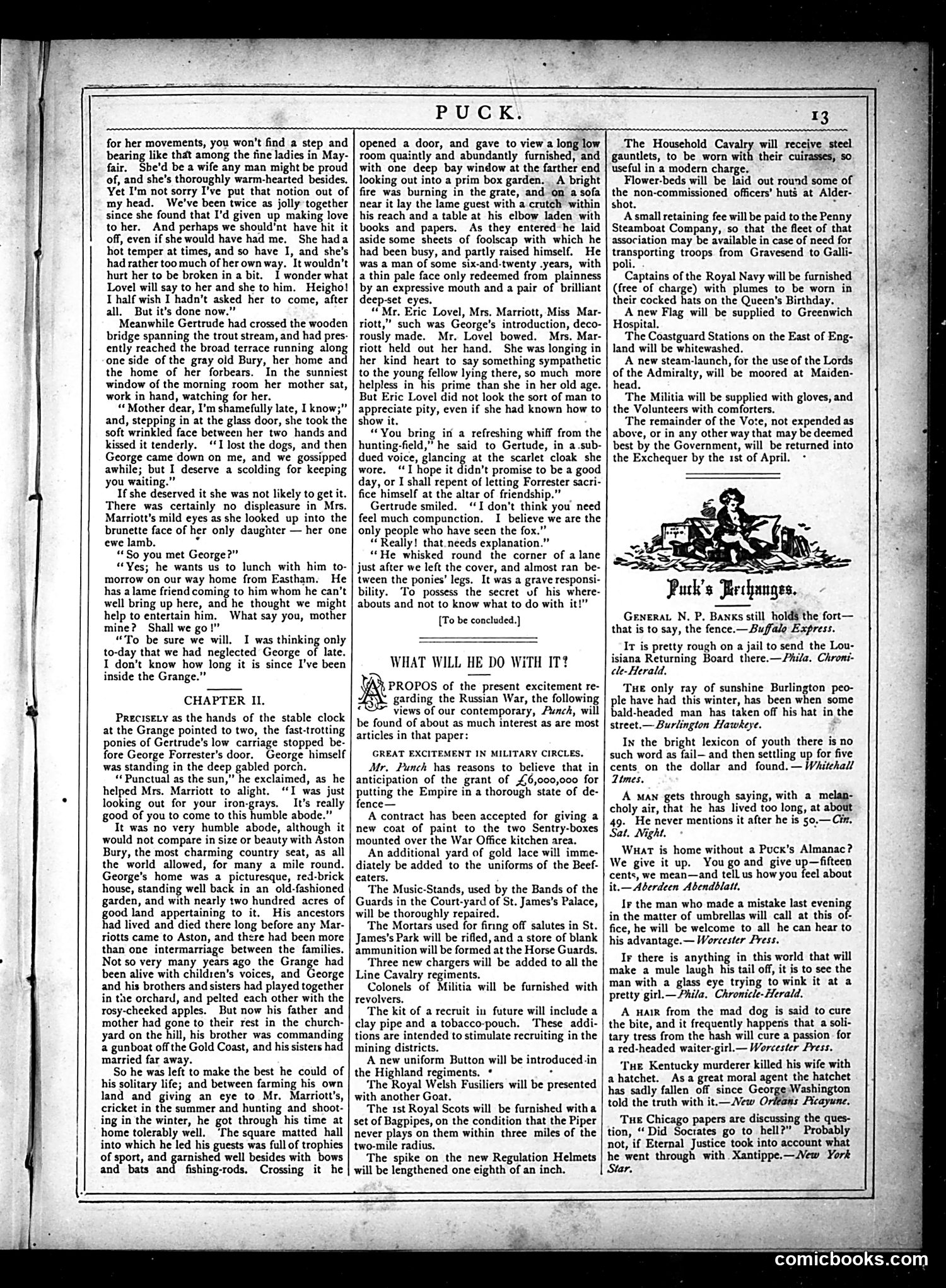
The visible cartoon and accompanying text satirize contemporary British military and governmental inefficiency. The section "What Will He Do With It?" references proposals affecting military operations—including provisions for paint, uniforms for Household Cavalry, and supplies for new regiments and militia units. The cartoons mock bureaucratic absurdity through humorous anecdotes in "Puck's Artjapes," critiquing everything from military recruitment to administrative incompetence. One piece jokes about a man's confusion after being hit by an umbrella in the street, while another mocks the notion that a Puck's Almanac could substitute for practical knowledge. The overall tone suggests frustration with governmental red tape and military mismanagement during what appears to be a period of military expansion or reorganization.
📄 Transcribed text from this page (OCR, searchable)
Machine-transcribed from the original scan — historical spelling and the odd misread are preserved.
PUCK. for her movements, you won't find a step and bearing like that among the fine ladies in May- fair. She'd be a wife any man might be proud of, and she’s thoroughly warm-hearted besides. Yet I'm not sorry I’ve put that notion out of my head. We've been twice as jolly together since she found that I'd given up making love toher. And perhaps we should’nt have hit it off, even if she would have had me. She hada hot temper at times, and so have I, and she’s had rather too much of her own way. It wouldn't hurt her to be broken in a bit. I wonder what Lovel will say to her and she to him. Heigho! I half wish I hadn’t asked her to come, after all. But it’s done now.” Meanwhile Gertrude had crossed the wooden bridge spanning the trout stream, and had pres- ently reached the broad terrace running along one side of the gray old Bury, her home and the home of her forbears. In the sunniest window of the morning room her mother sat, work in hand, watching for her. “Mother dear, I’m shamefully late, I know;” and, stepping in at the glass door, she took the soft wrinkled face between her two hands and kissed it tenderly. ‘I lost the dogs, and then George came down on me, and we gossipped awhile; but I deserve a scolding for keeping you waiting.” If she deserved it she was not likely to get it. There was certainly no displeasure in Mrs. Marriott's mild eyes as she looked up into the brunette face of her only daughter — her one ewe lamb. = “So you met George?” “Yes; he wants us to lunch with him to- morrow on our way home from Eastham. He has a lame friend coming to him whom he can’t well bring up here, and he thought we might help to entertain him, What say you, mother mine? Shall we go!” “To be sure we will, I was thinking only to-day that we had neglected George of late. I don’t know how long it is since I’ve been inside the Grange.” CHAPTER Il. Precisety as the hands of the stable clock at the Grange pointed to two, the fast-trotting ponies of Gertrude’s low carriage stopped be- fore George Forrester’s door. George himself was standing in the deep gabled porch. ‘Punctual as the sun,” he exclaimed, as_he helped Mrs. Marriott to alight. “I was just looking out for your iron-grays. It’s really good of you to come to this humble abode.” It was no very humble abode, although it would not compare in size or beauty with Aston Bury, the most charming country seat, as all the world allowed, for many a mile round. George's home was a picturesque, red-brick house, standing well back in an old-fashioned garden, and with nearly two hundred acres of good land appertaining to it. His ancestors had lived and died there long before any Mar- riotts came to Aston, and there had been more than one intermarriage between the families. Not so very many years ago the Grange had been alive with children’s voices, and George and his brothers and sisters had played together in the orchard, and pelted each other with the rosy-cheeked apples. But now his father and mother had gone to their rest in the church- yard on the hill, his brother was commanding a gunboat off the Gold Coast, and his sisters had married far away. So he was left to make the best he could of his solitary life; and between farming his own land and giving an eye to Mr. Marriott's, cricket in the summer and hunting and shoot- ing in the winter, he got through his time at home tolerably well. ‘The square matted hall into which he led his guests was full of trophies of sport, and garnished well besides with bows and bats and fishing-rods, Crossing it he opened a door, and gave to view a long low room quaintly and abundantly furnished, and with one deep bay window at the farther end looking out into a prim box garden. A bright fire was burning in the grate, and on a sofa near it lay the lame guest with a crutch within his reach and a table at his elbow laden with books and papers. As they entered-he laid aside some sheets of foolscap with which he had been busy, and partly raised himself. He was a man of some six-and-twenty .years, with a thin pale face only redeemed from plainness by an expressive mouth and a pair of brilliant deep-set eyes. “Mr. Eric Lovel, Mrs. Marriott, Miss Mar- riott,” such was George's introduction, deco- rously made. Mr. Lovel bowed. Mrs. Mar- riott held out her hand. She was longing in her kind heart to say something sympathetic to the young fellow lying there, so much more helpless in his prime than she in her old age. But Eric Lovel did not look the sort of man to appreciate pity, even if she had known how to show it, “You bring in a refreshing whiff from the hunting-field,” he said to Gertude, in a.sub- dued voice, glancing at the scarlet cloak she wore. ‘I hope it didn’t promise to be a good day, or I shall repent of letting Forrester sacri- fice himself at the altar of friendship.” Gertrude smiled. ‘I don't think you need feel much compunction. I believe we are the only people who have seen the fox.” “Really! that.needs explanation.” “He whisked round the corner of a lane just after we left the cover, and almost ran be- tween the ponies’ legs. It was a grave responsi- bility. To possess the secret uf his where- abouts and not to know what to do with it!” [To be concluded.] WHAT WILL HE DO WiTH IT? PROPOS of the present excitement re- garding the Russian War, the following i views of our contemporary, Punch, will be found of about as much interest as are most articles in that paper: GREAT EXCITEMENT IN MILITARY CIRCLES, Mr, Punch has reasons to believe that in anticipation of the grant of £6,000,000 for putting the Empire in a thorough state of de- fence— A contract has been accepted for giving a new coat of paint to the two Sentry-boxes mounted over the War Office kitchen area. An additional yard of gold lace will imme- diately be added to the uniforms of the Beef- eaters. The Music-Stands, used by the Bands of the Guards in the Court-yard of St. James’s Palace, will be thoroughly repaired. The Mortars used for firing off salutes in St. James's Park will be rifled, and a store of blank ammunition will be formed at the Horse Guards. ‘Three new chargers will be added to all the Line Cavalry regiments. Colonels of Militia will be furnished with revolvers, The kit of a recruit in future will include a clay pipe and a tobacco-pouch. These addi- tions are intended to stimulate recruiting in the mining districts. A new uniform Button will be introduced.in the Highland regiments. * 2 ‘The Royal Welsh Fusiliers will be presented with another Goat. The 1st Royal Scots will be furnished witha set of Bagpipes, on the condition that the Piper never plays on them within three miles of the two-mile radius. The spike on the new Regulation Helmets will be lengthened one eighth of an inch. The Household Cavalry will receive steel gauntlets, to be worn with their cuirasses, so useful in a modern charge. Flower-beds will be laid out round some of she non-commissioned officers’ huts at Alder- shot. 3 Asmall retaining fee will be paid to the Penny Steamboat Company, so that the fleet of that association may be available in case of need for transporting troops from Gravesend to Galli- poli. Captains of the Royal Navy will be furnished (free of charge) with plumes to be worn in their cocked hats on the Queen’s Birthday. A new Flag will be supplied to Greenwich Hospital. The Coastguard Stations on the East of Eng- land will be whitewashed. A new steam-launch, for the use of the Lords of the Admiralty, will be moored at Maiden- head. The Militia will be supplied with gloves, and the Volunteers with comforters. The remainder of the Vote, not expended as above, or in any other way that may be deemed best by the Government, will be returned into the Exchequer by the 1st of April. Puck’ Bechanges, Genera N. P. Banks still hold§ the fort— that is to say, the fence.— Buffalo Express. Ir is pretty rough on a jail to send the Lou- isiana Returning Board there.—/hila. Chroni- cle-Herald, Tue only ray of sunshine Burlington peo- le have had this winter, has been when some ald-headed man has taken off his hat in the street.— Burlington Hawkeye. . In the bright lexicon of youth there is no such word as fail— and then settling up for five cents on the dollar and found. — Whitehall Times. A Man gets through saying, with a melap- choly air, that he has lived too long, at about 49. He never mentions it after he is 50,— Cin. Sat. Night. Wuat is home without a Puck's Almanac? We give it up. You go and give up—fifteen cents, we mean—and tell us how you feel about it.— Aberdeen Abendblatt, Ip the man who made a mistake last evenin, in the matter of umbrellas will call at this of- fice, he will be welcome to all he can hear to his advantage.— Worcester Press. Ir there is anything in this world that will make a mule laugh his tail off, it is to see the man with a glass eye trying to wink it at a pretty girl.— Phila. Chronicle- Herald, A Hair from the mad dog is said to cure the bite, and it frequently happens that a soli- tary tress from the hash will cure a passion for a red-headed waiter-girl.— Worcester Press. ‘Tne Kentucky murderer killed his wife with ahatchet. Asa great moral agent the hatchet has sadly fallen off since Georgg Washington told the truth with it.—Vew Orleans Picayune, Tue Chicago papers are discussing the ques- tion, “Did Soctates go to hell?” Probably not, if Eternal Justice took into account what he went through with Xantippe.—Wew York Star, comicbooks.com