
Puck, 1878-02-20 · page 12 of 16
Puck — February 20, 1878 — page 12: what you’re looking at
What you’re looking at
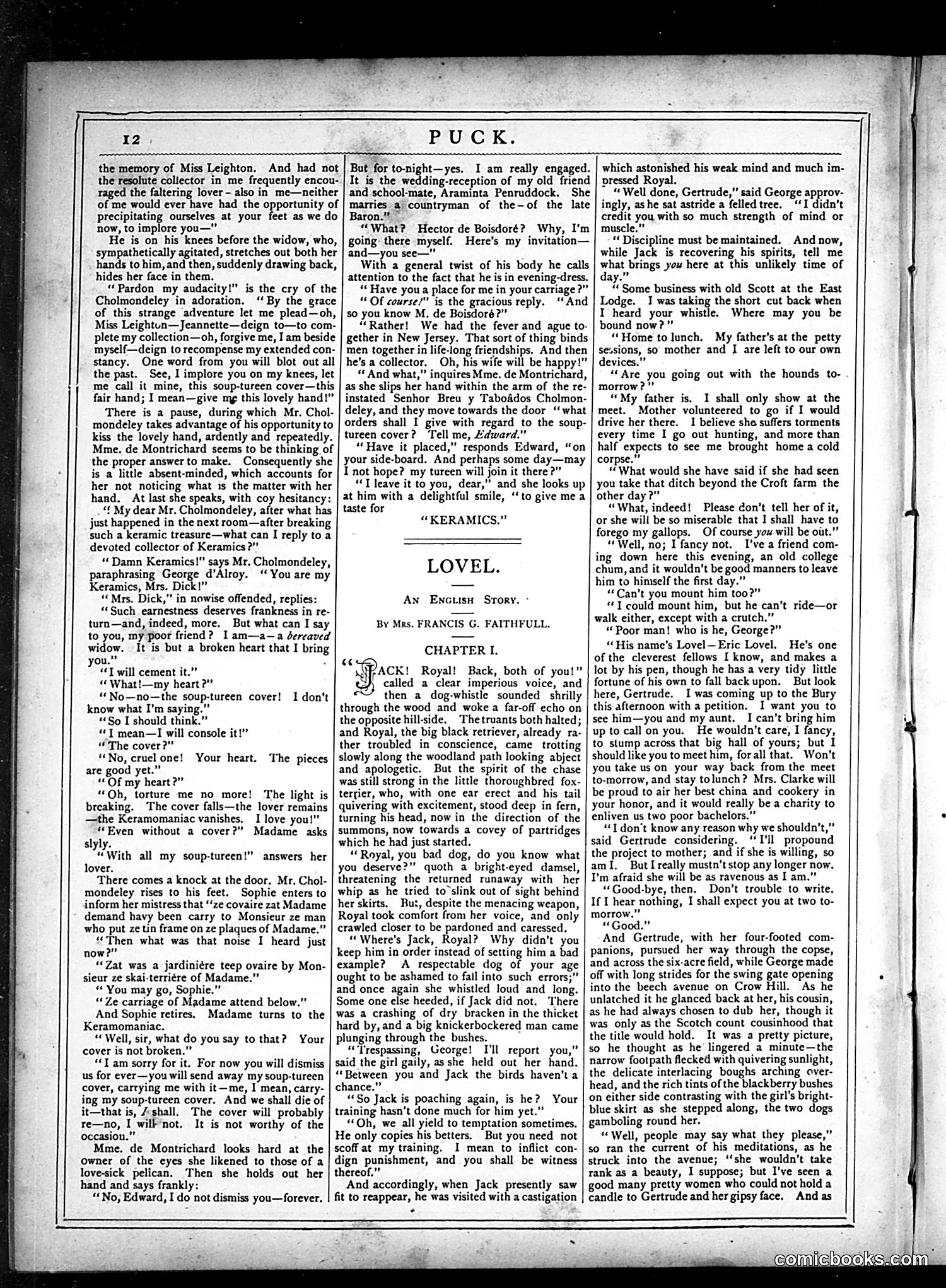
This page contains **no political cartoon or satire**. Instead, it's a literary installment from Puck magazine—specifically the opening of a serialized story titled "**LOVEL: An English Story**" by Mrs. Francis G. Faithfull. The page presents Chapter I of what appears to be a domestic fiction narrative involving characters named Jack, Gertrude, and others in an English country setting. The text focuses on romantic and social drama rather than political commentary. The left column concludes previous satirical content (references to "Keramics" and dialogue about collectors), but the bulk of this particular page is devoted to serialized fiction—a common feature in magazines of this era to attract and retain readers.
📄 Transcribed text from this page (OCR, searchable)
Machine-transcribed from the original scan — historical spelling and the odd misread are preserved.
me 12, PUCK. the memory of Miss Leighton. And had not the resolute collector in me frequently encou- raged the faltering lover - also in me—neither of me would ever have had the opportunity of precipitating ourselves at your feet as we do now, to implore you—”” He is on his knees before the widow, who, sympathetically agitated, stretches out both her hands to him, and then, suddenly drawing back, hides her face in them. “Pardon my audacity!” is the cry of the Cholmondeley in adoration. ‘By the grace of this strange adventure let me plead—oh, Miss Leightun—Jeannette—deign to—to com- plete my collection—oh, forgive me, I am beside myself—deign to recompense my extended con- stancy. One word from you will blot out all the past. See, I implore you on my knees, let me call it mine, this soup-tureen cover—this fair hand; I mean—give mg this lovely hand!" There is a pause, during which Mr. Chol- mondeley takes advantage of his opportunity to kiss the lovely hand, ardently and repeatedly. Mme. de Montrichard seems to be thinking. of the proper answer to make. Consequently she is a little absent-minded, which accounts for her not noticing what is the matter with her hand. At last she speaks, with coy hesitancy: ‘¢ My dear Mr. Cholmondeley, after what has just happened in the next room—after breaking such a keramic treasure—what can I reply to a devoted collector of Keramics?” “Damn Keramics!” says Mr. Cholmondeley, paraphrasing George d’Alroy. ‘You are my Keramics, Mrs. Dick!” “Mrs. Dick,” in nowise offended, replies: “Such earnestness deserves frankness in re- turn—and, indeed, more. But what can I say to you, my poor friend? I am—a~—a bereaved widow. It is but a broken heart that I bring ou.” z “T will cement it.” “‘ What!—my heart ?” “'No—no—the soup-tureen cover! know what I’m saying.” “So I should think.” “I mean—I will console it!” “The cover?” “No, cruel one! are good yet.” “Of my heart?” “Oh, torture me no more! The light is breaking. The cover falls—the lover remains —the Keramomaniac vanishes. I love you!” “Even without a cover?” Madame asks slyly. “With all my soup-tureen!” answers her lover. There comes a knock at the door. Mr. Chol- mondeley rises to his feet. Sophie enters to inform her mistress that “ze covaire zat Madame demand havy been carry to Monsieur ze man who put ze tin frame on ze plaques of Madame.” “Then what was that noise I heard just now?” “Zat was a jardini¢re teep ovaire by Mon- sieur ze skai-terriére of Madame.” “You may go, Sophie.” “Ze carriage of Madame attend below.” And Sophie retires. Madame turns to the Keramomaniac. “Well, sir, what do you say to that? Your cover is not broken.” “Tam sorry for it. For now you will dismiss us for ever—you will send away my soup-tureen cover, carrying me with it—me, I mean, carry- ing my soup-tureen cover. And we shall die of it—that is, /-shall, The cover will probably re—no, I wilk’not. It is not worthy of the occasion.” Mme, de Montrichard looks hard at the owner of the eyes she likened to those of a love-sick pelican. Then she holds out her hand and says frankly: ‘No, Edward, I do not dismiss you—forever. I don't Your heart. The pieces But for to-night—yes. I am really engaged. It is the wedding-reception of my old friend and school-mate, Araminta Penruddock. She marries a) countryman of the-of the late Baron.” “What? Hector de Boisdoré? Why, I'm going there myself. Here's my invitation— and—you see—"" With a general twist of his body he calls attention to the fact that he is in evening-dress. “ Have you a place for me in your carriage ?” “ Of course/” is the gracious reply. ‘And so you know M. de Boisdoré?” “Rather! We had the fever and ague to- gether in New Jersey. That sort of thing binds men together in life-long friendships. And then he’s a collector. Oh, his wife will be happy!” “And what,” inquires Mme. de Montrichard, as she slips her hand within the arm of the re- instated Senhor Breu y Tabofidos Cholmon- deley, and they move towards the door “what orders shall I’ give with regard to the soup- tureen cover? Tell me, Zdward.” “Have it placed,” responds Edward, “on your side-board. And perhaps some day—may T not hope? my tureen will join it there ?” “T leave it to you, dear,” and she looks up at him with a delightful smile, “to give me a taste for “KERAMICS.” LOVEL. An EnGtisH Srory. ° By Mrs. FRANCIS G. FAITHFULL, CHAPTER I. CK! Royal! Back, both of you!” called a clear imperious voice, and then a dog-whistle sounded shrilly through the wood and woke a far-off echo on the opposite hill-side. The truants both halted; and Royal, the big black retriever, already ra- ther troubled in conscience, came trotting slowly along the woodland path looking abject and apologetic. But the spirit of the chase was still strong in the little thoroughbred fox- terrier, who, with one ear erect and his tail quivering with excitement, stood deep in fern, turning his head, now in the direction of the summons, now towards a covey of partridges which he had just started. “Royal, you bad dog, do you know what you deserve?” quoth a bright-eyed damsel, threatening the returned runaway with her whip as he tried to-slink out of sight behind her skirts. But, despite the menacing weapon, Royal took comfort from her voice, and only crawled closer to be pardoned and caressed. “Where's Jack, Royal? Why didn’t you keep him in order instead of setting him a bad example? A respectable dog of your age ought to be ashamed to fall into such errors;” and once again she whistled loud and long. Some one else heeded, if Jack did not. There was a crashing of dry bracken in the thicket hard by, and a big knickerbockered man came plunging through the bushes. “Trespassing, George! I'll report you,” said the girl gaily, as she held out her hand. “Between you and Jack the birds haven't a chance.” “So Jack is poaching again, is he? Your training hasn’t done much for him yet.” “Oh, we all yield to temptation sometimes. He only copies his betters. But you need not scoff at my training. I mean to inflict con- dign punishment, and you shall be witness thereof.” ‘And accordingly, when Jack presently saw fit to reappear, he was visited with a castigation which astonished his weak mind and much im- pressed Royal. “Well done, Gertrude,” said George approv- ingly, ashe sat astride a felledtree. ‘I didn’t credit you with so much strength of mind or muscle,” “Discipline must be maintained. And now, while Jack is recovering his spirits, tell me what brings you here at this unlikely time of day.” “Some business with old Scott at the East Lodge. I was taking the short cut back when I heard your whistle. Where may you be bound now?” “Home to lunch, My father’s at the petty sessions, so mother and J are left to our own devices.” “Are you going out with the hounds to- morrow?” “My father is, I shall only show at the meet. Mother volunteered to go if I would drive her there. 1 believe she suffers torments every time I go out hunting, and more than half expects to see me brought home a cold corpse.”” “What would she have said if she had seen you take that ditch beyond the Croft farm the other day ?” “What, indeed! Please don’t tell her of it, or she will be so miserable that I shall have to forego my gallops. Of course you will be out.” “Well, no; I fancy not. I’ve a friend com- ing down here this evening, an old college chum, and it wouldn't be good manners to leave him to himself the first day.” “Can't you mount him too?” “T could mount him, but he can’t ride—or walk either, except with a crutch.” “Poor man! who is he, George?” “His name's Lovel—Eric Lovel. He's one of the cleverest fellows I know, and makes a lot by his pen, though he has a very tidy little fortune of his own to fall back upon. But look here, Gertrude. I was coming up to the Bury this afternoon with a petition. I want you to see him—you and my aunt. I can’t bring him up to call‘on you. He wouldn’t care, I fancy, to stump across that big hall of yours; but I should like you to meet him, forall that. Won't you take us on your way back from the meet to-morrow, and stay tolunch? Mrs. Clarke will be proud to air her best china and cookery in your honor, and it would really be a charity to enliven us two poor bachelors.”” “TI don’t know any reason why we shouldn't,” said Gertrude considering. ‘I'll propound the project to mother; and if she is willing, so am I. But [really mustn’t stop any longer now. I'm afraid she will be as ravenous as I am.” “Good-bye, then. Don’t trouble to write. If I hear nothing, I shall expect you at two to- morrow.”” “Good.” And Gertrude, with her four-footed com- panions, pursued her way through the copse, and across the six-acre field, while George made off with long strides for the swing gate opening into the beech avenue on Crow Hill. As he unlatched it he glanced back at her, his cousin, as he had always chosen to dub her, though it was only as the Scotch count cousinhood that the title would hold. It was a pretty picture, so he thought as he lingered a minute—the narrow footpath flecked with quivering sunlight, the delicate interlacing boughs arching over- head, and the rich tints of the blackberry bushes on either side contrasting with the girl’s bright- blue skirt as she stepped along, the two dogs gamboling round her. “Well, people may say what they please,” so ran the current of his meditations, as he struck into the avenue; ‘she wouldn't take rank as a beauty, I suppose; but I’ve seen a good many pretty women who could not hold a candle to Gertrude and her gipsy face, And as _comicbooks. con.