
Puck, 1878-02-20 · page 5 of 16
Puck — February 20, 1878 — page 5: what you’re looking at
What you’re looking at
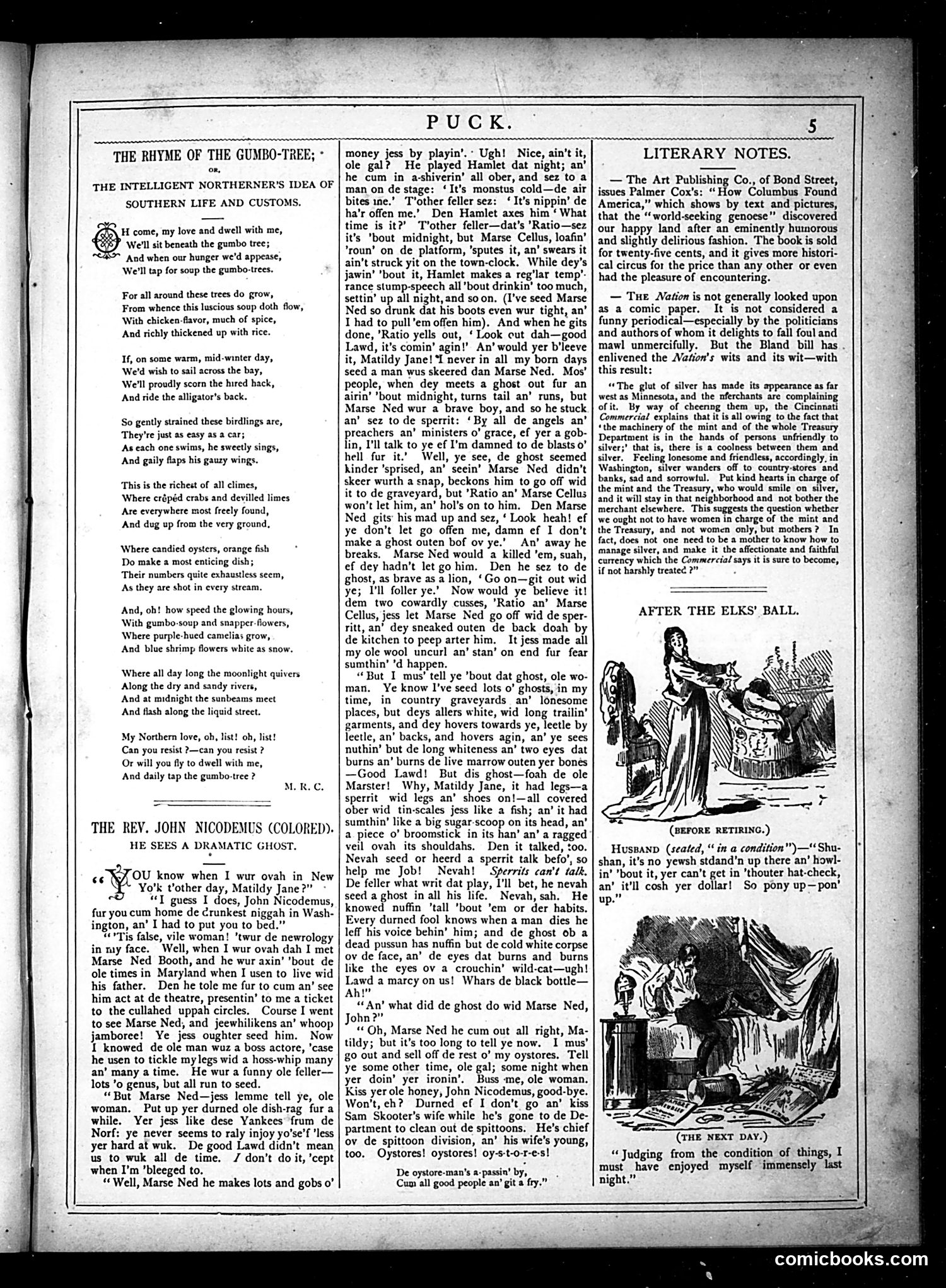
This page from *Puck* contains primarily **literary and humorous content** rather than political satire: **Main Features:** - "The Rhyme of the Gumbo-Tree": A dialect poem mocking Southern speech patterns and customs, written in exaggerated vernacular - "The Rev. John Nicodemus (Colored): He Sees a Dramatic Ghost": A comedic story featuring a Black minister encountering a ghost, filled with period racial stereotypes and dialect humor - "After the Elks' Ball": A brief illustrated comic depicting social aftermath scenes **The Satire:** The humor relies on **racial caricature and dialect comedy** typical of late 19th/early 20th-century American publications. Rather than political commentary, it traffics in stereotypical portrayals of African American speech and behavior for entertainment purposes. The illustrations support these dialect-heavy narratives with period-appropriate imagery.
📄 Transcribed text from this page (OCR, searchable)
Machine-transcribed from the original scan — historical spelling and the odd misread are preserved.
PUCK. THE RHYME OF THE GUMBO-TREE; * THE INTELLIGENT NORTHERNER’S IDEA OF SOUTHERN LIFE AND CUSTOMS. H come, my love and dwell with me, ‘We'll sit beneath the gumbo tree; ‘And when our hunger we'd appease, ‘We'll tap for soup the gumbo-trees. For all around these trees do grow, From whence this luscious soup doth flow, With chicken-favor, much of spice, ‘And richly thickened up with rice. If, on some warm, mid-winter day, ‘We'd wish to sail across the bay, We'll proudly scorn the hired hack, And ride the alligator’s back. So gently strained these birdlings are, ‘They're just as easy as a car; ‘Aseach one swims, he sweetly sings, And gaily flaps his gauzy wings. ‘This is the richest of all climes, Where crépéd crabs and devilled limes Are everywhere most freely found, ‘And dug up from the very ground, Where candied oysters, orange fish Do make a most enticing dish; Their numbers quite exhaustless seem, ‘As they are shot in every stream, And, oh! how speed the glowing hours, With gumbo-soup and snapper-flowers, Where purple-hued camelias grow, And blue shrimp flowers white as snow. Where all day long the moonlight quivers Along the dry and sandy rivers, And at midnight the sunbeams meet ‘And flash along the liquid street. My Northern love, ob, list! ob, list! Can you resist 2—can you resist ? Or will you fly to dwell with me, And daily tap the gumbo-tree ? THE REY. JOHN NICODEMUS (COLORED). HE SEES A DRAMATIC GHOST. ce WOU know when I wur ovah in New Yo'k t’other day, Matildy Jane?” “T guess I does, John Nicodemus, fur you cum home de crunkest niggah in Wash- ington, an’ I had to put you to bed.” “Tis false, vile woman! ‘twur de newrology in my face. Well, when I wur ovah dah I met Marse Ned Booth, and he wur axin’ 'bout de ole times in Maryland when I usen to live wid his father. Den he tole me fur to cum an’ see him act at de theatre, presentin’ to me a ticket to the cullahed uppah circles. Course I went to see Marse Ned, and jeewhilikens an’ whoop jamboree! Ye jess oughter seed him. Now 1 knowed de ole man wuz a boss actore, ‘case he usen to tickle my legs wid a hoss-whip many an’ many atime, He wura funny ole feller— lots ’o genus, but all run to seed. “But Marse Ned—jess lemme tell ye, ole woman. Put up yer durned ole dish-rag fur a while. Yer jess like dese Yankees frum de Norf: ye never seems to raly injoy yo'se’f ‘less yer hard at wuk. De good Lawd didn’t mean us to wuk all de time. / don’t do it, cept when I'm ’bleeged to. “Well, Marse Ned he makes lots and gobs 0’ money jess by playin’. Ugh! Nice, ain’t it, ole gal? He played Hamlet dat night; an’ he cum in a-shiverin’ all ober, and sez to a man on de stage: ‘It's monstus cold—de air bites ine.’ T’other feller sez: ‘ It’s nippin’ de ha'r offen me.’ Den Hamlet axes him ‘ What time is it?’ T’other feller—dat's ’Ratio—sez it’s "bout midnight, but Marse Cellus, loafin’ ‘roun’ on de platform, 'sputes it, an’ swears it ain’t struck yit on the town-clock. While dey’s jawin’ "bout it, Hamlet makes a reg'lar temp’- trance stump-speech all bout drinkin’ too much, settin’ up all night,and soon. (I've seed Marse Ned so drunk dat his boots even wur tight, an’ Thad to pull’em offen him). And when he gits done, 'Ratio yells out, ‘ Look out dah—good Lawd, it's comin’ agin!’ An’ would yer b'leeve it, Matildy Jane! ‘I never in all my born days seed a man wus skeered dan Marse Ned. Mos’ people, when dey meets a ghost out fur an airin’ 'bout midnight, turns tail an’ runs, but Marse Ned wur a brave boy, and so he stuck. an’ sez to de sperrit: ‘By all de angels an’ preachers an’ ministers o grace, ef yer a gob- lin, I'll talk to ye ef I’m damned to de blasts 0’ hell fur it.’ Well, ye see, de ghost seemed hinder 'sprised, an’ seein’ Marse Ned didn’t skeer wurth a snap, beckons him to go off wid it to de graveyard, but "Ratio an’ Marse Cellus won't let him, an’ hol’s on to him, Den Marse Ned gits his mad up and sez, ‘ Look heah! ef ye don’t let go offen me, damn ef I don’t make a ghost outen bof ov ye.’ An’ away he breaks. Marse Ned would a killed 'em, suah, ef dey hadn’t let gohim. Den he sez to de ghost, as brave as a lion, ‘Go on—git out wid ye; I'll foller ye." Now would ye believe it! dem two cowardly cusses, ‘Ratio an’ Marse Cellus, jess let Marse Ned go off wid de sper- ritt, an’ dey sneaked outen de back doah by de kitchen to peep arter him. It jess made all my ole wool uncurl an’ stan’ on end fur fear sumthin’ 'd happen. “But I mus’ tell ye bout dat ghost, ole wo- man. Ye know I've seed lots o’ ghosts, in my time, in country graveyards an’ lonesome places, but deys allers white, wid long trailin’ garments, and dey hovers towards ye, leetle by leetle, an’ backs, and hovers agin, an’ ye sees nuthin’ but de long whiteness an’ two eyes dat burns an’ burns de live marrow outen yer bonés —Good Lawd! But dis ghost—foah de ole Marster! Why, Matildy Jane, it had legs—a sperrit wid legs an’ shoes on!—all covered ober wid tin-scales jess like a fish; an’ it had sumthin’ like a big sugar-scoop on its head, an’ a piece o’ broomstick in its han’ an’ a ragged veil ovah its shouldahs. Den it talked, too. Nevah seed or heerd a sperrit talk befo’, so help me Job! Nevah! Sperrits can't talk. De feller what writ dat play, I'll bet, he nevah seed a ghost in all his life. Nevah,sah. He knowed nuffin ’tall ‘bout ‘em or der habits. Every durned fool knows when a man dies he leff his voice behin’ him; and de ghost ob a dead pussun has nuffin but de cold white corpse ov de face, an’ de eyes dat burns and burns like the eyes ov a crouchin’ wild-cat—ugh! Lawd a marcy on us! Whars de black bottle— Ah!” ‘An’ what did de ghost do wid Marse Ned, John?” “Oh, Marse Ned he cum out all right, Ma- tildy; but it’s too long to tell ye now. I mus’ go out and sell off de rest 0’ my oystores, Tell ye some other time, ole gal; some night when yer doin’ yer ironin’. Buss me, ole woman. Kiss yer ole honey, John Nicodemus, good-bye. Won't, ch? Durned ef I don’t go an’ kiss Sam Skooter’s wife while he's gone to de De- partment to clean out de spittoons. He’s chief ov de spittoon division, an’ his wife's young, too. Oystores! oystores! oy-s-t-o-r-e-s! De oystore-man’s a-passin’ by, Cum all good people an’ git a fry.” LITERARY NOTES. — The Art Publishing Co., of Bond Street, issues Palmer Cox's: ‘How Columbus Found America,” which shows by text and pictures, that the “world-secking genoese” discovered our happy land after an eminently humnorous and slightly delirious fashion. The book is sold for twenty-five cents, and it gives more histori- cal circus for the price than any other or even had the pleasure of encountering. — Tue Nation is not generally looked upon as a comic paper. It is not considered a funny periodical—especially by the politicians and authors of whom it delights to fall foul and maw! unmercifully. But the Bland bill has . enlivened the Nation's wits and its wit—with this result: “The glut of silver has made its appearance as far west as Minnesota, and the nferchants are complaining of it. By way of cheenng them up, the Cincinnati Commercial explains that it is all owing to the fact that ‘the machinery of the mint and of the whole Treasury Department is in the hands of persons unfriendly to silver;? that is, there is a coolness between them and silver. Feeling lonesome and friendless, accordingly, in Washington, silver wanders off to country-stores and banks, sad and sorrowful. Put kind hearts in charge of the mint and the Treasury, who would smile on silver, and it will stay in that neighborhood and_not bother the merchant elsewhere. This suggests the question whether we ought not to have women in charge of the mint and the Treasury, and not women only, but mothers? In fact, does not one need to be a mother to know how to manage silver, and make it the affectionate and faithful currency which the Commercial says it is sure to become, if not harshly treatee ?” AFTER THE ELKS’ BALL. (BEFORE RETIRING.) Huspanp (seated, “in a condition" — Shu- shan, it’s no yewsh stdand’n up there an’ howl- in’ "bout it, yer can’t get in ’thouter hat-check, an’ ie cosh yer dollar! So pony up—pon’ up.” (THE NEXT DAY.) “Judging from the condition of things, I aia have’ enjoyed myself “immensely last night.”