
Puck, 1878-02-20 · page 2 of 16
Puck — February 20, 1878 — page 2: what you’re looking at
What you’re looking at
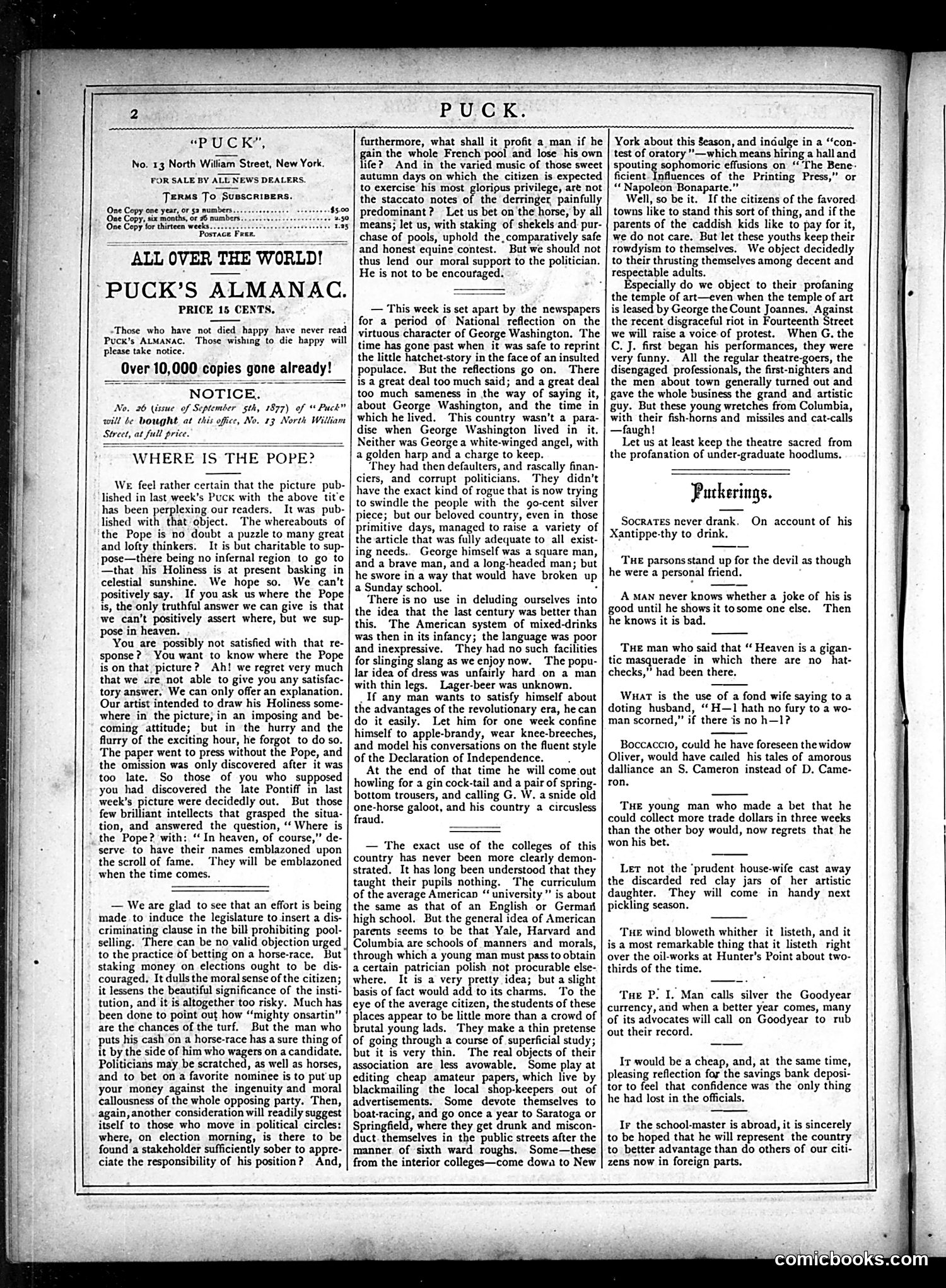
This page is primarily **editorial content and advertisements** rather than political cartoons. The main pieces include: **"Where is the Pope?"** — An editorial expressing uncertainty about the Pope's location and criticizing Puck's own previous illustration as misleading. The editors discuss the Pope's historical significance and debate whether depicting religious figures accurately matters to readers. **"Puckerings"** — A column of brief satirical observations on contemporary life, including jibes at drinking habits, marriage, education at elite colleges (Yale, Harvard, Columbia), and social pretension. The **advertising section** promotes Puck's Almanac (10,000+ copies sold) and subscription rates. No specific political figures or dated events are clearly referenced. The tone is generally satirical toward American social institutions and human foibles rather than partisan politics.
📄 Transcribed text from this page (OCR, searchable)
Machine-transcribed from the original scan — historical spelling and the odd misread are preserved.
PUCK. “PUCK”, No. 13 North William Street, New York. FOR SALE BY ALU NEWS DEALERS. Terms To Susscripers. One Copy one year, or $2 numbers. One Copy, six months, or 28 num One Copy tor thirteen weeks ALL OVER THE WORLD! ~PUCK’S ALMANAC. PRICE 15 CENTS. -Those who have not died happy have never read Puck's ALMANAC. Those wishing to die happy will please take notice. Over 10,000 copies gone already! NOTICE. No. 26 (issue of September sth, 1877) of “Puck” will be bought at this office, No. 13 North William Street, at full price. WHERE IS THE POPE? We feel rather certain that the picture pub- lished in last week's Puck with the above tit'e has been perplexing our readers, It was pub- lished with that object. The whereabouts of the Pope is no doubt a puzzle to many great and lofty thinkers. It is but charitable to sup- pose—there being no infernal region to go to —that his Holiness is at present basking in celestial sunshine. We hope so. We can't itively say. If you ask us where the Pope is, the only truthful answer we can give is that we can’t positively assert where, but we sup- pose in heaven. You are possibly not satisfied with that re- sponse? You want to know where the Pope is on that picture? Ah! we regret very much that we cre not able to give you any satisfac- tory answer, We can only offer an explanation. Our artist intended to draw his Holiness some- where in the picture; in an imposing and be- coming attitude; but in the hurry and the flurry of the exciting hour, he forgot to do so. The paper went to press without the Pope, and the omission was only discovered after it was too late. So those of you who supposed you had discovered the late Pontiff in last week’s picture were decidedly out. But those few brilliant intellects that grasped the situa- tion, and answered the question, ‘‘ Where is ‘the Pope? with: ‘ In heaven, of course,” de- serve to have their names emblazoned upon the scroll of fame. They will be emblazoned when the time comes. — Weare glad to see that an effort is being made to induce the legislature to insert a dis- criminating clause in the bill prohibiting pool- selling. There can be no valid objection urged to the practice of betting on a horse-race. But staking money on elections ought to be dis- couraged, It dulls the moral sense of the citizen; it lessens the beautiful significance of the insti- tution, and it is altogether too risky. Much has been done to point out how “mighty onsartin” are the chances of the turf. But the man who puts his cash on a horse-race has a sure thing of it by the side of him who wagers on a candidate, Politicians may be scratched, as well as horses, and to bet on a favorite nominee is to put up your money against the ingenuity and moral callousness of the whole opposing party. Then, again, another consideration will readily suggest itself to those who move in political circles: where, on election morning, is there to be found a stakeholder sufficiently sober to appre- ciate the responsibility of his position? And, furthermore, what shall it profit a_man if he pa the whole French pool and lose his own ife? And in the varied music of those sweet autumn days on which the citizen is expected to exercise his most glorious privilege, art not the staccato notes af the derringer painfully predominant? Let us bet on the horse, by all means; let us, with staking of shekels and: pur- chase of pools, uphold the, comparatively safe and honest equine contest. But we should not thus lend our moral support to the politician. He is not to be encouraged. — This week is set apart by the newspapers for a period of National reflection on the virtuous character of George Washington. The time has gone past when it was safe to reprint the little hatchet-story in the face of an insulted populace. But the reflections go on. There is a great deal too much said; and a great deal too much sameness in the way of saying it, about George Washington, and the time in which he lived. This country wasn’t a para- dise when George Washington lived in it. Neither was George a white-winged angel, with a golden harp and a charge to keep. ‘They had then defaulters, and rascally finan- ciers, and corrupt politicians. They didn't have the exact kind of rogue that is now trying to swindle the people with the go-cent silver piece; but our beloved country, even in those primitive days, managed to raise a variety of the article that was fully adequate to all exist- ing needs.. George himself was a square man, and a brave man, and a long-headed man; but he swore in a way that would have broken up a Sunday school. ° There is no use in deluding ourselves into the idea that the last century was better than this. The American system of mixed-drinks was then in its infancy; the language was poor and inexpressive. They had no such facilities for slinging slang as we enjoy now. The popu- lar idea of dress was unfairly hard on a man with thin legs. Lager-beer was unknown. _If any man wants to satisfy himself about the advantages of the revolutionary era, he can do it easily. Let him for one week confine himself to apple-brandy, wear knee-breeches, and model his conversations on the fluent style of the Declaration of Independence. At the end of that time he will come out howling for a gin cock-tail and a pair of spring- bottom trousers, and calling G. W. a snide old one-horse galoot, and his country ‘a circusless fraud. — The exact use of the colleges of this country has never been more clearly demon- strated. It has long been understood that they taught their pupils nothing. ‘The curriculum of the average American “ university” is about the same as that of an English or Germat high school. But the general idea of American parents seems to be that Yale, Harvard and Columbia are schools of manners and morals, through which a young man must pass to obtain acertain patrician polish not procurable else- where. It is a very pretty idea; but a slight basis of fact would add to its charms. To the eye of the average citizen, the students of these places appear to be little more than a crowd of brutal young lads. They make a thin pretense of going through a course of superficial study; but it is very thin. ‘The real objects of their association are less avowable. Some play at editing cheap amateur papers, which live by blackmailing the local shop-keepers out of advertisements. Some devote themselves to boat-racing, and go once a year to Saratoga or Springfield, where they get drunk and miscon- duct. themselves in the public streets after the manner. of sixth ward roughs, Some—these from the interior colleges—come dowa to New York about this Season, and indalge in a ‘“‘con- test of oratory ”—which means hiring a hall and spouting sophomoric effusions on ‘The Bene: ficient Ynfiuences of the Printing Press,” or “Napoleon Bonaparte.” Well, so be it. If the citizens of the favored towns like to stand this sort of thing, and if the parents of the caddish kids like to pay for it, we do not care. But let these youths keep their rowdyism to themselves. We object decidedly to their thrusting themselves among decent and respectable adults. Especially do we object to their profaning the temple of art—even when the temple of art is leased by George the Count Joannes. Against the recent disgraceful riot in Fourteenth Street we will raise a voice of protest. When G, the C. J. first began his performances, they were very funny. All the regular theatre-goers, the disengaged professionals, the first-nighters and the men about town generally turned out and gave the whole business the grand and artistic guy. But these young wretches from Columbia, with their fish-horns and missiles and cat-calls —faugh! Let us at least keep the theatre sacred from the profanation of under-graduate hoodlums, Puckerings. Socrates never drank. On account of his Xantippe-thy to drink. ‘Tue parsonsstand up for the devil as though he were a personal friend. A MAN never knows whether a joke of his is good until he shows it tosome one else. Then he knows it is bad. ‘Tue man who said that “ Heaven is a gigan- tic masquerade in which there are no hat- checks,” had been there. Wuar is the use of a fond wife saying to a doting husband, “H—1 hath no fury to a wo- man scorned,” if there is no h—1? Boccaccio, could he have foreseen the widow Oliver, would have cailed his tales of amorous dalliance an S. Cameron instead of D. Came- ron, THE young man who made a bet that he could collect more trade dollars in three weeks than the other boy would, now regrets that he won his bet. Ler not the ‘prudent house-wife cast away the discarded red clay jars of her artistic daughter. They will come in handy next pickling season. ‘Tue wind bloweth whither it listeth, and it is a most remarkable thing that it listeth right over the oil-works at Hunter’s Point about two- thirds of the time. ‘Tue P! I. Man calls silver the Goodyear currency, and when a better year comes, many of its advocates will call on Goodyear to rub out their record. Ir would be a cheap, and, at the same time, pleasing reflection for the savings bank deposi- tor to feel that confidence was the only thing he had lost in the officials. Ir the school-master is abroad, it is sincerely to be hoped that he will represent the country to better advantage than do others of our citi. zens now in forcign parts.