
Puck, 1878-02-20 · page 4 of 16
Puck — February 20, 1878 — page 4: what you’re looking at
What you’re looking at
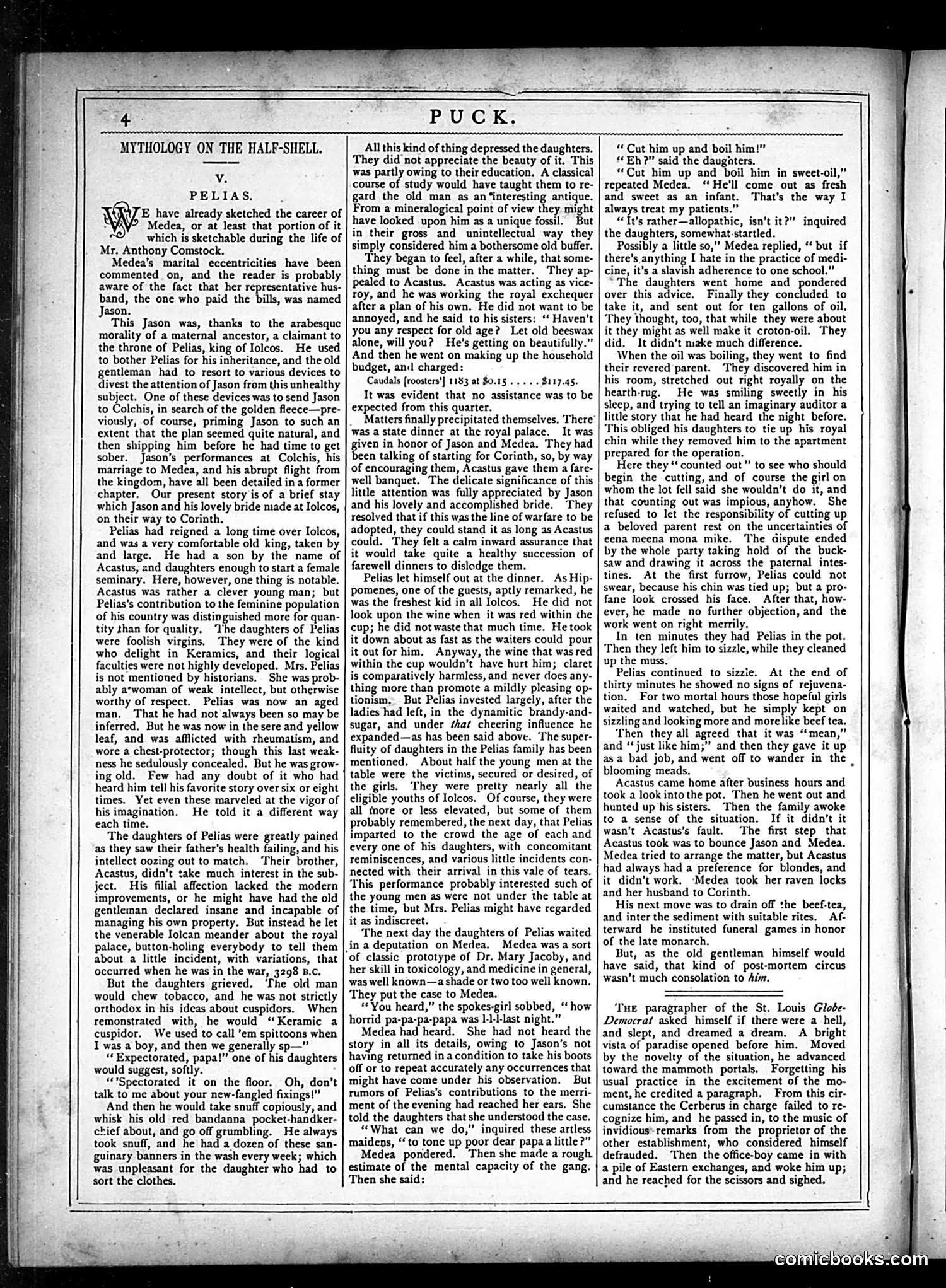
This page contains no political cartoon. Instead, it features "Mythology on the Half-Shell V: Pelias," a serialized fictional story presented in two columns of dense text. The narrative is a humorous, modernized retelling of the Greek myth of Pelias and Jason. It satirizes upper-class society by depicting classical mythological characters—Medea, Jason, Pelias, and his daughters—dealing with contemporary domestic concerns: household budgets, servants' wages, marital disputes, and social propriety. The satire lies in applying mundane Victorian-era anxieties to ancient Greek heroes, creating comedy through anachronistic contrast. References to "Corinth," "royal palace," and classical mythology are juxtaposed against petty bourgeois concerns like household accounts and social embarrassment. This is humor through literary parody rather than visual satire.
📄 Transcribed text from this page (OCR, searchable)
Machine-transcribed from the original scan — historical spelling and the odd misread are preserved.
PUCK. MYTHOLOGY ON THE HALF-SHELL. v. PELIAS. E have already sketched the career of > Medea, or at least that portion of it which is sketchable during the life of Mr. Anthony Comstock. Medea’s marital eccentricities have been commented on, and the reader is probably aware of the fact that her representative hus- band, the one who paid the bills, was named Jason. This Jason was, thanks to the arabesque morality of a maternal ancestor, a claimant to the throne of Pelias, king of Iolcos. He used to bother Pelias for his inheritance, and the old entleman had to resort to various devices to ivest the attention of Jason from this unhealthy subject. One of these devices was to send Jason to Colchis, in search of the golden fleece—pre- viously, of course, priming Jason to such an extent that the plan seemed quite natural, and then shipping him before he had time to get sober. Jason’s performances at Colchis, his marriage to Medea, and his abrupt flight from the kingdom, have all been detailed in a former chapter. Our present story is of a brief stay which Jason and his lovely bride made at Iolcos, on their way to Corinth. Pelias had reigned a long time over Iolcos, and was a very comfortable old king, taken by and large. He had a son by the name of Acastus, and daughters enough to start a female seminary. Here, however, one thing is notable. Acastus was rather a clever young man; but Pelias’s contribution to the feminine population of his country was distinguished more for quan- tity than for quality. ‘The daughters of Pelias were foolish virgins. They were of the kind who delight in Keramics, and their logical faculties were not highly developed. Mrs. Pelias is not mentioned by historians. She was prob- ably a*woman of weak intellect, but otherwise worthy of respect. Pelias was now an aged man. That he had not always been so may be inferred, But he was now in the sere and yellow leaf, and was afflicted with rheumatism, and wore a chest-protector; though this last weak- ness he sedulously concealed. But he was grow- ing old. Few had any doubt of it who had heard him tell his favorite story over six or eight times. Yet even these marveled at the vigor of his imagination. He told it a different way each time. The daughters of Pelias were greatly pained as they saw their father’s health failing, and his intellect oozing out to match. ‘Their brother, Acastus, didn’t take much interest in the sub- ject. His filial affection lacked the modern improvements, or he might have had the old gentleman declared insane and incapable of managing his own property. But instead he let the venerable Iolcan meander about the royal palace, button-holing everybody to tell them about a little incident, with variations, that occurred when he was in the war, 3298 B.c. But the daughters grieved. ‘The old man would chew tobacco, and he was not strictly orthodox in his ideas about cuspidors. When remonstrated with, he would “Keramic a cuspidor. We used to call ’em spittoons when I was a boy, and then we generally sp—" “ Expectorated, papa!” one of his daughters would suggest, softly. ‘'Spectorated it on the floor. Oh, don’t talk to me about your new-fangled fixings!” And then he would take snuff copiously, and whisk his old red bandanna pocket-handker- chief about, and go off grumbling. He always took snuff, and he had a dozen of these san- guinary banners in the wash every week; which was unpleasant for the daughter who had to sort the clothes. .in a deputation on Medea. All this kind of thing depressed the daughters. They did not appreciate the beauty of it. This was partly owing to their education. A classical course of study would have taught them to re- gard the old man as an ‘interesting antique. From a mineralogical point of view they might have looked upon him as a unique fossil. But in their gross and unintellectual way they simply considered him a bothersome old buffer. They began to feel, after a while, that some- thing must be done in the matter. They ap- pealed to Acastus. Acastus was acting as vice- roy, and he was working the royal exchequer after a plan of his own. He did not want to be annoyed, and he said to his sisters: ‘* Haven't you any respect for old age? Let old beeswax alone, will you? He's getting on beautifully.” And then he went on making up the household budget, and charged: Caudals (roosters'} 1183 at $0.15 It was evident that no assistance was to be expected from this quarter. Matters finally precipitated themselves. There was a state dinner at the royal palace. It was piven in honor of Jason and Medea. They had een talking of starting for Corinth, so, by way of encouraging them, Acastus gave them a fare- well banquet. The delicate significance of this little attention was fully appreciated by Jason and his lovely and accomplished bride. They resolved that if this was the line of warfare to be adopted, they could stand it as long as Acastus could. They felt a calm inward assurance that it would take quite a healthy succession of farewell dinneis to dislodge them. Pelias let himself out at the dinner. As Hip- pomenes, one of the guests, aptly remarked, he was the freshest kid in all Iolcos. He did not look upon the wine when it was red within the cup; he did not waste that much time. He took it down about as fast as the waiters could pour it out for him. Anyway, the wine that wasred within the cup wouldn’t have hurt him; claret is comparatively harmless, and never does any- thing more than promote a mildly pleasing op- tionism, But Pelias invested largely, after the ladies had left, in the dynamitic brandy-and- sugar, and under shat cheering influence he expanded—as has been said above. ‘The super- fluity of daughters in the Pelias family has been mentioned. About half the young men at the table were the victims, secured or desired, of the girls. They were pretty nearly all the eligible youths of Iolcos. Of course, they were all more or less elevated, but some of them probably remembered, the next day, that Pelias imparted to the crowd the age of each and every one of his daughters, with concomitant reminiscences, and various little incidents con- nected with their arrival in this vale of tears. ‘This performance probably interested such of the young men as were not under the table at the time, but Mrs. Pelias might have regarded it as indiscreet. ‘The next day the daughters of Pelias waited Medea was a sort of classic prototype of Dr. Mary Jacoby, and her skill in toxicology, and medicine in general, was well known—a shade or two too well known, They put the case to Medea. “You heard,” the spokes-girl sobbed, “how horrid pa-pa-pa-papa was 1-1-I-last night.”” Medea had heard. She had not heard the story in all its details, owing to Jason’s not having returned in a condition to take his boots off or to repeat accurately any occurrences that might have come under his observation. But rumors of Pelias’s contributions to the merri- ment of the evening had reached her ears. She told the daughters that she understood the case. “What can we do,” inquired these artless maidens, “to tone up poor dear papaa little?” Medea pondered. ‘Then she made a rough. estimate of the mental capacity of the gang. Then she said: “Cut him up and boil him!" “Eh?” said the daughters. “Cut him up and boil him in sweet-oil,” repeated Medea. ‘He'll come out as fresh and sweet as an infant. That's the way I always treat my patients.” “It’s rather—allopathic, isn’t it?” inquired the daughters, somewhat-startled. Possibly a little so,” Medea replied, “ but if there's anything I hate in the practice of medi- cine, it’s a slavish adherence to one school.” “The daughters went home and pondered over this advice. Finally they concluded to take it, and sent out for ten gallons of oil. ‘They thought, too, that while they were about it they might as well make it croton-oil. They did. It didn’t make much difference. When the oil was boiling, they went to find their revered parent. They discovered him in his room, stretched out right royally on the hearth-rug. He was smiling sweetly in his sleep, and trying to tell an imaginary auditor a little story that fe had heard the night before. This obliged his daughters to tie up his royal chin while they removed him to the apartment prepared for the operation. Here they “‘ counted out” to see who should begin the cutting, and of course the girl on whom the lot fell said she wouldn’t do it, and that counting out was impious, anyhow. She refused to let the responsibility of cutting up a beloved parent rest on the uncertainties of eena meena mona mike. The dispute ended by the whole party taking hold of the buck- saw and drawing it across the paternal intes- tines. At the first furrow, Pelias could not swear, because his chin was tied up; but a pro- fane look crossed his face. After that, how- ever, he made no further objection, and the work went on right merrily. In ten minutes they had Pelias in the pot. ‘Then they left him to sizzle, while they cleaned up the muss, Pelias continued to sizzie. At the end of thirty minutes he showed no signs of rejuvena- tion. For two mortal hours those hopeful girls waited and watched, but he simply kept on sizzling and looking more and morelike beef tea. Then they all agreed that it was ‘‘mean,” and ‘just like him;” and then they gave it up asa bad job, and went off to wander in the | blooming meads. Acastus came home after business hours and took a look into the pot. Then he went out and hunted up ‘his sisters. Then the family awoke to a sense of the situation. If it didn’t it wasn't Acastus’s fault. The first step that Acastus took was to bounce Jason and Medea. Medea tried to arrange the matter, but Acastus had always had a preference for blondes, and it didn’t work. ‘Medea took her raven locks and her husband to Corinth. His next move was to drain off the beef-tea, and inter the sediment with suitable rites. Af- terward he instituted funeral games in honor of the late monarch. But, as the old gentleman himself would have said, that kind of post-mortem circus wasn’t much consolation to him, ‘Tue paragrapher of the St. Louis Glode- Democrat asked himself if there were a hell, and slept, and dreamed a dream. A bright vista of paradise opened before him. Moved by the novelty of the situation, he advanced toward the mammoth portals. Forgetting his usual practice in the excitement of the mo- ment, he credited a paragraph. From this cir- cumstance the Cerberus in charge failed to re- cognize him, and he passed in, to the music of invidious” remarks from the proprietor of the other establishment, who considered himself defrauded. Then the office-boy came in with a pile of Eastern exchanges, and woke him up; and he reached for the scissors and sighed.