
A complete issue · 16 pages · 1878
Puck — January 16, 1878
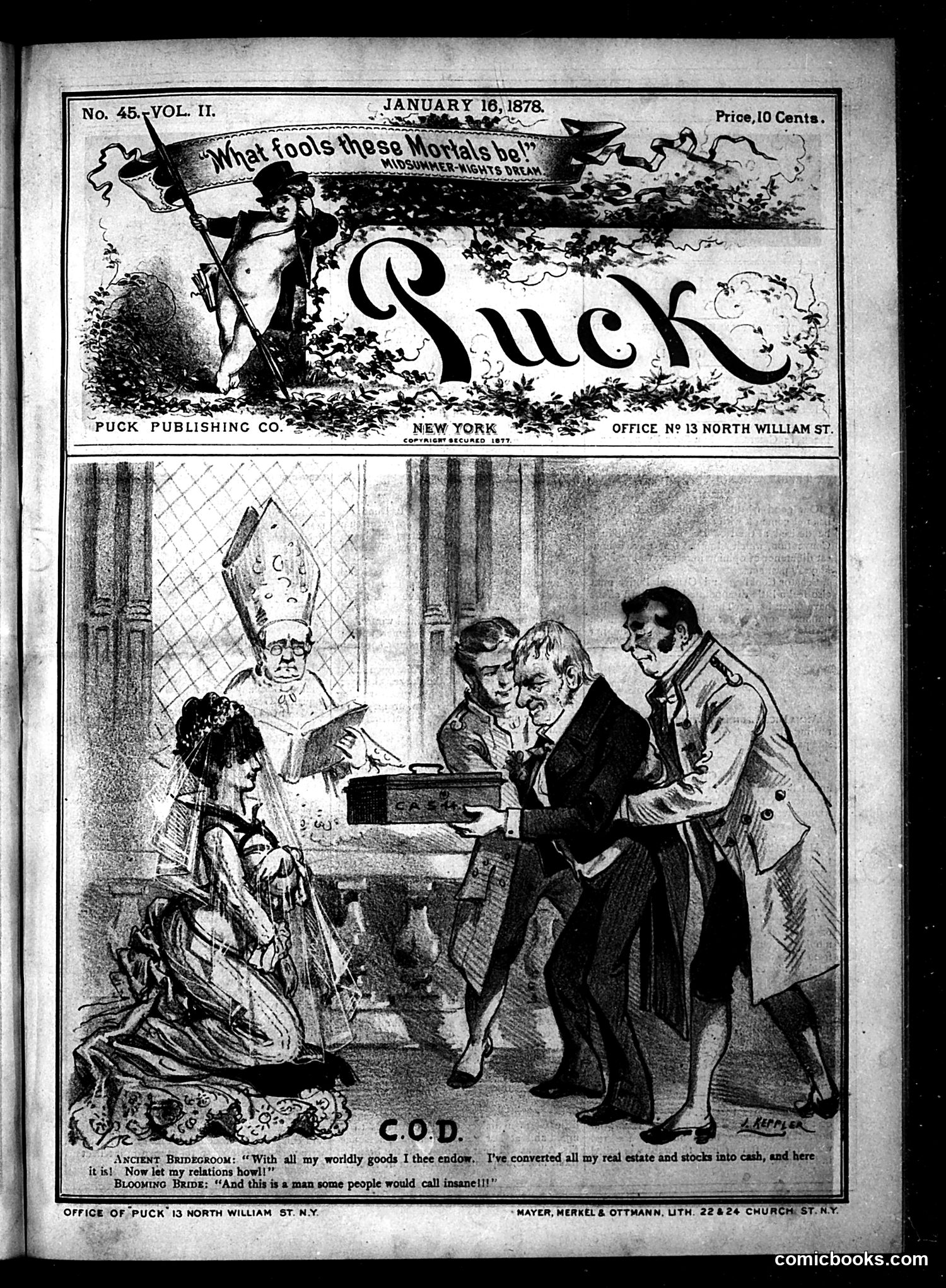
This Puck cartoon satirizes a wealthy woman's conversion to spiritualism. The "Ancient Bridegroom" (a ghost or spiritual apparition) claims he's converted her worldly assets—real estate and stocks—to cash. The "Blooming Bride" responds that spiritualists would call this "insane." The satire targets two concerns: wealthy women being financially exploited by spiritualist con artists posing as supernatural intermediaries, and the broader 1870s spiritualism craze that swept America. The "C.O.D." (Cash on Delivery) title suggests the woman is essentially buying spiritual communion at a high financial price—paying the medium to contact the supernatural rather than receiving genuine spiritual contact. The cartoon mocks both spiritualism as fraud and gullible wealthy patrons.
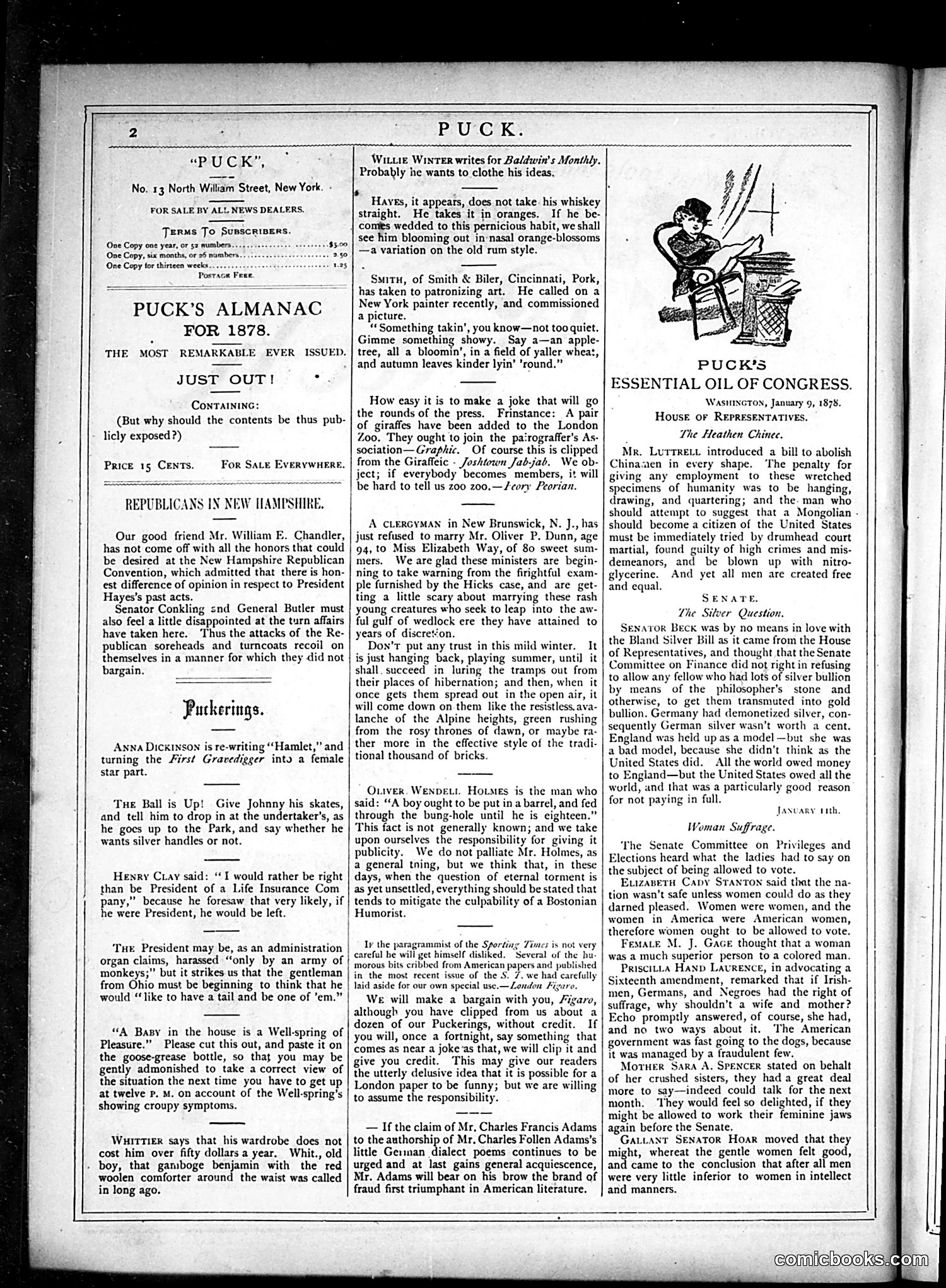
The page features "Puck's Essential Oil of Congress" (dated January 9, 1878), satirizing the U.S. Senate's debate over women's suffrage. The cartoon critiques senators opposing voting rights for women. The text mocks Senator Beck's claim that women voting would corrupt them, and records responses from other senators defending women's intellectual capacity. Senator Sargent is quoted supporting female suffrage, while others made dismissive arguments—one senator apparently claimed a woman was superior to a colored man, revealing the racist and sexist logic of the era. The satire targets the Senate's patronizing, contradictory arguments against women's voting rights, exposing the absurdity and bigotry underlying their opposition during this pivotal suffrage debate.
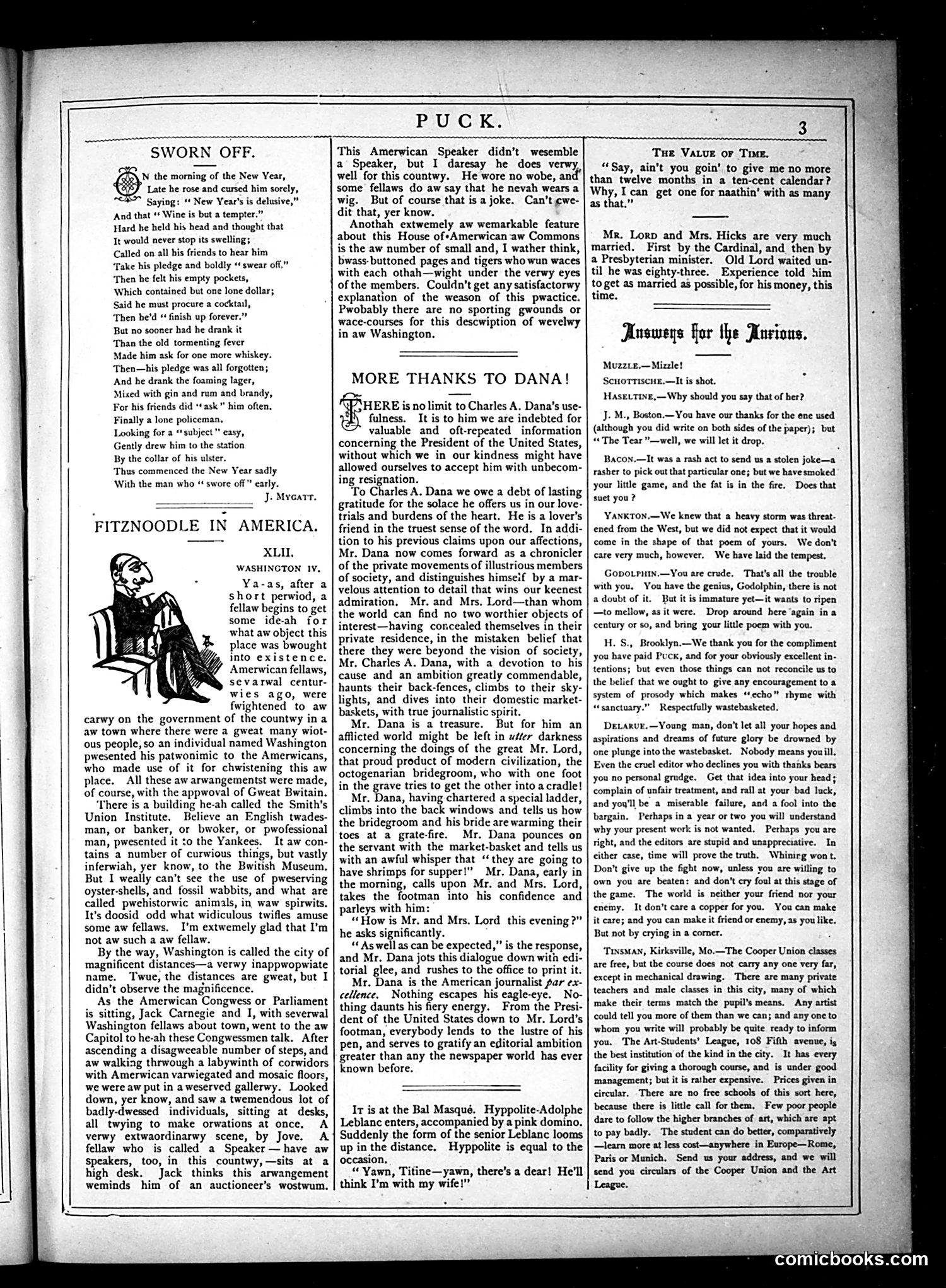
This page contains three distinct pieces: 1. **"Sworn Off"** — A New Year's poem about someone renouncing drinking, following the traditional New Year's resolution theme. 2. **"Fitznoodle in America"** — A satirical sketch about an Englishman visiting Washington, D.C. The humor centers on American pretensions: he observes grand government buildings but finds them architecturally derivative and culturally immature. The piece mocks both American boasting about its institutions and British snobbery toward American civilization. 3. **"Answers for the Anxious"** — An advice column addressing reader inquiries on various domestic and social matters. The page primarily features literary satire rather than visual political cartoons, typical of Puck's mixed-content format during this period.
This page contains no cartoon illustrations—it is primarily text. The left column continues "Puck's History of the United States," Chapter XXIII, detailing Civil War naval engagements involving the USS Trent and Confederate diplomats Mason and Slidell. The narrative discusses Union General Hallock's Tennessee River campaign and various naval confrontations. The right column shifts to "Literary Notes," reviewing contemporary works including Longfellow's poetry, James Barton's illustrated book on "Caricature," Juliet Corson's cookbook, and When Scribe's collected plays. This appears to be a typical Puck editorial page blending historical serialization with cultural criticism—no political satire or caricature is evident on this particular page.
This page contains satirical essays rather than visual cartoons. The left column, "Fashion and Its Foibles," mocks wealthy society figures—particularly Mrs. Kressnip of Murray Hill—for obsessive concern with fashionable appearance and etiquette. The piece satirizes how the upper class treats fashion rules as moral imperatives while neglecting genuine virtues. The right column features "Fables" by "A Man of the World," including moral tales about a Calf challenging a Bull, a Dramatist criticizing theater critics, and a Gorilla. These use animal characters to mock human pretension and social hypocrisy—particularly among the wealthy and those seeking social status. The overall satire targets Gilded Age excess and superficiality among New York's elite.
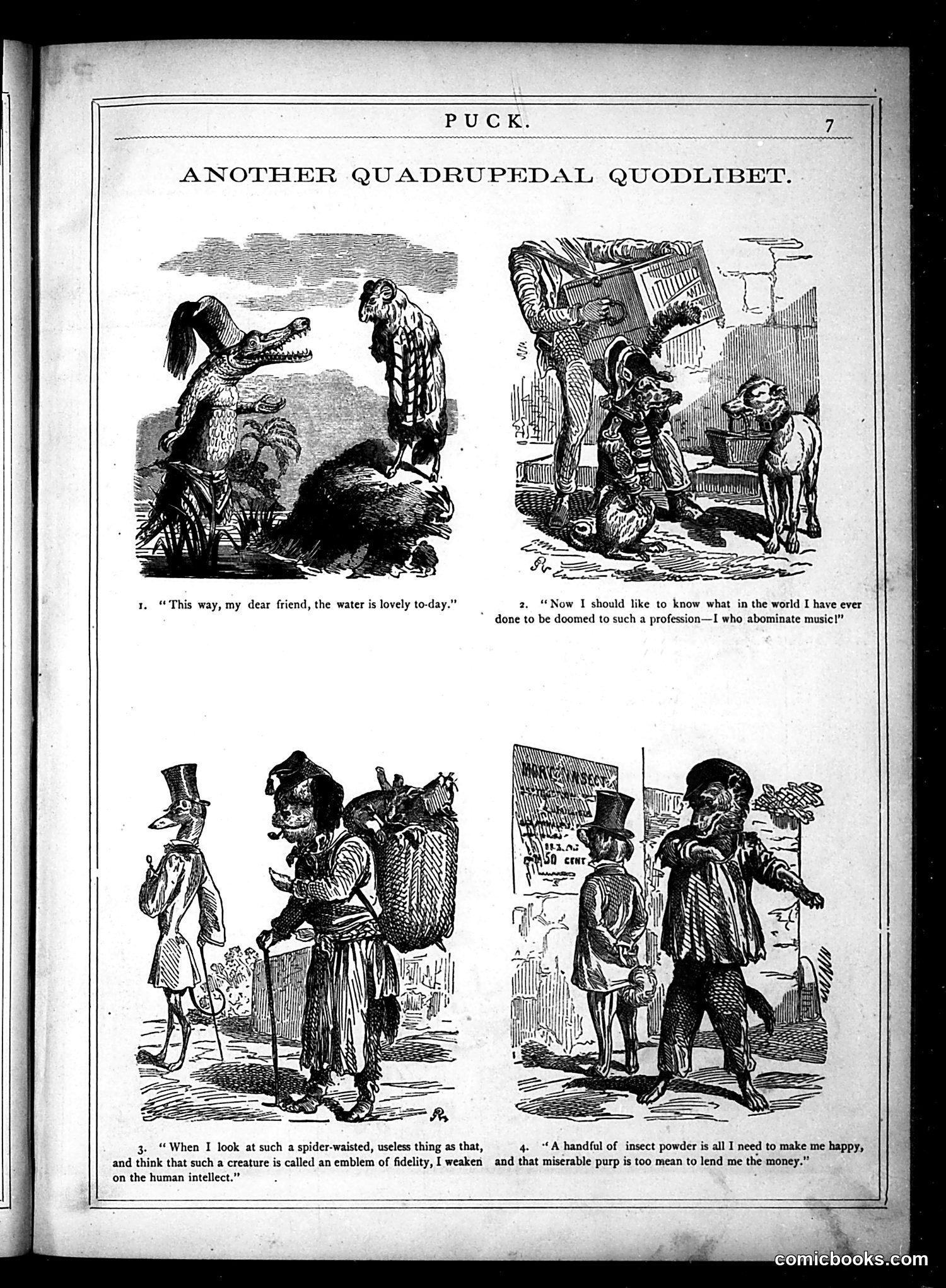
This four-panel satirical cartoon mocks various human professions and character flaws through animal caricatures engaging in absurd conversations. Panel 1 depicts two creatures by water; Panel 2 shows a figure complaining about being forced into music despite abominating it—likely satirizing forced career choices or nepotism in 19th-century professions. Panel 3 features a character lamenting that a "spider-waisted, useless thing" called fidelity weakens human intellect—mocking romantic sentimentality as foolish. Panel 4 presents someone claiming insect powder alone suffices for happiness, dismissing a "miserable purp" as unworthy of money—satirizing materialism and shallow values. The title "Quodlibet" (a miscellaneous collection) suggests these are disconnected social criticisms unified by grotesque animal-human hybrids commenting on Victorian society's pretensions and contradictions.
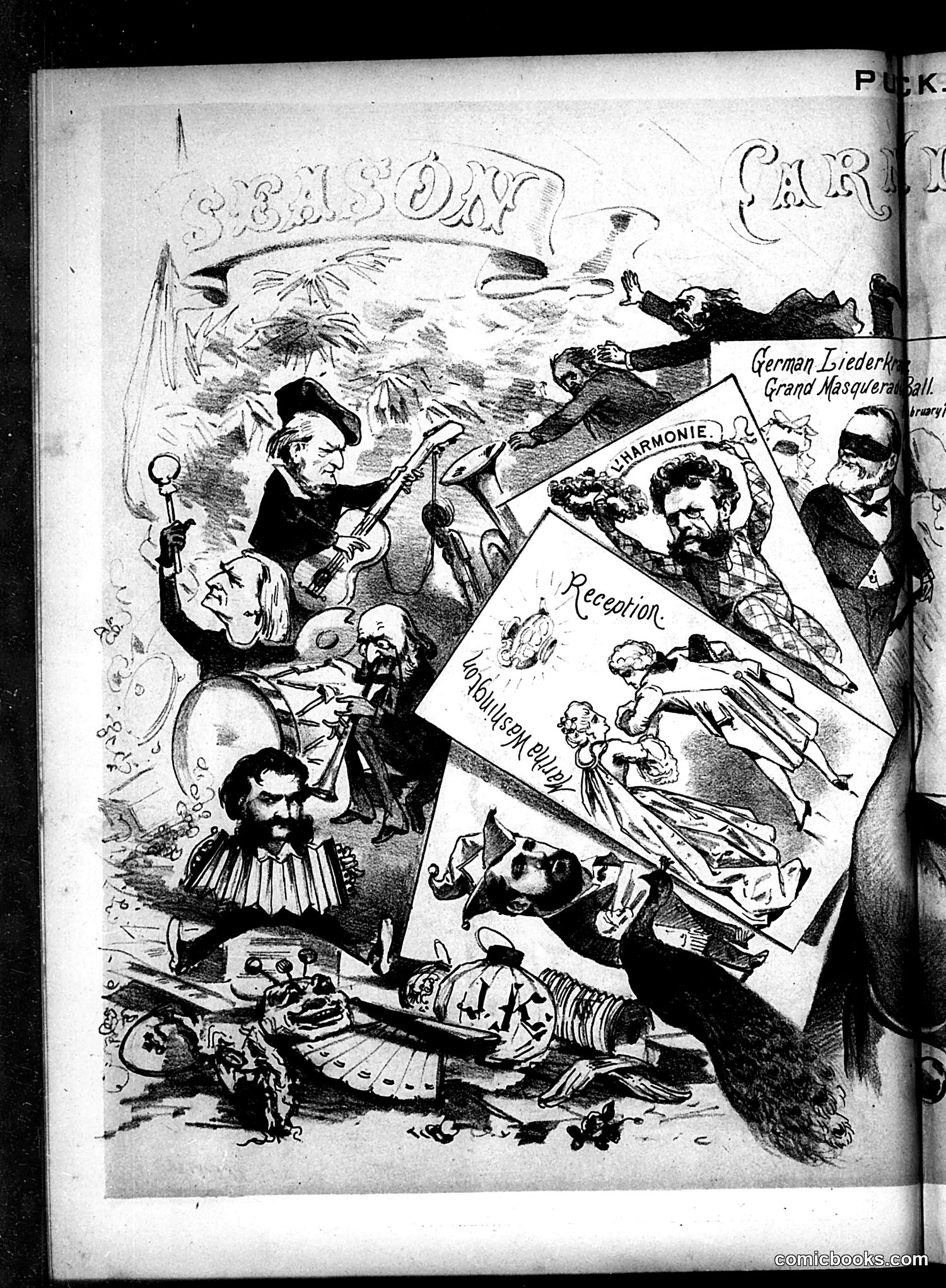
This satirical cartoon depicts a theatrical carnival or "Seaside Carnival" scene featuring German Liederkranz (a German-American male singing group) performers and what appears to be entertainment acts. The visible labels reference "German Liederkranz Grand Masquerade Ball," "Harmonie," and "Reception." The composition shows caricatured figures in performance dress, with smaller theatrical vignettes displayed within the main image—suggesting multiple entertainment acts or performances. The style is typical of Puck's late 19th-century satirical approach, likely mocking German-American cultural events or social pretensions of immigrant communities. Without clearer dates or additional context, the specific political target remains unclear, though the exaggerated caricatures and chaotic composition suggest mockery of the event's organization or participants' self-importance.
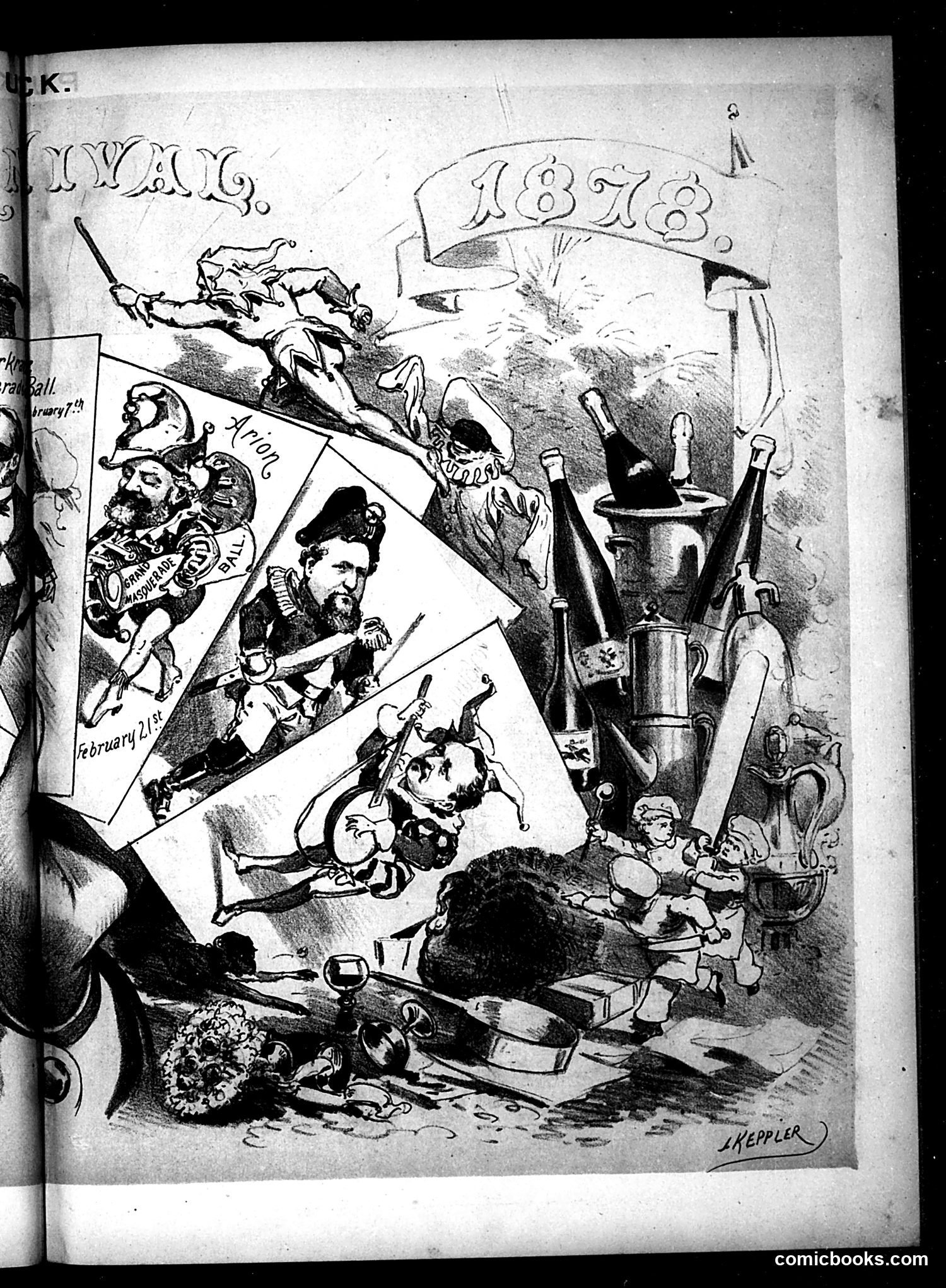
This Puck cartoon satirizes the year 1878 through allegorical imagery. The central cauldron labeled "1878" appears to be a witch's brew or alchemical vessel—suggesting the year brought chaotic, turbulent, or suspicious political developments. The figures around it seem to represent political actors or forces of the time, depicted as witches, demons, or supernatural beings engaged in magical/destructive activities. Small portrait vignettes on the left (including one marked "February 21st") appear to reference specific political figures or events from early 1878. The overall message appears critical: the year 1878 is presented as dangerous, unstable, or morally suspect—a bubbling cauldron of political intrigue and questionable dealings. The witch/occult imagery suggests hidden manipulation or dark intentions behind contemporary political events.
This page features a satirical article about sensationalist journalism. The piece mocks how newspapers compete for readers through increasingly lurid headlines and invented stories—even fabricating crimes and scandals. The humor targets the era's "yellow journalism," where papers prioritized shocking content over accuracy. References include a fabricated murder of a young girl in the East River and invented stories about political figures and scandals, all designed to boost circulation. The satire critiques how newspapers manipulate readers and spread misinformation to increase profits. The article presents absurd dialogue between editors discussing their unethical practices—inventing stories, suppressing facts, and prioritizing sensationalism over truth. This reflects genuine late-19th/early-20th-century concerns about press irresponsibility and the damage caused by competitive, unscrupulous journalism.
This page from *Puck* magazine contains a literary narrative titled "The Fuel in Herne Wood," extracted from "The Case of Mr. Lionel Farrago" by Wilkie Collins. The page is primarily text-based rather than cartoon-based, presenting a serialized fiction story structured as testimony. It begins with "The Telegram," featuring a character named John Byne, a managing clerk, providing a written account to solicitors about events from mid-June 1817. The narrative describes a young woman's journey from Jamaica to England, her family conflicts, romantic entanglements, and various social complications of the period. There are no political cartoons or satirical illustrations visible on this page—it functions as a magazine's literary content section rather than its satirical commentary section.
This page contains three separate humorous articles rather than political cartoons: 1. **"A Woman's Clavicle"** satirizes why women supposedly can't throw stones, attributing it to anatomical differences in the shoulder bone structure that prevent the full arm motion needed for throwing. 2. **"He Came Back"** recounts an anecdote about Governor Duval of Florida and his son, detailing the boy's return from Washington after years away, with emphasis on family reunion and personal growth. 3. **"A Knotty Affair"** discusses a shooting incident involving Alexander Short and John S. Nott, examining conflicting accounts of who shot whom and questioning witness reliability. The page demonstrates Puck's mix of light social commentary, personal anecdotes, and local news stories presented with satirical humor typical of 19th-century American humor magazines.
This page consists entirely of short satirical items and jokes rather than cartoons. The content targets various social absurdities of the era: **Key targets include:** - Aristocratic marriage practices (Lord family marrying "Holladay Schmaltz") - Cockney dialect and working-class affectations - New York society figures and their pretensions - Gender roles (French teachers being "masculine") - Animal cruelty in aquariums - Mark Twain's irreverent humor - Fashion trends and social conventions The satire employs brief anecdotes, attributed quotes, and observational humor to mock contemporary manners, class distinctions, and cultural pretensions. Without illustrations, the humor relies entirely on witty commentary and ironic wordplay—typical of Puck's "paragraph humor" format that filled pages between major political cartoons.
This page is primarily **advertising and administrative content** rather than political satire. The right side features a "Special Announcement" from Puck's publishing company advertising their new "General Designing Office" headed by cartoonist **Joseph Keppler**. They're promoting services including illustrations, theatrical profession lithographic portraits, and compressed yeast advertising (visible in the Fleischmann's Yeast ad). The left side contains miscellaneous satirical snippets and jokes typical of Puck's format—brief humorous observations about society, gender relations, and current events—but these are fragmentary one-liners rather than developed cartoons, making specific historical references difficult to identify without additional context. The page serves primarily as a business announcement rather than substantial political commentary.
This page is primarily filled with late 19th-century advertisements rather than editorial cartoons. The ads feature various New York businesses: hat manufacturers, wine importers, portrait photographers, printing companies, theaters, and a dental practice. The only editorial content is a "Letter from SIR HENRY IRVING" published in the Vanity Fair section, discussing his experience with French cigarettes and tobacco during a theatrical tour. Irving was a famous English actor-manager of the era, and the piece appears to be a humorous testimonial about his preferences. The page also advertises Puck's 1878 Almanac and offers back issues and patent covers for filing the magazine at $1.00 each.
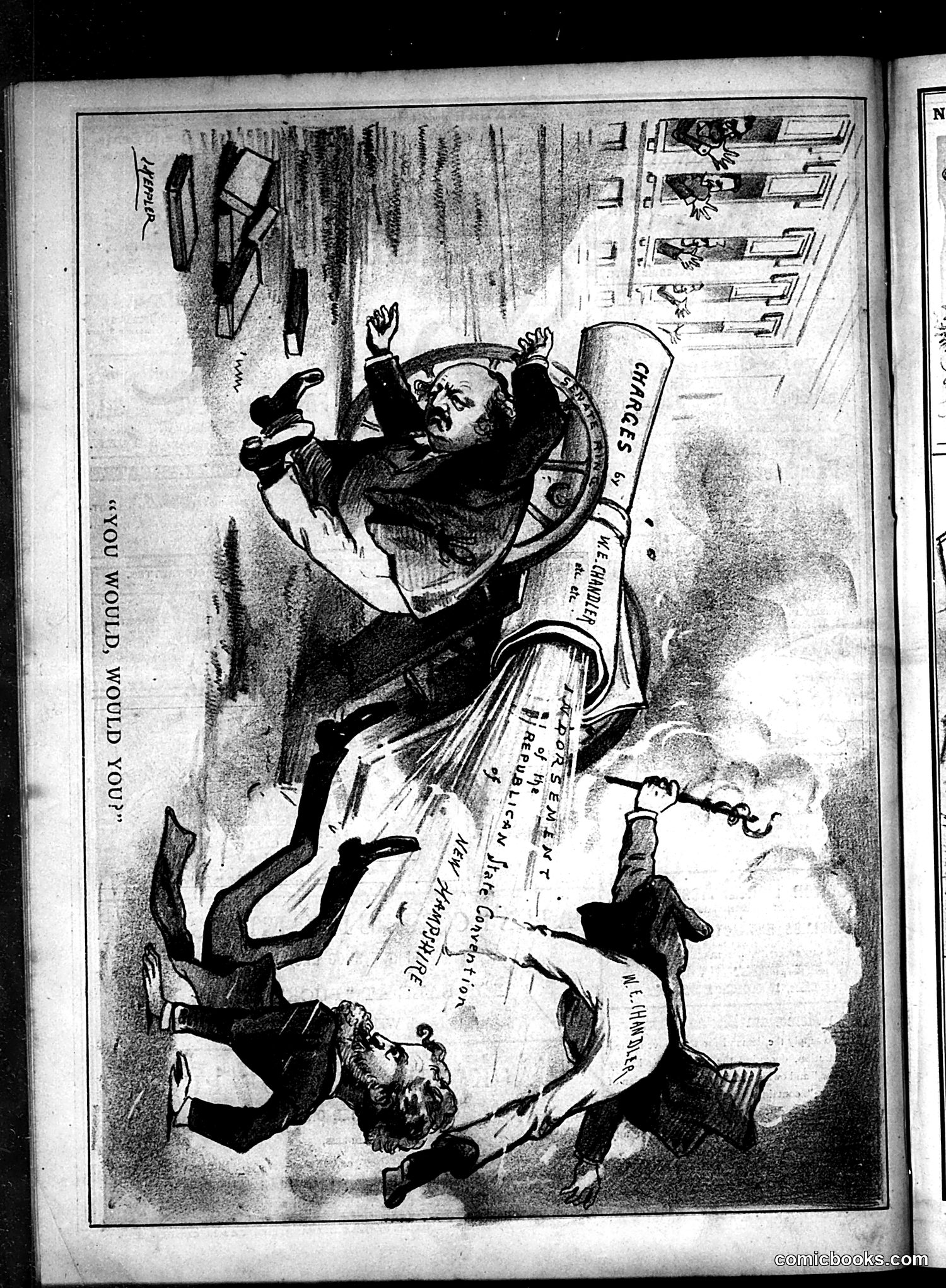
This is a satirical cartoon from *Puck* magazine depicting a figure trapped in what appears to be a wheel or circular mechanism labeled with text that's difficult to read clearly in this image quality. The central figure appears distressed, with arms raised, while smaller figures below seem to be operating or controlling the apparatus. The title reads "FROM MOULD YOU?" (or similar—OCR unclear). The cartoon likely criticizes some form of political manipulation, bureaucratic entanglement, or public policy that constrains individual freedom. The wheel imagery suggests a grinding, mechanistic system. Without clearer text visibility or a specific date, I cannot definitively identify which political figure or policy is targeted. The style and printing quality suggest late 19th or early 20th-century publication.