
Puck, 1878-01-16 · page 11 of 16
Puck — January 16, 1878 — page 11: what you’re looking at
What you’re looking at
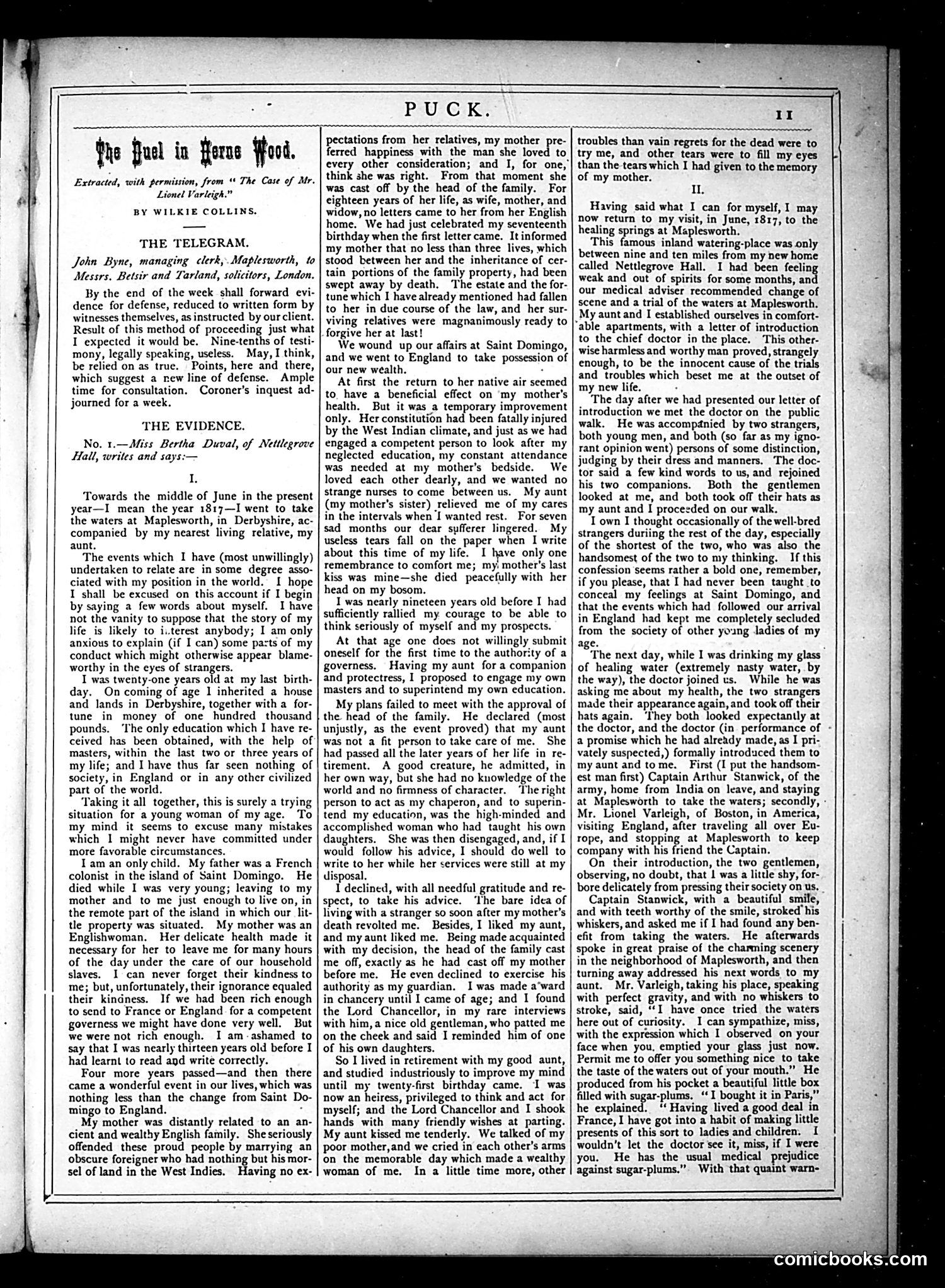
This page from *Puck* magazine contains a literary narrative titled "The Fuel in Herne Wood," extracted from "The Case of Mr. Lionel Farrago" by Wilkie Collins. The page is primarily text-based rather than cartoon-based, presenting a serialized fiction story structured as testimony. It begins with "The Telegram," featuring a character named John Byne, a managing clerk, providing a written account to solicitors about events from mid-June 1817. The narrative describes a young woman's journey from Jamaica to England, her family conflicts, romantic entanglements, and various social complications of the period. There are no political cartoons or satirical illustrations visible on this page—it functions as a magazine's literary content section rather than its satirical commentary section.
📄 Transcribed text from this page (OCR, searchable)
Machine-transcribed from the original scan — historical spelling and the odd misread are preserved.
PUCK. fhe fuel in fone food. Extracted, with permission, from “ The Case of Mr. Lionel Varleigh.” BY WILKIE COLLINS. THE TELEGRAM. John Byne, managing clerk,.Maplesworth, to Messrs. Betsir and Tarland, solicitors, London. By the end of the week shall forward evi- dence for defense, reduced to written form by witnesses themselves, as instructed by our client. Result of this method of proceeding just what I expected it would be. Nine-tenths of testi- mony, legally speaking, useless. May, I think, be relied on as true. Points, here and there, which suggest a new line of defense. Ample time for consultation. Coroner’s inquest ad- journed for a week. THE EVIDENCE. No. 1.—Miss Bertha Duval, of Netllegrove Hall, writes and says:— Towards the middle of June in the present year—I mean the year 1817—I went to take the waters at Maplesworth, in Derbyshire, ac- companied by my nearest living relative, my aunt. The events which I have (most unwillingly) undertaken to relate are in some degree asso- ciated with my position in the world. I hope I shall be excused on this account if I begin by saying a few words about myself. I have not the vanity to suppose that the story of my life is likely to iuterest anybody; I am only anxious to explain (if I can) some pazts of my conduct which might otherwise appear blame- worthy in the eyes of strangers. I was twenty-one years old at my last birth- day. On coming of age 1 inherited a house and lands in Derbyshire, together with a for- tune in money of one hundred thousand pounds. ‘The only education which I have re- ceived has been obtained, with the help of masters, within the last two or three years of my life; and I have thus far seen nothing of society, in England or in any other civilized part of the world. ‘Taking it all together, this is surely a trying situation for a young woman of my age. To my mind it seems to excuse many mistakes which I might never have committed under more favorable circumstances. Tam an only child. My father was a French colonist in the island of Saint Domingo. He died while I was very young; leaving to my mother and to me just enough to live on, in the remote part of the island in which our lit- tle property was situated. My mother was an Englishwoman. Her delicate health made it necessary for her to leave me for many hours of the day under the care of our household slaves. I can never forget their kindness to me; but, unfortunately, their ignorance equaled their kindness. If we had been rich enough to send to France or England for a competent governess we might have done very well. But we were not rich enough. I am-ashamed to say that I was nearly thirteen years old before I had learnt to read and write correctly. Four more years passed—and then there came a wonderful event in our lives, which was nothing less than the change from Saint Do- mingo to England. My mother was distantly related to an an- cient and wealthy English family. Sheseriously offended these proud people by marrying an obscure foreigner who had nothing but his mor- sel of land in the West Indies. Having no ex- pectations from her relatives, my mother pre- ferred happiness with the man she loved to every other consideration; and I, for one,’ think she was right. From that moment she was cast off by the head of the family. For eighteen years of her life, as wife, mother, and widow, no letters came to her from her English home. We had just celebrated my seventeenth birthday when the first letter came. It informed my mother that no less than three lives, which stood between her and the inheritance of cer- tain portions of the family property, had been swept away by death. ‘The estate and the for- tune which I have already mentioned had fallen to her in due course of the law, and her sur- viving relatives were magnanimously ready to |- forgive her at last! We wound up our affairs at Saint Domingo, and we went to England to take possession of our new wealth, = At first the return to her native air seemed to. have a beneficial effect on ‘my mother’s health. But it was a temporary improvement only. Herconstitution had been fatally injured by the West Indian climate, and just as we had engaged a competent person to look after my neglected education, my constant attendance was needed at my mother’s bedside. We loved each other dearly, and we wanted no strange nurses to come between us. My aunt (my mother's sister) relieved me of my cares in the intervals when I wanted rest. For seven sad months our dear sufferer lingered. My useless tears fall on the paper when I write about this time of my life. I have only one remembrance to comfort me; my; mother's last kiss was mine—she died peacefully with her head on my bosom. I was nearly nineteen years old before I had sufficiently rallied my courage to be able to think seriously of myself and my prospects. At that age one does not willingly submit oneself for the first time to the authority of a governess. Having my aunt for a companion and protectress, 1 proposed to engage my own masters and to superintend my own education. My plans failed to meet with the approval of the head of the family. He declared (most unjustly, as the event proved) that my aunt was not a fit person to take care of me. She had passed all the later years of her life in re- tirement. A good creature, he admitted, in her own way, but she had no knowledge of the world and no firmness of character. The right person to act as my chaperon, and to superin- tend my education, was the high-minded and accomplished woman who had taught his own daughters. She was then disengaged, and, if I would follow his advice, I should do well to write to her while her services were still at my disposal. I declined, with all needful gratitude and re- spect, to take his advice. ‘The bare idea of living with a stranger so soon after my mother’s death revolted me. Besides, I liked my aunt, and my aunt liked me. Being made acquainted with my decision, the head of the family cast me off, exactly as he had cast off my mother before me. He even declined to exercise his authority as my guardian. I was made a’ward in chancery until I came of age; and I found the Lord Chancellor, in my rare interviews with him, a nice old gentleman, who patted me on the cheek and said I reminded him of one of his own daughters. So I lived in retirement with my good aunt, and studied industriously to improve my mind until my twenty-first birthday came. ‘I was now an heiress privileged to think and act for myself; and the Lord Chancellor and I shook hands with many friendly wishes at parting. My aunt kissed me tenderly. We talked of my poor mother,and we cried in each other’s arms on the memorable day which made a wealthy woman of me. In a little time more, other troubles than vain regrets for the dead were to try me, and other tears were to fill my eyes than the tears which I had given to the memory of my mother. Il. Having said what I can for myself, I may now return to my visit, in June, 1817, to the healing springs at Maplesworth. This famous inland watering-place was only between nine and ten miles from my new home called Nettlegrove Hall. I had been feelin, weak and out of spirits for some months, an our medical adviser recommended change of scene and a trial of the waters at Maplesworth. My auntand I established ourselves in comfort- able apartments, with a letter of introduction to the chief doctor in the place. This other- wise harmless and worthy man proved, strangely enough, to be the innocent cause of the trials and troubles which beset me at the outset of my new life. : The day after we had presented our letter of introduction we met the doctor on the public walk. He was accompanied by two strangers, both young men, and both (so far as my igno- rant opinion went) persons of some distinction, judging by their dress and manners. The doc- tor said a few kind words to us, and rejoined his two companions. Both the gentlemen looked at me, and both took off their hats as my aunt and I proceeded on our walk. I own I thought occasionally of the well-bred strangers during the rest of the day, especially of the shortest of the two, who was also the handsomest of the two to my thinking. If this confession seems rather a bold one, remember, if you please, that I had never been taught to conceal my feelings at Saint Domingo, and that the events which had followed our arrival in England had kept me completely secluded from the society of other young Jadies of my age. eThe next day, while I was drinking my glass of healing water (extremely nasty water, by the way), the doctor joined us. While he was asking me about my health, the two strangers made their appearance again, and took off their hats again. ‘They both looked expectantly at the doctor, and the doctor (in performance of - a promise which he had already made, as I pri- vately suspected,) formally introduced them to my aunt and tome. First (I put the handsom- est man first) Captain Arthur Stanwick, of the army, home from India on leave, and staying at Maplesworth to take the waters; secondly, - Mr. Lionel Varleigh, of Boston, in America, visiting England, after traveling all over Eu- rope, and stopping at Maplesworth to keep company with his friend the Captain. On their introduction, the two gentlemen, observing, no doubt, that | was a little shy, for- bore delicately from pressing their society on us, Captain Stanwick, with a beautiful smile, and with teeth worthy of the smile, stroked’ his whiskers, and asked me if I had found any ben- efit from taking the waters. He afterwards spoke in great praise of the charming scenery in the neighborhood of Maplesworth, and then turning away addressed his next words to my aunt. Mr. Varleigh, taking his place, speaking with perfect gravity, and with no whiskers to stroke, said, ‘I have once tried the waters here out of curiosity. I can sympathize, miss, with the expression which I observed on your face when you, emptied your glass just now. Permit me to offer you something nice to take the taste of the waters out of your mouth.” He produced from his pocket a beautiful little box filled with sugar-plums. “I bought it in Paris,” he explained. ‘‘ Having lived a good deal in France, I have got into a habit of making little presents of this sort to ladies and children. I wouldn't let the doctor see it, miss, if I were you. He has the usual medical prejudice against sugar-plums.”. With that quaint warn-