
Puck, 1878-01-16 · page 6 of 16
Puck — January 16, 1878 — page 6: what you’re looking at
What you’re looking at
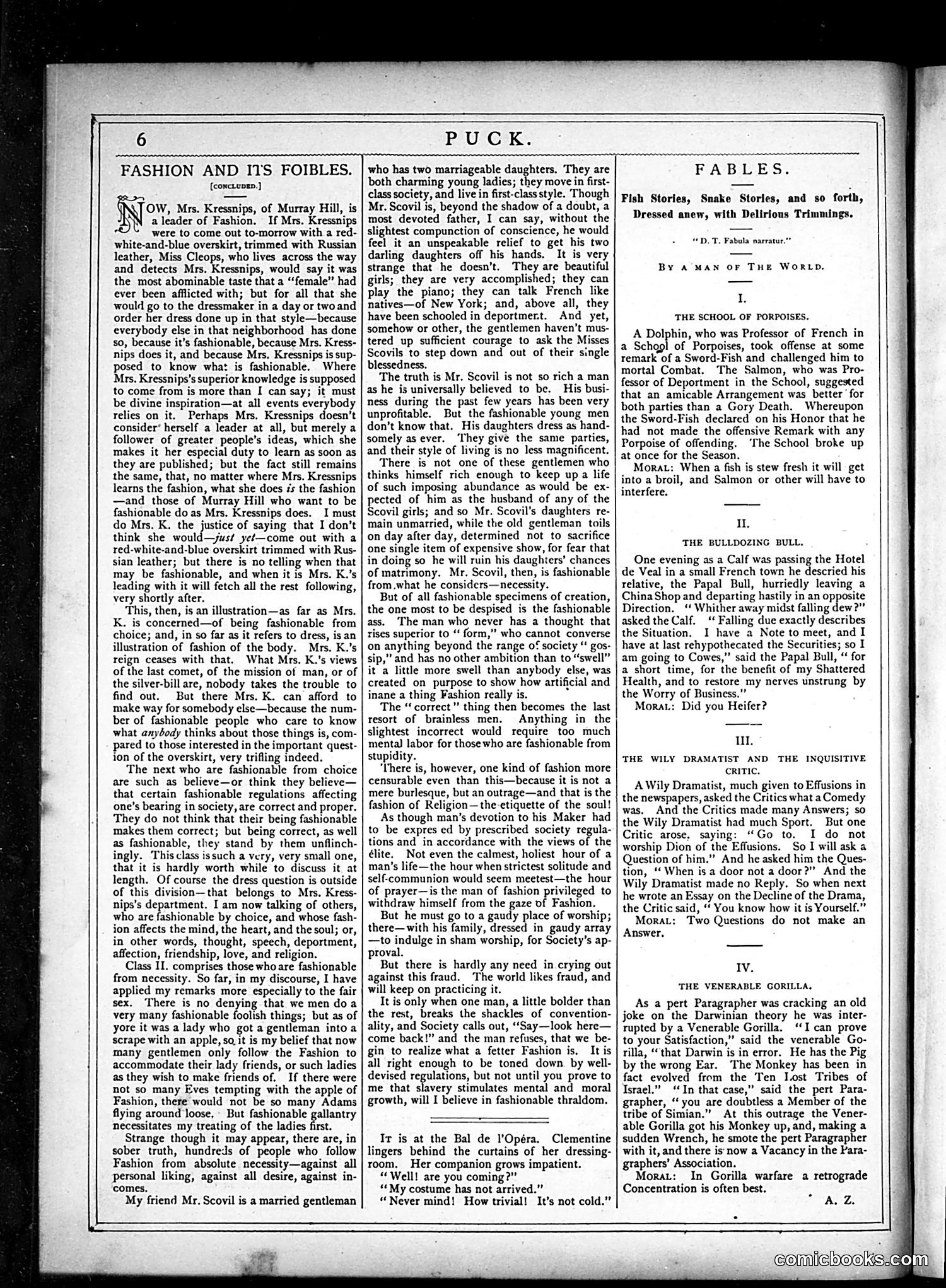
This page contains satirical essays rather than visual cartoons. The left column, "Fashion and Its Foibles," mocks wealthy society figures—particularly Mrs. Kressnip of Murray Hill—for obsessive concern with fashionable appearance and etiquette. The piece satirizes how the upper class treats fashion rules as moral imperatives while neglecting genuine virtues. The right column features "Fables" by "A Man of the World," including moral tales about a Calf challenging a Bull, a Dramatist criticizing theater critics, and a Gorilla. These use animal characters to mock human pretension and social hypocrisy—particularly among the wealthy and those seeking social status. The overall satire targets Gilded Age excess and superficiality among New York's elite.
📄 Transcribed text from this page (OCR, searchable)
Machine-transcribed from the original scan — historical spelling and the odd misread are preserved.
6 PUCK. FASHION AND ITS FOIBLES. (conceupen.} OW, Mrs. Kressnips, of Murray Hill, is ‘a leader of Fashion. If Mrs. Kressnips were to come out to-morrow with a red- white-and-blue overskirt, trimmed with Russian leather, Miss Cleops, who lives across the way and detects Mrs. Kressnips, would say it was the most abominable taste that a “female” had ever been afflicted with; but for all that she would go to the dressmaker in a day or twoand order her dress done up in that style—because everybody else in that neighborhood has done so, because it’s fashionable, because Mrs. Kress- nips does it, and because Mrs. Kressnips is sup- posed to know what is fashionable. Where Mrs. Kressnips’s superior knowledge is supposed to come from is more than I can say; it must be divine inspiration—at all events everybody relies on it. Perhaps Mrs. Kressnips doesn’t consider’ herself a leader at all, but merely a follower of greater people’s ideas, which she makes it her especial duty to learn as soon as they are published; but the fact still remains the same, that, no matter where Mrs. Kressnips learns the fashion, what she does #s the fashion —and those of Murray Hill who want to be fashionable do as Mrs. Kressnips does. I must do Mrs. K. the justice of saying that I don’t think she would just yet—come out with a red-white-and-blue overskirt trimmed with Rus- sian leather; but there is no telling when that may be fashionable, and when it is Mrs. K.’'s leading with it will fetch all the rest following, very shortly after. This, then, is an illustration—as far as Mrs. K. is concerned—of being fashionable from choice; and, in so far as it refers to dress, is an illustration of fashion of the body. Mrs. K.’s reign ceases with that. What Mrs. K.’s views of the last comet, of the mission of man, or of the silver-bill are, nobody takes the trouble to find out. But there Mrs. K. can afford to make way for somebody else—because the num- ber of fashionable people who care to know what anybody thinks about those things is, com- pared to those interested in the important quest- ion of the overskirt, very trifling indeed. The next who are fashionable from choice are such as believe—or think they believe— that certain fashionable regulations affecting one’s bearing in society, are correct and proper. They do not think that their being fashionable makes them correct; but being correct, as well as fashionable, they stand by them unflinch- ingly. This lass issuch a very, very small one, that it is hardly worth while to discuss it at length. Of course the dress question is outside of this division—that belongs to Mrs. Kress- nips’s department. I am now talking of others, who are fashionable by choice, and whose fash- ion affects the mind, the heart, and the soul; or, in other words, thought, speech, deportment, affection, friendship, love, and religion. Class II. comprises those who are fashionable from necessity. So far, in my discourse, I have applied my remarks more especially to the fair sex. There is no denying that we men doa very many fashionable foolish things; but as of yore it was a lady who got a gentleman into a scrape with an apple, so it is my belief that now many gentlemen only follow the Fashion to accommodate their lady friends, or such ladies as they wish to make friends of. If there were not so many Eves tempting with the apple of Fashion, there would not be so many Adams flying around loose.» But fashionable gallantry necessitates my treating of the ladies frst. Strange though it may appear, there are, in sober truth, hundreds of people who follow Fashion from absolute necessity—against all personal liking, against all desire, against in- ‘comes. My friend Mr. Scovil is a married gentleman who has two marriageable daughters. They are both charming young ladies; they move in first- class society, and live in first-class style. Though Mr. Scovil is, beyond the shadow of a doubt, a most devoted father, I can say, without the slightest compunction of conscience, he would feel it an unspeakable relief to get his two darling daughters off his hands. It is very strange that he doesn’t. They are beautiful girls; they are very accomplished; they can play the piano; they can talk French like natives—of New York; and, above all, they have been schooled in deportmert. And yet, somehow or other, the gentlemen haven’t mus- tered up sufficient courage to ask the Misses Scovils to step down and out of their single blessedness. The truth is Mr. Scovil is not so rich a man as he is universally believed to be. His busi- ness during the past few years has been very unprofitable. But the fashionable young men don’t know that. His daughters dress as hand- somely as ever. ‘They give the same parties, and their style of living is no less magnificent. There is not one of these gentlemen who thinks himself rich enough to keep up a life of such imposing abundance as would be ex- pected of him as the husband of any of the Scovil girls; and so Mr. Scovil’s daughters re- main unmarried, while the old gentleman toils on day after day, determined not to sacrifice ‘one single item of expensive show, for fear that in doing so he will ruin his daughters’ chances of matrimony. Mr. Scovil, then, is fashionable from what he considers—necessity. But of all fashionable specimens of creation, the one most to be despised is the fashionable ass. ‘The man who never has a thought that rises superior to “ form,” who cannot converse on anything beyond the range of society “ gos- sip,” and has no other ambition than to “swell” it a little more swell than anybody else, was created on purpose to show how artificial and inane a thing Fashion really is. The “correct” thing then becomes the last resort of brainless men. Anything in the slightest incorrect would require too much mental labor for those who are fashionable from stupidity. ‘There is, however, one kind of fashion more censurable even than this—because it is not a mere burlesque, but an outrage—and that is the fashion of Religion—the-etiquette of the soul! As though man’s devotion to his Maker had to be expres ed by prescribed society regula- tions and in accordance with the views of the élite. Not even the calmest, holiest hour of a man's life—the hour when strictest solitude and self-communion would seem meetest—the hour of prayer—is the man of fashion privileged to withdraw himself from the gaze of Fashion. But he must go to a gaudy place of worship; there—with his family, dressed in gaudy array —to indulge in sham worship, for Society's ap- proval. But there is hardly any need in.crying out against this fraud. The world likes fraud, and will keep on practicing it. It is only when one man, a little bolder than the rest, breaks the shackles of convention- ality, and Society calls out, “Say—look here— come back!” and the man refuses, that we be- gin to realize what a fetter Fashion is. It is all right enough to be toned down by well- devised regulations, but not until you prove to me that slavery stimulates mental and moral growth, will I believe in fashionable thraldom. Ir is at the Bal de l'Opéra. Clementine lingers behind the curtains of her dressing- room. Her companion grows impatient. “Well! are you coming?” ‘My costume has not arrived.” “Never mind! How trivial! It’s not cold.” FABLES. Fish Stories, Snake Stories, and so forth, Dressed anew, with Delirious Trimmings. “D.T. Fabola narratur.”* By A MAN OF THE WoRLD. I, THE SCHOOL OF PORPOISES. A Dolphin, who was Professor of French in a School of Porpoises, took offense at some remark of a Sword-Fish and challenged him to mortal Combat. The Salmon, who was Pro- fessor of Deportment in the School, suggested that an amicable Arrangement was better for both parties than a Gory Death. Whereupon the Sword-Fish declared on his Honor that he had not made the offensive Remark with any Porpoise of offending. ‘The School broke up at once for the Season. Morar: When a fish is stew fresh it will get into a broil, and Salmon or other will have to interfere. I. THE BULLDOZING BULL. One evening as a Calf was passing the Hotel de Veal in a small French town he descried his relative, the Papal Bull, hurriedly leaving a China Shop and departing hastily in an opposite Direction. ‘“ Whither away midst falling dew?” asked the Calf.‘ Falling due exactly describes the Situation. I have a Note to meet, and I have at last rehypothecated the Securities; so I am going to Cowes,” said the Papal Bull, “ for a short time, for the benefit of my Shattered Health, and to restore my nerves unstrung by the Worry of Business.” Morat: Did you Heifer? lll. THE WILY DRAMATIST AND THE INQUISITIVE CRITIC. A Wily Dramatist, much given to Effusions in the newspapers, asked the Critics what a Comedy was, And the Critics made many Answers; so the Wily Dramatist had much Sport. But one Critic arose, saying: “Go to. I do not worship Dion of the Effusions. So I will ask a Question of him.” And he asked him the Ques- tion, ‘When is a door not a door?” And the Wily Dramatist made no Reply. So when next he wrote an Essay on the Decline of the Drama, the Critic said, ‘ You know how it is Yourself.” Mora: Two Questions do not make an Answer, Iv. ‘THE VENERABLE GORILLA, As a pert Paragrapher was cracking an old joke on the Darwinian theory he was inter- rupted by a Venerable Gorilla. ‘I can prove to your Satisfaction,” said the venerable Go- rilla, “that Darwin is in error. He has the Pig by the wrong Ear. ‘The Monkey has been in fact evolved from the Ten lost Tribes of Israel.” ‘In that case,” said the pert Para- grapher, ‘ you are doubtless a Member of the tribe of Simian.” At this outrage the Vener- able Gorilla got his Monkey up, and, making a sudden Wrench, he smote the pert Paragrapher with it, and there is now a Vacancy in the Para- graphers’ Association, Morat: In Gorilla warfare a retrograde Concentration is often best. A. Z. —— comichooks.eei