
Puck, 1878-01-16 · page 3 of 16
Puck — January 16, 1878 — page 3: what you’re looking at
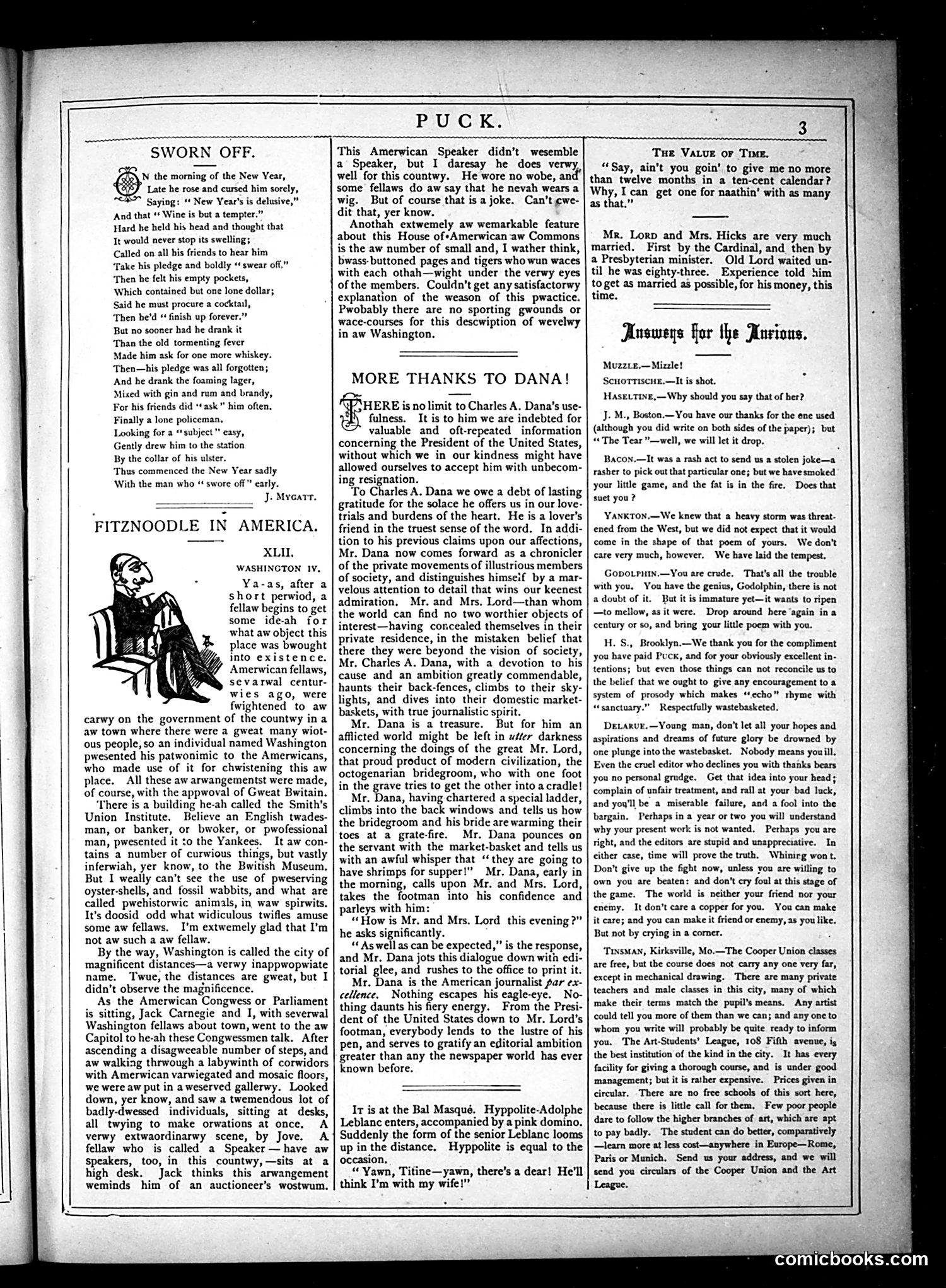
What you’re looking at
This page contains three distinct pieces: 1. **"Sworn Off"** — A New Year's poem about someone renouncing drinking, following the traditional New Year's resolution theme. 2. **"Fitznoodle in America"** — A satirical sketch about an Englishman visiting Washington, D.C. The humor centers on American pretensions: he observes grand government buildings but finds them architecturally derivative and culturally immature. The piece mocks both American boasting about its institutions and British snobbery toward American civilization. 3. **"Answers for the Anxious"** — An advice column addressing reader inquiries on various domestic and social matters. The page primarily features literary satire rather than visual political cartoons, typical of Puck's mixed-content format during this period.
📄 Transcribed text from this page (OCR, searchable)
Machine-transcribed from the original scan — historical spelling and the odd misread are preserved.
——— PUCK. SWORN OFF. N the morning of the New Year, Late he rose and cursed him sorely, “CAS Saying: New Year's is delusive,” ‘And that “Wine is but a tempter.” Hard he held his head and thought that It would never stop its swelling; Called on all his friends to hear him ‘Take his pledge and boldly ‘* swear off.” ‘Then he felt his empty pockets, Which contained but one lone dollar; Said he must procure a cocktail, Then he'd “finish up forever.” But no sooner had he drank it ‘Than the old tormenting fever Made him ask for one more whiskey. ‘Then—his pledge was all forgotten; And he drank the foaming lager, Mixed with gin and rum and brandy, For his friends did *¢ ask” him often. Finally a lone policeman, Looking for a ‘subject easy, Gently drew him to the station By the collar of his ulster. ‘Thus commenced the New Year sadly With the man who “ swore off” early. J. Mycarr. FITZNOODLE IN AMERICA. _—— XLII. WASHINGTON IV, Ya-as, after a short perwiod, a fellaw begins to get some ide-ah for what aw object this place was bwought into existence, Amerwican fellaws, sevarwal centur- wies ago, were fwightened to aw carwy on the government of the countwy in a aw town where there were a gweat many wiot- ous people, so an individual named Washington pwesented his patwonimic to the Amerwicans, who made use of it for chwistening this aw place. All these aw arwangementst were made, of course, with the appwoval of Gweat Bwitain. ‘There is a building he-ah called the Smith’s Union Institute. Believe an English twades- man, or banker, or bwoker, or pwofessional man, pwesented it to the Yankees. It aw con- tains a number of curwious things, but vastly inferwiah, yer know, to the Bwitish Museum. But I weally can’t see the use of pweserving oyster-shells, and fossil wabbits, and what are called pwehistorwic animals, in waw spirwits. It’s doosid odd what widiculous twifles amuse some aw fellaws. I'm extwemely glad that I’m not aw such a aw fellaw. By the way, Washington is called the city of magnificent distances—a verwy inappwopwiate name. Twue, the distances are gweat, but I didn’t observe the magnificence. As the Amerwican Congwess or Parliament is sitting, Jack Carnegie and I, with severwal Washington fellaws about town, went to the aw Capitol to he-ah these Congwessmen talk. After ascending a disagweeable number of steps, and aw walking thrwough a labywinth of corwidors with Amerwican varwiegated and mosaic floors, we were aw put in aweserved gallerwy. Looked down, yer know, and saw a twemendous lot of badly-dwessed individuals, sitting at desks, all twying to make orwations at once, A verwy extwaordinarwy scene, by Jove. A fellaw who is called a Speaker —have aw speakers, too, in this countwy,—sits at a high desk. Jack thinks this arwangement weminds him of an auctioneer’s wostwum, This Amerwican Speaker didn’t wesemble a Speaker, but I daresay he does verwy well for this countwy. He wore no wobe, ant some fellaws do aw say that he nevah wears a wig. But of course that is a joke. Can't cwe- dit that, yer know. Anothah extwemely aw wemarkable feature about this House of*Amerwican aw Commons is the aw number of small and, I wather think, bwass- buttoned pages and tigers who wun waces with each othah—wight under the verwy eyes ofthe members. Couldn't get any satisfactorwy explanation of the weason of this pwactice. Pwobably there are no sporting gwounds or wace-courses for this descwiption of wevelwy in aw Washington. MORE THANKS TO DANA! HERE is no limit to Charles A. Dana’s use- fulness. It is to him we are indebted for valuable and oft-repeated information concerning the President of the United States, without which we in our kindness might have allowed ourselves to accept him with unbecom- ing resignation. To Charles A. Dana we owe a debt of lasting gratitude for the solace he offers us in our love- trials and burdens of the heart. He is a lover's friend in the truest sense of the word. In addi- tion to his previous claims upon our affections, Mr. Dana now comes forward as a chronicler of the private movements of illustrious members of society, and distinguishes himseif by a mar- velous attention to detail that wins our keenest admiration, Mr. and Mrs. Lord—than whom the world can find no two worthier objects of interest—having concealed themselves in their private residence, in the mistaken belief that there they were beyond the vision of society, Mr. Charles A. Dana, with a devotion to his cause and an ambition greatly commendable, haunts their back-fences, climbs to their sky- lights, and dives into their domestic market- baskets, with true journalistic spirit. Mr. Dana is a treasure. But for him an afflicted world might be left in uéer darkness concerning the doings of the great Mr. Lord, that proud product of modern civilization, the octogenarian bridegroom, who with one foot in the grave tries to get the other into acradle! Mr. Dana, having chartered a special ladder, climbs into the back windows and tells us how the bridegroom and his bride are warming their toes at a grate-fire. Mr. Dana pounces on the servant with the market-basket and tells us with an awful whisper that “they are going to have shrimps for supper!" Mr. Dana, early in the morning, calls upon Mr. and Mrs. Lord, takes the footman into his confidence and parleys with him: “How is Mr. and Mrs. Lord this evening ?” he asks significantly. « Aswell as can be expected,” is the response, and Mr. Dana jots this dialogue down with edi- torial glee, and rushes to the office to print it. Mr. Dana is the American journalist par ¢x- cellence. Nothing escapes his eagle-eye. No- thing daunts his fiery energy. From the Presi- dent of the United States down to Mr. Lord’s footman, everybody lends to the lustre of his pen, and serves to gratify an editorial ambition greater than any the newspaper world has ever known before. Ir is at the Bal Masqué. Hyppolite-Adolphe Leblanc enters, accompanied by a pink domino. Suddenly the form of the senior Leblanc looms up in the distance, Hyppolite is equal to the occasion, “ Yawn, Titine—yawn, there's a dear! He'll think I’m with my wife!” Tue VALuE or Time. “Say, ain't you goin’ to give me no more than twelve months in a ten-cent calendar? Why, I can get one for naathin’ with as many as that.” Mr. Lorp and Mrs. Hicks are very much married. First by the Cardinal, and then by a Presbyterian minister. Old Lord waited un- til he was eighty-three. Experience told him to get as married as possible, for his money, this time. Answeys for the Anrious. Muzzte.. Scuorriscue. HaseuTine,—Why should you say that of her? J. M., Boston.—You have our thanks for the ene used (although you did write on both sides of the paper); but “The Tear "—well, we will let it drop. Bacon.—It was a rash act to send us a stolen joke—a rasher to pick out that particular one; but we have smoked your little game, and the fat is in the fire. Does that suet you ? YANKTON.—We knew that a heavy storm was threat- ened from the West, but we did not expect that it would come in the shape of that poem of yours. We don’t care very much, however. We have laid the tempest. Govo.rity.—You are crude. That's all the trouble with you, You have the genius, Godol; adoubt of it. But it is immature yet—it wants to ripen —to mellow, as it were. Drop around here again ina century or so, and bring your little poem with you. H. S., Brooklyn.—We thank you for the compliment you have paid Puck, and for your obviously excellent in- tentions; but even those things can not reconcile us to the belief that we ought to give any encouragement to a system of prosody which makes “echo” rhyme with “sanctuary.” Respectfully wastebasketed. Detarve.—Young man, don't let all your hopes and aspirations and dreams of future glory be drowned by one plunge into the wastebasket. Nobody means youill. Even the cruel editor who declines you with thanks bears you no personal grudge. Get that idea into your head; complain of unfair treatment, and rail at your bad luck, and you'll be a miserable failure, and a fool into the bargain, Perhaps in a year or two you will understand why your present work is not wanted. Perhaps you are right, and the editors are stupid and unappreciative. In either case, time will prove the truth. Whinirg won t. Don't give up the fight now, unless you are willing to ‘own you are beaten: and don’t cry foul at this stage of the game. The world is neither your friend nor your enemy. It don’t care a copper for you. You can make it care; and you can make it friend or enemy, as you like. Bat not by crying in a corner. : Tuxsaan, Kirksville, Mo.—The Cooper Union classes are free, but the course does not carry any one very far, except in mechanical drawing. There are many private teachers and male classes in this city, many of which make their terms match the pupil's means. Any artist could tell you more of them than we can; and any one to whom you write will probably be quite ready to inform you. ‘The Art-Students’ League, 108 Fifth avenue, ig the best institution of the kind in the city. It has every facility for giving a thorough course, and is under good management; but it is rather expensive. Prices given in circular. There are no free schools of this sort here, because there is little call for them. Few poor people dare to follow the higher branches of art, which are apt to pay badly. The student can do better, comparatively —learn more at less cost—anywhere in Europe—Rome, Paris or Munich. Send us your address, and we will send you circulars of the Cooper Union and the Art League. : ‘comicbooks.com