
Puck, 1878-01-16 · page 12 of 16
Puck — January 16, 1878 — page 12: what you’re looking at
What you’re looking at
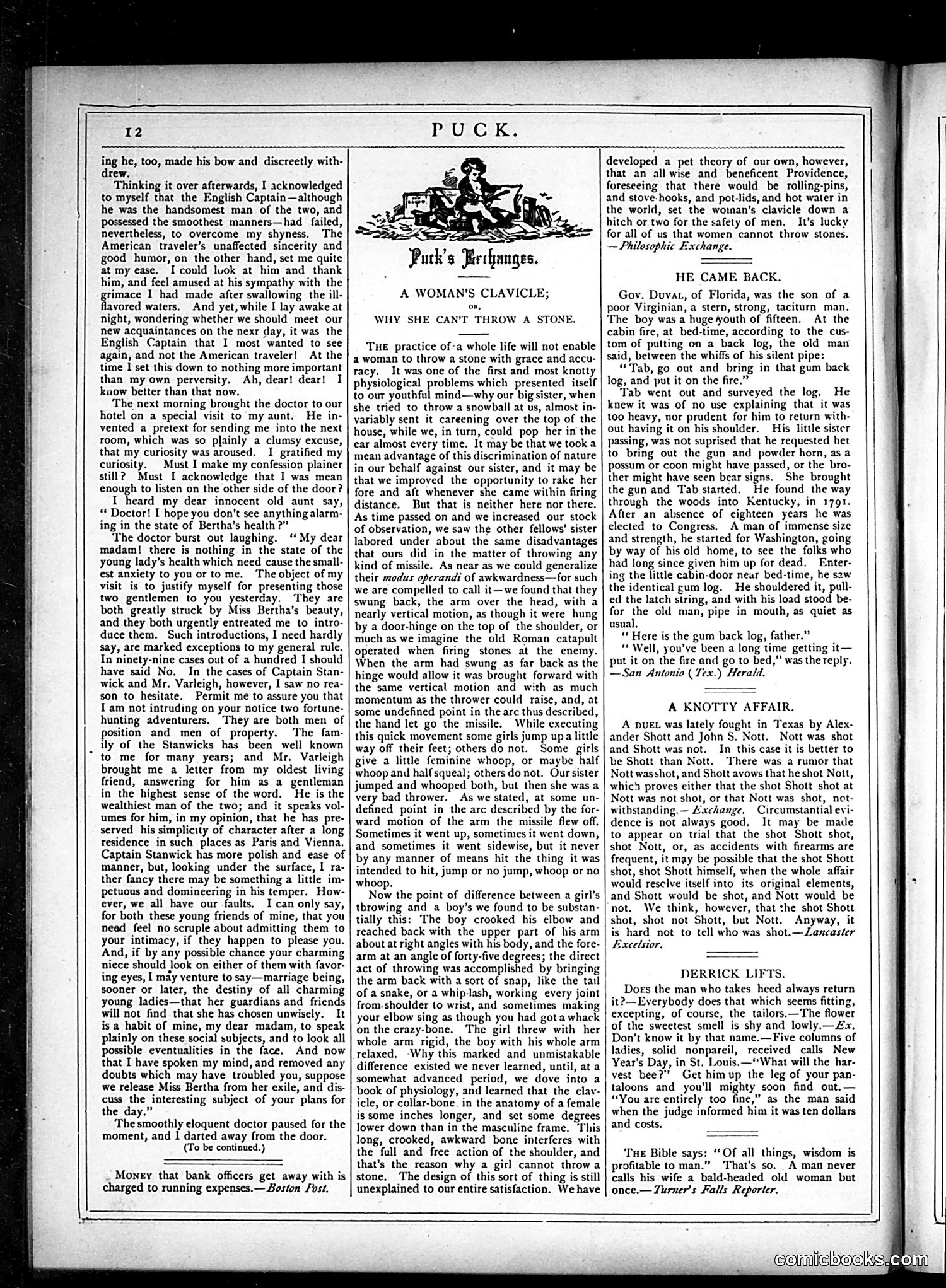
This page contains three separate humorous articles rather than political cartoons: 1. **"A Woman's Clavicle"** satirizes why women supposedly can't throw stones, attributing it to anatomical differences in the shoulder bone structure that prevent the full arm motion needed for throwing. 2. **"He Came Back"** recounts an anecdote about Governor Duval of Florida and his son, detailing the boy's return from Washington after years away, with emphasis on family reunion and personal growth. 3. **"A Knotty Affair"** discusses a shooting incident involving Alexander Short and John S. Nott, examining conflicting accounts of who shot whom and questioning witness reliability. The page demonstrates Puck's mix of light social commentary, personal anecdotes, and local news stories presented with satirical humor typical of 19th-century American humor magazines.
📄 Transcribed text from this page (OCR, searchable)
Machine-transcribed from the original scan — historical spelling and the odd misread are preserved.
ing he, too, made his bow and discreetly with- drew. Thinking it over afterwards, I acknowledged to myself that the English Captain—although he was the handsomest man of the two, and possessed the smoothest manners—had failed, nevertheless, to overcome my shyness. The American traveler's unaffected sincerity and good humor, on the other hand, set me quite at my ease. I could luok at him and thank him, and feel amused at his sympathy with the grimace I had made after swallowing the ill- lavored waters. And yet, while I lay awake at night, wondering whether we should meet our new acquaintances on the nexr day, it was the English Captain that I most wanted to see again, and not the American traveler! At the time I set this down to nothing more important than my own perversity. Ah, dear! dear! I know better than that now. ‘The next morning brought the doctor to our hotel on a special visit to my aunt. He in- vented a pretext for sending me into the next room, which was so plainly a clumsy excuse, that my curiosity was aroused. I gratified my curiosity. Must I make my confession plainer still? Must I acknowledge that I was mean enough to listen on the other side of the door? I heard my dear innocent old aunt say, “ Doctor! I hope you don’t see anything alarm- ing in the state of Bertha’s health ?” ‘The doctor burst out laughing. ‘ My dear madam! there is nothing in the state of the young lady’s health which need cause the small- est anxiety to you or tome. The object of my visit is to justify myself for presenting those two gentlemen to you yesterday. They are both greatly struck by Miss Bertha’s beauty, and they both urgently entreated me to intro- duce them. Such introductions, I need hardly say, are marked exceptions to my general rule. In ninety-nine cases out of a hundred I should have said No. In the cases of Captain Stan- wick and Mr. Varleigh, however, I saw no rea- son to hesitate. Permit me to assure you that I am not intruding on your notice two fortune- hunting adventurers. They are both men of position and men of property, The fam- ily of the Stanwicks has been well known to me for many years; and Mr. Varleigh brought me a letter from my oldest living friend, answering for him as a gentleman in the highest sense of the word. He is the wealthiest man of the two; and it speaks vol- umes for him, in my opinion, that he has pre- served his simplicity of character after a long residence in such places as Paris and Vienna. Captain Stanwick has more polish and ease of manner, but, looking under the surface, I ra- ther fancy there may be something a little im- petuous and domineering in his temper. How- ever, we all have our faults. I can only say, for both these young friends of mine, that you need feel no scruple about admitting them to your intimacy, if they happen to please you. And, if by any possible chance your charming niece should look on either of them with favor- ing eyes, I may venture to say—marriage being, sooner or later, the destiny of all charming young ladies—that her guardians and friends will not find that she has chosen unwisely. It isa habit of mine, my dear madam, to speak plainly on these social subjects, and to look all possible eventualities in the face. And now that I have spoken my mind, and removed any doubts which may have troubled you, suppose we release Miss Bertha from her exile, and dis- cuss the interesting subject of your plans for the day.” The smoothly eloquent doctor paused for the moment, and I darted away from the door. (To be continued.) Money that bank officers get away with is charged to running expenses.— Boston Fost. A WOMAN'S CLAVICLE; on, WHY SHE CAN'T THROW A STONE. THE practice of-a whole life will not enable a woman to throw a stone with grace and accu- racy. It was one of the first and most knotty physiological Probie which presented itself to our youthful mind—why our big sister, when she tried to throw a snowball at us, almost in- variably sent it careening over the top of the house, while we, in turn, could pop her in the ear almost every time. It may be that we took a mean advantage of this discrimination of nature in our behalf against our sister, and it may be that we improved the opportunity to rake her fore and aft whenever she came within firing distance. But that is neither here nor there. As time passed on and we increased our stock of observation, we saw the other fellows’ sister labored under about the same disadvantages that ours did in the matter of throwing any kind of missile. As near as we could generalize their modus operandi of awkwardness—for such we are compelled to call it—we found that they swung back, the arm over the head, with a nearly vertical motion, as though it were hung by a door-hinge on the top of the shoulder, or much as we imagine the old Roman catapult operated when firing stones at the enemy. When the arm had swung as far back as the hinge would allow it was brought forward with the same vertical motion and with as much momentum as the thrower could raise, and, at some undefined point in the arc thus described, the hand let go the missile. While executing this quick movement some girls jump upa little way off their feet; others do not. Some girls give a little feminine whoop, or maybe half whoop and half squeal; others do not. Oursister jumped and whooped both, but then she was a very bad thrower. As we stated, at some un- defined point in the arc described by the for- ward motion of the arm the missile flew off. Sometimes it went up, sometimes it went down, and sometimes it went sidewise, but it never by any manner of means hit the thing it was intended to hit, jump or no jump, whoop or no whoop. Now the point of difference between a girl's throwing and a boy’s we found to be substan- tially this: The boy crooked his elbow and reached back with the upper part of his arm about at right angles with his body, and the fore- arm at an angle of forty-five degrees; the direct act of throwing was accomplished by bringing the arm back with a sort of snap, like the tail | of a snake, or a whip-lash, working every joint from-shoulder to wrist, and sometimes making your elbow sing as though you had got a whack on the crazy-bone. The girl threw with her whole arm rigid, the boy with his whole arm relaxed. -Why this marked and unmistakable difference existed we never learned, until, at a somewhat advanced period, we dove into a book of physiology, and learned that the clav- icle, or collar-bone. in the anatomy of a female is some inches longer, and sct some degrees lower down than in the masculine frame. ‘This long, crooked, awkward bone interferes with the full and free action of the shoulder, and that’s the reason why a girl cannot throwa stone. The design of this sort of thing is still unexplained to our entire satisfaction. We have developed a pet theory of our own, however, that an all wise and beneficent Providence, foreseeing that there would be rolling-pins, and stove-hooks, and pot-lids, and hot water in the world, set the woman's clavicle down a hitch or two for the safety of men. It’s lucky for all of us that women cannot throw stones. HE CAME BACK. Gov. Duvat, of Florida, was the son of a poor Virginian, a stern, strong, taciturn man. The boy was a huge youth of fifteen. At the cabin fire, at bed-time, according to the cus- tom of putting on a back log, the old man said, between the whiffs of his silent pipe: “Tab, go out and bring in that gum back log, and put it on the fire.”” ‘Tab went out and surveyed the log. He knew it was of no use explaining that it was too heavy, nor prudent for him to return with- out having it on his shoulder. His little sister passing, was not suprised that he requested het to bring out the gun and powder horn, as a possum or coon might have passed, or the bro- ther might have seen bear signs. She brought the gun and Tab started. He found the way through the woods into Kentucky, in 1791. After an absence of eighteen years he was elected to Congress. A man of immense size and strength, he started for Washington, going by way of his old home, to see the folks who had long since given him up for dead. Enter- ing the file cabin-door near bed-time, he saw the identical gum log. He shouldered it, pull- ed the latch string, and with his load stood be- for the old man, pipe in mouth, as quiet as usual, “Here is the gum back log, father.” “Well, you've been a long time getting it— put it on the fire and go to bed,” was thereply. —San Antonio ( Tex.) Herald. A KNOTTY AFFAIR. A pUEL was lately fought in Texas by Alex- ander Shott and John S. Nott. Nott was shot and Shott was not. In this case it is better to be Shott than Nott. There was a rumor that Nott wasshot, and Shott avows that he shot Nott, which proves either that the shot Shott shot at Nott was not shot, or that Nott was shot, not- withstanding.— xchange. Circumstantial evi- dence is not always good. It may be made to appear on trial that the shot Shott shot, shot Nott, or, as accidents with firearms are frequent, it may be possible that the shot Shott shot, shot Shott himself, when the whole affair would resclve itself into its original elements, and Shott would be shot, and Nott would be not. We think, however, that the shot Shott shot, shot not Shott, but Nott. Anyway, it is hard not to tell who was shot.—Lancaster Excelsior, DERRICK LIFTS. Does the man who takes heed always return it?—Everybody does that which seems fitting, excepting, of course, the tailors.—The flower of the sweetest smell is shy and lowly.—£x. Don’t know it by that name.—Five columns of ladies, solid nonpareil, received calls New Year's Day, in St. Louis.—“What will the har- vest bee?” Get him up the leg of your pan- taloons and you'll mighty soon find out.— “You are entirely too fine,” as the man said when the judge informed him it was ten dollars and costs. Tue Bible says: “Of all things, wisdom is profitable to man.” That's so. A man never calls his wife a bald-headed old woman but once.—Zurner’s Falls Reporter. comichooks, com