
Puck, 1878-01-16 · page 5 of 16
Puck — January 16, 1878 — page 5: what you’re looking at
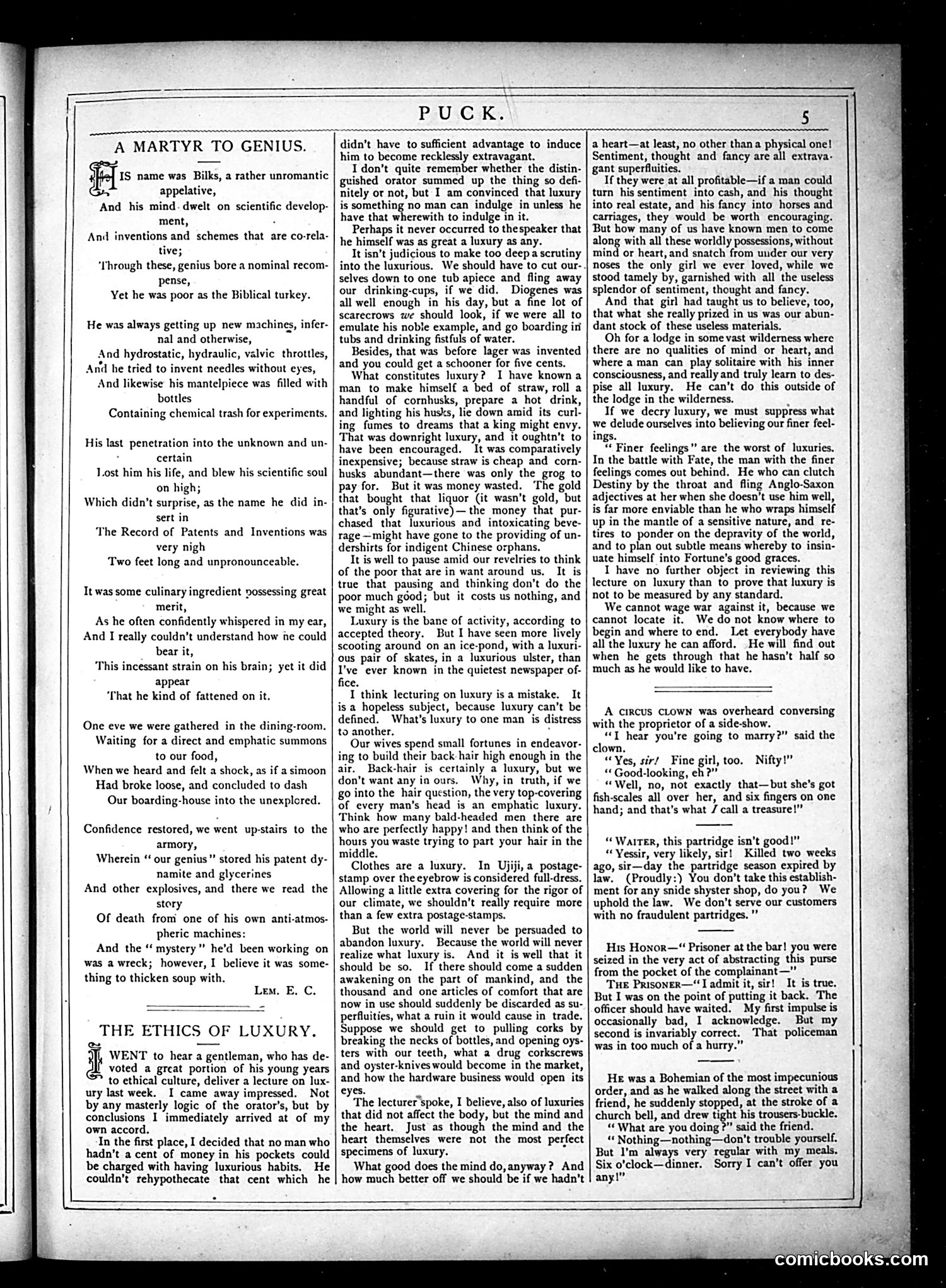
A restored page from Puck, 1878-01-16. Page through the whole issue in the reader above.
📄 Transcribed text from this page (OCR, searchable)
Machine-transcribed from the original scan — historical spelling and the odd misread are preserved.
PUCK. A MARTYR TO GENIUS. FAs name was Bilks, a rather unromantic appelative, And his mind. dwelt on scientific develop- ment, : And inventions and schemes that are co-rela- tive; ‘Through these, genius bore a nominal recom- pense, Yet he was poor as the Biblical turkey. He was always getting up new machines, infer- nal and otherwise, And hydrostatic, hydraulic, valvic throttles, And he tried to invent needles without eyes, And likewise his mantelpiece was filled with bottles. Containing chemical trash for experiments. His last penetration into the unknown and un- certain Lost him his life, and blew his scientific soul on high; Which didn’t surprise, as the name he did in- sert in ‘The Record of Patents and Inventions was very nigh ‘Two feet long and unpronounceable. It was some culinary ingredient possessing great merit, As he often confidently whispered in my ear, And I really couldn’t understand how ie could bear it, ‘This incessant strain on his brain; yet it did appear ‘That he kind of fattened on it. One eve we were gathered in the dining-room. Waiting for a direct and emphatic summons to our food, When we heard and felt a shock, as if a simoon Had broke loose, and concluded to dash Our boarding-house into the unexplored. Confidence restored, we went up-stairs to the armory, Wherein “ our genius” stored his patent dy- namite and glycerines And other explosives, and there we read the story Of death from one of his own anti-atmos- pheric machines: And the “ mystery” he'd been working on was a wreck; however, I believe it was some- thing to thicken soup with. Lem. E. C. THE ETHICS OF LUXURY. ik WENT to hear a gentleman, who has de- voted a great portion of his young years to ethical culture, deliver a lecture on lux- ury last week. I came away impressed. Not by any masterly logic of the orator’s, but by conclusions I immediately arrived at of my own accord, In the first place, I decided that no man who hadn't a cent of money in his pockets could be charged with having luxurious habits. He couldn't rehypothecate that cent which he didn't have to sufficient advantage to induce him to become recklessly extravagant. I don’t quite remember whether the distin- guished orator summed up the thing so defi- nitely or not, but I am convinced that luxury is something no man can indulge in unless he have that wherewith to indulge in it. Perhaps it never occurred to thespeaker that he himself was as great a luxury as any. It isn’t judicious to make too deep a scrutiny into the luxurious. We should have to cut our- selves down to one tub apiece and fling away our drinking-cups, if we did. Diogenes was all well enough in his day, but a fine lot of scarecrows we should look, if we were all to emulate his noble example, and go boarding iri tubs and drinking fistfuls of water. Besides, that was before lager was invented and you could get a schooner for five cents. What constitutes luxury? I have known a man to make himself a bed of straw, roll a handful of cornhusks, prepare a hot drink, and lighting his husks, lie down amid its curl- ing fumes to dreams that a king might envy. That was downright luxury, and it oughtn’t to have been encouraged. It was comparatively inexpensive; because straw is cheap and corn- husks abundant—there was only the grog to pay for. But it was money wasted. ‘The gold that bought that liquor (it wasn’t gold, but that’s only figurative)— the money that pur- chased that luxurious and intoxicating beve- rage —might have gone to the providing of un- dershirts for indigent Chinese orphans, It is well to pause amid our revelries to think of the poor that are in want around us. It is true that pausing and thinking don’t do the poor much good; but it costs us nothing, and we might as well. Luxury is the bane of activity, according to accepted theory. But I have seen more lively scooting around on an ice-pond, with a luxuri- ous pair of skates, in a luxurious ulster, than I’ve ever known in the quietest newspaper of- fice. I think lecturing on luxury is a mistake. It is a hopeless subject, because luxury can’t be defined. What's luxury to one man is distress to another, . Our wives spend small fortunes in endeavor- ing to build their back-hair high enough in the air. Back-hair is certainly a luxury, but we don’t want any in ours. Why, in truth, if we go into the hair question, the very top-covering of every man’s head is an emphatic luxury. ‘Think how many bald-headed men there are who are perfectly happy! and then think of the hours you waste trying to part your hair in the middle. Clothes are a luxury. In Ujiji, a postage- stamp over the eyebrow is considered full-dress. Allowing a little extra covering for the rigor of our climate, we shouldn’t really require more than a few extra postage-stamps. But the world will never be persuaded to abandon luxury. Because the world will never realize what luxury is. And it is well that it should be so. If there should come a sudden awakening on the part of mankind, and the thousand and one articles of comfort that are now in use should suddenly be discarded as su- perfluities, what a ruin it would cause in trade. Suppose we should get to pulling corks by breaking the necks of bottles, and opening oys- ters with our teeth, what a drug corkscrews and oyster-knives would become in the market, and how the hardware business would open its eyes. The lecturer'spoke, I believe, also of luxuries that did not affect the body, but the mind and the heart. Just as though the mind and the heart themselves were not the most perfect specimens of luxury. f: What good does the mind do, anyway? And how much better off we should be if we hadn't a heart—at least, no other thana physical one! Sentiment, thought and fancy are all extrava- gant superfluities. If they were at all profitable—if a man could turn his sentiment into cash, and his thought into real estate, and his fancy into horses and carriages, they would be worth encouraging. But how many of us have known men to come along with all these worldly possessions, without mind or heart, and snatch from under our very noses the only girl we ever loved, while we stood tamely by, garnished with all the useless splendor of sentiment, thought and fancy. And that girl had taught us to believe, too, that what she really prized in us was our abun- dant stock of these useless materials. Oh for a lodge in some vast wilderness where there are no qualities of mind or heart, and where a man can play solitaire with his inner consciousness, and really and truly learn to des- pise all luxury, He can’t do this outside of the lodge in the wilderness. e If we decry luxury, we must suppress what we delude ourselves into believing our finer feel- ings. “ Finer feelings” are the worst of luxuries. In the battle with Fate, the man with the finer feelings comes out behind. He who can clutch Destiny by the throat and fling Anglo-Saxon adjectives at her when she doesn’t use him well, is far more enviable than he who wraps himself up in the mantle of a sensitive nature, and re- tires to ponder on the depravity of the world, and to plan out subtle means whereby to insin- uate himself into Fortune’s good graces. I have no further object in reviewing this lecture on luxury than to prove that luxury is not to be measured by any standard. We cannot wage war against it, because we cannot locate it. We do not know where to begin and where to end. Let everybody have all the luxury he can afford. He will find out when he gets through that he hasn’t half so much as he would like to have. A CIRCUS CLOWN was overheard conversing with the proprietor of a side-show. “I hear you're going to marry?” said the clown. “Yes, sir! Fine girl, too. Nifty!” “«Good-looking, eh?” “Well, no, not exactly that—but she’s got fish-scales all over her, and six fingers on one hand; and that’s what / call a treasure!” “ Warrer, this partridge isn’t good!” “Yessir, very likely, sir! Killed two weeks ago, sir—day the partridge season expired by law. (Proudly:) You don’t take this establish- ment for any snide shyster shop, do you? We uphold the law. We don’t serve our customers with no fraudulent partridges. "” His Honor—“ Prisoner at the bar! you were seized in the very act of abstracting this purse from the pocket of the complainant—” Tue Prisoner—“‘I admit it, sir! It is true. But I was on the point of putting it back. The officer should have waited. My first impulse is occasionally bad, I acknowledge. But my second is invariably correct. That policeman was in too much of a hurr, HE was a Bohemian of the most impecunious order, and as he walked along the street with a friend, he suddenly stopped, at the stroke of a church bell, and drew tight his trousers-buckle. “What are you doing ?” said the friend. “ Nothing—nothing—don’t trouble yourself. But I'm always very regular with my meals, Six o'clock—dinner. Sorry I can’t offer you any!”