
A complete issue · 16 pages · 1878
Puck — January 9, 1878
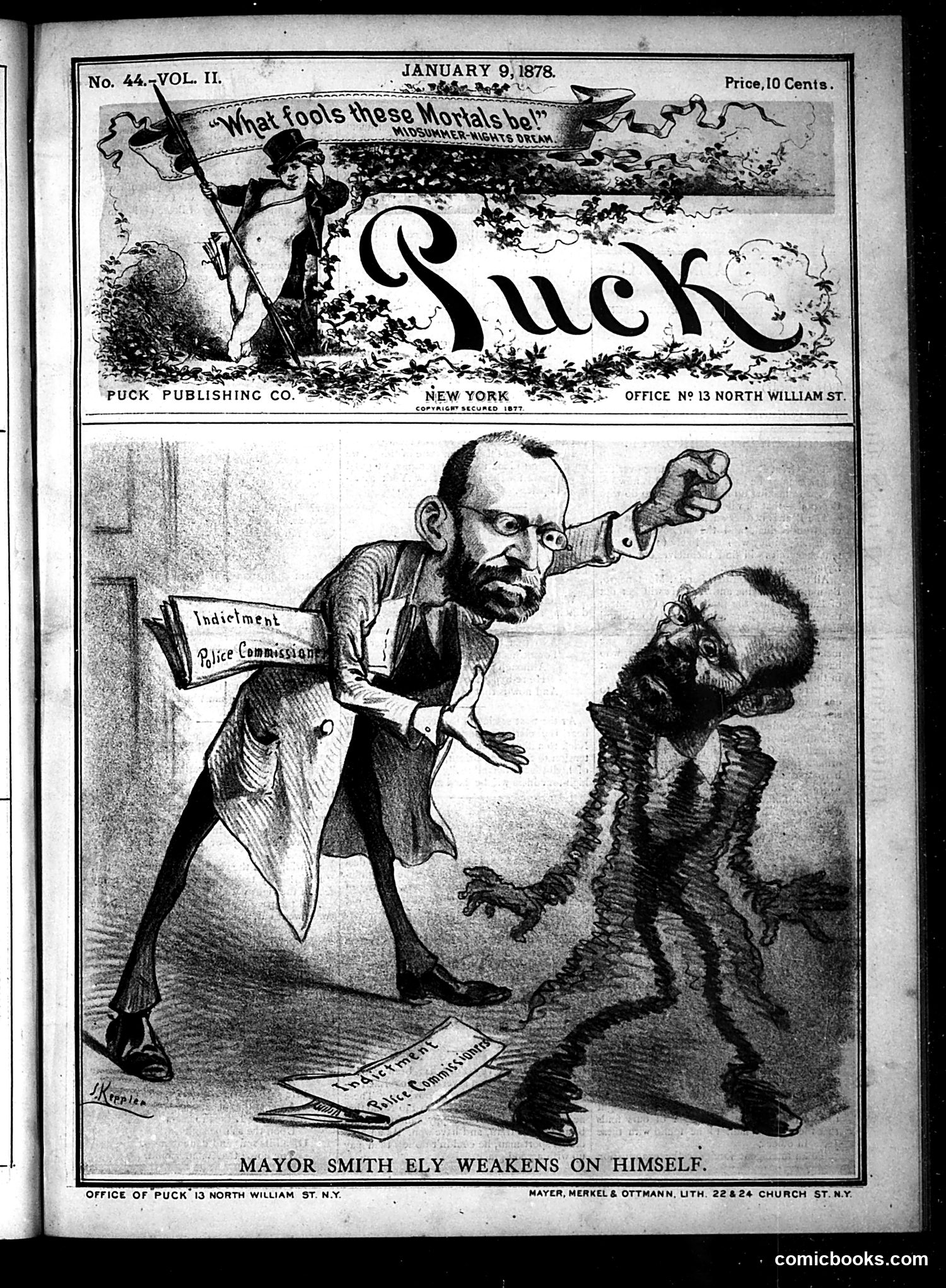
**Date & Publication**: Puck Magazine, January 9, 1878 **Main Figure**: Mayor Smith Ely of New York, depicted as a man in formal dress holding an "Indictment" and "Police Commission" document. **The Satire**: The cartoon criticizes Mayor Ely for weakening his own position or authority. He's shown gesturing defensively while confronted by what appears to be a demon or devil figure (likely representing corruption or criminal forces), surrounded by scattered papers labeled "Police Commission" and related documents. **The Point**: The satire suggests the Mayor is undermining his own anti-corruption efforts or police reform initiatives through inconsistency or lack of resolve. Rather than effectively combating the forces of corruption, he's portrayed as compromising his own stated position—hence "weakens on himself."
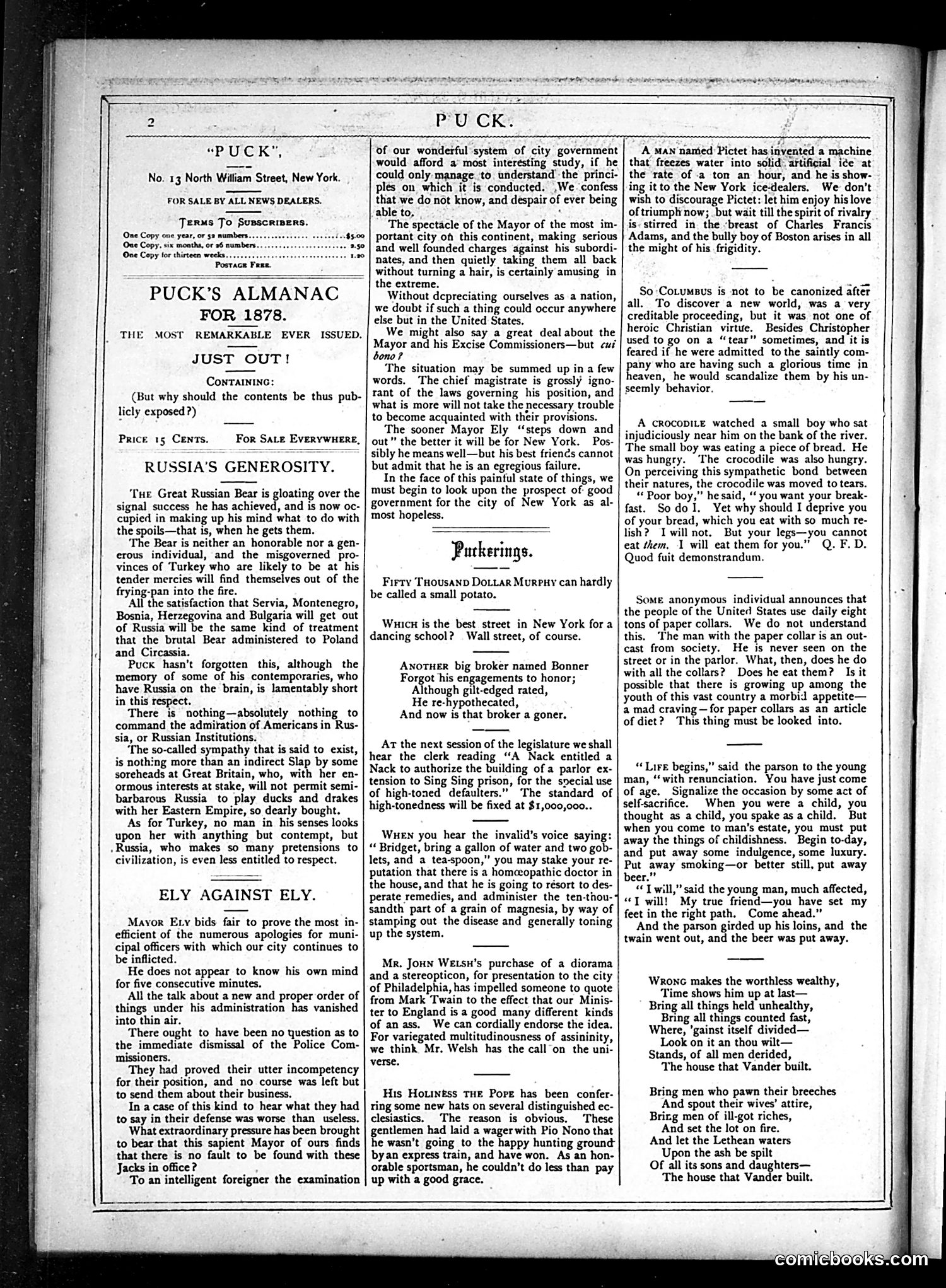
This page contains satirical commentary rather than illustrated cartoons. The pieces mock New York City Mayor Ely, who apparently faced criticism for mismanaging city government and failing to enforce laws properly. The "Ely Against Ely" section sarcastically notes the Mayor's incompetence, suggesting he's dismissed police commissioners for their inefficiency while being equally ineffective himself. The satire implies he's unfit for office yet somehow retained his position. Other sections include brief humorous observations about contemporary figures—a broker named Bonner, a man inventing a mechanical tree-feller, and various social commentary about wealth and class. These are typical Puck material: quick jabs at public figures and absurd social observations meant to amuse readers while critiquing civic corruption and incompetence.
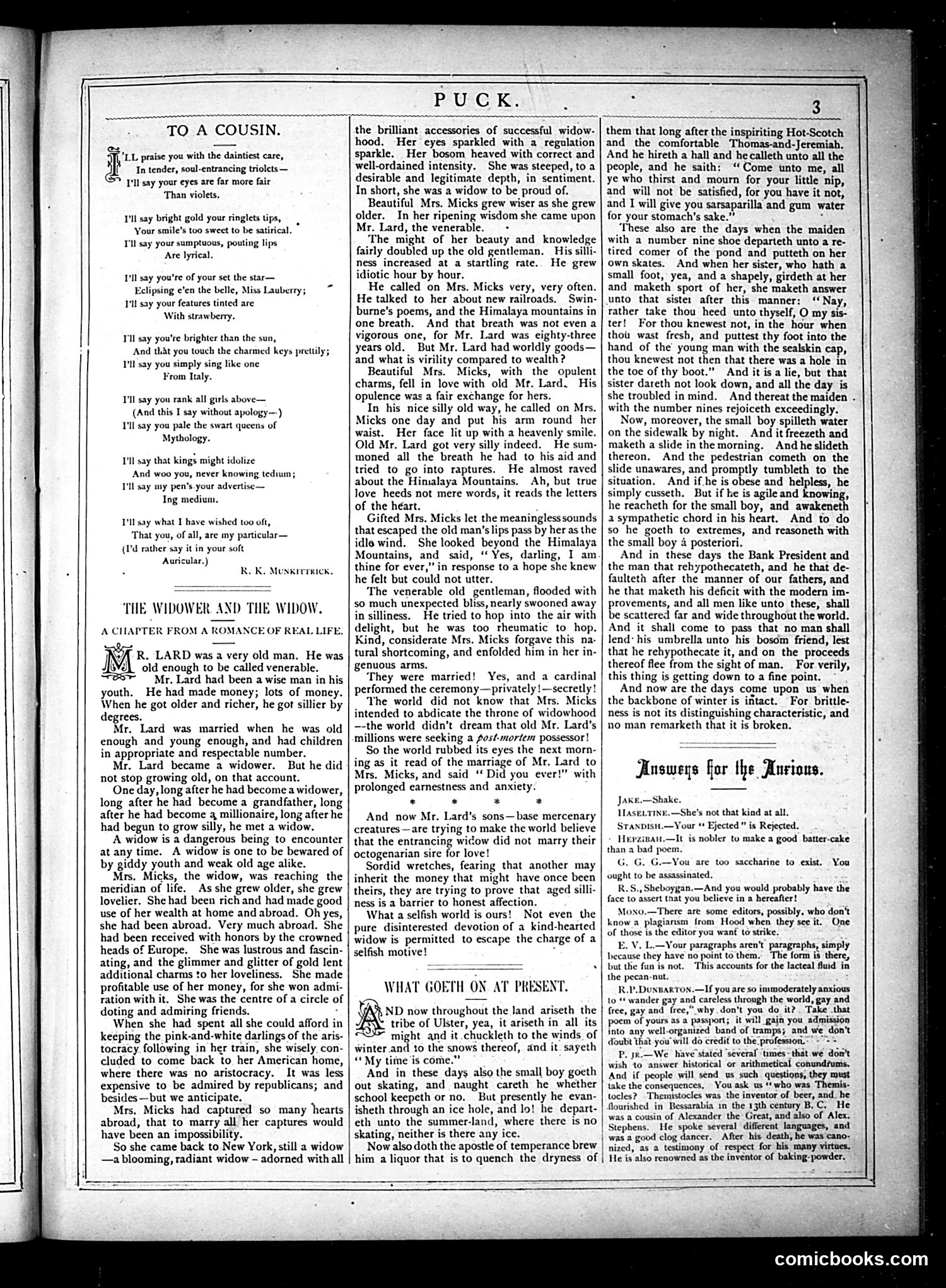
This page contains primarily **literary content** rather than political cartoons. The main feature is "To a Cousin," a poem by R.K. Munkittrick with romantic verses praising a cousin's qualities. Below that is "The Widower and the Widow," described as "a chapter from a romance of real life," which tells the story of an elderly widower, Mr. Lord, who marries Mrs. Micks, a wealthy widow. The narrative focuses on their courtship and marriage rather than political satire. The bottom section, "What Goeth On At Present," appears to be humorous social commentary about contemporary life and behavior. **No clear political cartoons or caricatures are visible** on this page—it's primarily a literary/humor magazine feature rather than satirical visual content.
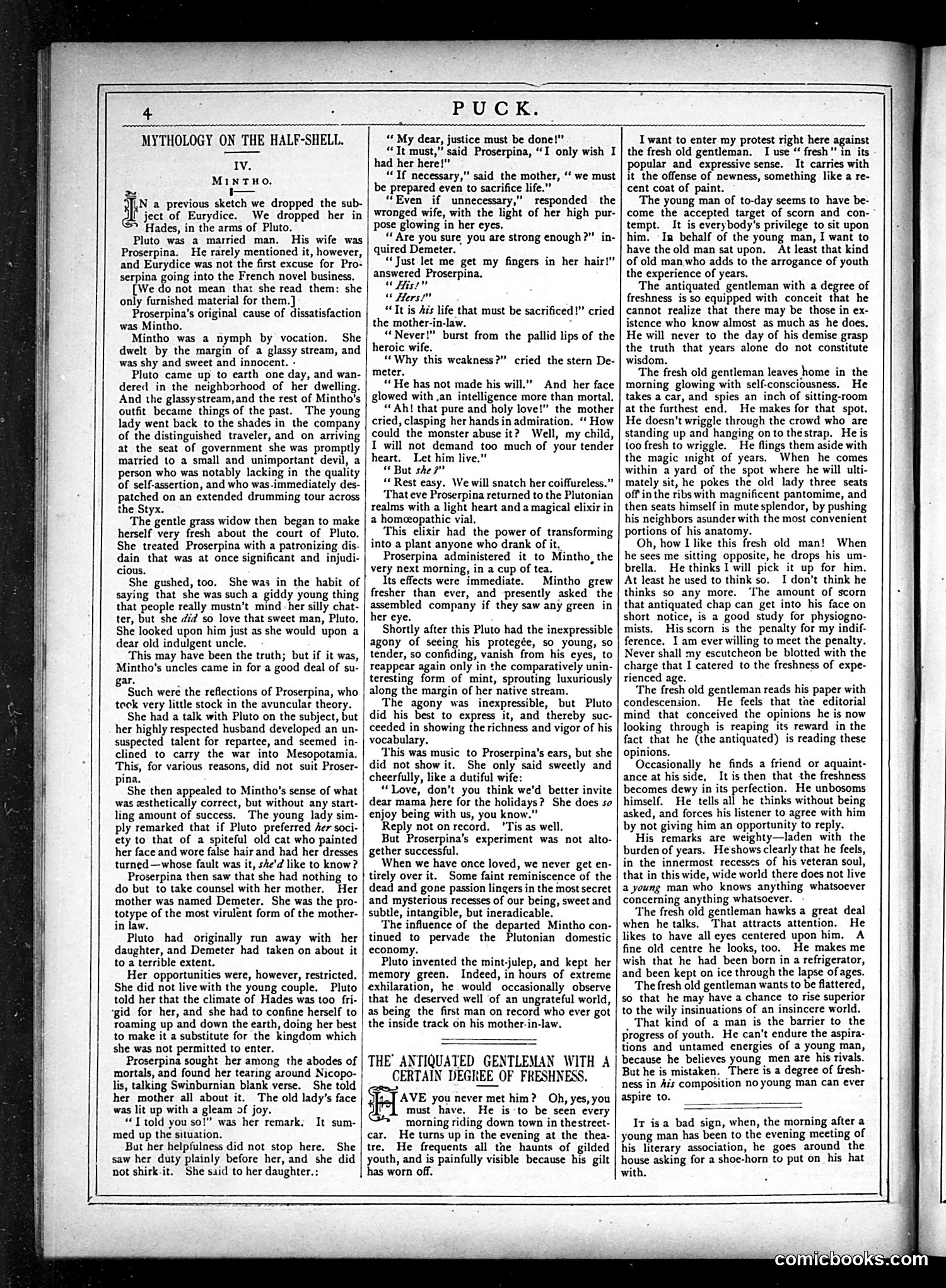
This page appears to be primarily literary content rather than political satire. The left column continues "Mythology on the Half-Shell," a humorous retelling of the Persephone and Pluto myth, with emphasis on domestic comedy—Persephone's dissatisfaction with her husband, her mother Demeter's interference, and various marital disputes presented as melodrama. The right column features "The Antiquated Gentleman with a Certain Degree of Freshness," which satirizes an elderly man who frequents social scenes despite his age, attempting to appear youthful and fashionable. The piece mocks his vanity and failure to recognize his irrelevance to younger society. Both pieces employ humor through exaggeration of character types rather than targeting specific political figures or events. The satire is social rather than political in nature.
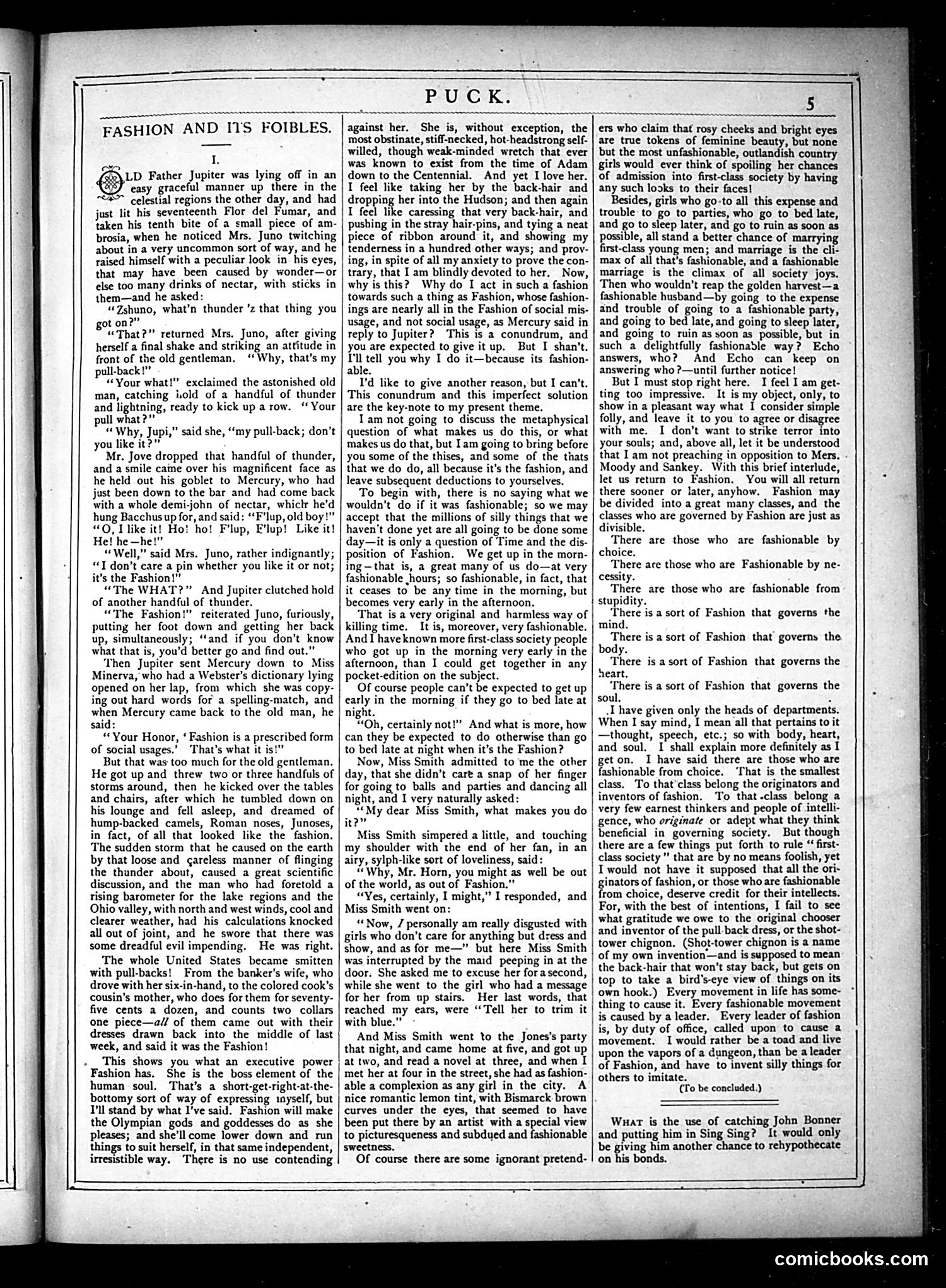
This page from *Puck* contains a satirical essay titled "Fashion and Its Foibles" (Part I), not a political cartoon. The text is a lengthy critique of high society's obsession with fashion, using dialogue between mythological figures—Jupiter and Mercury—to mock the illogical rules governing fashionable dress and behavior. The satire targets wealthy women who slavishly follow fashion trends regardless of practicality or comfort. Jupiter complains that fashionable society operates by arbitrary, contradictory rules: certain activities are only acceptable at specific times, yet the rules constantly change. The piece ridicules both the tyranny of fashion itself and society women's unquestioning compliance with it. This represents *Puck*'s typical social criticism of Gilded Age excess and conformity among the upper classes.
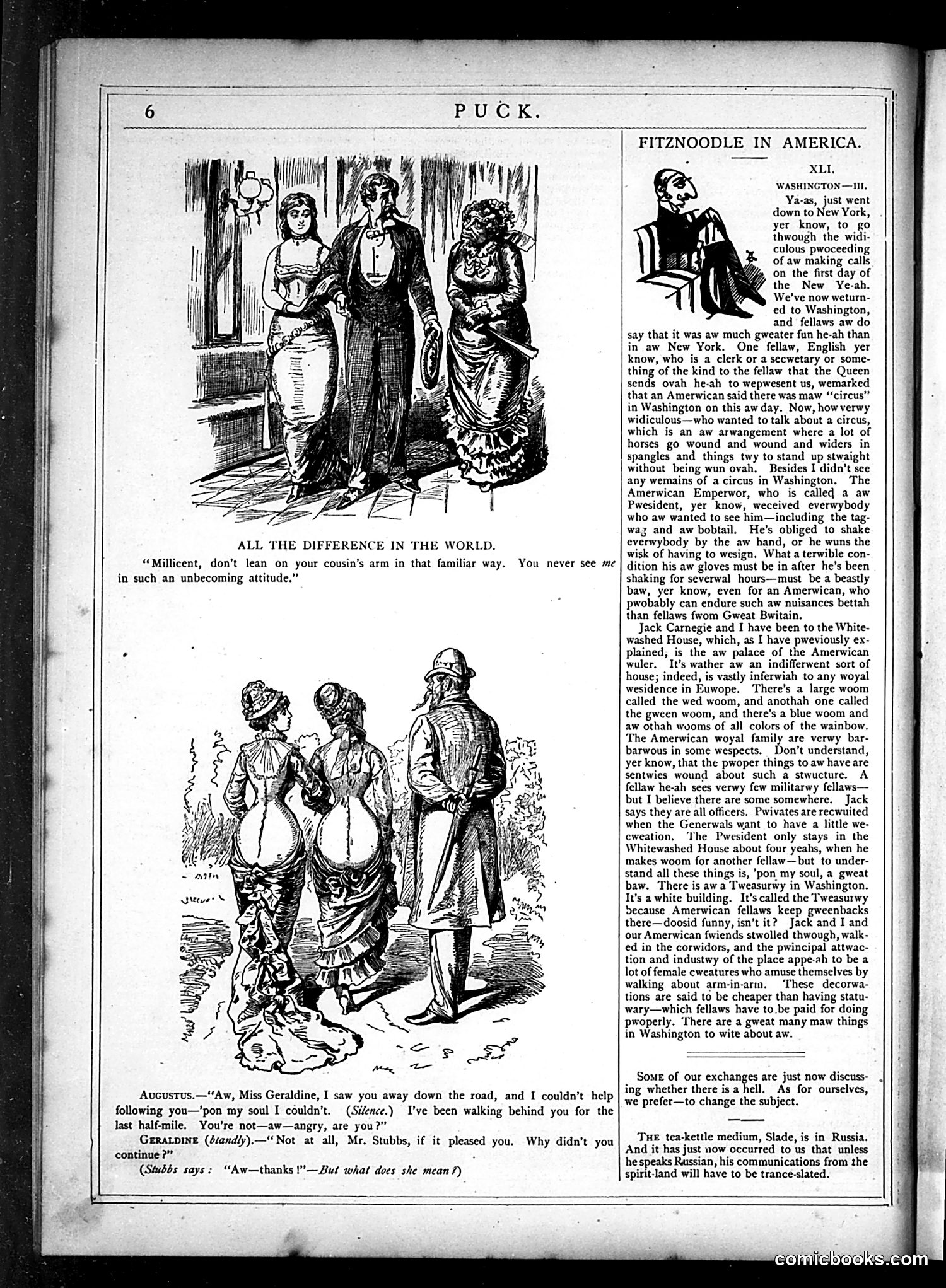
**Top Cartoon ("All the Difference in the World"):** Shows three figures in formal dress. A man admonishes a woman for leaning on her cousin's arm "in that familiar way," calling it "unbecoming." The satire mocks rigid Victorian etiquette rules—the joke being that such minor physical contact was considered scandalous among the upper classes. **Bottom Cartoon (Augustus dialogue):** A man confronts a woman he saw walking alone, claiming he followed her "half a mile" because she wouldn't acknowledge him. She responds coldly, suggesting unwanted male attention and harassment. The satire ridicules aggressive male behavior disguised as concern for propriety. **Right Column:** "Fitznoodle in America" describes a British visitor's observations of Washington, D.C., mocking American architecture and customs as inferior to European standards—typical Anglo-American satirical commentary of the period.
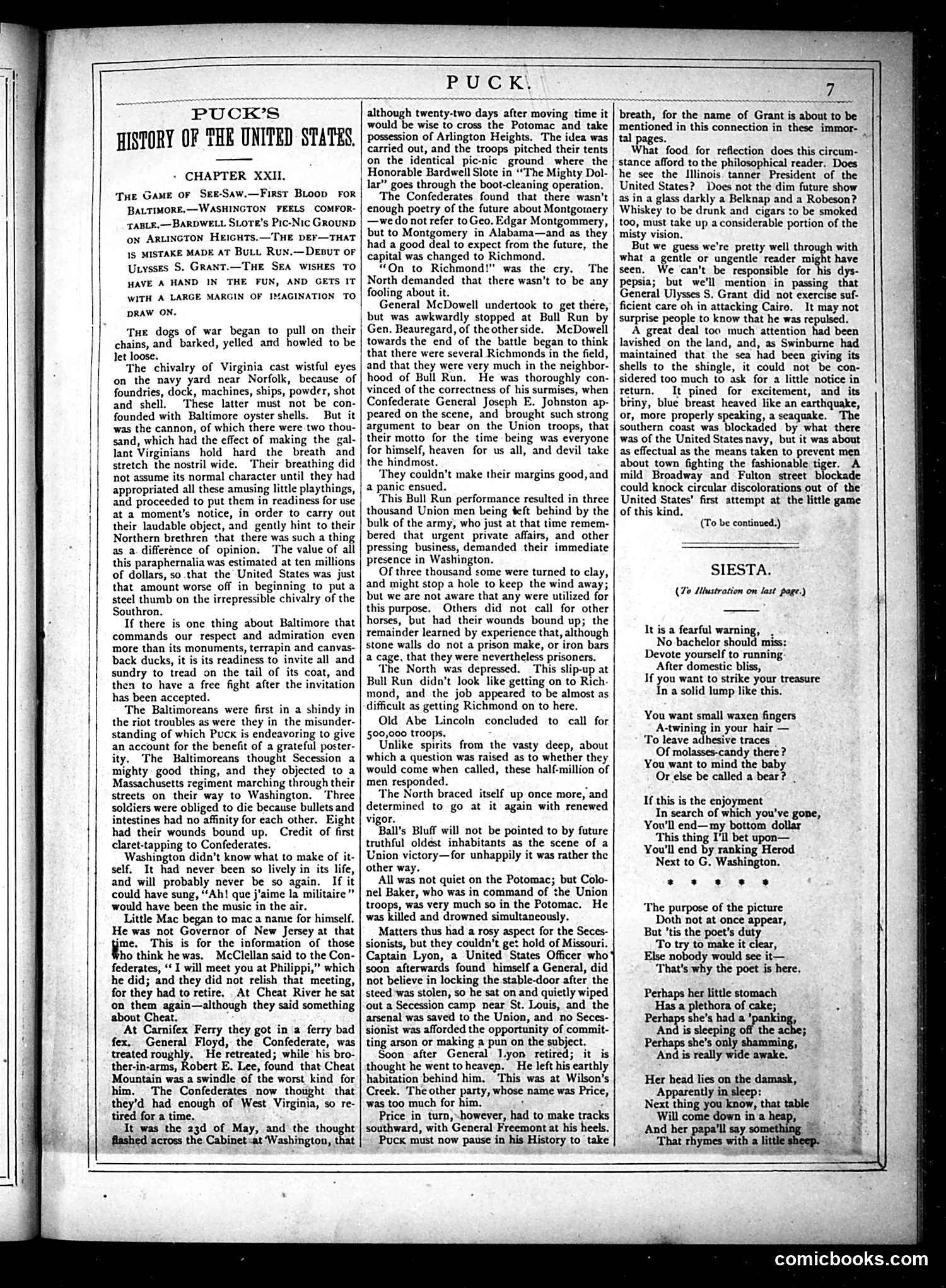
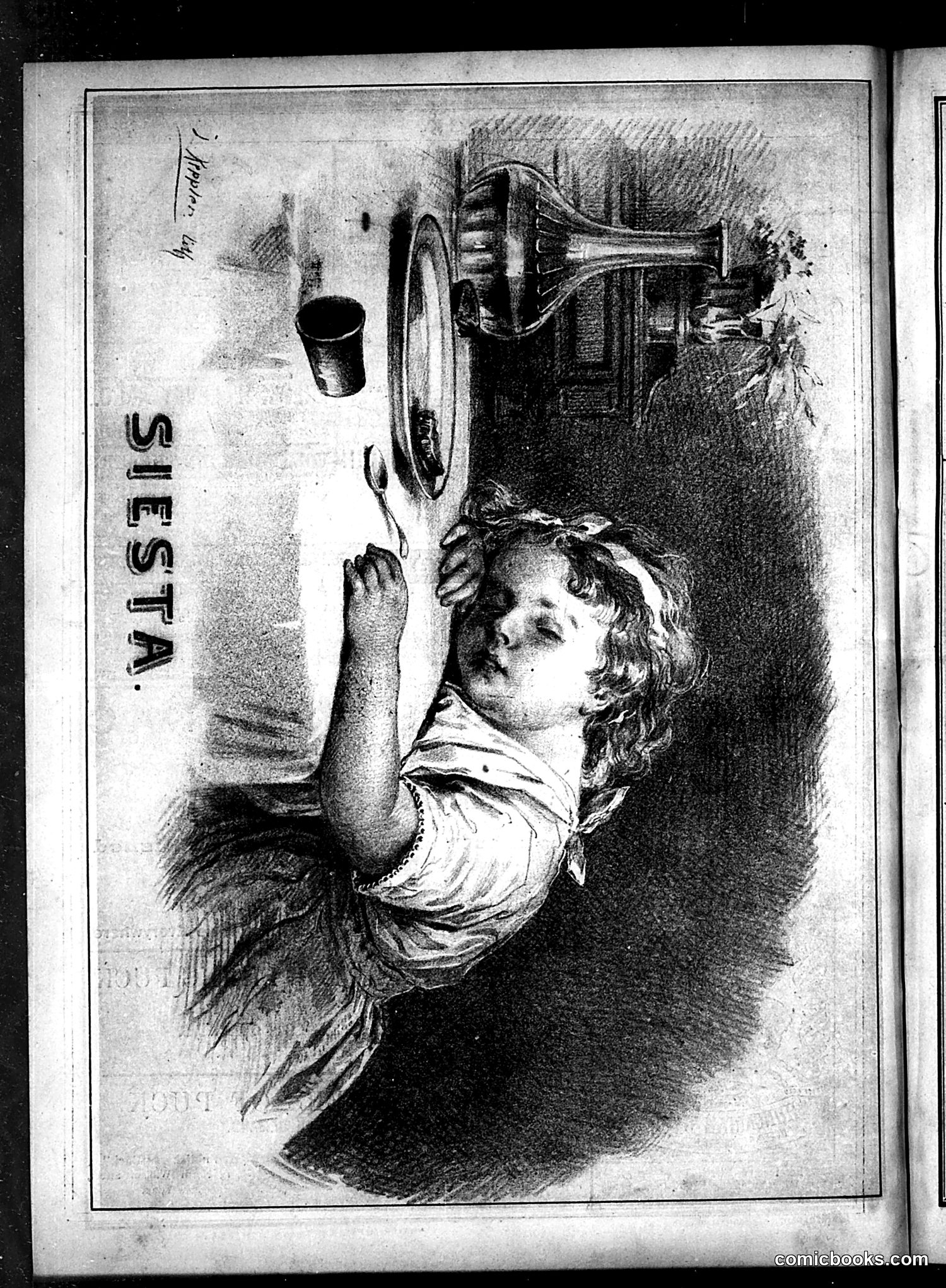
This page contains two distinct sections: **Left Column:** "Puck's History of the United States," Chapter XXII, discusses Civil War battles around Richmond and Baltimore, focusing on the First Battle of Bull Run. The text describes military movements, Confederate General Joseph E. Johnston, and Union General Lyon's death. **Right Column:** A poem titled "SIESTA" with accompanying illustration (referenced as "To Illustration on last page"). The satirical verse mocks someone—likely a political figure—for laziness and incompetence, using sharp criticism about "running after domestic bliss" and ranking "Herod" as preferable leadership. The page appears to mix historical commentary with contemporary political satire, typical of Puck's approach. Without seeing the actual illustration clearly, precise identification of the satirized figure remains uncertain.
This Puck cartoon depicts a military or political figure (identifiable by the distinctive spiked Prussian-style helmet) standing authoritatively while reading from a book, gesturing toward what appears to be an anthropomorphized animal or caricatured figure seated at a table with food. The seated figure wears a flat cap and appears to be a working-class or peasant character. The satire likely critiques authoritarian leadership or imperial decree—the standing figure's formal military dress and act of reading proclamations contrasts sharply with the seated figure's humble status. The specific political context is unclear from the image alone, though the Prussian helmet suggests commentary on German militarism or similar authoritarian governance. The exact historical reference and intended targets cannot be determined without additional context or visible caption text.
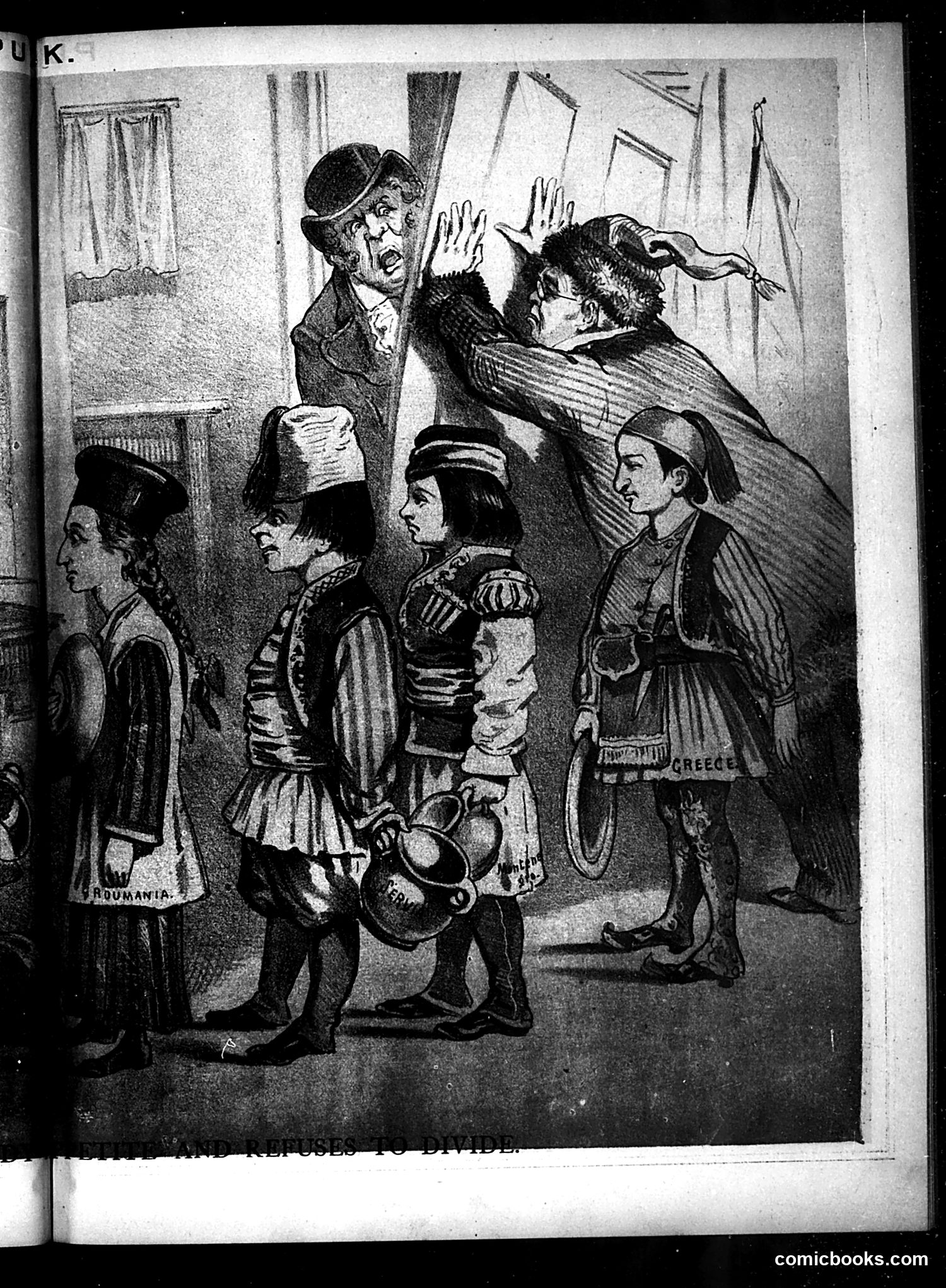
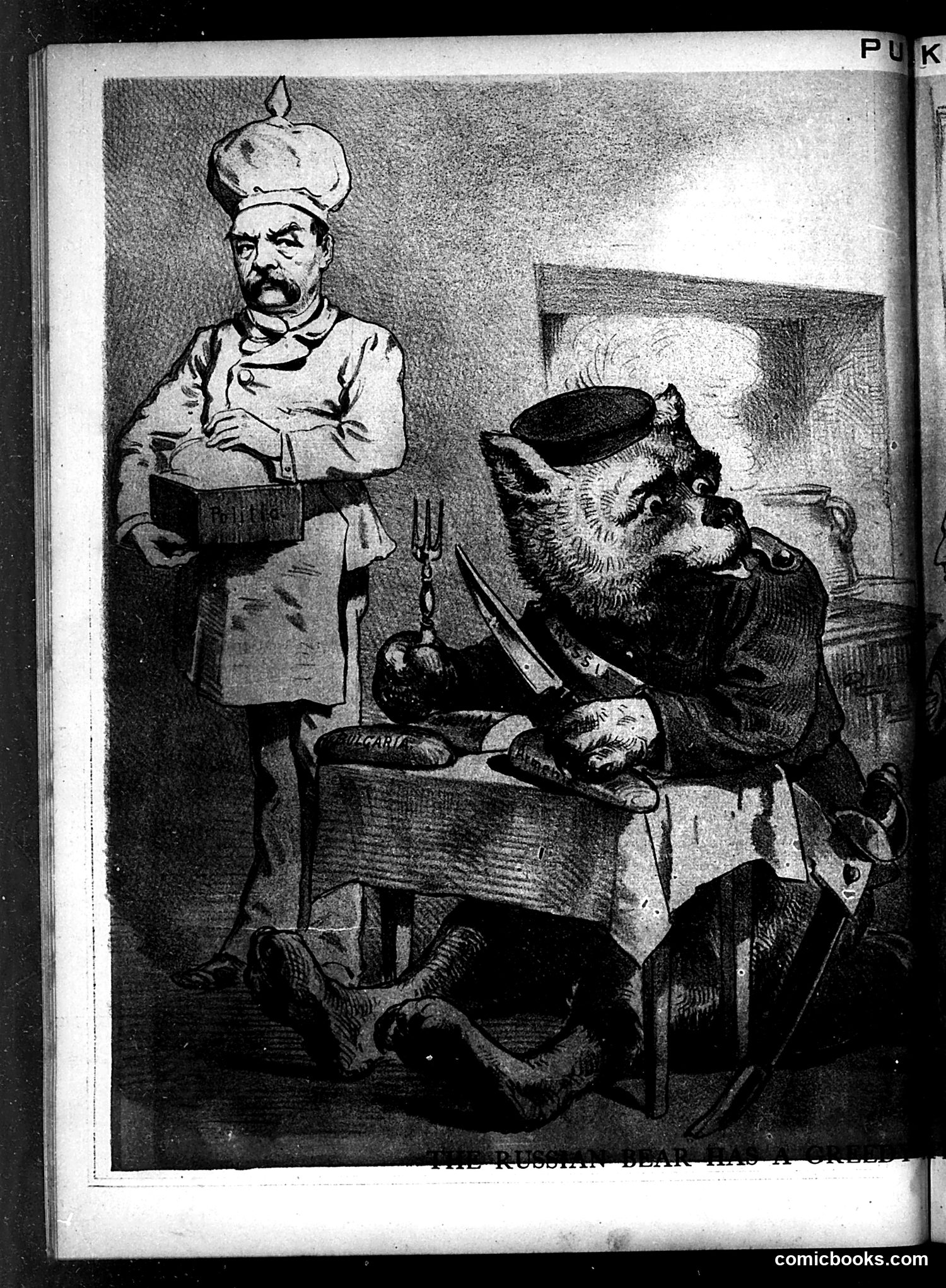
This Puck cartoon satirizes Balkan tensions, likely from the early 1900s. The labeled figures represent national/regional entities: Romania, and what appear to be military officers or diplomats in ornate uniforms (possibly representing Serbia, Bulgaria, or Ottoman interests), plus a figure labeled "Greece." The central figure at top—gesturing dramatically with an expression of alarm or refusal—appears to be a personified nation or power refusing to participate in territorial division negotiations. The uniformed figures below seem to represent competing Balkan interests or rival powers squabbling over territory. The cartoon mocks the inability of these nations to cooperate or fairly divide disputed territories during a period of Ottoman decline and Balkan nationalist conflicts. The title "Refuses to Divide" suggests one faction's obstruction of settlement agreements.
This Puck page is primarily **text-based satirical commentary** rather than a cartoon. The main article "Patent Skeletons" is a humorous story about an undertaker named Beemans who discovers that a competitor, Banister, is substituting cheap skeleton models for actual human remains in his funeral business—essentially committing fraud by passing off anatomical teaching skeletons as the genuine article during services. The satire targets **unscrupulous business practices** and the willingness to deceive grieving families for profit. It's a dark humor piece exploiting Victorian anxieties about death, body snatching, and trust in service industries. The page also includes brief "Dramatic Notes" and "Political Notes" sections commenting on contemporary theater and politics, but these are brief notices rather than developed satire.
This page contains primarily text content—a serialized English short story titled "Two Knaves and a Queen" by Frank Barrett, with a subtitle indicating it began in an earlier issue of Puck. The story appears to be a serialized fiction feature rather than political satire or commentary. It depicts a melodramatic narrative involving characters named Hugh, Renée, and others in what seems to be a 19th-century setting, with plot elements involving fire, social class tensions, and romantic complications. At the top of the page is a separate brief item titled "Oil City in '61," attributed as "[Reenacted from the Derrick]," which may be a humorous anecdote, but the text is partially illegible in this image. **This page represents Puck's fiction serialization rather than its signature satirical cartooning.** No identifiable political figures or social commentary satire is evident.
This page is primarily **text narrative** from a serialized story, with only a small illustration at the bottom labeled "Puck's Archipelago." The illustrated section shows a caricatured figure in period dress (appears to be 19th century) with exaggerated features, accompanying a brief satirical note about an "aspiring patriot" who petitioned President Jackson for a ministerial appointment. The satire mocks someone seeking political favor by offering the "gift" of old breeches and referencing a colored man in Florida, while requesting recognition that "his race ought to be recognized." The cartoon ridicules opportunistic political ambition and the absurdity of such brazen patronage-seeking during the Jackson era, but the specific historical references are unclear without additional context about the period's political appointments.
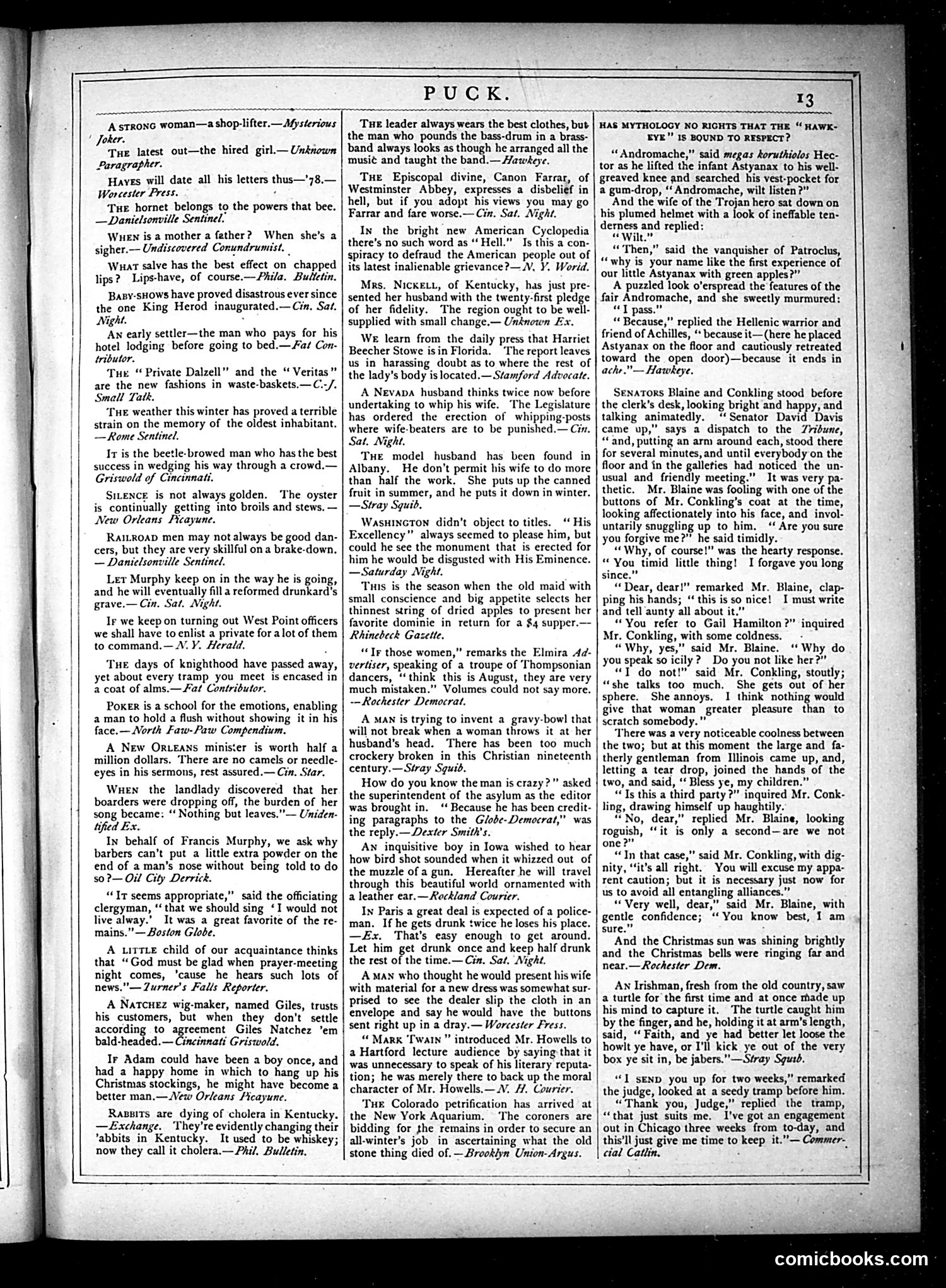
This page consists primarily of satirical short items and jokes rather than illustrated cartoons. The content targets various social issues and public figures of the period through brief, pointed quips. The items mock diverse targets: incompetent husbands, unfaithful spouses, clerical hypocrisy, women's rights debates, and military/political incompetence. One piece references "Mark Twain" introducing a Hartford lecture audience. Another jokes about prayer-meeting propriety and another about West Point officers. The satire employs typical Puck strategies—exaggeration, irony, and absurdist humor—to critique social conventions, gender dynamics, and institutional failures. Without visible illustrations, the humor relies entirely on text. The tone is lighthearted mockery aimed at middle-class American readers, targeting both individual foibles and broader social pretensions of the era.
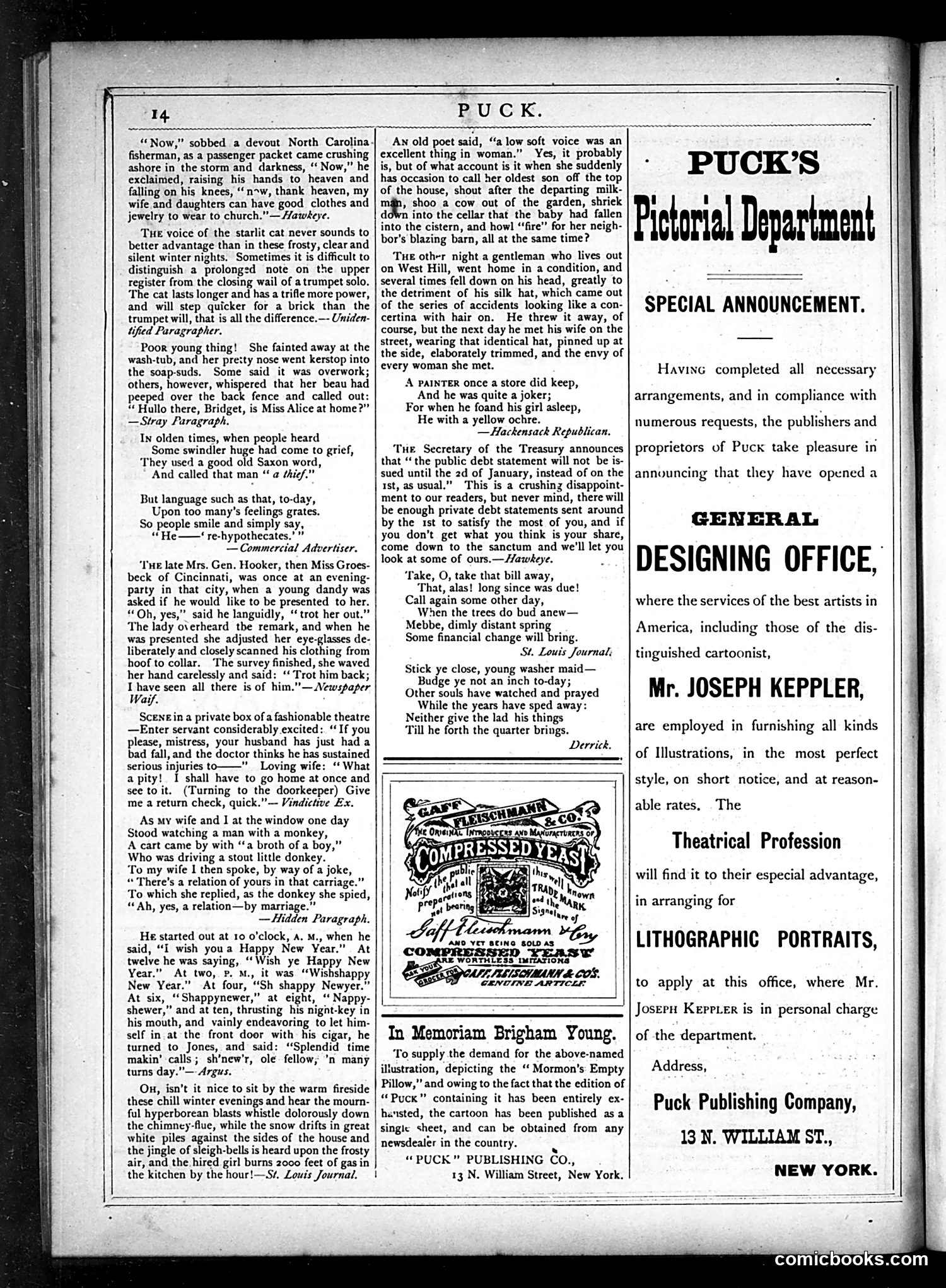
This page is primarily **advertising and announcements** rather than political satire. The main content advertises Puck's newly opened "General Designing Office," which offers illustration services through cartoonist **Joseph Keppler**. The office provides theatrical portraits and lithographic work for the theatrical profession at reasonable rates. The left column contains various **humorous anecdotes and jokes** from different newspapers—brief, disconnected stories about absent-minded professors, marital mishaps, and comic misunderstandings. These represent typical period humor rather than political commentary. A **Fleischmann's Yeast advertisement** appears in the center, with decorative typography typical of the era. The page serves primarily as a business notice and general humor compilation rather than presenting satirical cartoons addressing contemporary political or social issues.
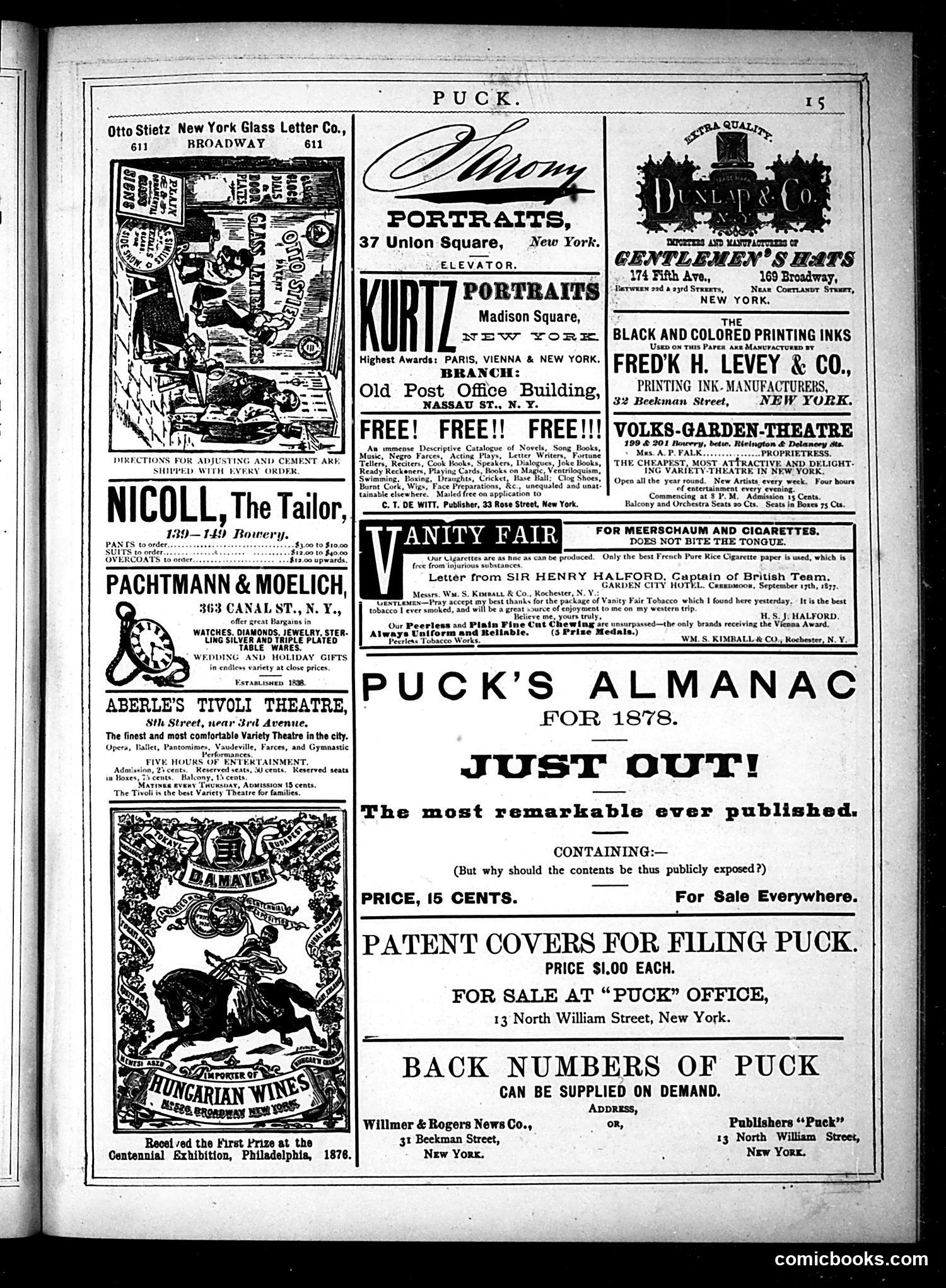
This appears to be primarily an **advertising page** from Puck magazine (page 15), rather than featuring satirical cartoons. The page contains numerous advertisements for New York businesses and services circa 1878, including: - Portrait studios (Kurtz, Dimothy) - A tailor (Nicoll) - Jewelry and watches (Pachtmann & Moelich) - A theater (Aberle's Tivoli) - Wine (Bamayer Hungarian Wine advertisement with decorative imagery) - Hats, printing inks, and other goods The main editorial content advertises **Puck's Almanac for 1878** as "just out" and "the most remarkable ever published" (15 cents), along with patent file covers available at the Puck office. This is essentially a back-page advertisement section rather than satirical content requiring historical interpretation.
This appears to be a Puck magazine advertisement or illustration titled "She's a." The image shows a winged female figure (likely representing an allegorical or mythological character) playing a large gramophone or phonograph horn. The illustration is rendered in the classical engraving style typical of late 19th/early 20th-century satirical publications. Without clearer OCR text or additional context, the specific satirical point is unclear. The phrase "She's a" appears incomplete, suggesting this may be a partial page or the text is illegible in the reproduction. The gramophone likely references modernity or popular entertainment, but I cannot definitively identify what social commentary or political figure this targets without more readable text or caption information.