
Puck, 1878-01-09 · page 5 of 16
Puck — January 9, 1878 — page 5: what you’re looking at
What you’re looking at
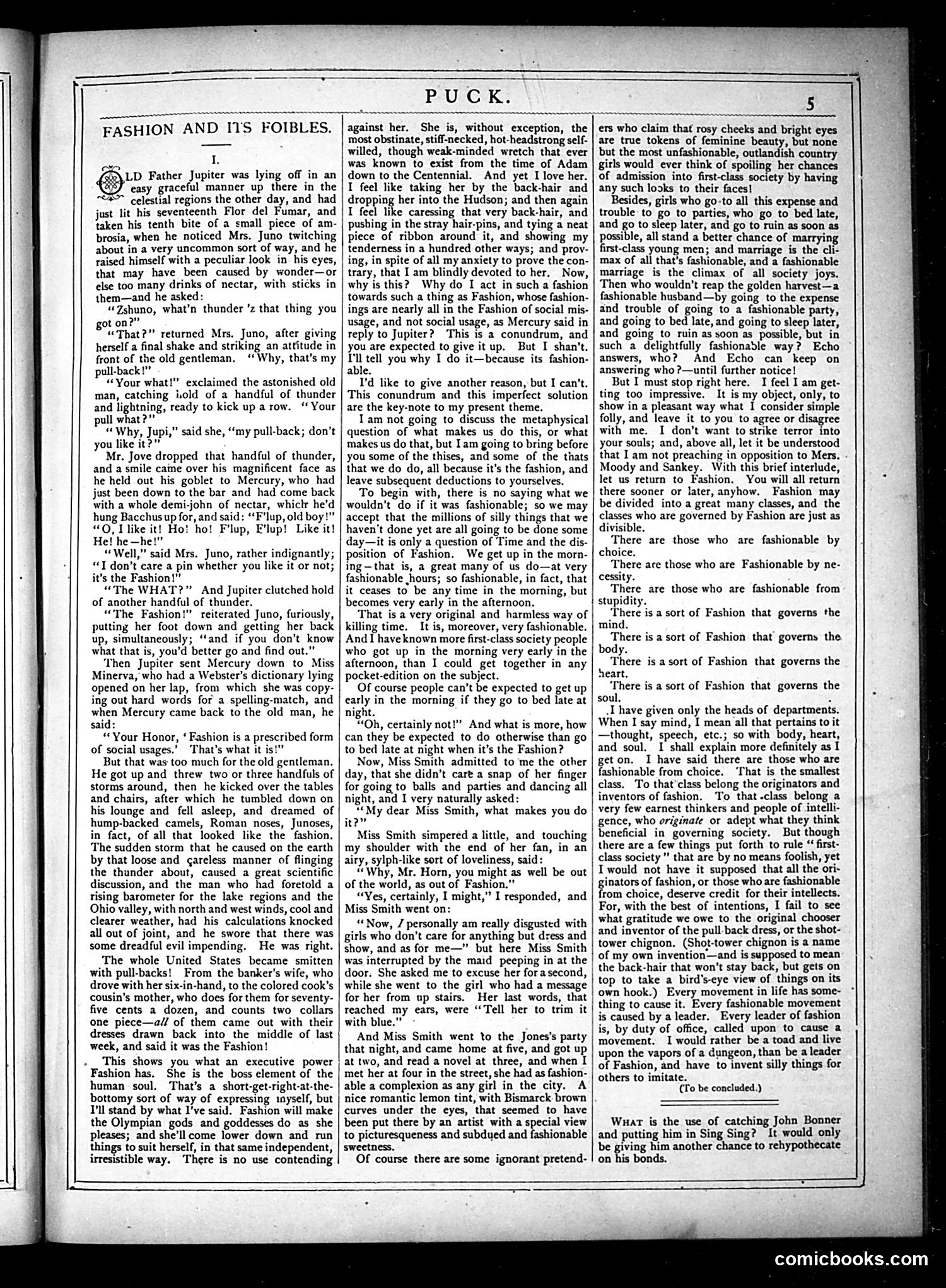
This page from *Puck* contains a satirical essay titled "Fashion and Its Foibles" (Part I), not a political cartoon. The text is a lengthy critique of high society's obsession with fashion, using dialogue between mythological figures—Jupiter and Mercury—to mock the illogical rules governing fashionable dress and behavior. The satire targets wealthy women who slavishly follow fashion trends regardless of practicality or comfort. Jupiter complains that fashionable society operates by arbitrary, contradictory rules: certain activities are only acceptable at specific times, yet the rules constantly change. The piece ridicules both the tyranny of fashion itself and society women's unquestioning compliance with it. This represents *Puck*'s typical social criticism of Gilded Age excess and conformity among the upper classes.
📄 Transcribed text from this page (OCR, searchable)
Machine-transcribed from the original scan — historical spelling and the odd misread are preserved.
lace es s FASHION AND ITS FOIBLES. 1h ip Father Jupiter was lying off in an easy graceful manner up there in the “4 celestial regions the other day, and had just lit his seventeenth Flor del Fumar, and taken his tenth bite of a small piece of am- brosia, when he noticed Mrs. Juno twitching about in a very uncommon sort of way, and he raised himself with a peculiar look in. his eyes, that may have been caused by wonder—or else too many drinks of nectar, with sticks in them—and he asked: “Zshuno, what’n thunder ’z that thing you ot on?” “That?” returned Mrs. Juno, after giving herself a final shake and striking an attitude in front of the old gentleman. ‘Why, that’s my pull-back!”” “Your what!” exclaimed the astonished old man, catching old of a handful of thunder and lightning, ready to kick up a row. ‘Your pull what?” “Why, Jupi,” said she, “my pull-back; don’t you like it?” Mr. Jove dropped that handful of thunder, and a smile came over his magnificent face as he held out his goblet to Mercury, who had just been down to the bar and had come back with a whole demi-john of nectar, whictr he’d hung Bacchus up for, and said: “*F'lup, old boy!” “(O, like it! Ho! ho! F'lup, E'lup! Like it! He! he—he!"” “Well,” said Mrs. Juno, rather indignantly; “T don’t care a pin whether you like it or not; it’s the Fashion!” “The WHAT?” And Jupiter clutched hold of another handful of thunder. “The Fashion!” reiterated Juno, furiously, putting her foot down and getting her back up, simultaneously; “and if you don’t know what that is, you’d better go and find out.” ‘Then Jupiter sent Mercury down to Miss Minerva, who had a Webster’s dictionary lying opened on her lap, from which she was copy- ing out hard words for a spelling-match, and when Mercury came back to the old man, he said: “Your Honor, ‘ Fashion is a prescribed form of social usages.’ That's what it is!” But that was too much for the old gentleman. He got up and threw two or three handfuls of storms around, then he kicked over the tables and chairs, after which he tumbled down on his lounge and fell asleep, and dreamed of hump-backed camels, Roman noses, Junoses, in fact, of all that looked like the fashion. The sudden storm that he caused on the earth by that loose and careless manner of flinging the thunder about, caused a great scientific discussion, and the man who had foretold a rising barometer for the lake regions and the Ohio valley, with north and west winds, cool and clearer weather, had his calculations knocked all out of joint, and he swore that there was some dreadful evil impending. He was right. The whole United States became smitten with pull-backs! From the banker's wife, who drove with her six-in-hand, to the colored cook’s cousin’s mother, who does for them for seventy- five cents a dozen, and counts two collars one piece—a// of them came out with their dresses drawn back into the middle of last week, and said it was the Fashion! This shows you what an executive power Fashion has. She is the boss element of the human soul. That’s a short-get-right-at-the- bottomy sort of way of expressing inyself, but I'll stand by what I've said. Fashion will make the Olympian gods and goddesses do as she pleases; and she'll come lower down and run things to suit herself, in that same independent, irresistible way. There is no use contending = PUCK. against her. She is, without exception, the most obstinate, stiff-necked, hot-headstrong self- willed, though weak-minded wretch that ever was known to exist from the time of Adam down to the Centennial. And yet I love her. I feel like taking her by the back-hair and dropping her into the Hudson; and then again I feel ike caressing that very back-hair, and pushing in the stray hair-pins, and tying a neat piece of ribbon around it, and showing my tenderness in a hundred other ways; and prov- ing, in spite of all my anxiety to prove the con- trary, that I am blindly devoted to her. Now, why is this? Why do I act in such a fashion towards such a thing as Fashion, whose fashion- ings are nearly all in the Fashion of social mis- usage, and not social usage, as Mercury said in reply to Jupiter? This is a conundrum, and you are expected to give it up. But I shan’t. I'll tell you why I do it—because its fashion- able. I'd like to give another reason, but I can’t. This conundrum and this imperfect solution are the key-note to my present theme. I am not going to discuss the metaphysical question of what makes us do this, or what makes us do that, but Iam going to bring before you some of the thises, and some of the thats that we do do, all because it’s the fashion, and leave subsequent deductions to yourselves. To begin with, there is no saying what we wouldn't do if it was fashionable; so we may accept that the millions of silly things that we haven't done yet are all going to be done some day—it is only a question of Time and the dis- position of Fashion. We get up in the morn- ing—that is, a great many of us do—at very fashionable hours; so fashionable, in fact, that it ceases to be any time in the morning, but becomes very early in the afternoon. ‘That is a very original and harmless way of killing time. It is, moreover, very fashionable. And I have known more first-class society people who got up in the morning very early in the afternoon, than I could get together in any pocket-edition on the subject. Of course people can’t be expected to get up early in the morning if they go to bed late at night. “Oh, certainly not!” And what is more, how can they be expected to do otherwise than go to bed late at night when it’s the Fashion? Now, Miss Smith admitted to me the other day, that she didn’t cart a snap of her finger for going to balls and parties and dancing all night, and I very naturally asked: “My dear Miss Smith, what makes you do in?” Miss Smith simpered a little, and touching | my shoulder with the end of her fan, in an airy, sylph-like sort of loveliness, said: “Why, Mr. Horn, you might as well be out of the world, as out of Fashion.” “Yes, certainly, I might,” I responded, and Miss Smith went on: “Now, / personally am really disgusted with girls who don’t care for anything but dress and show, and as for me—" but here Miss Smith was interrupted by the maid peeping in at the door. She asked me to excuse her for asecond, while she went to the girl who had a message for her from up stairs. reached my ears, were ‘Tell her to trim it with blue.” And Miss Smith went to the Jones's party that night, and came home at five, and got up at two, and read a novel at three, and when I met her at four in the street, she had as fashion- able a complexion as any girl in the city. A nice romantic lemon tint, with Bismarck brown curves under the eyes, that seemed to have been put there by an artist with a special view to picturesqueness and subdued and fashionable sweetness. Of course there are some ignorant pretend- Her last words, that } ers who claim that rosy cheeks and bright eyes are true tokens of feminine beauty, but none but the most unfashionable, outlandish country girls would ever think of spoiling her chances of admission into first-class society by having any such looks to their faces! Besides, girls who go-to all this expense and trouble to go to parties, who go to bed late, and go to sleep later, and go to ruin as soon as possible, all stand a better chance of marrying first-class young men; and marriage is the cli- max of all that’s fashionable, and a fashionable marriage is the climax of all society joys. Then who wouldn't reap the golden harvest—a fashionable husband—by going to the expense and trouble of going to a fashionable party, and going to bed late, and going to sleep later, and going to ruin as soon as possible, but in such a delightfully fashionadle way? Echo answers, who? And Echo can keep on answering who ?—until further notice! But I must stop right here, I feel I am get- ting too impressive. It is my object, only, to show in a pleasant way what I consider simple folly, and leave it to you to agree or disagree with me. I don’t want to strike terror into your souls; and, above all, let it be understood that I am not preaching in opposition to Mers. Moody and Sankey. With this brief interlude, let us return to Fashion. You will all return there sooner or later, anyhow. Fashion may be divided into a great many classes, and the classes who are governed by Fashion are just as divisible. There are those who are fashionable by choice, There are those who are Fashionable by ne- cessity. There are those who are fashionable from stupidity. ‘There is a sort of Fashion that governs the mind. There is a sort of Fashion that’ governs the body. There is a sort of Fashion that governs the heart. ‘There is a sort of Fashion that governs the soul. . I have given only the heads of departments. When I say mind, I mean all that pertains to it —thought, speech, etc.; so with body, heart, and soul. I shall explain more definitely as I geton. I have said there are those who are fashionable from choice. ‘That is the smallest class. To that’class belong the originators and inventors of fashion. To that.class belong a very few earnest thinkers and people of intelli- gence, who originate or adept what they think beneficial in governing society. But though there are a few things put forth to rule “ first- class society” that are by no means foolish, yet I would not have it supposed that all the ori- inators of fashion, or those who are fashionable rom choice, deserve credit for their intellects. For, with the best of intentions, I fail to see what gratitude we owe to the original chooser and inventor of the pull-back dress, or the shot- tower chignon. (Shot-tower chignon is a name of my own invention—and is supposed to mean the back-hair that won't stay back, but gets on top to take a bird's-eye view of things on its own hook.) Every movement in life has some- thing to cause it. Every fashionable movement | is caused by a leader. Every leader of fashion | is, by duty of office, called’ upon to cause a movement. I would rather be a toad and live upon the vapors of a dungeon, than be aleader of Fashion, and have to invent silly things for others to imitate. (To be concluded.) Wuat is the use of catching John Bonner and putting him in Sing Sing? It would only be giving him another chance to rehypothecate on fis bonds. comicbooks.com