
Puck, 1878-01-09 · page 4 of 16
Puck — January 9, 1878 — page 4: what you’re looking at
What you’re looking at
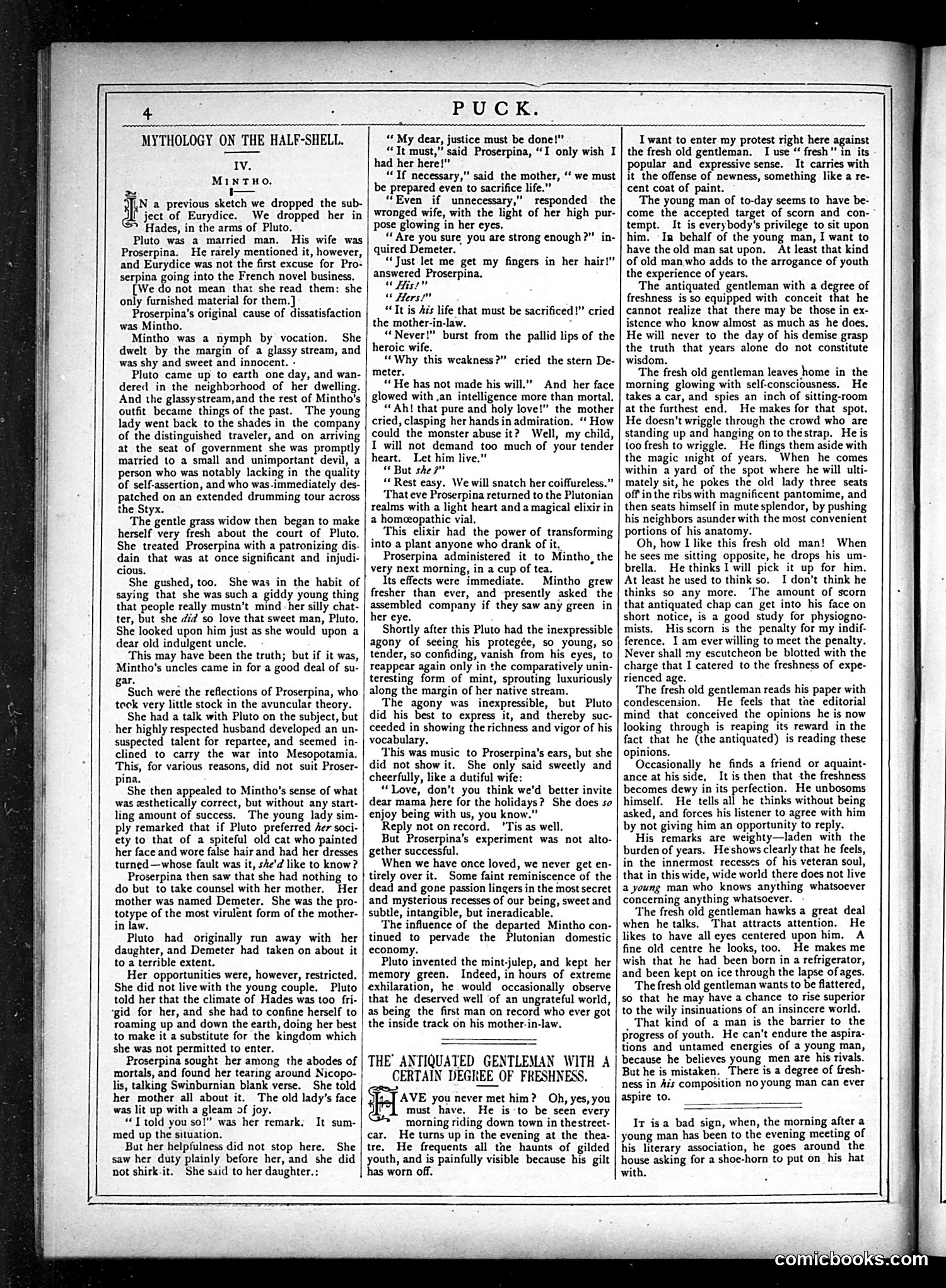
This page appears to be primarily literary content rather than political satire. The left column continues "Mythology on the Half-Shell," a humorous retelling of the Persephone and Pluto myth, with emphasis on domestic comedy—Persephone's dissatisfaction with her husband, her mother Demeter's interference, and various marital disputes presented as melodrama. The right column features "The Antiquated Gentleman with a Certain Degree of Freshness," which satirizes an elderly man who frequents social scenes despite his age, attempting to appear youthful and fashionable. The piece mocks his vanity and failure to recognize his irrelevance to younger society. Both pieces employ humor through exaggeration of character types rather than targeting specific political figures or events. The satire is social rather than political in nature.
📄 Transcribed text from this page (OCR, searchable)
Machine-transcribed from the original scan — historical spelling and the odd misread are preserved.
PUCK. MYTHOLOGY ON THE HALF-SHELL. Iv. MINTHO. — iN a previous sketch we dropped the sub- ject of Eurydice. We dropped her in Hades, in the arms of Pluto. Pluto was a married man. His wife was Proserpina. He rarely mentioned it, however, and Eurydice was not the first excuse for Pro- serpina going into the French novel business. [We do not mean that she read them: she only furnished material for them.) Proserpina’s original cause of dissatisfaction was Mintho. Mintho was a nymph by vocation. She dwelt by the margin of a glassy stream, and was shy and sweet and innocent. - Pluto came up to earth one day, and wan- dered in the neighborhood of her dwelling. And the glassy stream, and the rest of Mintho’s outfit became things of the past. The young lady went back to the shades in the company of the distinguished traveler, and on arriving at the seat of government she was promptly married to a small and unimportant devil, a person who was notably lacking in the quality of self-assertion, and who was.immediately des- patched on an extended drumming tour across the Styx. The gentle grass widow then began to make herself very fresh about the court of Pluto. She treated Proserpina with a patronizing dis- dain that was at once significant and injudi- cious. She gushed, too. She was in the habit of saying that she was such a giddy young thing that people really mustn’t mind -her silly chat- ter, but she did so love that sweet man, Pluto. She looked upon him just as she would upon a dear old indulgent uncle. This may have been the truth; but if it was, Mintho's uncles came in for a good deal of su- ar. ee Such weré'the reflections of Proserpina, who tock very little stock in the avuncular theory. She had a talk with Pluto on the subject, but her highly respected husband developed an un- suspected talent for repartee, and seemed in- clined to carry the war into Mesopotamia. This, for various reasons, did not suit Proser- ina. Pighe then appealed to Mintho’s sense of what was wsthetically correct, but without any start- ling amount of success. The young lady sim- ply remarked that if Pluto preferred her soci- ety to that of a spiteful old cat who painted her face and wore false hair and had her dresses turned —whose fault was it, she'd like to know? Proserpina then saw that she had nothing to do but to take counsel with her mother. Her mother was named Demeter. She was the pro- totype of the most virulent form of the mother- in law. Pluto had originally run away with her daughter, and Demeter had taken on about it to a terrible extent. Her opportunities were, however, restricted. She did not live with the young couple. Pluto told her that the climate of Hades was too fri- ‘gid for her, and she had to confine herself to roaming up and down the earth, doing her best she was not permitted to enter. Proserpina sought her among the abodes of mortals, and found her tearing around Nicopo- lis, talking Swinburnian blank verse. She told her mother all about it. The old lady's face was lit up with a gleam of joy. “T told you so!” was her remark: med up the situation. But her helpfulness did not stop here. She saw her duty plainly before her, and she did not shirk.it. She said to her daughter.: It sum- “* My dear, justice must be done!” “Tt must,” said Proserpina, “I only wish I had her here!" “If necessary,” said the mother, ‘‘ we must be prepared even to sacrifice life.” “Even if unnecessary,” responded the wronged wife, with the light of her high pur- pose glowing in her eyes. “ Are you sure you are strong enough?” in- quired Demeter. “Just let me get my fingers in her hair!” answered Proserpina. Hist” “ Hers!” “It is Ads life that must be sacrificed!” cried the mother-in-law. “Never!” burst from the pallid lips of the heroic wife. “Why this weakness?” cried the stern De- meter. “He has not made his will.” And her face glowed with ,an intelligence more than mortal, ‘‘Ah! that pure and holy love!” the mother cried, clasping her hands in admiration. “ How could the monster abuse it? Well, my child, I will not demand too much of your tender heart. Let him live.” “ But she?” “ Rest easy. We will snatch her coiffureless.” ‘That eve Proserpina returned to the Plutonian realms with a light heart and a magical elixir in a homeeopathic vial. This elixir had the power of transforming into a plant anyone who drank of it. Proserpina administered it to Mintho, the very next morning, in a cup of tea. Its effects were immediate. Mintho grew fresher than ever, and presently asked the assembled company if they saw any green in her eye. Shortly after this Pluto had the inexpressible agony of seeing his protegée, so young, so tender, so confiding, vanish from his eyes, to reappear again only in the comparatively unin- teresting form of mint, sprouting luxuriously along the margin of her native stream. The agony was inexpressible, but Pluto did his best to express it, and thereby suc- ceeded in showing the richness and vigor of his vocabulary. This was music to Proserpina’s ears, but she did not show it. She only said sweetly and cheerfully, like a dutiful wife: “Love, don’t you think we'd better invite dear mama here for the holidays? She does so enjoy being with us, you know.” Reply not on record. 'Tis as well. But Proserpina’s experiment was not alto- gether successful. When we have once loved, we never get en- tirely over it. Some faint reminiscence of the dead and gone passion lingers in the most secret and mysterious recesses of our being, sweet and subtle, intangible, but ineradicable. The influence of the departed Mintho con- tinued to pervade the Plutonian domestic economy. Pluto invented the mint-julep, and kept her memory green. Indeed, in hours of extreme exhilaration, he would occasionally observe that he deserved well ‘of an ungrateful world, as being the first man on record who ever got | the inside track on his mother-in-law. to make it a substitute for the kingdom which | a THE’ ANTIQUATED GENTLEMAN WITH A CERTAIN DEGREE OF FRESHNESS. Pe AvE you never met him? Oh, yes, you j must have. He isto be seen every morning riding down town in thestreet- car. He turns up in the evening at the thea- tre, He frequents all the haunts of gilded youth, and is painfully visible because his gilt has worn off. I want to enter my protest right here against the fresh old gentleman. I use “ fresh” in its popular and expressive sense. It carries with it the offense of newness, something like a re- cent coat of paint. The young man of to-day seems to have be- come the accepted target of scorn and con- tempt. It is everybody's privilege to sit upon him. In behalf of the young man, I want to have the old man sat upon. At least that kind of old manwho adds to the arrogance of youth the experience of years. The antiquated gentleman with a degree of freshness is so equipped with conceit that he cannot realize that there may be those in ex- istence who know almost as much as he does, He will never to the day of his demise grasp the truth that years alone do not constitute wisdom. The fresh old gentleman leaves home in the morning glowing with self-consciousness. He takes a car, and spies an inch of sitting-room at the furthest end. He makes for that spot. He doesn’t wriggle through the crowd who are standing up and hanging onto thestrap. He is too fresh to wriggle. He flings them aside with the magic inight of years. When he comes within a yard of the spot where he will ulti- mately sit, he pokes the old lady three seats off inthe ribs with magnificent pantomime, and then seats himself in mute splendor, by pushing his neighbors asunder with the most convenient portions of his anatomy. Oh, how I like this fresh old man! When he sees me sitting opposite, he drops his um- brella. He thinks I will pick it up for him. At least he used to think so. I don’t think he thinks so any more. ‘The amount of scorn that antiquated chap can get into his face on short notice, is a good study for physiogno- mists. His scorn is the penalty for my indif- ference. I am ever willing to meet the penalty. Never shall my escutcheon be blotted with the charge that I catered to the freshness of expe- rienced age. ‘The fresh old gentleman reads his paper with condescension. He feels that tne editorial mind that conceived the opinions he is now looking through is reaping its reward in the fact that he (the antiquated) is reading these opinions. Occasionally he finds a friend or aquaint- ance at his side, It is then that the freshness becomes dewy in its perfection. He unbosoms himself. He tells all he thinks without being asked, and forces his listener to agree with him by not giving him an opportunity to reply. His remarks are weighty—laden with the burden of years. He'shows clearly that he feels, in the innermost recesses of his veteran soul, that in this wide, wide world there does not live a young man who knows anything whatsoever concerning anything whatsoever. ‘The fresh old gentleman hawks a great deal when he talks. That attracts attention. He likes to have all eyes centered upon him. A fine old centre he looks, too. He makes me wish that he had been born in a refrigerator, and been kept on ice through the lapse of ages. The fresh old gentleman wants to be flattered, so that he may have a chance to rise superior to the wily insinuations of an insincere world. That kind of a man is the barrier to the progress of youth. He can’t endure the aspira- tions and untamed energies of a young man, because he believes young men are his rivals. But he is mistaken. There is a degree of fresh- ness in Ais composition no young man can ever aspire to. Ir isa bad sign, when, the morning after a young man has been to the evening meeting of his literary association, he goes around the house asking for a shoe-horn to put on his hat with,