
Puck, 1878-01-09 · page 10 of 16
Puck — January 9, 1878 — page 10: what you’re looking at
What you’re looking at
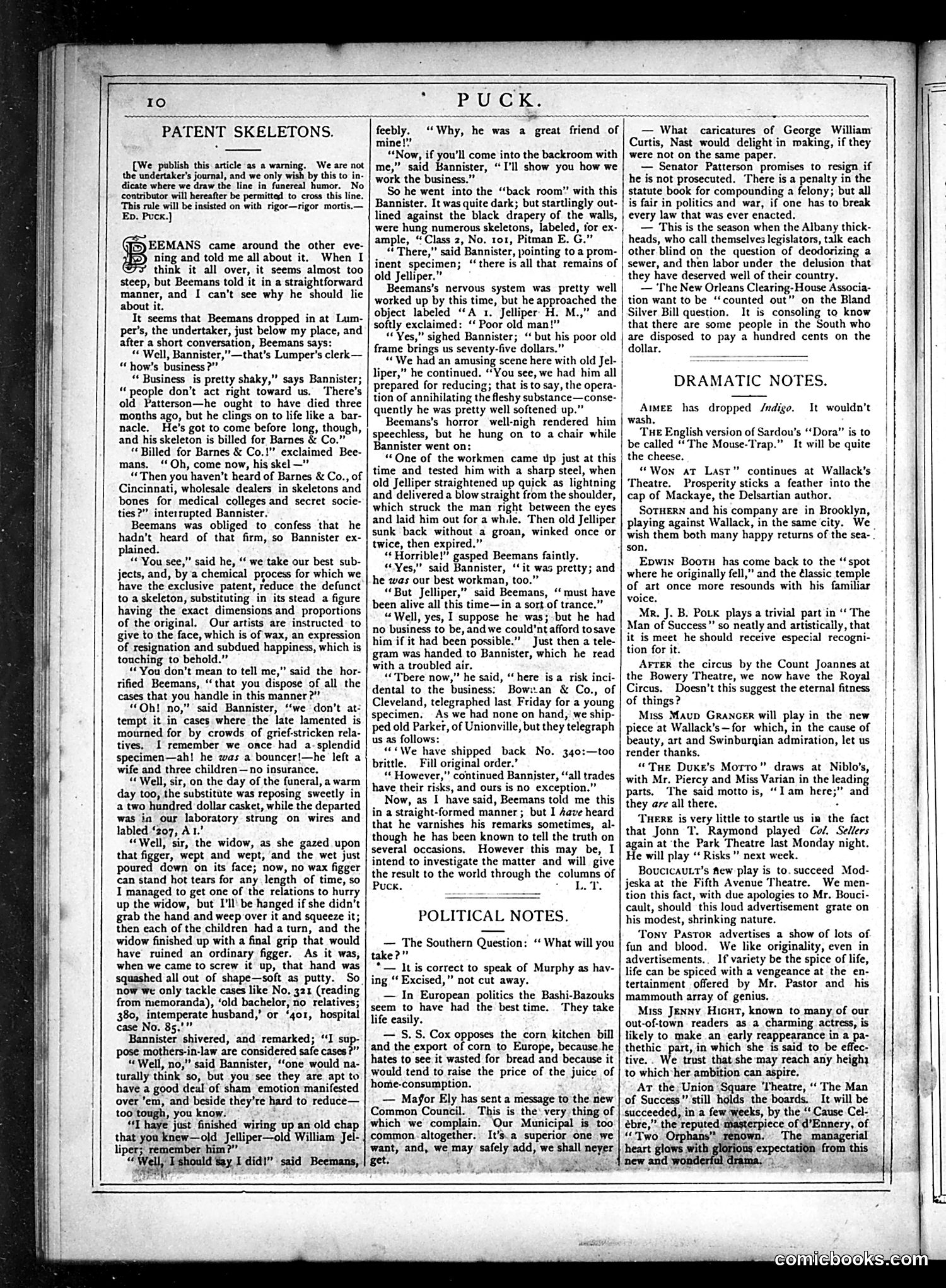
This Puck page is primarily **text-based satirical commentary** rather than a cartoon. The main article "Patent Skeletons" is a humorous story about an undertaker named Beemans who discovers that a competitor, Banister, is substituting cheap skeleton models for actual human remains in his funeral business—essentially committing fraud by passing off anatomical teaching skeletons as the genuine article during services. The satire targets **unscrupulous business practices** and the willingness to deceive grieving families for profit. It's a dark humor piece exploiting Victorian anxieties about death, body snatching, and trust in service industries. The page also includes brief "Dramatic Notes" and "Political Notes" sections commenting on contemporary theater and politics, but these are brief notices rather than developed satire.
📄 Transcribed text from this page (OCR, searchable)
Machine-transcribed from the original scan — historical spelling and the odd misread are preserved.
PATENT SKELETONS. [We publish this article as a warning. We are not the undertaker’s journal, and we only wish by this to in- dicate where we draw the line in funereal humor. No contributor will hereafter be permitted to cross this line. This rule will be insisted on with rigor—rigor mortis.— Ep. Puck.] Qf EEMANS came around the other eve- yf) ning and told me all about it. When I think it all over, it seems almost too steep, but Beemans told it in a straightforward manner, and [ can't see why he should lie about it. It seems that Beemans dropped in at Lum- per’s, the undertaker, just below my place, and after a short conversation, Beemans says: “ Well, Bannister,”—that’s Lumper’s clerk — “ how’s business ?”” “ Business is pretty shaky,” says Bannister; “people don’t act right toward us. There's old Patterson—he ought to have died three months ago, but he clings on to life like a bar- nacle. He's got to come before long, though, and his skeleton is billed for Barnes & Co.”” “Billed for Barnes & Co.!" exclaimed Bee- mans. ‘Oh, come now, his skel —” Then you haven't heard of Barnes & Co., of Cincinnati, wholesale dealers in skeletons and bones for medical colleges and secret socie- ties?” interrupted Bannister. Beemans was obliged to confess that he hadn't heard of that firm, so Bannister ex- plained. “You see,” said he, ‘“ we take our best sub- jects, and, by a chemical process for which we have the exclusive patent, reduce the defunct to a skeleton, substituting in its stead a figure having the exact dimensions and proportions of the original. Our artists are instructed to give to the face, which is of wax, an expression of resignation and subdued happiness, which is touching to behold.” “You don't mean to tell me,” said the hor- rified Beemans, “that you dispose of all the cases that you handle in this manner?” “Oh! no,” said Bannister, ‘‘we don’t at- tempt it in cases where the late lamented is mourned for by crowds of grief-stricken rela- tives, I remember we once had a-splendid specimen—ah! he was a bouncer!—he left a wife and three children—no insurance, “Well, sir, on the day of the funeral, a warm day too, the substitute was reposing sweetly in a two hundred dollar casket, while the departed was in our laboratory strung on wires and labled. ‘207, Al’ “Well, sir, the widow, as she gazed upon that figger, wept and wept, and the wet just poured down on its face; now, no wax figger can stand hot tears for any length of time, so I managed to get one of the relations to hurry up the widow, but I'll’ be hanged if she didn’t grab the hand and weep over it and squeeze it; then each of the children had a turn, and the widow finished up with a final grip that would have ruined an ordinary figger. As it was, when we came to screw it up, that hand was squashed all out of shape—soft as putty. So now we only tackle cases like No. 321 (reading from memoranda), ‘old bachelor, no relatives; 380, intemperate husband,’ or ‘401, hospital case No. 85,'"" Bannister shivered, and remarked; ‘I su pose mothers-in-law are considered safe cases?” “Well, no,” said Bannister, ‘‘one would na- turally think so, but you see they are apt to have a good deal of sham emotion manifested over 'em, and beside they’re hard to reduce— too tough, you know. “I haye just finished wiring up an old Cap that you knew—old pepe ole William Jel- iper; remember him?” “el Tshould fay did)” said Beemans, ; PUCK. feebly. “Why, he was a sigan friend of mine!”’ “Now, if you'll come into the backroom with me,” said Bannister, “I'll show you how we work the business.” So he went into the “back room” with this Bannister. It was quite dark; but startlingly out- lined against the black drapery of the walls, were hung numerous skeletons, labeled, for ex- ample, “Class 2, No. 101, Pitman E. G.” “There,” said Bannister, pointing to a prom- inent specimen; “there is all that remains of old Jelliper.” Beemans’s nervous system was pretty well worked up by this time, but he approached the object labeled “A 1. Jelliper- H. M.,” softly exclaimed: ‘‘ Poor old man!” “Yes,” sighed Bannister; “ but his poor old frame brings us seventy-five dollars.” “We had an amusing scene here with old Jel- liper,” he continued. “You see, we had him all prepared for reducing; that is to say, the opera- tion of annihilating the fleshy substance—conse- quently he was pretty well softened up.” Beemans’s horror well-nigh rendered him speechless, but he hung on to a chair while Bannister went on: “One of the workmen came up just at this time and tested him with a sharp steel, when old Jelliper straightened up quick as lightning and delivered a blow straight from the shoulder, which struck the man right between the eyes and laid him out for a while. Then old Jelliper sunk back without a groan, winked once or twice, then expired.” “Horrible!” gasped Beemans faintly. “Yes,” said Bannister, ‘‘ it was pretty; and he was our best workman, too.” “But Jelliper,” said Beemans, “ must have been alive all this time—in a sort of trance.” “Well, yes, I suppose he was; but he had no business to be, and we could'nt afford tosave him if it had been possible.” Just then a tele- gram was handed to Bannister, which he read with a troubled air. “Tere now,” he said, “here is a risk inci- dental to the business; Bow:.an & Co., of Cleveland, telegraphed last Friday for a young ccimen, As we had none on hand,’ we ship- ped old Parker, of Unionville, but they telegraph us as follows “<We have shipped back No. 340:—too brittle. Fill original order.” “ However,” continued Bannister, “all trades have their risks, and ours is no exception.” Now, as I have said, Beemans told me this in a straight-formed manner ; but I Aave heard that he varnishes his remarks sometimes, al- though he has been known to tell the truth on several occasions, However this may be, I intend to investigate the matter and will give the result to the world through the columns of Puck. LT. POLITICAL NOTES. — The Southern Question: “ What will you take?” *— lvis correct to speak of Murphy as hav- ing ‘‘ Excised,” not cut away. — In European politics the Bashi-Bazouks seem to have had the best time. They take life easily. — S.S. Cox opposes the corn kitchen bill and the export of corn to Europe, because.he hates to see it wasted for bread and because it would tend to raise the price of the juice of honie-consumption. — Mafor Ely has sent a message to the, new Common Council. This is the: very thing of which we complain. Our Municipal is too common. altogether. It’s.a superior one we want, and, we may’ safely add, we shall neyer gets sal aR and | di | = What caricatures of George William Curtis, Nast would delight in making, if they were not on the same paper. — Senator Patterson promises to resign if he is not prosecuted. There is a penalty in the statute book for compounding a felony; but all is fair in politics and war, if one has to break every law that was ever enacted, — This is the season when the Albany thick- heads, who call themselves legislators, talk each other blind on the question of deodorizing a sewer, and then labor under the delusion that | they have deserved well of their country. — The New Orleans Clearing-House Associa- tion want to be ‘counted out” on the Bland Silver Bill question. It is consoling to know that there are some people in the South who are disposed to pay a hundred cents on the dollar. DRAMATIC NOTES. It wouldn't Aimee has dropped Jndigo. wash. Tue English version of Sardou’s “Dora” is to be called “The Mouse-Trap.” It will be quite the cheese. “Won at Last” continues at Wallack’s ‘Theatre. Prosperity sticks a feather into the cap of Mackaye, the Delsartian author. SoTHERN and his company are in Brooklyn, playing against Wallack, in the same city. We wish them both many happy returns of the sea- son, Epwin Bootn has come back to the ‘spot where he originally fell,” and the élassic temple of art once more resounds with his familiar voice. Mr. J. B. Pork plays a trivial part in “ The Man of Success” so neatly and artistically, that it is meet he should receive especial recogni- tion for it. Arter the circus by the Count Joannes at the Bowery Theatre, we now have the Royal Circus. Doesn't this suggest the eternal fitness of things? Miss Maup Grancer will play in the new piece at Wallack’s—for which, in the cause of beauty, art and Swinburnian admiration, let us render thanks. “THe Duxe’s Morto” draws at Niblo’s, with Mr. Piercy and Miss Varian in the leading parts, The said motto is, “I am here;” and they are all there. . TueRre is very little to startle us in the fact that Jonn T. Raymond played Col, Sellers again at ‘the Park Theatre last Monday night. He will play “ Risks” next week. Boucicautt’s flew play is to. succeed Mod- jeska at the Fifth Avenue Theatre. We men- tion this fact, with due apologies to Mr. Bouci- cault, should this loud advertisement grate on his modest, shrinking nature. ‘Tony Pastor advertises a show of lots of. fun and blood. We like originality, even in advertisements. If variety be the spice of life, life can be spiced with a vengeance at the en- tertainment offered by Mr. Pastor and his mammouth array of genius. Miss Jenny Hicut, known to many of our out-of-town readers as a charming actress, is likely to make an early reappearance in a pa- thethic part, in which she is said to be effec- tive... We trust that she may reach any heighy to which her ambition can aspire. Ar the Union ‘Square ‘Theatre, ‘‘ The Man of Success’”’still holds the boards. It will be succeeded, in a few ‘weeks, by the ‘ Cause Cel- eébre,” the reputed masterpiece of d’Ennery, a “Two Orphans” icomicbooks=com