
Puck, 1878-01-09 · page 7 of 16
Puck — January 9, 1878 — page 7: what you’re looking at
What you’re looking at
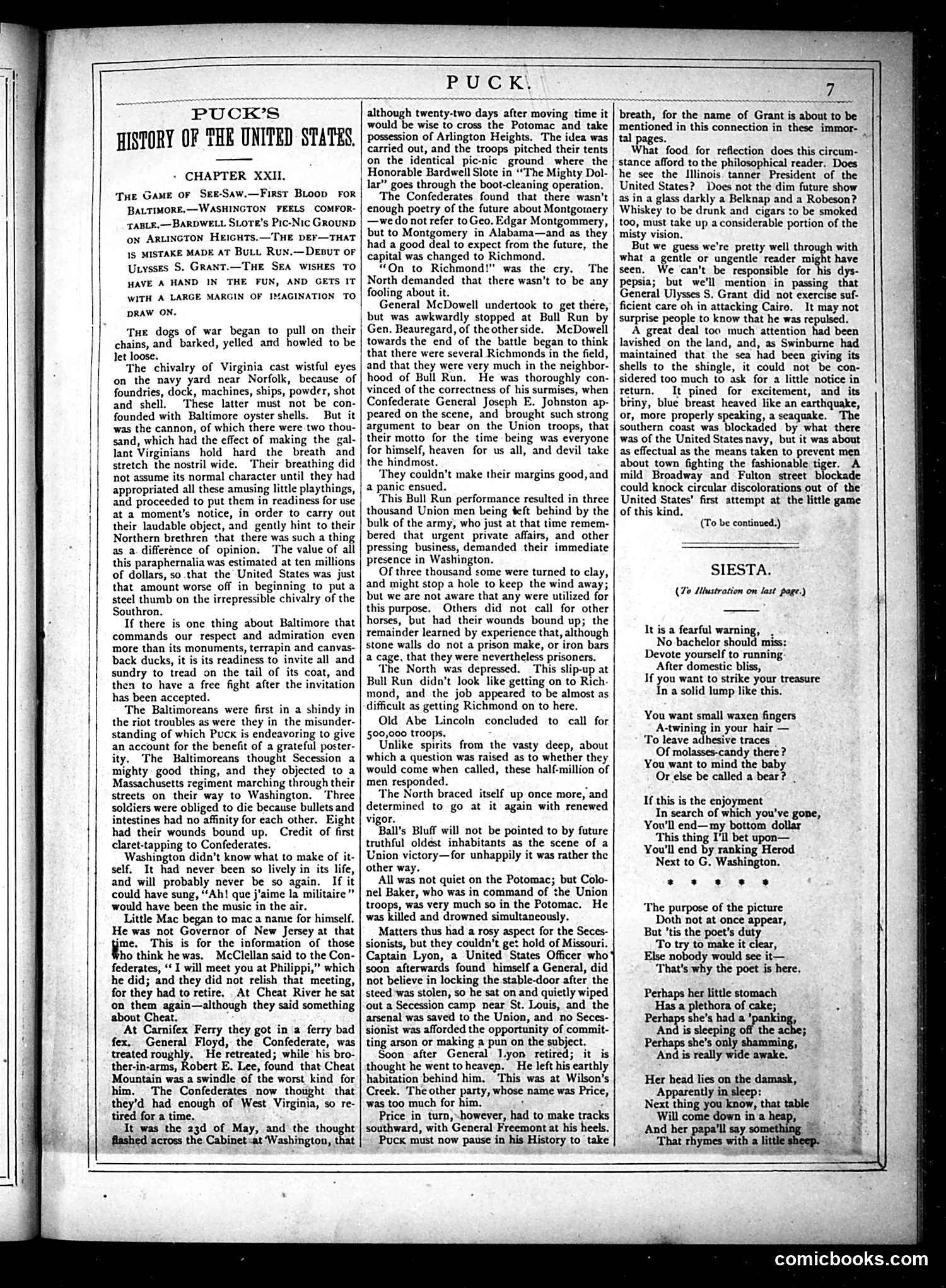
This page contains two distinct sections: **Left Column:** "Puck's History of the United States," Chapter XXII, discusses Civil War battles around Richmond and Baltimore, focusing on the First Battle of Bull Run. The text describes military movements, Confederate General Joseph E. Johnston, and Union General Lyon's death. **Right Column:** A poem titled "SIESTA" with accompanying illustration (referenced as "To Illustration on last page"). The satirical verse mocks someone—likely a political figure—for laziness and incompetence, using sharp criticism about "running after domestic bliss" and ranking "Herod" as preferable leadership. The page appears to mix historical commentary with contemporary political satire, typical of Puck's approach. Without seeing the actual illustration clearly, precise identification of the satirized figure remains uncertain.
📄 Transcribed text from this page (OCR, searchable)
Machine-transcribed from the original scan — historical spelling and the odd misread are preserved.
PUCK’S HISTORY OF THE UNITED STATES. + CHAPTER XXII. ‘Tue Game or See-Saw.—First BLoop FoR BALTIMORE.—WASHINGTON FEELS COMFOR- ‘TABLE.— BARDWELL S.ore’s Pic-Nic Grounp on ARLINGTON HEIGHTS.—THE DEF—THAT 1s MISTAKE MADE AT Butt Run.—Denut oF Unysses S. GRANT.—THE SEA WISHES TO HAVE A HAND IN THE FUN, AND GETS IT WITH A LARGE MARGIN OF IMAGINATION TO DRAW ON. ‘Tue dogs of war began to pull on their chains, and barked, yelled and howled to be let loose. The chivalry of Virginia cast wistful eyes on the navy yard near Norfolk, because of foundries, dock, machines, ships, powder, shot and shell. These latter must not be con- founded with Baltimore oyster shells. But it was the cannon, of which there were two thou- sand, which had the effect of making the gal- lant Virginians hold hard the breath and stretch the nostril wide. Their breathing did not assume its normal character until they had appropriated all these amusing little playthings, and proceeded to put them in readiness for use at a moment’s notice, in order to carry out their laudable object, and gently hint to their Northern brethren that there was such a thing as a. difference of opinion. ‘he value of all this paraphernalia was estimated at ten millions of dollars, so.that the United States was just that amount worse off in beginning to puta steel thumb on the irrepressible chivalry of the Southron. If there is one thing about Baltimore that commands our respect and admiration even more than its monuments, terrapin and canvas- back ducks, it is its readiness to invite all and sundry to tread on the tail of its coat, and then to have a free fight after the invitation has been accepted. The Baltimoreans were first in a shindy in the riot troubles as were they in the misunder- standing of which Puck is endeavoring to give an account for the benefit of a grateful poster- ity. The Baltimoreans thought Secession a mighty good thing, and they objected to a Massachusetts regiment marching through their streets on their way to Washington. Three soldiers were obliged to die because bullets and intestines had no affinity for each other. Eight had their wounds bound up. Credit of first claret-tapping to Confederates. Washington didn’t know what to make of it- self. It had never been so lively in its life, and will probably never be so again. If it could have sung, “Ah! que j'aime la militaire” would have been the music in the air. Little Mac began to mac a name for himself. He was not Governor of New Jersey at that ime, This is for the information of those ho think he was. McClellan said to the Con- federates, ‘‘ I will meet you at Philippi,” which he did; and they did not relish that meeting, for they had to retire, At Cheat River he sat on them again—although they said something about Cheat, At Carnifex Ferry they got in a ferry bad fex. General Floyd, the Confederate, was treated roughly. He retreated; while his bro- ther-in-arms, Robert E. Lee, found that Cheat Mountain was a swindle of the worst kind for him. The Confederates now thought that they’d had enough of West Virginia, so re- tired for a time. It was the 23d of May, and the thought flashed ‘across the Cabinet «at ‘Washington, although twenty-two days after moving time it would be wise to cross the Potomac and take possession of Arlington Heights. The idea was carried out, and the troops pitched their tents on the identical pic-nic ground where the Honorable Bardwell Slote in ‘The Mighty Dol- lar” goes through the boot-cleaning operation. | The Confederates found that there wasn’t enough poetry of the future about Montgomery —we do not refer to Geo. Edgar Montgommery, but to Montgomery in Alabama—and as they had a good deal to expect from the future, the capital was changed to Richmond. “On to Richmond!” was the cry. The North demanded that there wasn’t to be any fooling about it. General McDowell undertook to get there, but was awkwardly stopped at Bull Run by Gen. Beauregard, of theotherside. McDowell towards the end of the battle began to think that there were several Richmonds in the field, and that they were very much in the neighbor- hood of Bull Run. He was thoroughly con- vinced of the correctness of his surmises, when Confederate General Joseph E. Jobnston ap- peared on the scene, and brought such strong argument to bear on the Union troops, that their motto for the time being was everyone for himself, heaven for us all, and devil take the hindmost. ‘They couldn’t make their margins good, and a panic ensued. This Bull Run performance resulted in three thousand Union men being eft behind by the bulk of the army, who just at that time remem- bered that urgent private affairs, and other pressing business, demanded their immediate presence in Washington. Of three thousand some were turned to clay, and might stop a hole to keep the wind away; but we are not aware that any were utilized for this purpose. Others did not call for other horses, but had their wounds bound up; the remainder learned by experience that, although stone walls do not a prison make, or iron bars a cage, that they were nevertheless prisoners. ‘The North was depressed. This slip-up at Bull Run didn’t look like getting on to Rich- mond, and the job appeared to be almost as difficult as getting Richmond on to here. Old Abe Lincoln concluded to call for 500,000 troops. Unlike spirits from the vasty deep, about which a question was raised as to whether they would come when called, these half-million of men responded. i ‘The North braced itself up once more, and determined to go at it again with renewed vigor. Ball's Bluff will not be pointed to by future truthful oldest inhabitants as the scene of a Union victory—for unhappily it was rather the other way. All was not quiet on the Potomac; but Colo- nel Baker, who was in command of the Union troops, was very much so in the Potomac. He was killed and drowned simultaneously. Matters thus had a rosy aspect for the Seces- sionists, but they couldn’t get hold of Missouri. Captain Lyon, a United States Officer who soon afterwards found himself a General, did not believe in locking the.stable-door after the steed was stolen, so he sat on and quietly wiped out a Secession camp near St. Louis, and the arsenal was saved to the Union, and _ no Seces- sionist was afforded the opportunity of commit- ting arson or making a pun on the subject. Soon after General I.yon retired; it is thought he went toheaven. He left his earthly habitation behind him. This was at Wilson’s Creek. The other party, whose name was Price, was too much for him. s 4 Price in turn,-however, had to make tracks southward, with General Freemont at his heels. Puck must now pause in his History to take breath, for the name of Grant is about to be mentioned in this connection in these immor- What food for reflection does this circum- stance afford to the philosophical reader. Does he see the Illinois. tanner President of the United States? Does not the dim future show as in a glass darkly a Belknap and a Robeson? Whiskey to be drunk and cigars :o be smoked too, must take up a considerable portion of the misty vision. But we guess we're pretty well through with what a gentle or ungentle reader might have seen, We can't be responsible for his dys- pepsia; but we'll mention in passing that General Ulysses S. Grant did not exercise suf- ficient care oh in attacking Cairo. It may not surprise people to know that he was repulsed. A great deal too much attention had been lavished on the land, and, as Swinburne had maintained that the sea had been giving its shells to the shingle, it could not be con- sidered too much to ask for a little notice in return. It pined for excitement, and its briny, blue breast heaved like an earthquake, or, more properly speaking, a seaquake. The southern coast was blockaded by what there was of the United States navy, but it was about as effectual as the means taken to prevent men about town fighting the fashionable tiger. A mild Broadway and Fulton street blockade could knock circular discolorations out of the United States’ first attempt at the little game of this kind. (To be continued.) SIESTA. (To Htustration om last page.) It is a fearful warning, No bachelor should miss: Devote yourself to running: After domestic bliss, If you want to strike your treasure In a solid lump like this. You want small waxen fingers A-twining in your hair — To leave adhesive traces Of molasses-candy there? You want to mind the baby Or else be called a bear? . If this is the enjoyment In search of which you've gone, You'll end—my bottom dollar This thing I'll bet upon— You'll end by ranking Herod Next to G, Washington. es 2 © & @ The purpose of the picture Doth not at once appear, But ’tis the poet's duty To try to make it clear, Else nobody would see it— That’s why the poet is here. Perhaps her little stomach Hasa Pinon of cake; Perhaps she’s a st And is Sleeping ahaue ae Perhaps she’s only shamming, ‘And is really wide awake. Her head lies Se alge A ntly in. fs Next thing you know, that table Will come down in a And her papa'll say sor That rhymes with a