
Puck, 1878-01-09 · page 3 of 16
Puck — January 9, 1878 — page 3: what you’re looking at
What you’re looking at
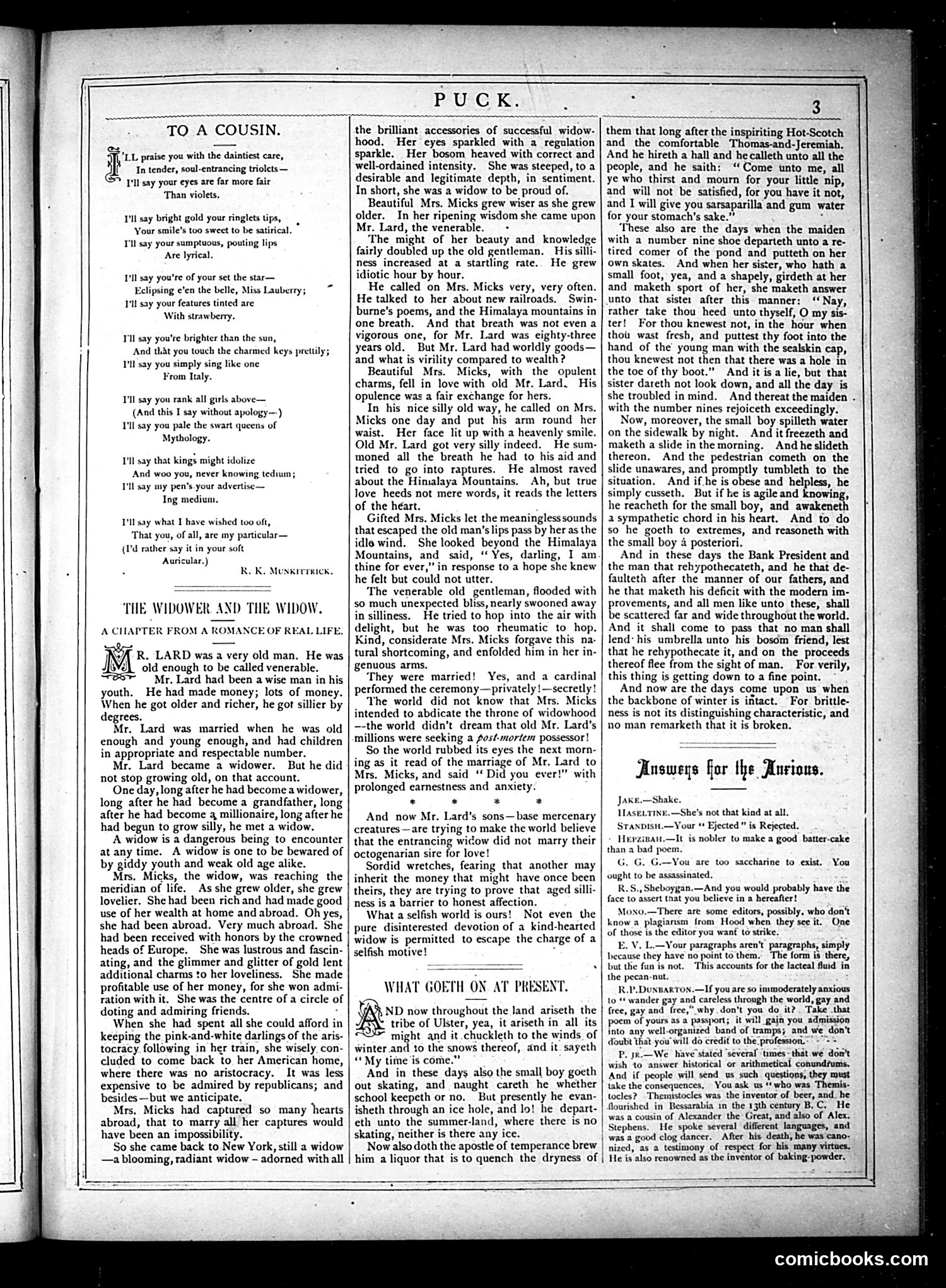
This page contains primarily **literary content** rather than political cartoons. The main feature is "To a Cousin," a poem by R.K. Munkittrick with romantic verses praising a cousin's qualities. Below that is "The Widower and the Widow," described as "a chapter from a romance of real life," which tells the story of an elderly widower, Mr. Lord, who marries Mrs. Micks, a wealthy widow. The narrative focuses on their courtship and marriage rather than political satire. The bottom section, "What Goeth On At Present," appears to be humorous social commentary about contemporary life and behavior. **No clear political cartoons or caricatures are visible** on this page—it's primarily a literary/humor magazine feature rather than satirical visual content.
📄 Transcribed text from this page (OCR, searchable)
Machine-transcribed from the original scan — historical spelling and the odd misread are preserved.
PUCK. TO A COUSIN. "LL praise you with the daintiest care, I In tender, soul-entrancing triolets— T'll say your eyes are far more fair Than violets. V'll say bright gold your ringlets tips, Your smile’s too sweet to be satirical, Tl say your sumptuous, pouting lips Are lyrical. T'll say you're of your set the star— Eclipsing e’en the belle, Miss Lauberry; T'll say your features tinted are With strawberry. Tl say you're brighter than the sun, And that you touch the charmed keys prettily T'll say you simply sing like one From Italy. T'll say you rank all girls above— (And this I say without apology—) T'll say you pale the swart queens of Mythology. T'll say that kings might idolize And woo you, never knowing tedium; I'll say my pen’s-your advertise— Ing medium, T'll say what I have wished too oft, That you, of all, are my particular— (Ud rather say it in your soft Auricular.) R. K. Mukrrreick. THE WIDOWER AND THE WIDOW. A CHAPTER FROM A ROMANCE OF REAL LIFE, rue JM) = R. LARD was a very old man. He was old enough to be called venerable. Mr. Lard had been a wise man in his youth. He had made money; lots of money. When he got older and richer, he got sillier by degrees. Mr. Lard was married when he was old enough and young enough, and had children in appropriate and respectable number. Mr. Lard became a widower. But he did not stop growing old, on that account. One day, long after he had become a widower, long after he had become a grandfather, long after he had become a millionaire, long after he had begun to grow silly, he met a widow. A widow is a dangerous being to encounter at any time. A widow is one to be bewared of by giddy youth and weak old age alike. Mrs. Micks, the widow, was reaching the meridian of life. As she grew older, she grew lovelier. She had been rich and had made good use of her wealth at home and abroad. Oh yes, she had been abroad. Very much abroad. She had been received with honors by the crowned heads of Europe. She was lustrous and fascin- ating, and the glimmer and glitter of gold lent additional charms to her loveliness. She made profitable use of her money, for she won admi- ration with it. She was the centre of a circle o| doting and admiring friends. ‘ When she had spent all she could afford in keeping the pink-and-white darlings of the aris- tocracy. following in her train, she wisely con- cluded to come back to her American home, where there was no aristocracy. It was less expensive to be admired by republicans; and besides —but we anticipate. Mrs. Micks had captured so many hearts abroad, that to marry all her captures would have been an impossibility. So she came back to New York, still a widow —a blooming, radiant widow - adorned with all the brilliant accessories of successful widow- hood. Her eyes sparkled with a regulation sparkle, Her bosom heaved with correct and well-ordained intensity. She was steeped, to a desirable and legitimate depth, in sentiment. In short, she was a widow to be proud of. Beautiful Mrs. Micks grew wiser as she grew older. In her ripening wisdom she came upon Mr. Lard, the venerable. + The might of her beauty and knowledge fairly doubled up the old gentleman. His silli- ness increased at a startling rate. He grew idiotic hour by hour. He called on Mrs. Micks very, very often. He talked to her about new railroads. Sw burne’s poems, and the Himalaya mountains in one breath. And that breath was not even a vigorous one, for Mr. Lard was eighty-three years old. But Mr. Lard had worldly goods— and what is virility compared to wealth? Beautiful Mrs. Micks, with the opulent charms, fell in love with old Mr. Lard. His opulence was a fair exchange for hers. In his nice silly old way, he called on Mrs. Micks one day and put his arm round her waist. Her face lit up with a heavenly smile. Old Mr. Lard got very silly indeed. He sum- moned all the breath he had to his aid and tried to go into raptures. He almost raved about the Himalaya Mountains. Ah, but true love heeds not mere words, it reads the letters of the heart. Gifted Mrs. Micks let the meaningless sounds that escaped the old man’s lips pass by her as the idle wind. She looked beyond the Himalaya Mountains, and said, “Yes, darling, I am thine for ever,” in response to a hope she knew he felt but could not utter. The venerable old gentleman, flooded with so much unexpected bliss, nearly swooned away in silliness. He tried to hop into the air with delight, but he was too rheumatic to hop. Kind, considerate Mrs. Micks forgave this na- tural shortcoming, and enfolded him in her in- genuous arms. ‘They were married! Yes, and a cardinal performed the ceremony—privately !—secretly! ‘The world did not know that Mrs. Micks intended to abdicate the throne of widowhood —-the world didn’t dream that old Mr. Lard’s millions were seeking a post-mortem possessor! So the world rubbed its eyes the next morn- ing as it read of the marriage of Mr. Lard to Mrs. Micks, and said ‘ Did you ever!” with prolonged earnestness and anxiety. * * * * And now Mr. Lard’s sons—base mercenary creatures —are trying to make the world believe that the entrancing widow did not marry their octogenarian sire for love! Sordid wretches, fearing that another may inherit the money that might have once been theirs, they are trying to prove that aged silli- ness is a barrier to honest affection. What a selfish world is ours! Not even the pure disinterested devotion of a kind-hearted widow is permitted to escape the charge of a selfish motive! WHAT GOETH ON AT PRESENT. ND now throughout the land ariseth the SX tribe of Ulster, yea, it ariseth in all its might and it chuckleth to the winds of winter.and to the snows thereof, and it sayeth “My titne is come.” ‘And in these days also the small boy goeth out skating, and naught careth he whether school keepeth or no. But presently he evan- isheth through an ice hole, and lo! he depart- eth unto the summer-land, where there is no | skating, neither is there any ice. | Now also doth the apostle of temperance brew | him a liquor that is to quench the dryness of them that long after the inspiriting Hot-Scotch and the comfortable Thomas-and-Jeremiah, And he hireth a hall and hecalleth unto all the people, and he saith: “Come unto me, all ye who thirst and mourn for your little nip, and will not be satisfied, for you have it not, and I will give you sarsaparilla and gum water for your stomach’s sake.” x These also are the days when the maiden with a number nine shoe departeth unto a re- tired comer of the pond and putteth on her own skates. And when her sister, who hath a small foot, yea, anda shapely, girdeth at her and maketh sport of her, she maketh answer unto that sister after this manner: ‘Nay, rather take thou heed unto thyself, O my sis- ter! For thou knewest not, in the hour when thou wast fresh, and puttest thy foot into the hand of the’ young man with the sealskin cap, thou knewest not then that there was a hole in the toe of thy boot.” And it isa lie, but that sister dareth not look down, and all the day is she troubled in mind. And thereat the maiden with the number nines rejoiceth exceedingly. Now, moreover, the small boy spilleth water on the sidewalk by night. And it freezeth and maketh a slide in the morning. And he slideth thereon, And the pedestrian cometh on the slide unawares, and promptly tumbleth to the situation. And if.he is obese and helpless, he simply cusseth. But if he is agile and knowing, he reacheth for the small boy, and awakeneth a sympathetic chord in his heart. And to do so he goeth to extremes, and reasoneth with the small boy 4 posteriori. And in these days the Bank President and the man that rehypothecateth, and he that de- faulteth after the manner of our fathers, and he that maketh his deficit with the modern im- provements, and all men like unto these, shall scattered far and wide throughout the world. And it shall come to pass that no man shall lend: his umbrella unto his bosom friend, lest that he rehypothecate it, and on the proceeds thereof flee from the sight of man. For verily, this thing is getting down to a fine point. And now are the days come upon us when the backbone of winter is intact. For brittle- ness is not its distinguishing characteristic, and no man remarketh that it is broken. Answers for the Anrions. Jake.—Shake. HAsELTINe.—She’s not that kind at all. STANDIsH.—Your + Ejected” is Rejected. Herzivant.—It is nobler to make a good batter-cake than a bad poem. G. G. G.—You are too saccharine to exist. ought to be assassinated. R.S., Sheboygan.—And you would probably have the face to assert that you believe in a hereafter! Moxo.—There are some editors, possibly, who don't know a plagiarism from Hood when they see it. One of those is the editor you want {6 strike. E. V. L.—Your paragraphs aren't paragraphs, simply because they have no point to them. ‘The form is there, but the fan is not. ‘This accounts for the lacteal fluid in the pecan-nut. : R.P.DuNBakTON.—If you are so immoderately anxious to wander gay and careless through the world, gay and free, gay and free,” why don't you do it?. Take .that poem of yours as a passport; it will gain you admissi into any well-organized band of tramps; and we don’t doubt that you will do credit to the profession. P. jx.—We have'statéd ‘several ‘times - that we don't wish to answer historical or arithmetical conundfumis. And if people will send ys such questions, they must take the consequences, You ask us ‘who was Themis- tocles? mistocles was the inventor of beer, and. he flourished in Bessarabia in the 13th century B.C, He was a cousin of Alexander the Great, and also of Alex. Stephens. He spoke several different languages, and was a good clog dancer. After his. death, he was cano- nized, as a testimony of respect for his many virtues. He is also renowned as the inventor of baking-powder. You comicbooks.com