
Puck, 1878-01-09 · page 11 of 16
Puck — January 9, 1878 — page 11: what you’re looking at
What you’re looking at
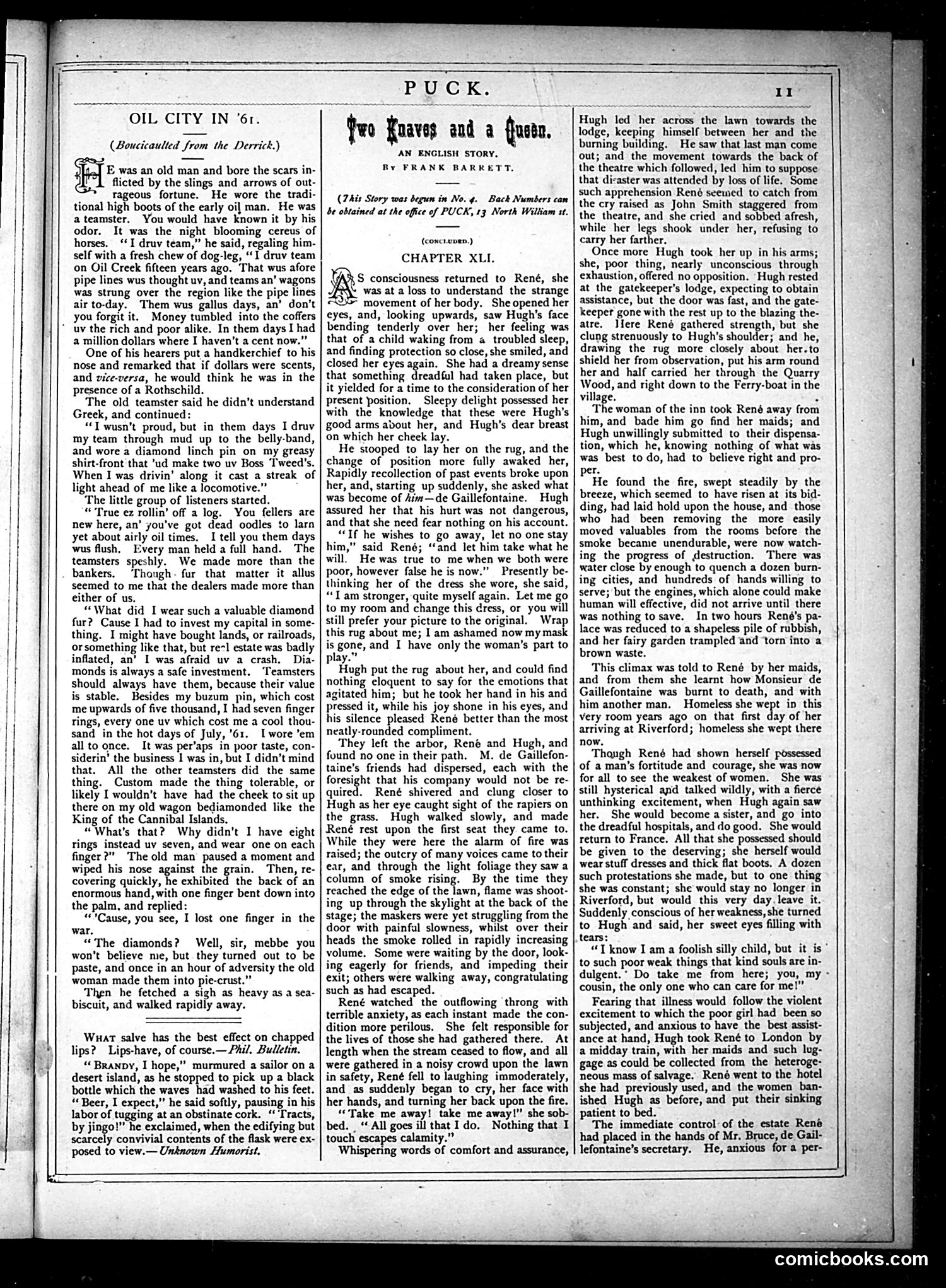
This page contains primarily text content—a serialized English short story titled "Two Knaves and a Queen" by Frank Barrett, with a subtitle indicating it began in an earlier issue of Puck. The story appears to be a serialized fiction feature rather than political satire or commentary. It depicts a melodramatic narrative involving characters named Hugh, Renée, and others in what seems to be a 19th-century setting, with plot elements involving fire, social class tensions, and romantic complications. At the top of the page is a separate brief item titled "Oil City in '61," attributed as "[Reenacted from the Derrick]," which may be a humorous anecdote, but the text is partially illegible in this image. **This page represents Puck's fiction serialization rather than its signature satirical cartooning.** No identifiable political figures or social commentary satire is evident.
📄 Transcribed text from this page (OCR, searchable)
Machine-transcribed from the original scan — historical spelling and the odd misread are preserved.
OIL CITY IN '6r. (Boucicaulted from the Derrick.) E was an old man and bore the scars in- flicted by the slings and arrows of out- rageous fortune. He wore the tradi- tional high boots of the early oi] man. He was ateamster. You would have known it by his odor. It was the night blooming cereus of horses. ‘I druv team,” he said, regaling him- self with a fresh chew of dog-leg, “I druv team on Oil Creek fifteen years ago, That wus afore pipe lines wus thought uv, and teams an’ wagons was strung over the region like the pipe lines air to-day. ‘Them wus gallus days, an’ don't you forgit it. Money tumbled into the coffers “uv the rich and poor alike. In them days I had a million dollars where I haven't a cent now.” One of his hearers put a handkerchief to his nose and remarked that if dollars were scents, and vice-versa, he would think he was in the presence of a Rothschild. The old teamster said he didn’t understand Greek, and continued: “Twusn’t proud, but in them days I druv my team through mud up to the belly-band, and wore a diamond linch pin on my greasy shirt-front that ‘ud make two uv Boss ‘Tweed’s. When I was drivin’ along it cast a streak of light ahead of me like a locomotive.” The little group of listeners started. “ True ez rollin’ off a log. You fellers are new here, an’ you've got dead oodles to larn yet about airly oil times. I tell you them days wus flush, Every man held a full hand. The teamsters speshly. We made more than the bankers. ‘Though. fur that matter it allus seemed to me that the dealers made more than either of us. “What did I wear such a valuable diamond fur? Cause I had to invest my capital in some- thing. I might have bought lands, or railroads, orsomething like that, but re] estate was badly inflated, an’ I was afraid uv a crash. Dia- monds is always a safe investment. ‘Teamsters should always have them, because their value is stable. Besides my buzum pin, which cost me upwards of five thousand, I had seven finger rings, every one uv which cost me a cool thou- sand in the hot days of July, 61. [wore em all to once. It was per’aps in poor taste, con- siderin’ the business 1 was in, but I didn’t mind that. All the other teamsters did the same thing. Custom made the thing tolerable, or likely I wouldn't have had the cheek to sit up there on my old wagon bediamonded like the King of the Cannibal Islands. “What's that? Why didn’t I have eight rings instead uv seven, and wear one on each finger?” The old man paused a moment and wiped his nose against the grain. Then, re- covering quickly, he exhibited the back of an enormous hand, with one finger bent down into the palm, and replied: “Cause, you see, I lost one finger in the war. “The diamonds? Well, sir, mebbe you won't believe me, but they turned out to be paste, and once in an hour of adversity the old woman made them into pie-crust.”” Then he fetched a sigh as heavy as a sea- biscuit, and walked rapidly away. Wuat salve has the best effect on chapped lips? Lips-have, of course.— Ail, Bulletin. “ Branpy, I hope,” murmured a sailor on a desert island, as he stopped to pick up a black bottle which the waves had washed to his feet. “Beer, I expect,” he said softly, pausing in his labor of tugging at an obstinate cork. ‘“‘ ‘Tracts, by jingo!”’ he exclaimed, when the edifying but rite convivial contents of the flask were ex- posed to view.— Unknown Humorist, ee ey Fwo fnaves and a fue. AN ENGLISH STORY. By FRANK BARRETT, (This Story was begun in No.4. Back Numbers can be obtained at the office of PUCK, 13 North William st. (coxctupen.) CHAPTER XLI. S consciousness returned to René, she \} was at a loss to understand the strange “25 movement of her body. She opened her eyes, and, looking upwards, saw Hugh's face bending tenderly over her; her feeling was that of a child waking from 4 troubled sleep, and finding protection so close, she smiled, and closed her eyes again. She had a dreamy sense that something dreadful had taken place, but it yielded for a time to the consideration of her present position. Sleepy delight possessed her with the knowledge that these were Hugh's good arms about her, and Hugh's dear breast on which her cheek lay. He stooped to lay her on the rug, and the change of position more fully awaked her, Rapidly recollection of past events broke upon her, and, starting up suddenly, she asked what was become of /um—de Gaillefontaine. Hugh assured her that his hurt was not dangerous, and that she need fear nothing on his account. “If he wishes to go away, let no one stay him,” said René; “and let him take what he will. He was true to me when we both were poor, however false he is now.” Presently be- thinking her of the dress she wore, she said, “Tam stronger, quite myself again. Let me go to my room and change this dress, or you will still prefer your picture to the original. Wrap this rug about me; 1 am ashamed now my mask is gone, and I have only the woman's part to play.” Hugh put the rug about her, and could find nothing eloquent to say for the emotions that agitated him; but he took her hand in his and pressed it, while his joy shone in his eyes, and his silence pleased René better than the most neatly-rounded compliment. They left the arbor, René and Hugh, and found no one in their path. M. de Gaillefon- taine’s friends had dispersed, each with the foresight that his company would not be re- quired. René shivered and clung closer to Hugh as her eye caught sight of the rapiers on the grass. Hugh walked slowly, and made René rest upon the first seat they. came to. While they were here the alarm of fire was raised; the outcry of many voices came to their ear, and through the light foliage they saw a column of smoke rising. By the time they reached the edge of the lawn, flame was shoot- ing up through the skylight at the back of the stage; the maskers were yet struggling from the door with painful slowness, whilst over their heads the smoke rolled in rapidly increasing volume. Some were waiting by the door, look- ing eagerly for friends, and impeding’ their exit; others were walking away, congratulating such as had escaped. René watched the outflowing throng with terrible anxiety, as each instant made the con- dition more perilous. She felt responsible for the lives of those she had gathered there. At length when the stream ceased to flow, and all were gathered in a noisy crowd upon the lawn in safety, René fell to laughing immoderately, and as suddenly began to cry, her face with her hands, and turning her back upon the fire. ‘Take me away! take me away!” she sob- bed. | “All goes ill that Ido. Nothing that I touch escapes calamity.” Whispering words of comfort and assurance, Hugh led her across the lawn towards the lodge, keeping himself between her and the burning building. He saw that last man come out; and the movement towards the back of the theatre which followed, led him to suppose that disaster was attended by loss of life. Some such apprehension René seemed to catch from the cry raised as John Smith staggered from the theatre, and she cried and sobbed afresh, while her legs shook under her, refusing to carry her farther. Once more Hugh took her up in his arms; she, poor thing, nearly unconscious through exhaustion, offered no opposition. “Hugh rested at the gatekeeper’s lodge, expecting to obtain assistance, but the door was fast, and the gate- keeper gone with the rest up to the blazing the- atre. Here René gathered strength, but she clung strenuously to Hugh’s shoulder; and he, drawing the rug more closely about her.to shield her from observation, put his arm round her and half carried her through the Quarry Wood, and right down to the Ferry-boat in the village. 5 ‘The woman of the inn took René away from him, and bade him go find her maids; and Hugh unwillingly submitted to their dispensa- tion, which he, knowing nothing of what was was best to do, had to believe right and pro- Tr. Pete found the fire, swept steadily by the breeze, which seemed to have risen at its bid- ding, had laid hold upon the house, and those who had been removing the more easily moved valuables from the rooms before the smoke became unendurable, were now watch- ing the progress of destruction. There was water close by enough to quench a dozen burn- ing cities, and hundreds of hands willing to serve; but the engines, which alone could make human will effective, did not arrive until there was nothing to save. In two hours René’s pa- lace was reduced to a shapeless pile of rubbish, and her fairy garden trampled and ‘torn into a brown waste. This climax was told to René by her maids, and from them she learnt how Monsieur de Gaillefontaine was burnt to death, and with him another man. Homeless she wept in this very room years ago on that first day of her arriving at Riverford; homeless she wept there now. Though René had shown herself possessed of a man’s fortitude and courage, she was now for all to see the weakest of women. She was still hysterical and talked wildly, with a fierce unthinking excitement, when Hugh again saw her. She would become a sister, and go into the dreadful hospitals, and do good. She would return to France. All that she possessed should be given to the deserving; she herself would wear stuff dresses and thick flat boots. A dozen such protestations she made, but to one thing she was constant; she would stay no longer in Riverford, but would this very day. leave it. Suddenly conscious of her weakness, she turned to Hugh’ and said, her sweet eyes filling with tears: “T know I am a foolish silly child, but it is to such poor weak things that kind souls are in- dulgent." Do take me from here; you, my - cousin, the only one who can care for me!” Fearing that illness would follow the violent excitement to which the poor girl had been so subjected, and anxious to have the best assist- ance at hand, Hugh took René to London by a midday train, with her maids and such log- gage as could be collected from the heteroge- neous mass of salvage. René went to the hotel she had previously used, and the women ban- ished Hugh as before, and put their sinking patient to bed. The immediate control: of the estate René had placed in the hands of Mr. Bruce, de Gail- lefontaine’s secretary. He, anxious for a per- comic ee books.com