
A complete issue · 16 pages · 1877
Puck — November 21, 1877
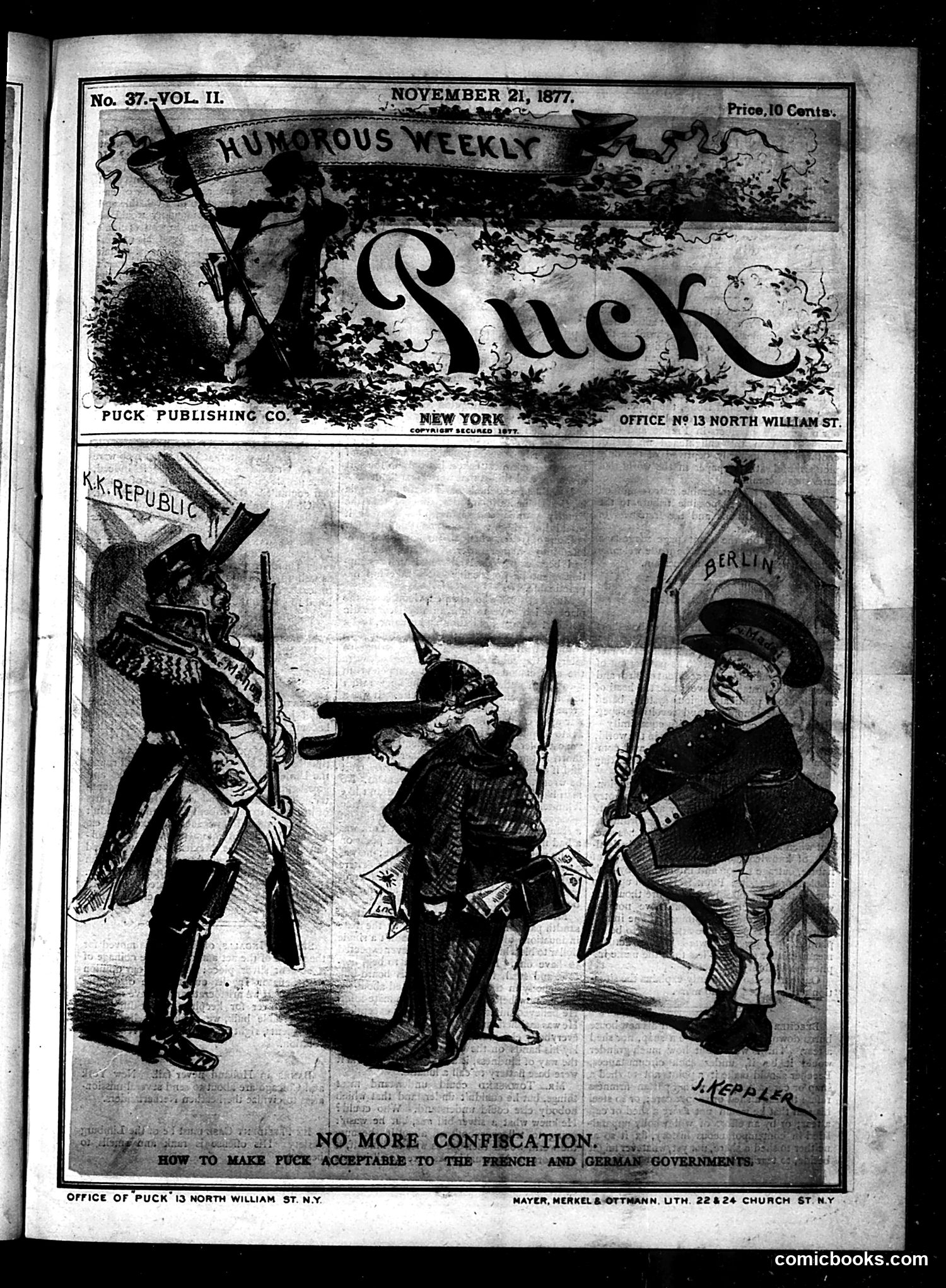
The main cartoon, titled "NO MORE CONFISCATION: HOW TO MAKE PUCK ACCEPTABLE TO THE FRENCH AND GERMAN GOVERNMENTS," depicts three military figures in Prussian/German and French uniforms engaged in dialogue or negotiation. The satire appears to mock diplomatic tensions between France and Germany following the Franco-Prussian War (1870-71). The cartoon suggests that Puck magazine—known for biting political satire—has become so controversial that it offends both French and German governments. The "confiscation" reference likely indicates that foreign authorities had seized or banned issues of the magazine. The joke seems to be that Puck must become completely bland and inoffensive to satisfy these rival powers—an impossible task for a satirical publication.
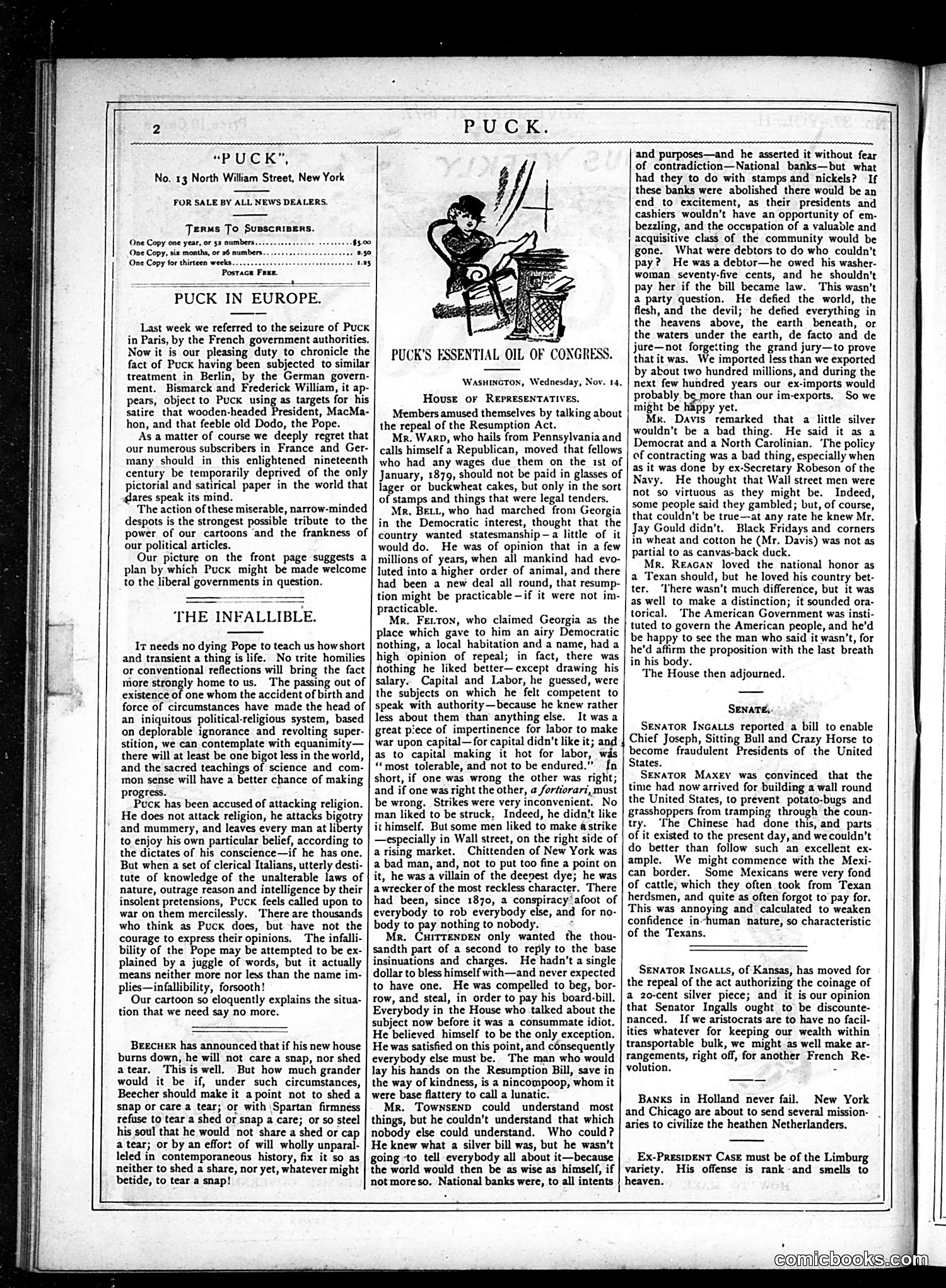
This cartoon satirizes congressional ineffectiveness through the metaphor of a patent medicine. The figure at left appears to be a congressman or senator literally *squeezing* Congress like a bottle of tonic, extracting its essence. The joke mocks how little substantive output Congress produces—suggesting its "essential oil" is negligible, like snake oil. The accompanying text criticizes various congressmen's speeches about the Resumption Act (currency policy), national honor, and labor disputes. Puck ridicules them as blowhards who accomplish little while talking endlessly. The cartoon suggests Congress itself has become a worthless nostrum—all packaging and marketing with no actual benefit to the nation.
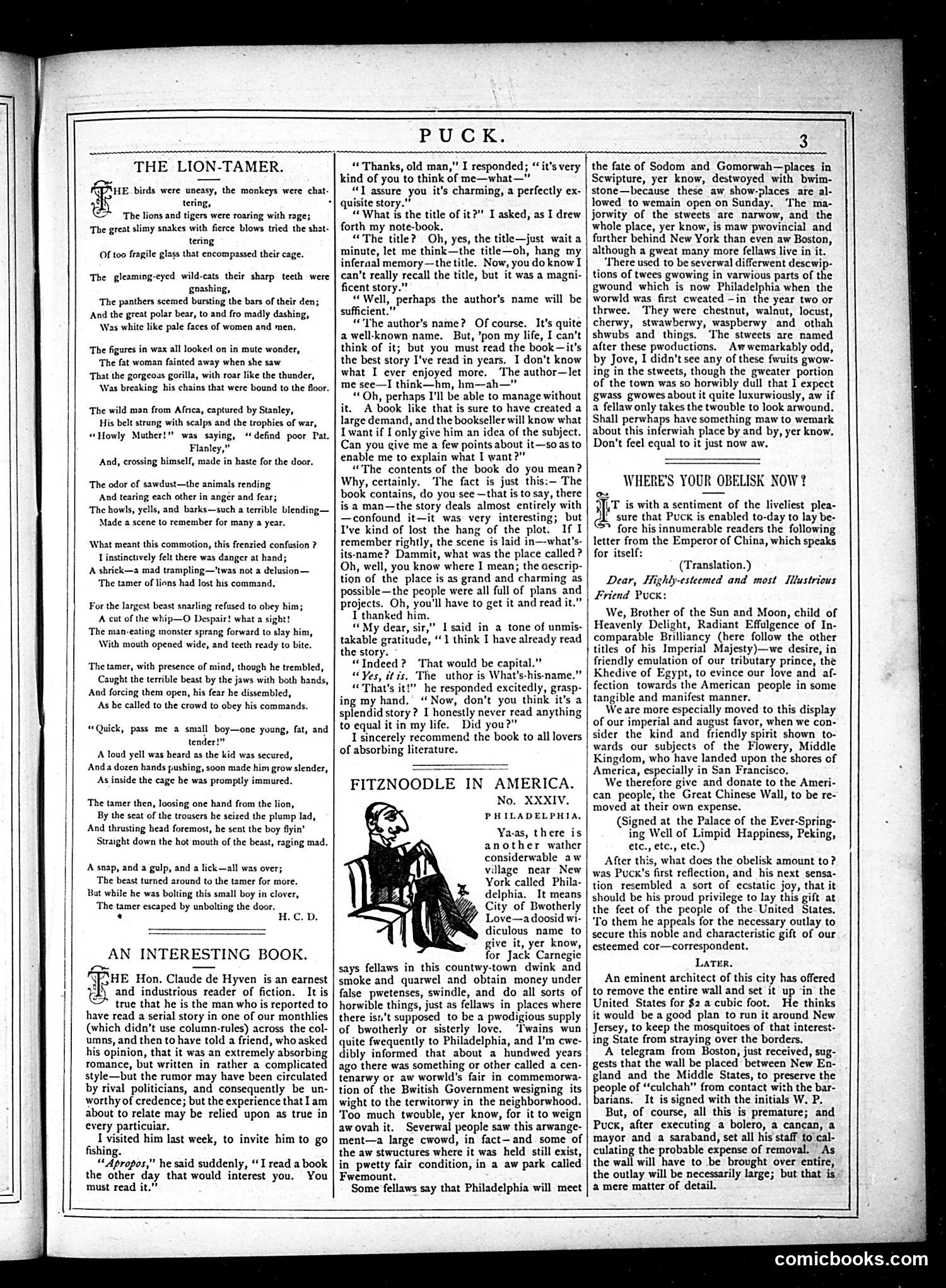
This page contains three distinct sections: a poem titled "The Lion-Tamer," text about "An Interesting Book" discussing Claude de Hyven's serialized fiction, and a short piece called "Fitznoodle in America" featuring an illustration of a figure seated in a chair. The "Fitznoodle" section appears to be satirical commentary about Philadelphia life—specifically mocking the city's pretensions and character. The seated figure's caricature suggests ridicule of a particular social type or personality associated with the city. The overall page mixes literary commentary with gentle social satire typical of Puck's approach. Without clearer visual context for all figures, the specific targets remain somewhat unclear, though the humor clearly targets American social and urban pretensions of the period.
This page consists primarily of **text content rather than visual cartoons**—specifically a lengthy dialogue between two characters identified as **Podgers** (a journalist) and **the Colonel** (editor of the Recorder newspaper). The satire concerns **newspaper economics and journalism ethics**. Podgers pitches various schemes to increase circulation and profit—including using the newspaper to promote a pencil factory and industrial enterprises. The Colonel repeatedly rejects these ideas as undignified compromises of editorial integrity. The humor satirizes the **tension between commercial pressure and journalistic principles** in the newspaper industry. It mocks how editors and reporters rationalize mixing advertising with news content, and how financial desperation can corrupt editorial standards. Without visible illustrations, the satire relies entirely on witty dialogue rather than visual caricature.
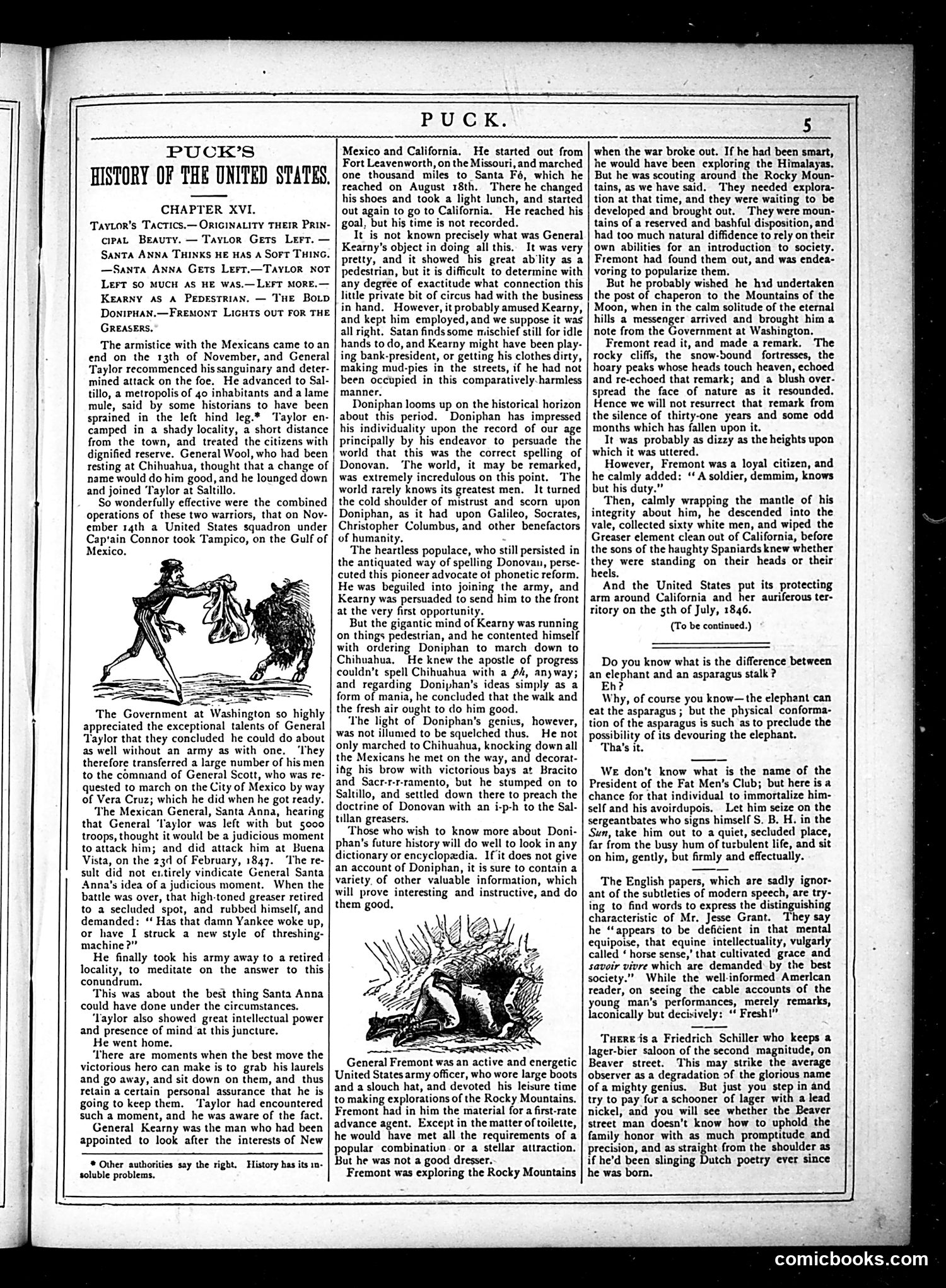
This page contains **Puck's History of the United States, Chapter XVI**, focusing on General Taylor's southwestern campaign tactics. The text discusses Taylor's strategic brilliance during the Mexican-American War, particularly his march toward Mexico City and interactions with General Doniphan. The two illustrations appear to be **historical engravings** rather than political cartoons: 1. **Top image**: Shows a figure in period dress, likely depicting a 19th-century military or frontier scene 2. **Bottom image**: Depicts what appears to be a frontier scout or explorer in the Rocky Mountains The page is primarily **historical narrative** rather than satire, documenting American military expansion and frontier exploration. The humor and satire typical of Puck appear minimal on this particular page, which focuses on educational historical content about American westward expansion and military campaigns.
This page from Puck magazine (November 20, 1877) primarily contains **theatrical criticism and letters**, not political satire. The main content reviews "The Mother's Secret," a play at the Union Square Theatre in New York. The small illustration at bottom right appears to be a **theatre-related vignette**—possibly depicting a dramatic scene or character moment from the reviewed play, consistent with Puck's inclusion of entertainment commentary. The page lacks the sharp political or social satire typically associated with Puck's reputation. Instead, it functions as **arts criticism**, evaluating the play's merit, the cast's performances (including Miss Jewett and Miss Katherine Rogers), and theatrical production values. This represents Puck's broader cultural coverage beyond partisan politics.
This appears to be a **text-heavy editorial page** rather than a cartoon page, containing: 1. **Theater reviews** discussing upcoming comedies, including works by writers Montague, Gilbert, and Plympton 2. **"Answers for the Anxious"** — a satirical advice column mocking various social issues and characters 3. **"Dictionary of the Future"** — a humorous section defining terms satirically The page satirizes contemporary concerns through fictional definitions and mock advice. References include journalism, theater, amateur musicians, and social pretensions of the era. Specific individuals mentioned (Daniel Webster, Andy Johnson) suggest this targets 19th-century figures, though exact dating is unclear from this excerpt alone. **This is primarily satirical commentary rather than visual cartooning**, using wordplay and social observation typical of Puck's editorial voice.
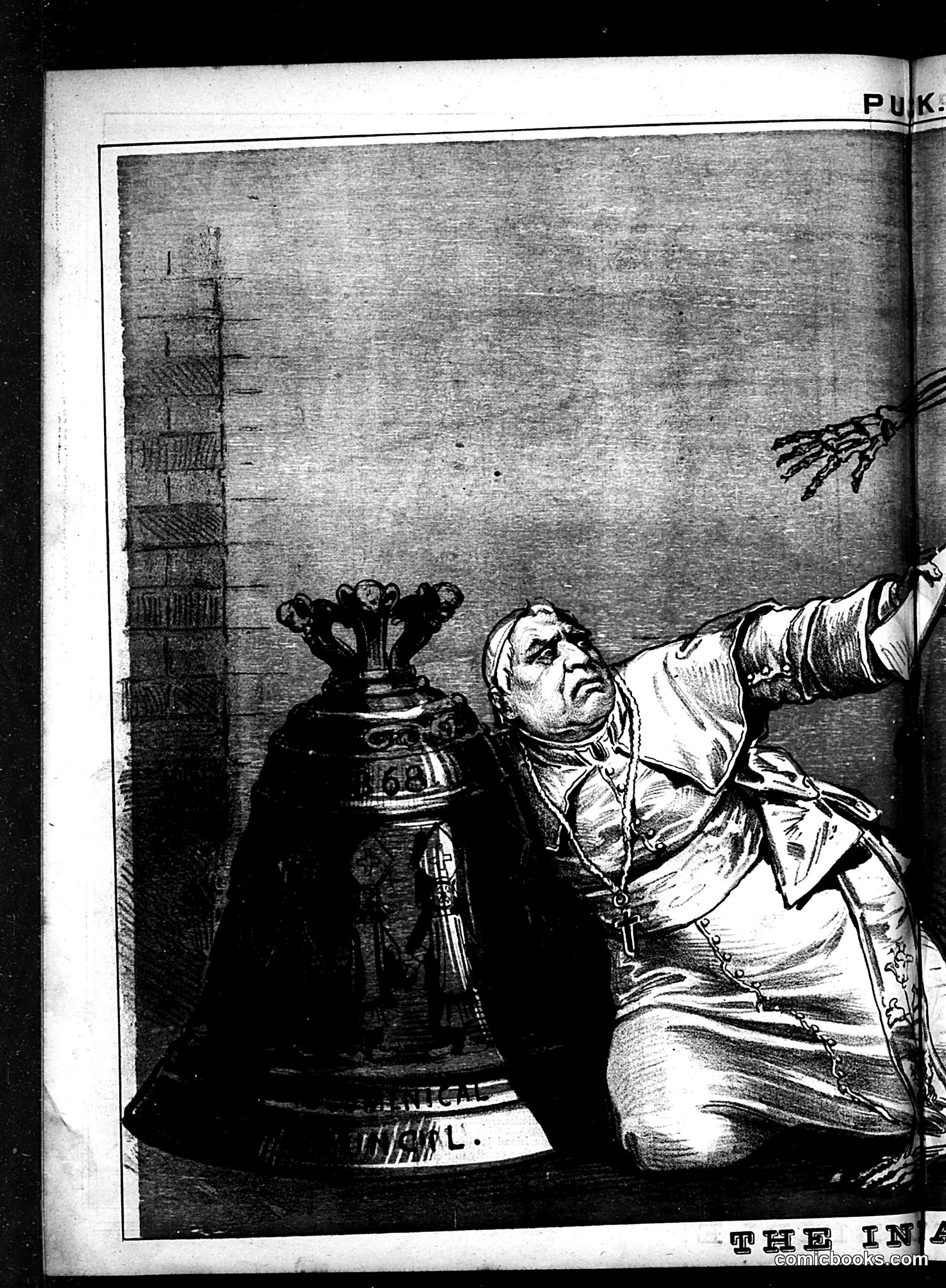
This appears to be a political cartoon from Puck magazine, though the OCR text is too fragmentary to provide complete context. The image shows a figure in military or formal dress kneeling before a large ornate bell, gesturing upward dramatically. The figure's posture and expression suggest desperation or pleading. The bell likely carries political or social significance—possibly representing authority, a major decision, or a significant institution. Without clearer text or date identification visible on this page fragment, I cannot definitively identify the specific political figure, event, or satirical target. The artistic style and subject matter are consistent with late 19th or early 20th-century American political satire, but determining the precise meaning requires additional context.
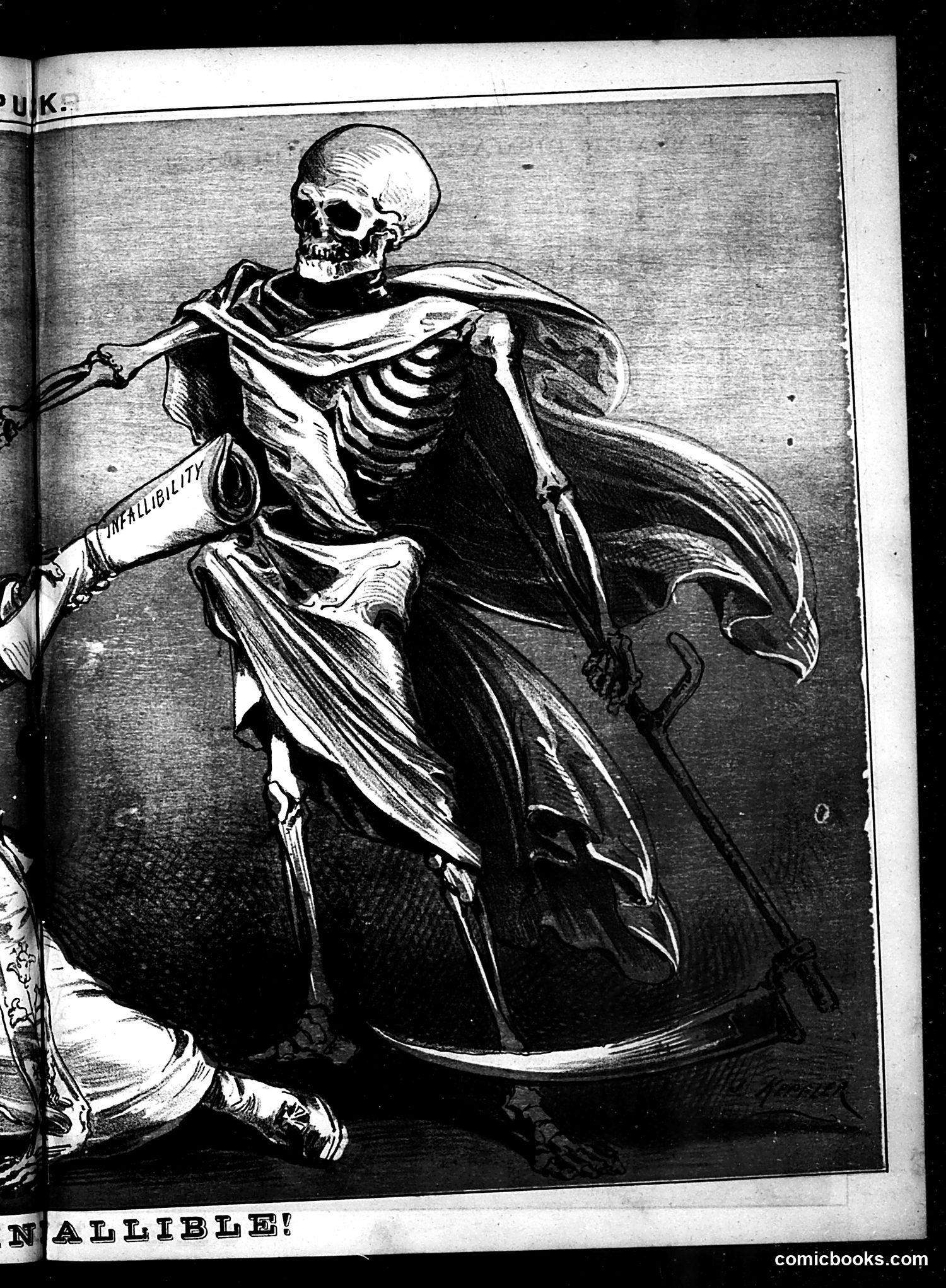
This engraving depicts Death (skeleton) as a figure of authority, holding a scroll labeled "INFALLIBILITY." The skeleton wears draped robes and wields a scythe, the traditional iconography of the Grim Reaper. The satire appears to critique claims of infallibility—likely referencing the Catholic Church's doctrine of papal infallibility (formally declared in 1870). By depicting Death itself as "infallible," the cartoonist suggests that claims of absolute, unchallengeable authority are absurd or dangerous. The message seems to be: the only truly infallible force is death itself, and mortal institutions should not presume such absolute certainty. The artwork style and Puck publication context suggest this is 19th-century American political satire.
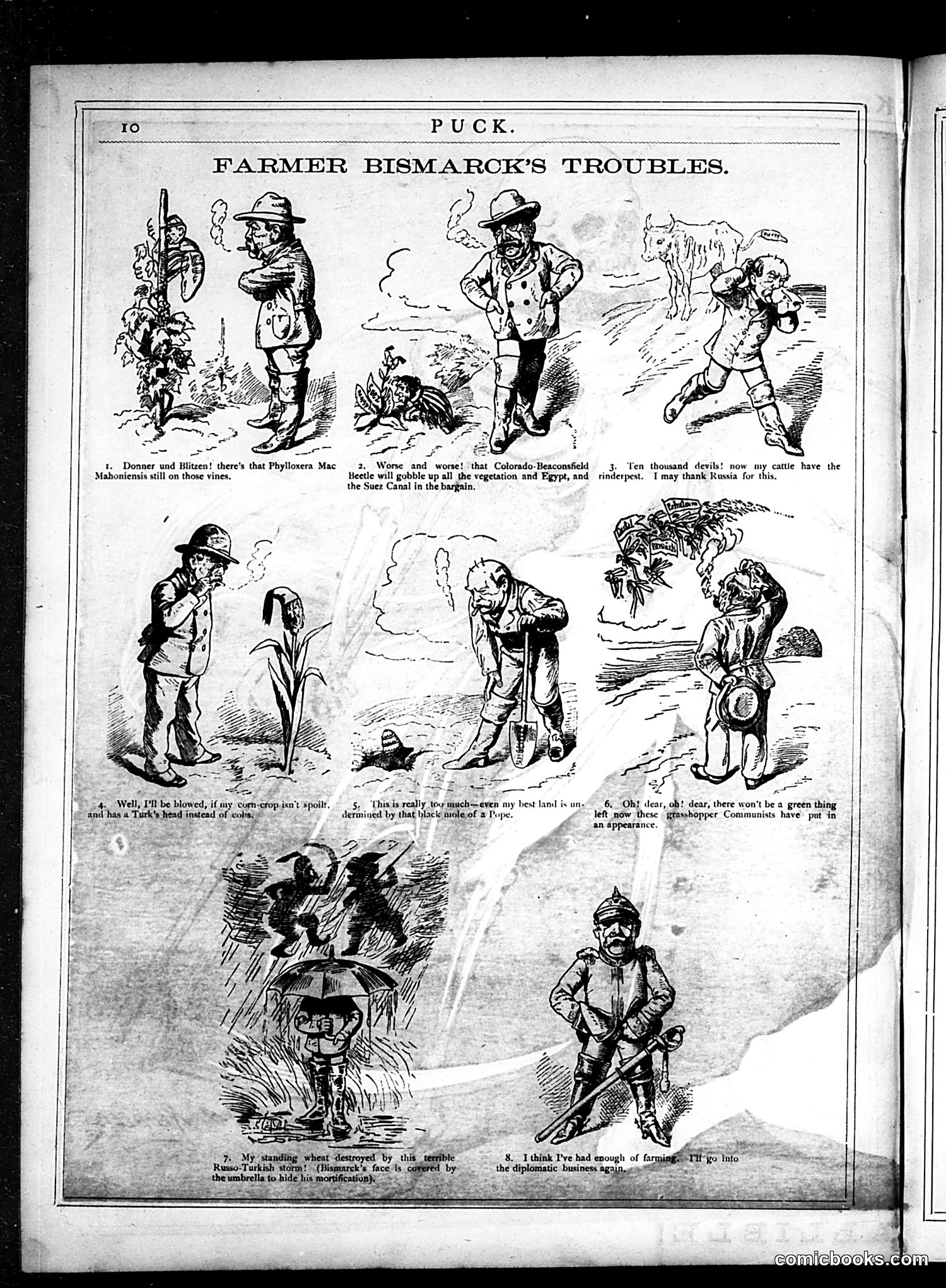
This satirical comic strip depicts **Otto von Bismarck**, Prussia's Iron Chancellor, as a troubled farmer facing multiple agricultural crises. The captions reference specific contemporary problems: phylloxera destroying vineyards (panel 1), the Colorado beetle and Suez Canal issues (panel 2), cattle disease (panel 3), crop failure (panel 4), and grasshopper plagues (panel 6). The satire equates Bismarck's political/diplomatic challenges to farming disasters—suggesting his various policy failures and international entanglements are uncontrollable like natural calamities. By the final panel, he abandons farming for "diplomatic business again," implying he should return to politics rather than attempting agricultural management. The cartoon appears designed for American readers familiar with both Bismarck's prominence and agricultural concerns of the era.
This page is primarily **literary fiction** rather than political satire. It's Chapter XXXIV of "Two Knaves and a Queen," a serialized story by Frank Barrett running in Puck magazine. The text describes a plot involving financial documents, a character named M. de Gaillefontaine managing affairs in Paris, and correspondence between gentlemen regarding money, property, and honor. References to "Hugh Biron" and various letters suggest 19th-century intrigue. **No political cartoon or satirical commentary appears visible on this page.** It's straightforward narrative prose—typical filler content magazines used between humorous sections. The story seems pitched at readers interested in romantic or dramatic fiction rather than contemporary political commentary.
This page contains **"Puck's Bruises,"** a humor section featuring anecdotes rather than political cartoons. The illustrated header shows a cherub-like figure amid scattered items, establishing a lighthearted tone. The content includes several short humorous stories and social commentary: - A lengthy anecdote about an opera singer named Beatrice Raffaelli and her experience at Burlington House - A story titled "The Sanguinary Prevaricator of the Black Hills" about a man exaggerating tales of Indian encounters - A tragic account of a mule accident at the Yuba River - Brief satirical notes about everyday absurdities (women in society, a Cincinnati incident) Rather than targeting specific political figures, these pieces mock general social pretensions, tall tales, and human foibles—typical of Puck's satirical approach to contemporary American life and culture.
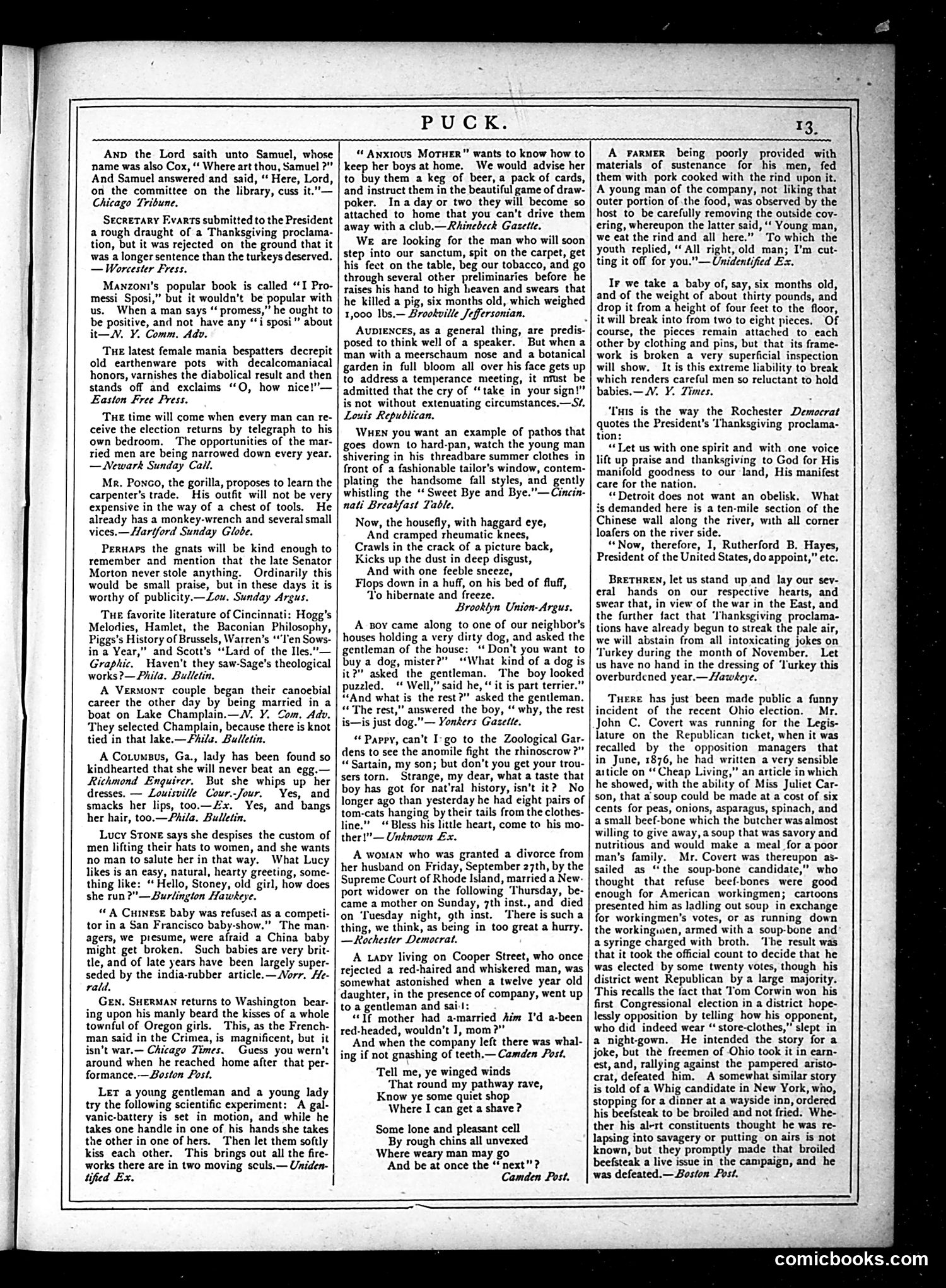
This page consists primarily of **text columns** rather than political cartoons. The content includes satirical commentary on contemporary issues and humorous anecdotes. Notable items include: - A jab at **"Anxious Mother"** advice column, mocking parental concerns - Commentary on **Thanksgiving proclamations**, appearing to reference Presidential messaging - A story about a **boy and dog** visiting a Zoological Garden, with satirical dialogue about the rhinoceros - References to **Ohio elections** and political candidacy - Commentary on **Tom Corwin**, appearing to reference political opposition and district elections - Various humorous social observations and domestic anecdotes The satire targets Victorian-era social conventions, political pretension, and advice-column culture. Without specific dates visible, the exact political references remain somewhat unclear, though the Ohio election reference suggests 1870s-1880s timeframe.
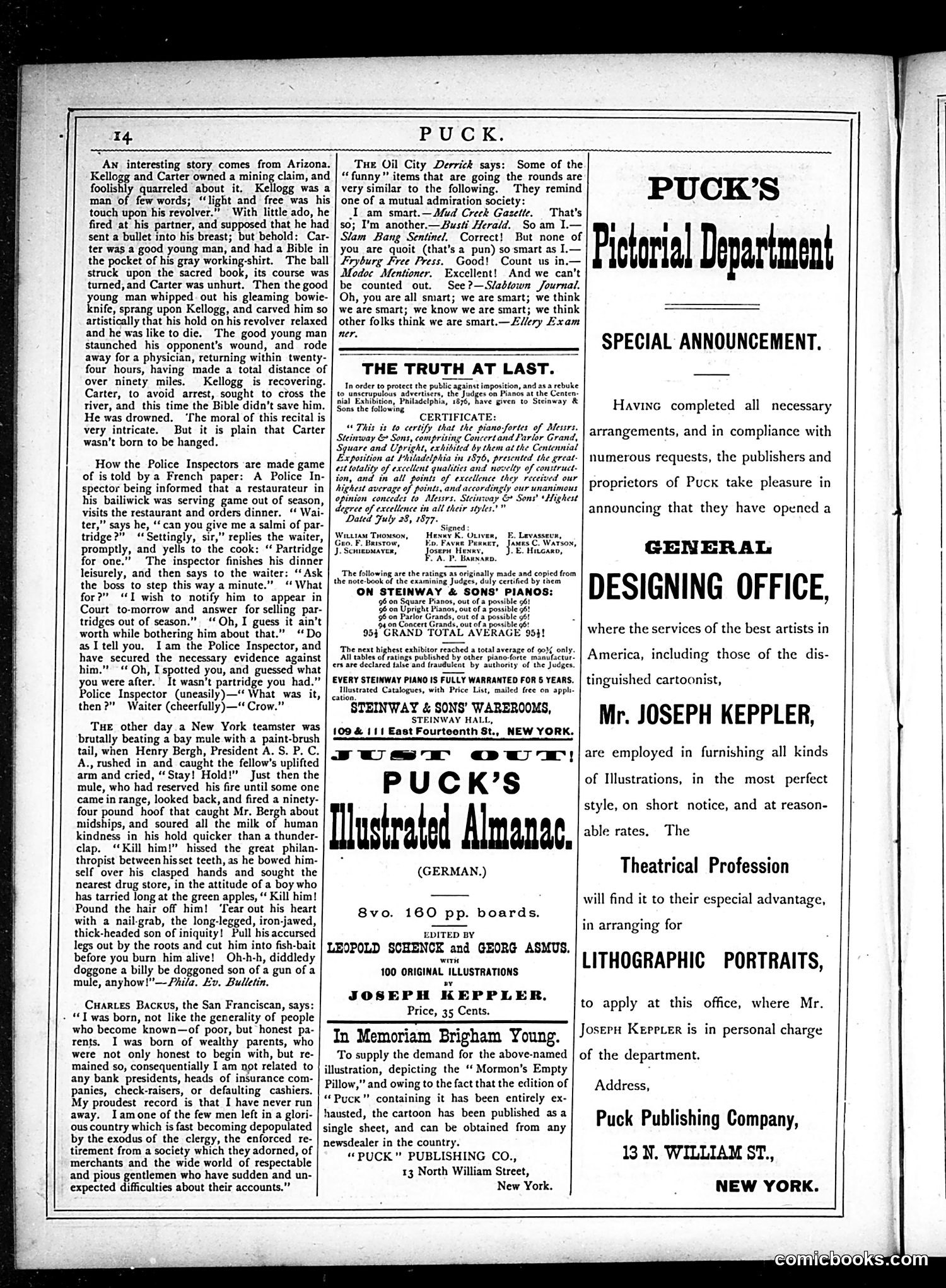
This page is **primarily advertising and announcements**, not political satire. The content includes: 1. **Puck's Pictorial Department announcement** — advertising a new "General Designing Office" run by cartoonist Joseph Keppler, offering illustration services to theatrical professionals and others needing lithographic portraits and artwork. 2. **"Puck's Illustrated Almanac"** — promoting a German-language publication (160 pages, 35 cents) edited by Leopold Schönberg and Georg Asmus, with 100 original illustrations by Joseph Keppler. 3. **Various humorous anecdotes and stories** in the left column, including jokes about police inspectors and a mule-beating incident. 4. **Steinway & Sons piano advertisements** promoting their instruments. The page serves primarily as a **business promotion for Puck magazine's publishing and illustration services** rather than as political commentary.
This is primarily an **advertising page** from Puck magazine, not a satirical cartoon page. It contains commercial advertisements for New York City businesses circa late 1800s/early 1900s, including: - Compressed yeast products - Portrait studios - Gentlemen's hats - Printing inks - A pamphlet binder - Theaters (Volks-Garden Theatre, Aberle's Tivoli Theatre) - D. Kelly's Carpet & Furniture Warerooms - A tailor shop - Champagne - Patent covers for filing Puck magazine itself The page demonstrates how Puck sustained itself financially through advertising revenue. The advertisements reflect the urban commercial landscape of New York City during this period, with services ranging from printing to entertainment to household furnishings. There are no visible political cartoons or satirical content on this particular page.
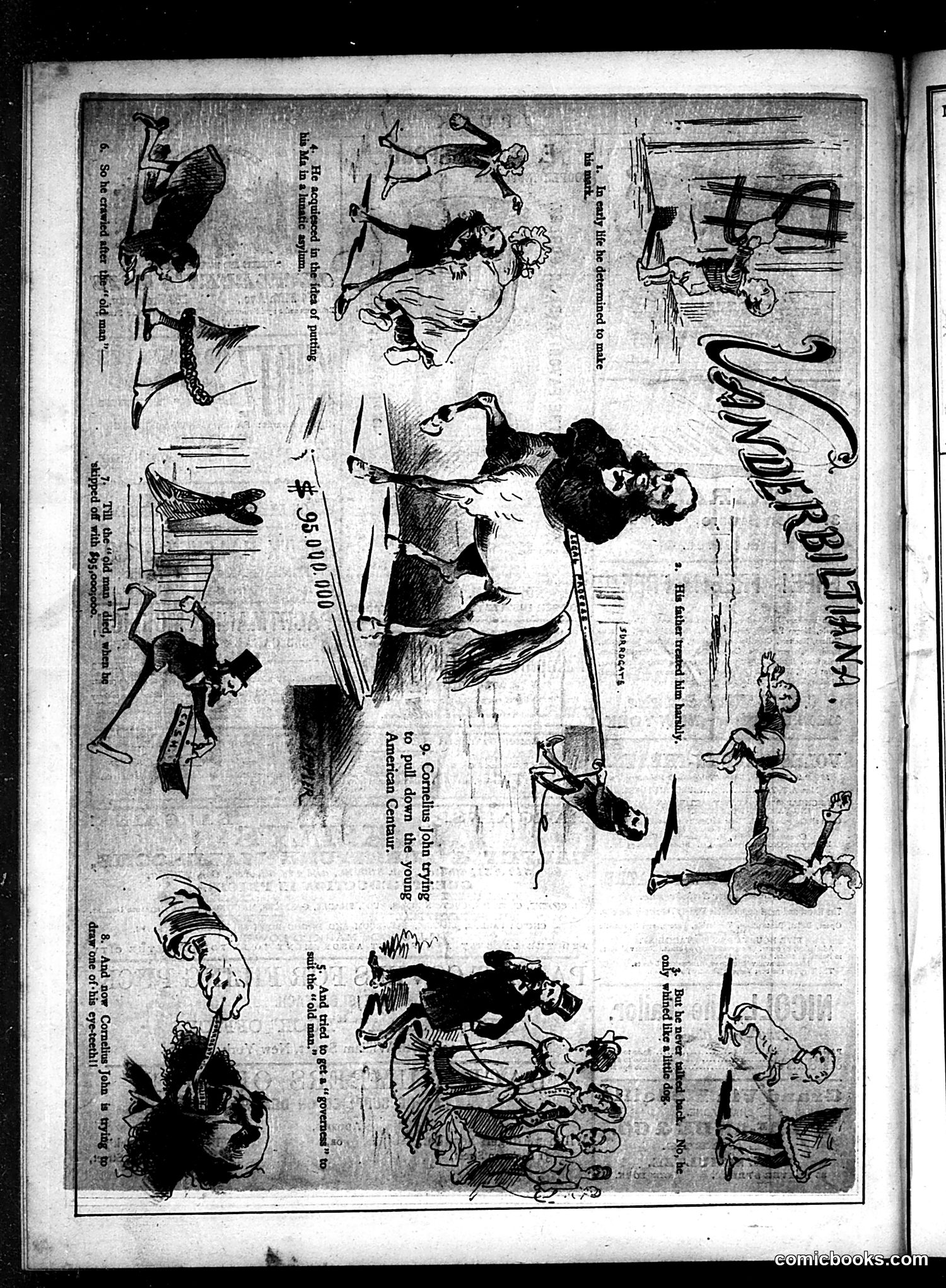
This page appears to be a collection of political cartoons with rotated orientations, making precise OCR difficult. The sketches use exaggerated caricature typical of Puck's style—depicting figures in absurd or compromising positions. Based on visible elements, the cartoons likely satirize contemporary political or social figures through physical comedy and grotesque portraiture. The style suggests late 19th or early 20th-century American politics. Without clearer text identification, I cannot confidently name specific politicians or events referenced. The overall approach—using distorted bodies, slapstick scenarios, and crude characterization—was Puck's signature method for mocking public figures and social conditions of its era. The page's layout and multiple vignettes suggest commentary on several concurrent scandals or absurdities.