
Puck, 1877-11-21 · page 7 of 16
Puck — November 21, 1877 — page 7: what you’re looking at
What you’re looking at
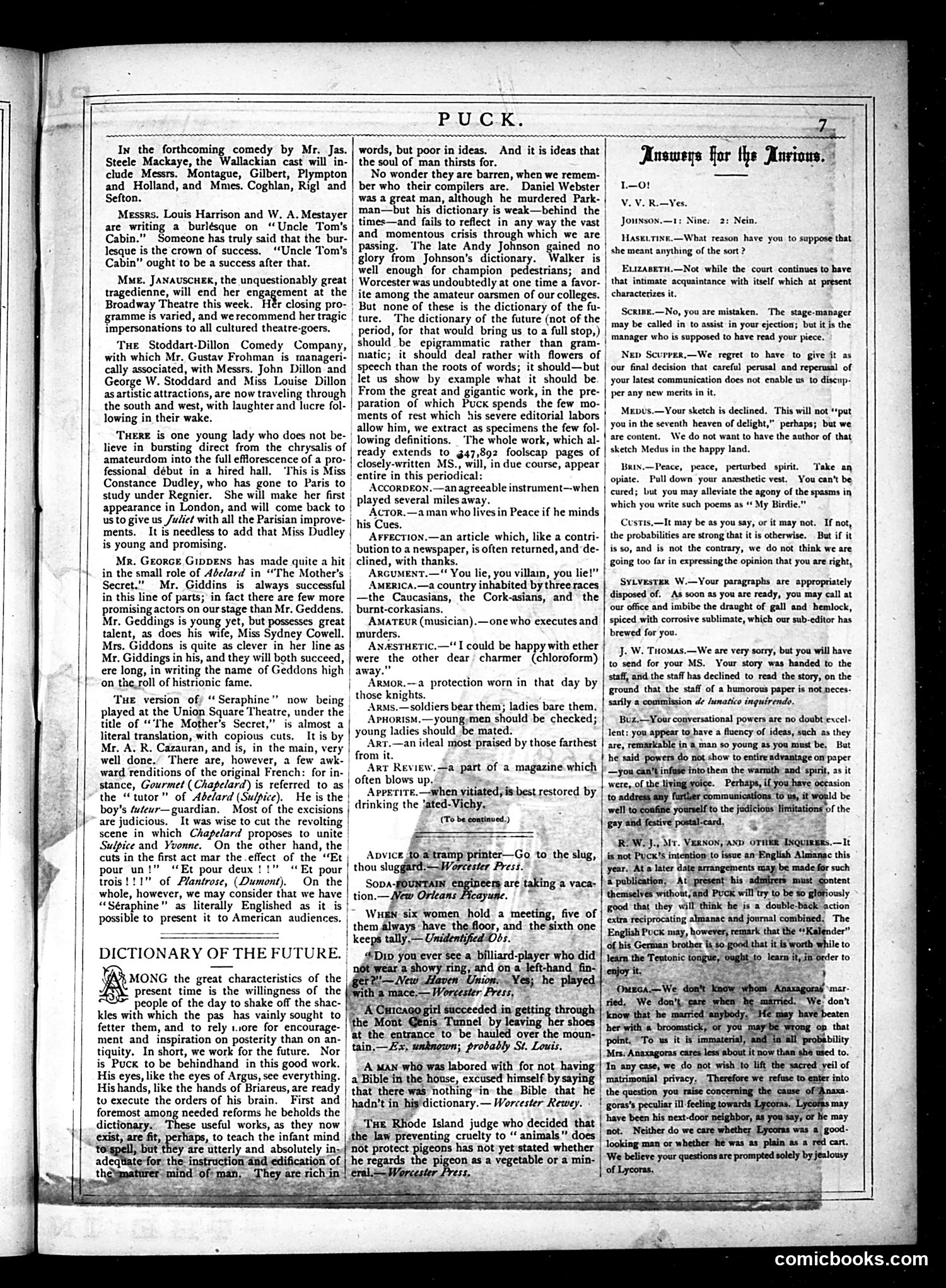
This appears to be a **text-heavy editorial page** rather than a cartoon page, containing: 1. **Theater reviews** discussing upcoming comedies, including works by writers Montague, Gilbert, and Plympton 2. **"Answers for the Anxious"** — a satirical advice column mocking various social issues and characters 3. **"Dictionary of the Future"** — a humorous section defining terms satirically The page satirizes contemporary concerns through fictional definitions and mock advice. References include journalism, theater, amateur musicians, and social pretensions of the era. Specific individuals mentioned (Daniel Webster, Andy Johnson) suggest this targets 19th-century figures, though exact dating is unclear from this excerpt alone. **This is primarily satirical commentary rather than visual cartooning**, using wordplay and social observation typical of Puck's editorial voice.
📄 Transcribed text from this page (OCR, searchable)
Machine-transcribed from the original scan — historical spelling and the odd misread are preserved.
In the forthcoming comedy by Mr. Jas. Steele Mackaye, the Wallackian cast will in- clude Messrs. Montague, Gilbert, Plympton and Holland, and Mmes. Coghlan, Rigl and Sefton. Messrs. Louis Harrison and W. A. Mestayer are writing a burlésque on ‘Uncle Tom's Cabin.” Someone has truly said that the bur- lesque is the crown of success. ‘Uncle Tom's Cabin” ought to be a success after that. Me. JaNnauscuek, the unquestionably great tragedienne, will end her engagement at the | Broadway Theatre this week. Her closing pro- gramme is varied, and we recommend her tragic impersonations to all cultured theatre, -ZOUeTS. THe Stoddart-Dillon Comedy Company, with which Mr. Gustav Frohman is manageri- cally associated, with Messrs. John Dillon and George W. Stoddard and Miss Louise Dillon asartistic attractions, are now traveling through the south and west, with laughter and lucre fol- lowing in their wake. ‘THERE is one young lady who does not be- lieve in bursting ‘direct from the chrysalis of | amateurdom into the full efflorescence of a pro- fessional début in a hired hall. ‘This is Miss | Constance Dudley, who has gone to Paris to study under Regnier. She will make her first appearance in London, and will come back to | us to give us Juliet with all the Parisian improve- ments. It is needless to add that Miss Dudley | is young and promising. Mr. Georce Gippens has made quite a hit in the small role of Ade/ard in ‘The Mother's Secret.” Mr. Giddins is always successful in this line of parts; in fact there are few more promising actors on our stage than Mr. Geddens. Mr. Geddings is young yet, but possesses great talent, as does his wife, Miss Sydney Cowell. Mrs. Giddons is quite as clever in her line as Mr. Giddings in his, and they will both succeed, | ere long, in writing the name of Geddons high on the,roll of histrionic fame. i ‘Tue version off “Seraphine” now being played at the Union Square Theatre, under the title of ‘The Mother’s Secret,” is almost a literal translation, with copious cuts. It is by Mr. A. R. Cazauran, and is, in the main, very | well done.” There are, however, a few awk- ward renditions of the original French: for in- stance, Gourmet (Chapelard) is referred to as | the “tutor” of Adelard (Sulpice). He is the | boy's fufeur—guardian. Most of the excisions | are judicious. It was wise to cut the revolting | scene in which Chape/ard proposes to unite Sulpice and Yvonne. On the other hand, the cuts in the first act mar the.effect of the “Et | ur un!” “Et pour deux !!" “Et pour | trois!!!" of Plantrose, (Dumont), On the whole, however, we may consider that we have | “Séraphine” as literally Englished as it is | possible to Present it to American audiences. | DICTIONARY OF THE FUTURE. ; MONG the great characteristics of the present time is the willingness of the “ & people of the day to shake off the shac- |e kles with which the pas has vainly sought to | fetter them, and to rely 1.0re for encourage- \\ ment and inspiration on posterity than on an- tiquity. In short, we work for the future. Nor is Puck to be behindhand in this good work. His eyes, like the eyes of Argus, see everything. | His hands, like the hands of Briareus, are ready | that’ there wis: nothing in» the Bible that he | the question you raise to execute the orders of his brain. First and foremost aon needed reforms he beholds the dictionary. ‘These useful works, as they now | exist, are fit, perhaps, to teach the infant mind s iy are utterly and absolutely in- te-for: the: instruction and edification of gaint off man gaiey ore-rich-ip | | well enough for champion pedestrians; and | Worcester was undoubtedly at one time a favor- pert ive Boer Union... Nes; he played | PUCK. words, but poor in ideas. And it is ideas that the soul of man thirsts for. No wonder they are barren, when we remem- ber who their compilers are. Daniel Webster | was a great man, although he murdered Park- | man—but his dictionary is weak—behind the | times—and fails to reflect in any way the vast and momentous crisis through which we are passing. ‘he late Andy Johnson gained no | glory from Johnson's dictionary. Walker is ite among the amateur oarsmen of our colleges. | But none of these is the dictionary of the fu- | ture. The dictionary of the future (not of the | period, for that would bring us to a full stop,) | should be epigrammatic rather than gram- | matic; it shoul i deal rather with flowers of speech than the roots of words; it should—but let us show by example what it should be. From the great and gigantic work, in the pre- paration of which Puck spends the few mo- ments of rest which his severe editorial labors allow him, we extract as specimens the few fol- lowing definitions. The whole work, which al- ready extends to g47,892 foolscap pages of closely-written MS., will, in due course, appear | entire in this periodical: | AccorDEON.—an agreeable instrument—when played several miles away. Acror.—a man who lives in Peace if he minds his Cues. AFFECTION.—an article which, like a contri- bution to a newspaper, is often returned, and-de- clined, with thanks. ArcuMENT.—“ You lie, you villain, you lie!”’ | AmEricA.—a country inhabited by three races —the Caucasians, the Cork-asians, and the burnt-corkasians. AMATEUR (musician).—one who executes and murders, AN&sTHETIC.—‘I could be happy with ether were the other dear, charmer (chloroform) away.” ARMor.—a protection worn in that day by those knights. Arms.—soldiers bear them; ladies bare them. ‘ApHorism.—young,men should be checked; | young ladies should be mated. RT.—an ideal most praised by those farthest Ry it. Arr Review.—a part of a magazine which often blows up, ApperiTe.—when yitiated, is:best restored by | drinking the ‘ated-Vichy, (To be continued.) | mee Apvice toa tramp’printer—Go to the slug, | thou sluggard:—Worcester Press. : Sopa-FOUNTAIN ete are taking a vaca: tion. —New Orleans Wuen six women hold a meeting, five of them always “have the Secs. end the sixth one | keeps tally, — Unidentified iO. Dip you ever see a cd |-player who did’ ‘wear a showy ring, and on a left-hand fin- ‘ith: ha mace,— Worcester Press, ~~ through: A Cuicago girl succeeded in the Mont at ‘Tunnel by eine her shoes at the entrance to be hauled over the moun- tain. Ex, unknown; probably St. Louis. A MAN-who was labored with for not. having a\Bible in the house, excused himself by saying hadn't in hi dictionary. — Worcester Rewey. 1 Tue Rhode Island judge who decided that the law preventing cruelty to ‘‘ animals” does not protect ioe has not yet’stated whether he roars eon as a vegetable or a min- rel We os Rasweys for the Anrions L-o! =o Vv. V. R.—Yes. Jounson.. Hasktine.—What reason have you to suppose that she meant anything of the sort ? EvizaseTH.—Not while the court continues to have | that intimate acquaintance with itself which at present characterizes it. Scrime.—No, you are mistaken. The stage-manager may be called in to assist in your ejection; but it is the manager who is supposed to have read your piece. Nep Scurver,—We regret to have to give ft as our final decision that careful perusal and reperusal of your latest communication does not enable us to discup- per any new merits in it, Mevvs.—Your sketch is declined. This will not “put you in the seventh heaven of delight,” perhaps; but we are content. We do not want to have the author of that sketch Medus in the happy land. Brix.—Peace, peace, perturbed spirit, Take an opiate. Pull down your anzsthetic vest. You can't be cured; Lut you may alleviate the agony of the spasms in which you write such poems as My Birdie." or it may not. If not, s otherwise. But if it is so, and is not the contrary, we do not think we are going too far in expressing the opinion that you are right, SyLvestex W.—Your paragraphs are appropriately disposed of. As soon as you are ready, you may call at our office and imbibe the draught of gall and hemlock, spiced with corrosive sublimate, which our sub-editor has brewed for you. J. W. THomas.—We are very sorry, but you will have to send for your MS. Your story was handed to the staff, aiid the staff has declined to read the story, on the ground that the staff of a humorous paper is not neces- sarily a commission de /unatico inguirendo. BUz.~-Your conversational powers are no doubt excel- lent: you, appear to have a fluency of ideas, such as they are, remarkable in a inan so young as you must be, But | he said powers do not show to entire advantage on paper —you can’t infuse into them the warmth: and ‘spirit, as it were, of the living voice. Perhaps, if you have occasion to address any further communications. 10 us, it world be wel sarees Yoana te ates Timitations’of the RW. J, Sir. Peake AND Orie INQUIRERS.—It is not Puck's intention®to issue an-English Almanac this year. Ata later date arrangements may be made for such 4 publication, . At present: his admirers must content themselves without;and Puck willtry to be 80 jously good that they will think he is a double-back action extra reciprocating almanac and journal combined, The English Puck may, however, remark that the “Kalender” of his German brother is $0.go0d that it is worth while to ic tong ‘ ity order to = We! don’t have beaten op that Ta any case, we do not wish to lift the sacred yeil of matrimonial privacy, Therefore we refuse to ¢ into concerning the cause | goras's peculiar ill feeling towards Lycoras. Ly may | have been his next-door neighbor, as you'say, or hie may not. Neither do we care whether Eycoras was a good- looking man or whether hé'was as. plain as a red cart. ‘We believe your questions are prompted solely by jealousy of comicbooks.com