
Puck, 1877-11-21 · page 5 of 16
Puck — November 21, 1877 — page 5: what you’re looking at
What you’re looking at
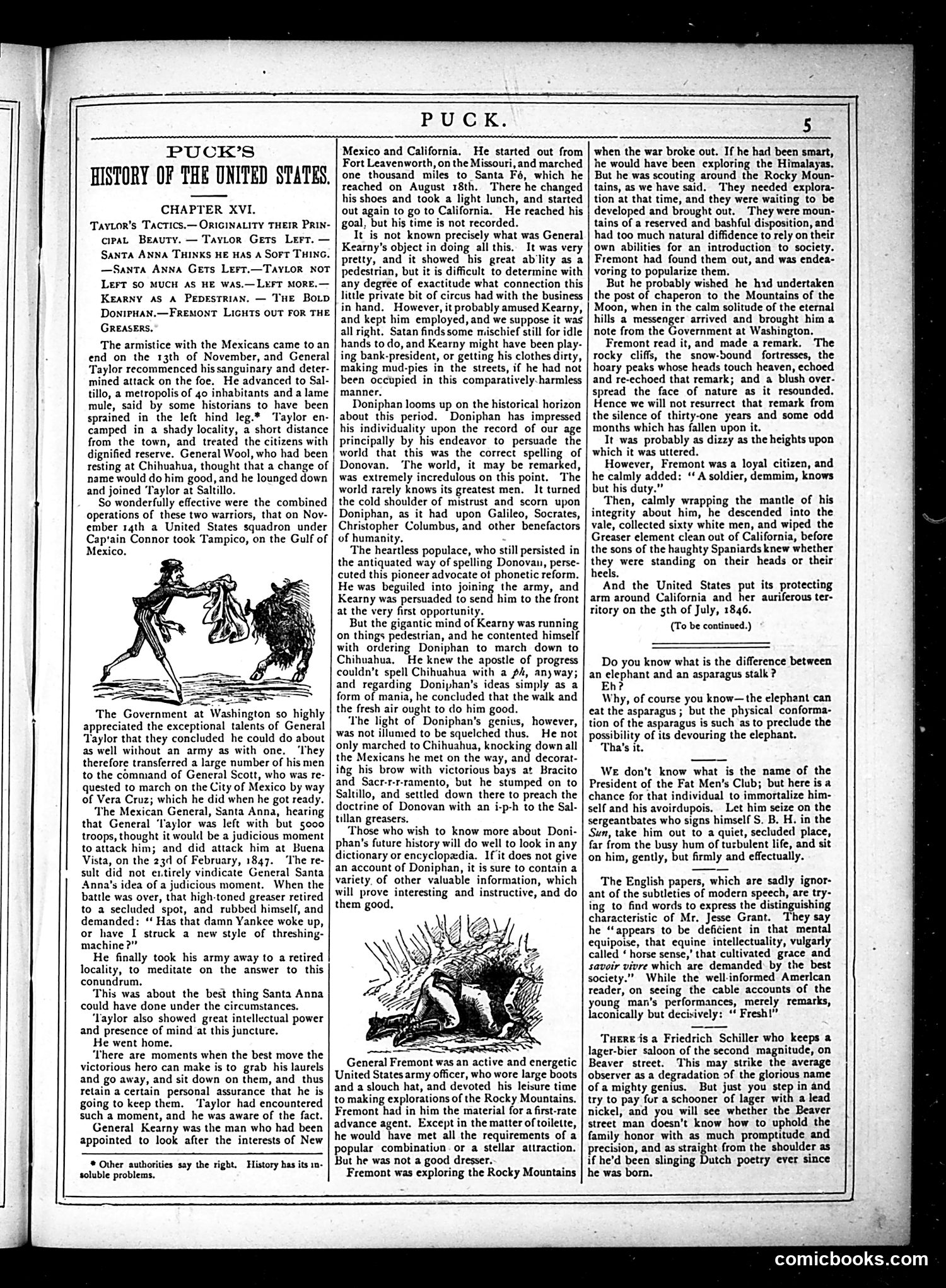
This page contains **Puck's History of the United States, Chapter XVI**, focusing on General Taylor's southwestern campaign tactics. The text discusses Taylor's strategic brilliance during the Mexican-American War, particularly his march toward Mexico City and interactions with General Doniphan. The two illustrations appear to be **historical engravings** rather than political cartoons: 1. **Top image**: Shows a figure in period dress, likely depicting a 19th-century military or frontier scene 2. **Bottom image**: Depicts what appears to be a frontier scout or explorer in the Rocky Mountains The page is primarily **historical narrative** rather than satire, documenting American military expansion and frontier exploration. The humor and satire typical of Puck appear minimal on this particular page, which focuses on educational historical content about American westward expansion and military campaigns.
📄 Transcribed text from this page (OCR, searchable)
Machine-transcribed from the original scan — historical spelling and the odd misread are preserved.
a PUCK’S HISTORY OF THE UNITED STATES. CHAPTER XVI. Taytor's TACTICS.— ORIGINALITY THEIR PRIN- cipaL. Beauty. — TayLor Gets Lert. — Santa ANNA THINKS HE HAS A Sort THING. —Santa Anna Gets Lert.—TayLor NOT Lert sO MUCH AS HE wAS.— LEFT MORE.— KEARNY AS A PEDESTRIAN. — THE BoLD DoniPHAN.—FREMONT LiGHTS OUT FOR THE GREASERS, The armistice with the Mexicans came to an end on the 13th of November, and General ‘Taylor recommenced his sanguinary and deter- mined attack on the foe. He advanced to Sal- tillo, a metropolis of 40 inhabitants and a lame mule, said by some historians to have been sprained in the left hind leg.* ‘Taylor en- camped in a shady locality, a short distance from the town, and treated the citizens with dignified reserve. General Wool, who had been resting at Chihuahua, thought that a change of name would do him good, and he lounged down and joined ‘Taylor at Saltillo. So wonderfully effective were the combined operations of these two warriors, that on Nov- ember 14th a United States squadron under Cap‘ain Connor took Tampico, on the Gulf of Mexico. a The Government at Washington so highly appreciated the exceptional talents of General Taylor that they concluded he could do about as well without’ an army as with one, ‘They therefore transferred a large number of his men to the command of General Scott, who was re- quested to march on the City of Mexico by way of Vera Cruz; which he did when he got ready. ‘The Mexican General, Santa Anna, hearing that General ‘l'aylor was left with but 5000 troops, thought it would be a judicious moment to attack him; and did attack him at Buena Vista, on the 23d of February, 1847. ‘The re- sult did not entirely vindicate General Santa Anna's idea of a judicious moment. When the battle was over, that high-toned greaser retired to a secluded spot, and rubbed himself, and demanded: ‘' Has that damn Yankee woke up, or have I struck a new style of threshing- machine?” He finally took his army away to a retired locality, to meditate on the answer to this conundrum. This was about the best thing Santa Anna could have done under the circumstances. ‘Taylor also showed great intellectual power and presence of mind at this juncture. He went home. ‘There are moments when the best move the victorious hero can make is to grab his laurels and go away, and sit down on them, and thus retain a certain personal assurance that he is going to keep them. ‘Taylor had encountered such a moment, and he was aware of the fact. General Kearny was the man who had been appointed to look after the interests of New © Other authorities say the right, History has its in- PUCK. Mexico and California, He started out from Fort Leavenworth, on the Missouri, and marched one thousand miles to Santa Fé, which he reached on August 18th. There he changed his shoes and took a light lunch, and started out again to go to California. He reached his goal, but his time is not recorded. It is not known precisely what was General Kearny’s object in doing all this. It was very pretty, and it showed his great ab'lity as a pedestrian, but it is difficult to determine with any degree of exactitude what connection this little private bit of circus had with the business in hand. However, it probably amused Kearny, and kept him employed, and we suppose it was all right. Satan finds some mischief still for idle hands todo, and Kearny might have been play- ing bank-president, or getting his clothes dirty, making mud-pies in the streets, if he had not been occupied in this comparatively-harmless manner. Doniphan looms up on the historical horizon about this period. Doniphan has impressed his individuality upon the record of our age principally by his endeavor to persuade the world that this was the correct spelling of Donovan. The world, it may be remarked, was extremely incredulous on this point. The world rarely knows its greatest men. It turned the cold shoulder of mistrust and scorn upon Doniphan, as it had upon Galileo, Socrates, Christopher Columbus, and other benefactors of humanity. The heartless populace, who still persisted in the antiquated way of spelling Donovan, perse- cuted this pioneer advocate ot phonetic reform. He was beguiled into joining the army, and Kearny was persuaded to send him to the front at the very first opportunity. But the gigantic mind of Kearny was running on things pedestrian, and he contented himself with ordering Doniphan to march down to Chihuahua. He knew the apostle of progress couldn't spell Chihuahua with a pi, anyway; and regarding Doniphan’s ideas simply as a form of mania, he concluded that the walk and the fresh air ought to do him good. ‘The light of Doniphan’s genius, however, was not illumed to be squelched thus. He not only marched to Chihuahua, knocking down all the Mexicans he met on the way, and decorat- ing his brow with victorious bays at Bracito and Sacr-r-r-ramento, but he stumped on to Saltillo, and settled down there to preach the doctrine of Donovan with an i-p-h to the Sal- tillan greasers. Those who wish to know more about Doni- phan's future history will do well to look in any dictionary or encyclopadia. If it does not give an account of Doniphan, it is sure to contain a variety. of other valuable information, which will prove interesting and instructive, and do them good, aaa General Fremont was an active and energetic United States army officer, who wore large boots and a slouch hat, and devoted his leisure time to making explorations of the Rocky Mountains. Fremont had in him the material for a first-rate advance agent. Except in the matter of toilette, he would have met all the requirements of a popular combinatiun. or a stellar attraction. But he was not a good dresser. soluble problems. Fremont was exploring the Rocky Mountains when the war broke out. If he had been smart, he would have been exploring the Himalayas. But he was scouting around the Rocky Moun- tains, as we have said. They needed explora- tion at that time, and they were waiting to be developed and brought out. ‘They were moun- tains of a reserved and bashful disposition, and had too much natural diffidence to rely on their own abilities for an introduction to society. Fremont had found them out, and was endea- voring to popularize them. But he probably wished he had undertaken the post of chaperon to the Mountains of the Moon, when in the calm solitude of the eternal hills a messenger arrived and brought him a note from the Government at Washington. Fremont read it, and made a remark. The rocky cliffs, the snow-bound fortresses, the hoary peaks whose heads touch heaven, echoed and re-echoed that remark; and a blush over- spread the face of nature as it resounded. Hence we will not resurrect that remark from the silence of thirty-one years and some odd months which has fallen upon it. It was probably as dizzy as the heights upon which it was uttered. However, Fremont was a loyal citizen, and he calmly added: ‘A soldier, demmim, knows but his duty.” Then, calmly wrapping the mantle of his integrity about him, he descended into the vale, collected sixty white men, and wiped the Greaser element clean out of California, before the sons of the haughty Spaniards knew whether they were standing on their heads or their heels. " ‘And the United States put its protecting arm around California and her auriferous ter- ritory on the sth of July, 1846. (To be continued.) Do you know what is the difference between an elephant and an asparagus stalk ? Eh? Why, of course you know—the elephant can eat the asparagus ; but the physical conforma- tion of the asparagus is such as to preclude the possibility of its devouring the elephant. ‘Tha's it. We don’t know what is the name of the President of the Fat Men’s Club; but here is a chance for that individual to immortalize him- self and his avoirdupois. Let him seize on the sergeantbates who signs himself S. B, H. in the Sun, take him out to a quiet, secluded place, far from the busy hum of turbulent life, and sit on him, gently, but firmly and effectually. The English papers, which are sadly ignor- ant of the subtleties of modern speech, are try- ing to find words to express the distinguishing characteristic of Mr. Jesse Grant. They say he “appears to be deficient in that mental equipoise, that equine intellectuality, vulgarly called ‘ horse sense,’ that cultivated grace and Savoir vivre which are demanded: by the best society.” While the well-informed Amerlcan reader, on seeing the cable accounts of the young man’s performances, merely remarks, laconically but decisively: ‘‘ Fresh!” Tuere is a Friedrich Schiller who keeps a lager-bier saloon of the second magnitude, on Beaver street. This may strike the average observer as a degradation of the glorious name of a mighty genius. But just you step in and try to pay for a schooner of lager with a lead nickel, and you will see whether the Beaver street man doesn’t know how to uphold the family honor with as much promptitude and precision, and as straight from the shoulder as if he'd been slinging Dutch poetry ever since he was born. comicbooks.com