
Puck, 1877-11-21 · page 2 of 16
Puck — November 21, 1877 — page 2: what you’re looking at
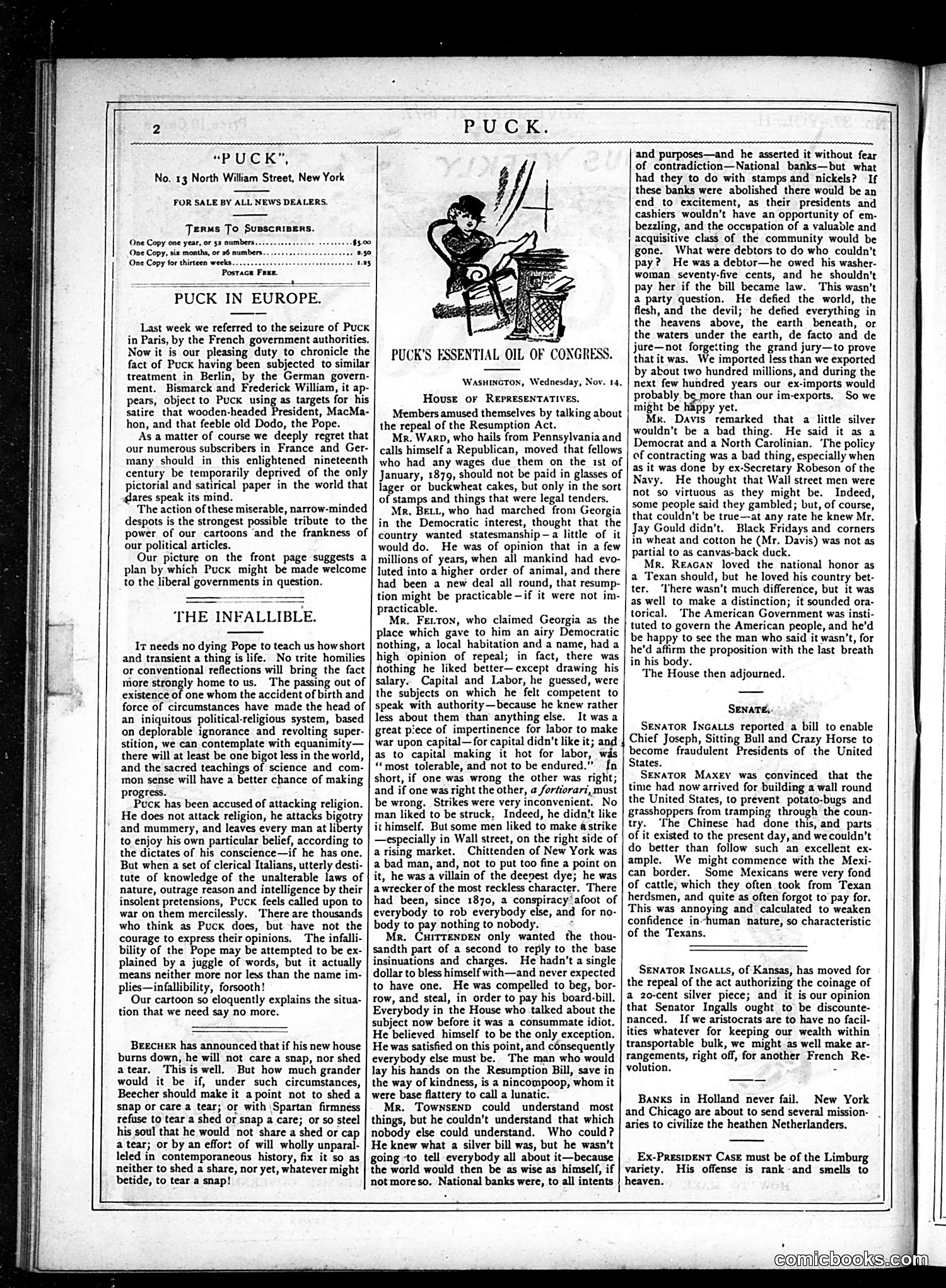
What you’re looking at
This cartoon satirizes congressional ineffectiveness through the metaphor of a patent medicine. The figure at left appears to be a congressman or senator literally *squeezing* Congress like a bottle of tonic, extracting its essence. The joke mocks how little substantive output Congress produces—suggesting its "essential oil" is negligible, like snake oil. The accompanying text criticizes various congressmen's speeches about the Resumption Act (currency policy), national honor, and labor disputes. Puck ridicules them as blowhards who accomplish little while talking endlessly. The cartoon suggests Congress itself has become a worthless nostrum—all packaging and marketing with no actual benefit to the nation.
📄 Transcribed text from this page (OCR, searchable)
Machine-transcribed from the original scan — historical spelling and the odd misread are preserved.
“PUCK”, No. 13 North William Street, New York FOR SALE BY ALL NEWS DEALERS. Terms To Supscripers. One Copy one year, or $2 numbers. One Copy, six months, or 26 numbe ‘One Copy for thirteen weeks.. Posta Last week we referred to the seizure of Puck in Paris, by the French government authorities. Now it is our pleasing duty to chronicle the fact of Puck having been subjected to similar treatment in Berlin, by the German govern- ment. Bismarck and Frederick William, it ap- pears, object to Puck using as targets for his satire that wooden-headed President, MacMa- hon, and that feeble old Dodo, the Pope. As a matter of course we deeply regret that our numerous subscribers in France and Ger- many should in this enlightened nineteenth century be temporarily deprived of the only pictorial and satirical paper in the world that dares speak its mind. The action of these miserable, narrow-minded despots is the strongest possible tribute to the power of our cartoons ‘and the frankness of our political articles. Our picture on the front page suggests a plan by which Puck might be made welcome to the liberal governments in question. ‘THE INFALLIBLE. Ir needs no dying Pope to teach us how short and transient a thing is life. No trite homilies or conventional reflections will bring the fact more strongly home to us. The passing out of existence of one whom the accident of birth and force of circumstances have made the head of an iniquitous political-religious system, based on deplorable ignorance and revolting super- stition, we can contemplate with equanimity— there will at least be one bigot less in the world, and the sacred teachings of science and com- mon sense will have a better chance of making progress. Puck has been accused of attacking religion. He does not attack religion, he attacks bigotry and mummery, and leaves every man at liberty to enjoy his own particular belief, according to the dictates of his conscience—if he has one. But when a set of clerical Italians, utterly desti- tute of knowledge of the unalterable laws of nature, outrage reason and intelligence by their insolent pretensions, Puck feels called upon to war on them mercilessly, There are thousands who think as Puck does, but have not the courage to express their opinions. ‘The infalli- bility of the Pope may be attempted to be ex- plained by a juggle of words, but it actually means neither more nor less than the name im- plies—infallibility, forsooth! Our cartoon so eloquently explains the situa- tion that we need say no more. BEECHER has announced that if his new house burns down, he will not care a snap, nor shed atear. This is well. But how much grander would it be if, under such circumstances, Beecher should make it a point not to shed a snap or care a tear; or with Spartan firmness refuse to tear a shed or snap a care; or so steel his soul that he would not share a shed or cap a tear; or by an effort of will wholly unparal- Ieled in contemporaneous history, fix it so as neither to shed a share, nor yet, whatever might betide, to tear a snap! PUCK’S ESSENTIAL OIL OF CONGRESS. Wasnincton, Wednesday, Nov. 14. House oF REPRESENTATIVES. Members amused themselves by talking about the repeal of the Resumption Act. Mr. Warp, who hails from Pennsylvania and calls himself a Republican, moved that fellows who had any wages due them on the ist of January, 1879, should not be paid in glasses of lager or buckwheat cakes, but only in the sort of staan and things that were legal tenders. Mr. BELL, who had marched from Georgia in the Democratic interest, thought that the country wanted statesmanship—a little of it would do. He was of opinion that in a few millions of years, when all mankind had evo- luted into a higher order of animal, and there had been a new deal all round, that resump- tion might be practicable —if it were not im- practicable. Mr. FeLton, who claimed Georgia as the place which gave to him an airy Democratic nothing, a local habitation and a name, had a high opinion of repeal; in fact, there was hothing he liked better—except drawing his salary. Capital and Labor, he guessed, were the subjects on which he felt competent to speak with authority—because he knew rather less about them than anything else. It was a great piece of impertinence for labor to make war upon capital—for capital didn’t like it; and as to capital making it hot for labor, was “most tolerable, and not to be endured.” fn short, if one was wrong the other was right; and if one was right the other, @ fortiorari, must be wrong. Strikes were very inconvenient. No man liked to be struck, Indeed, he didn’t like it himself. But some men liked to make a strike —especially in Wall street, on the right side of arising market, Chittenden of New York was a bad man, and, not to put too fine a point on it, he was a villain of the deepest dye; he was awrecker of the most reckless character. There had been, since 1870, a conspiracy afoot of everybody to rob everybody else, and for no- body to pay nothing to nobody. x Mr. Cuirrenven only wanted the thou- sandth part of a second to reply to the base insinuations and charges. He hadn't a single dollar to bless himself with—and never expected to have one. He was compelled to beg, bor- row, and steal, in order to pay his board-bill. Everybody in the House who talked about the subject now before it was a consummate idiot. He believed himself to be the only exception. He was satisfied on this point, and consequently everybody else must be. The man who would lay his hands on the Resumption Bill, save in the way of kindness, is a nincompoop, whom it were base flattery to call a lunatic. Mr. TownsEND could understand most things, but he couldn’t understand that which nobody else could understand. Who could? He knew what a silver bill was, but he wasn’t going to tell everybody all about it—because the world would then be as wise as himself, if not moreso. National banks were, to all intents and purposes—and he asserted it without fear of contradiction—National banks—but what had they to do with stamps and nickels? If these banks were abolished there would be an end to excitement, as their presidents and cashiers wouldn't have an opportunity of em- bezzling, and the occupation of a valuable and acquisitive class of the community would be gone. What were debtors to do who couldn't pay? He was a debtor—he owed his washer- woman seventy-five cents, and he shouldn't pay her if the bill became law. This wasn’t a party question. He defied the world, the flesh, and the devil; he defied everything in the heavens above, the earth beneath, or the waters under the earth, de facto and de jure—not forgetting the grand jury—to prove that it was. We imported less than we exported by atout two hundred millions, and during the next few hundred years our ex-imports would probably be more than our im-exports. So we might be happy yet. Mr. Davis remarked that a little silver wouldn’t be a bad thing. He said it as a Democrat and a North Carolinian. ‘The policy of contracting was a bad thing, especially when as it was done by ex-Secretary Robeson of the Navy. He thought that Wall street men were Not so virtuous as they might be. Indeed, some people said they gambled; but, of course, that couldn’t be true—at any rate he knew Mr. Jay Gould didn’t. Black Fridays and corners in wheat and cotton he (Mr. Davis) was not as partial to as canvas-back duck. Mr. Reacan loved the national honor as a Texan should, but he loved his country bet- ter. ‘here wasn’t much difference, but it was as well to make a distinction; it sounded ora- torical. ‘The American Government was insti- tuted to govern the American people, and he'd be happy to see the man who said it wasn’t, for he'd affirm the proposition with the last breath in his body. The House then adjourned. Senate, SENATOR INGALLS reported a bill to enable Chief Joseph, Sitting Bull and Crazy Horse to become fraudulent Presidents of the United States. SENATOR Maxey was convinced that the time had now arrived for building a wall round the United States, to prevent potato-bugs and grasshoppers from tramping through the coun- try. The Chinese had done this, and parts of it existed to the present day, and wecouldn’t do better than follow such an excellent ex- ample. We might commence with the Mexi- can border. Some Mexicans were very fond of cattle, which they often took from Texan herdsmen, and quite as often forgot to pay for. This was annoying and calculated to weaken confidence inhuman nature, so characteristic of the Texans. Senator INGALLs, of Kansas, has moved for the repeal of the act authorizing the coinage of a 2o-cent silver piece; and it is our opinion that Senator Ingalls ought to be discounte- nanced. If we aristocrats are to have no facil- ities whatever for keeping our wealth within transportable bulk, we might as well make ar- rangements, right off, for another French Re- volution. - Banxs in Holland never fail. New York and Chicago are about to send several mission- aries to civilize the heathen Netherlanders. Ex-PREsIDENT Case must be of the Limburg variety. His offense is rank-and smells to heaven. comichooks.cony