
Puck, 1877-11-21 · page 3 of 16
Puck — November 21, 1877 — page 3: what you’re looking at
What you’re looking at
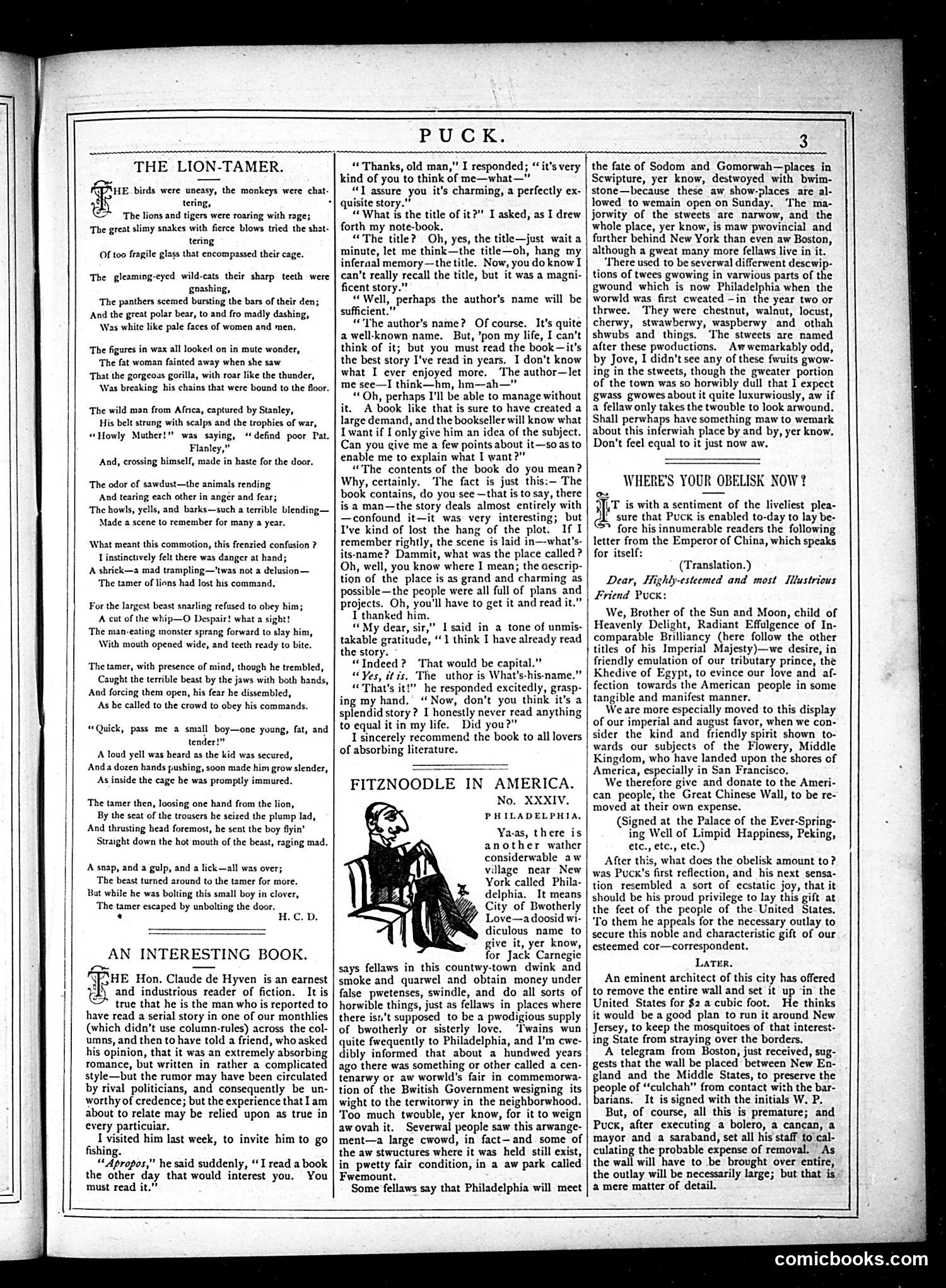
This page contains three distinct sections: a poem titled "The Lion-Tamer," text about "An Interesting Book" discussing Claude de Hyven's serialized fiction, and a short piece called "Fitznoodle in America" featuring an illustration of a figure seated in a chair. The "Fitznoodle" section appears to be satirical commentary about Philadelphia life—specifically mocking the city's pretensions and character. The seated figure's caricature suggests ridicule of a particular social type or personality associated with the city. The overall page mixes literary commentary with gentle social satire typical of Puck's approach. Without clearer visual context for all figures, the specific targets remain somewhat unclear, though the humor clearly targets American social and urban pretensions of the period.
📄 Transcribed text from this page (OCR, searchable)
Machine-transcribed from the original scan — historical spelling and the odd misread are preserved.
PUCK. 3 THE LION-TAMER. SPAHE birds were uneasy, the monkeys were chat- Fa tering, : The lions and tigers were roaring with rages ‘The great slimy snakes with fierce blows tried the shat- tering Of too fragile glass that encompassed their cage. The gleaming-eyed wild-cats their sharp teeth were gnashing, ‘The panthers scemed bursting the bars of their den; ‘And the great polar bear, to and fro madly dashing, Was white like pale faces of women and men. ‘The figures in wax all looked on in mute wonder, ‘The fat woman fainted away when she saw That the gorgeous gorilla, with roar like the thunder, Was breaking his chains that were bound to the floor. The wild man from Afnca, captured by Stanley, His belt strung with scalps and the trophies of war, ““Howly Muther!” was saying, ‘defind poor Pat. Flanley,” And, crossing himself, made in haste for the door. The odor of sawdust—the animals rending And tearing each other in anger and fear; The howls, yells, and barks—such a terrible blending— Made a scene to remember for many a year. What meant this commotion, this frenzied confusion ? I instinctively felt there was danger at hand; A shrick—a mad trampling—'twas not a delusion— ‘The tamer of lions had lost his command, For the largest beast snarling refused to obey him; A cut of the whip—O Despair! what a sight! The man-eating monster sprang forward to slay him, With mouth opened wide, and teeth ready to bite. The tamer, with presence of mind, though he trembled, Caught the terrible beast by the jaws with both hands, And forcing them open, his fear he dissembled, As he called to the crowd to obey his commands. “Quick, pass me a small boy—one young, fat, and tender!” A loud yell was heard as the kid was secured, Anda dozen hands pushing, soon made him grow slender, As inside the cage he was promptly immured. ‘The tamer then, loosing one hand from the lion, By the seat of the trousers he seized the plump lad, And thrusting head foremost, he sent the boy flyin’ Straight down the hot mouth of the beast, raging mad. A snap, and a gulp, and a lick—all was over; The beast turned around to the tamer for more. Bat while he was bolting this small boy in clover, The tamer escaped by unbolting the door. . H.C. D. AN INTERESTING BOOK. ‘pre Hon, Claude de Hyven is an earnest SH. and industrious reader of fiction. It is true that he is the man who is reported to have read a serial story in one of our monthlies (which didn’t use column-rules) across the col- umns, and then to have told a friend, who asked his opinion, that it was an extremely absorbin; romance, but written in rather a complicated style—but the rumor may have been circulated by rival politicians, and consequently be un- worthy of credence; but the experience that 1 am about to relate may be relied upon as true in every particuiar, I visited him last week, to invite him to go fishing. “Apropos,” he said suddenly, “I read a book the other day that would interest you. You must read it.” “ Thanks, old man,” I responded; “it's very kind of you to think of me—what—"" “I assure you it’s charming, a perfectly ex- qui ory. “ What is the title of it?” I asked, as I drew forth my note-book. “The title? Oh, yes, the tithe—just wait a minute, let me think—the title—oh, hang my inferaal memory —the title. Now, you do know I can’t really recall the title, but it was a magni- ficent story.” “Well, perhaps the author's name will be sufficient.” “The author's name? Of course. It's quite a well-known name. But, ’pon my life, I can’t think of it; but you must read the book—it's the best story I've read in years. I don’t know what I ever enjoyed more. ‘The author—let me see—I think—hm, hm—ah—” “Oh, perhaps I'll be able to manage without it. A book like that is sure to have created a large demand, and the bookseller will know what Iwant if I only give him an idea of the subject. Can you give me a few points about it—so as to enable me to explain what I want?” “The contents of the book do you mean? Why, certainly. The fact is just this:— The book contains, do you see —that is to say, there is a man—the story deals almost entirely with —confound it—it was very interesting; but I've kind of lost the hang of the plot. If I remember rightly, the scene is laid in—-what’s- its-name? Dammit, what was the place called ? Oh, well, you know where I mean; the aescrip- tion of the place is as grand and charming as possible—the people were all full of plans and projects. Oh, you'll have to get it and read it.” I thanked him. “My dear, sir,” I said in a tone of unmis- takable gratitude, “1 think I have already read the story. “Indeed? That would be capital.” “Yes, itis. The uthor is What’s-his-name.”” “That's it!” he responded excitedly, grasp- ing my hand. “Now, don’t you think it’s a splendid story? I honestly never read anything to equal it in my life. Did you?” I sincerely recommend the book to all lovers of absorbing literature. AMERICA. No. XXXIV. PHILADELPHIA, FITZNOODLE IN Ya-as, there is another wather considerwable aw village near New York called Phila- delphia, It means City of Bwotherly Love—a doosid wi- diculous name to give it, yer know, for Jack Carnegie says fellaws in this countwy-town dwink and smoke and quarwel and obtain money under false pwetenses, swindle, and do all sorts of horwible things, just as fellaws in places where there isn’t supposed to be a pwodigious supply of bwotherly or sisterly love. ‘Iwains wun quite fwequently to Philadelphia, and I'm cwe- dibly informed that about a hundwed years ago there was something or other called a cen- tenarwy or aw worwld’s fair in commemorwa- tion of the Bwitish Government wesigning its wight to the terwitorwy in the neighborwhood. Too much twouble, yer know, for it to weign awovah it. Severwal people saw this arwange- ment—a large cwowd, in fact—and some of the aw stwuctures where it was held still exist, in pwetty fair condition, in a aw park called Fwemount. Some fellaws say that Philadelphia will meet the fate of Sodom and Gomorwah—places in Sewipture, yer know, destwoyed with bwim- stone—because these aw show-places are al- lowed to wemain open on Sunday. ‘The ma- jorwity of the stweets are narwow, and the whole place, yer know, is maw pwovincial and further behind New York than even aw Boston, although a gweat many more fellaws live in it. ‘There used to be severwal differwent descwip- tions of twees gwowing in varwious parts of the gwound which is now Philadelphia when the worwld was first cweated -in the year two or thrwee. They were chestnut, walnut, locust, cherwy, stwawberwy, waspberwy and othah shwubs and things. ‘The stweets are named after these pwoductions. Aw wemarkably odd, by Jove, I didn’t see any of these fwuits gwow- ing in the stweets, though the gweater portion of the town was so horwibly dull that I expect gwass gwowes about it quite luxurwiously, aw if a fellaw only takes the twouble to look arwound. Shall perwhaps have something maw to wemark about this inferwiah place by and by, yer know, Don’t feel equal to it just now aw. WHERE'S YOUR OBELISK NOW? a iE is with a sentiment of the liveliest plea- sure that Puck is enabled to-day to lay be- ‘> fore his innumerable readers the following letter from the Emperor of China, which speaks for itself: (Translation.) Dear, Highly-esteemed and most Mlustrious Friend Puck: We, Brother of the Sun and Moon, child of Heavenly Delight, Radiant Effulgence of In- comparable Brilliancy (here follow the other titles of his Imperial Majesty)—we desire, in friendly emulation of our tributary prince, the Khedive of Egypt, to evince our love and af- fection towards the American people in some tangible and manifest manner. We are more especially moved to this display of our imperial and august favor, when we con- sider the kind and friendly spirit shown to- wards our subjects of the Flowery, Middle Kingdom, who have landed upon the shores of America, especially in San Francisco. We therefore give and donate to the Ameri- can people, the Great Chinese Wall, to be re- moved at their own expense, (Signed at the Palace of the Ever-Spring- ing Well of Limpid Happiness, Peking, etc., etc., etc.) After this, what does the obelisk amount to? was Puck's first reflection, and his next sensa- tion resembled a sort of ecstatic joy, that it should be his proud privilege to lay this gift at the feet of the people of the United States, ‘To them he appeals for the necessary outlay to secure this noble and characteristic gift of our esteemed cor—correspondent. Later. An eminent architect of this city has offered to remove the entire wall and set it up “in the United States for $2 a cubic foot. He thinks it would be a good plan to run it around New Jersey, to keep the mosquitoes of that interest- ing State from straying over the borders. ‘A telegram from Boston, just received, sug- gests that the wall be placed between New En- gland and the Middle States, to preserve the eople of “‘culchah” from contact with the bar- arians. It is signed with the initials W. P. But, of course, all this is premature; and Puck, after executing a bolero, a cancan, a mayor and a saraband, set all his staff to’cal- culating the probable expense of removal. "As the wall will have to be brought over entire, the outlay will be necessarily large; but that is a mere matter of detail. comicbooks.com