
Puck, 1877-11-21 · page 12 of 16
Puck — November 21, 1877 — page 12: what you’re looking at
What you’re looking at
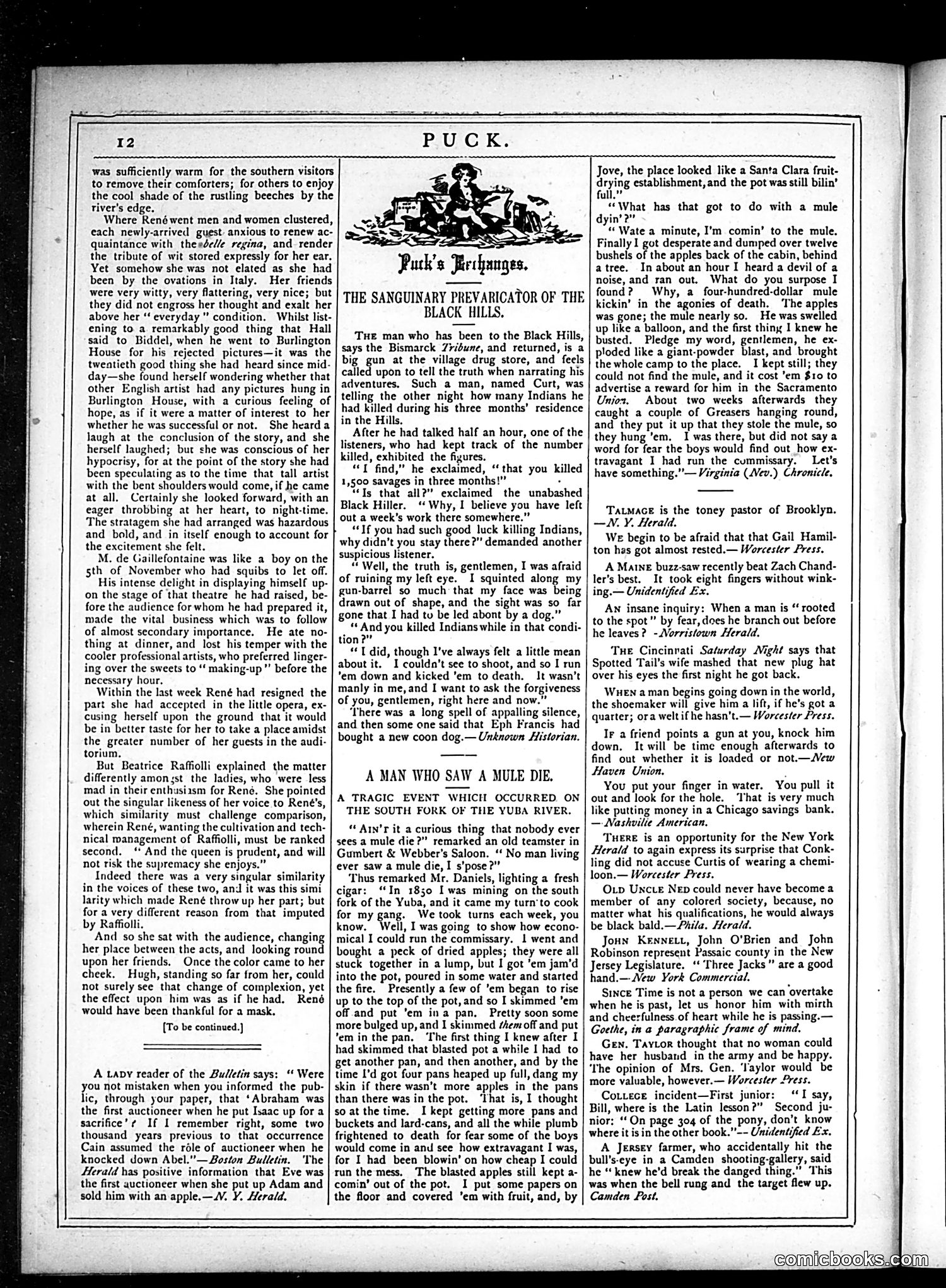
This page contains **"Puck's Bruises,"** a humor section featuring anecdotes rather than political cartoons. The illustrated header shows a cherub-like figure amid scattered items, establishing a lighthearted tone. The content includes several short humorous stories and social commentary: - A lengthy anecdote about an opera singer named Beatrice Raffaelli and her experience at Burlington House - A story titled "The Sanguinary Prevaricator of the Black Hills" about a man exaggerating tales of Indian encounters - A tragic account of a mule accident at the Yuba River - Brief satirical notes about everyday absurdities (women in society, a Cincinnati incident) Rather than targeting specific political figures, these pieces mock general social pretensions, tall tales, and human foibles—typical of Puck's satirical approach to contemporary American life and culture.
📄 Transcribed text from this page (OCR, searchable)
Machine-transcribed from the original scan — historical spelling and the odd misread are preserved.
12 was sufficiently warm for the southern visitors to remove their comforters; for others to enjoy the cool shade of the rustling beeches by the river's edge. Where René went men and women clustered, each newly-arrived guest anxious to renew ac- quaintance with theede//e regina, and render the tribute of wit stored expressly for her ear. Yet somehow she was not elated as she had been by the ovations in Italy. Her friends were very witty, very flattering, very nice; but they did not engross her thought and exalt her above her ‘‘ everyday" condition. Whilst list- ening to a remarkably good thing that Hall said to Biddel, when he went to Burlington House for his rejected pictures—it was the twentieth good thing she had heard since mid- day—she found herself wondering whether that other English artist had any pictures hung in Burlington House, with a curious feeling of hope, as if it were a matter of interest to her whether he was successful or not. She heard a laugh at the conclusion of the story, and she herself laughed; but she was conscious of her hypocrisy, for at the point of the story she had been speculating as to the time that tall artist with the bent shoulders would come, if he came at all. Certainly she looked forward, with an eager throbbing at her heart, to night-time. The stratagem she had arranged was hazardous and bold, and in itself enough to account for the excitement she felt. M. de Gaillefontaine was like a boy on the 5th of November who had squibs to let off. His intense delight in displaying himself up- on the stage of that theatre he had raised, be- fore the audience for whom he had prepared it, made the vital business which was to follow of almost secondary importance. He ate no- thing at dinner, and lost his temper with the cooler professional artists, who preferred linger- ing over the sweets to“ making-up” before the necessary hour. Within the last week René had resigned the part she had accepted in the little opera, ex- cusing herself upon the ground that it would be in better taste for her to take a place amidst the greater number of her guests in the audi- torium. But Beatrice Raffiolli explained the matter differently amonjst the ladies, who were less mad in their enthusiasm for René. She pointed out the singular likeness of her voice to René's, which similarity must challenge comparison, wherein René, wanting the cultivation and tech- nical management of Raffolli, must be ranked second. ‘And the queen is prudent, and will not risk the supremacy she enjoys.” Indeed there was a very singular similarity in the voices of these two, an: it was this simi larity which made René throw up her part; but for a very different reason from that imputed by Raffiolli. And so she sat with the audience, changin; her place between the acts, and looking round upon her friends. Once the color came to her cheek. Hugh, standing so far from her, could not surely see that change of complexion, yet the effect upon him was as if he had. René would have been thankful for a mask. [To be continued.] A tapy reader of the Bulletin says: “ Were you not mistaken when you informed the pub- lic, through your paper, that ‘Abraham was the first auctioneer when he put Isaac up for a sacrifice’¢ If 1 remember right, some two thousand years previous to that occurrence Cain assumed the réle of auctioneer when he knocked down Abel." — Boston Bulletin. The Herald has positive information that Eve was the first auctioneer when she put up Adam and sold him with an apple.—. Y. Herald. Puck's Firchanges, THE SANGUINARY PREVARICATOR OF THE BLACK HILLS, Tue man who has been to the Black Hills, says the Bismarck 7ribune, and returned, is a big gun at the village drug store, and feels called upon to tell the truth when narrating his adventures. Such a man, named Curt, was telling the other night how many Indians he had killed during his three months’ residence in the Hills, After he had talked half an hour, one of the listeners, who had kept track of the number killed, exhibited the figures. “1 find,” he exclaimed, “that you killed 1,500 savages in three months!” . “Ts that all?” exclaimed the unabashed Black Hiller. ‘ Why, 1 believe you have left out a week's work there somewhere.” “If you had such good luck killing Indians, why didn’t you stay there?” demanded another suspicious listener. “Well, the truth is, gentlemen, I was afraid of ruining my left eye. I squinted along my gun-barrel so much that my face was being drawn out of shape, and the sight was so far gone that I had tu be led abont by a dog.” * And you killed Indians while in that condi- tion?” “L did, though I've always felt a little mean about it. I couldn't see to shoot, and so I run ‘em down and kicked ‘em to death. It wasn’t manly in me, and I want to ask the forgiveness of you, gentlemen, right here and now.” ‘There was a long spell of appalling silence, and then some one said that Eph Francis had bought a new coon dog.— Unknown Historian. A MAN WHO SAW A MULE DIE. A TRAGIC EVENT WHICH OCCURRED ON THE SOUTH FORK OF THE YUBA RIVER. “ Atn’r it_a curious thing that nobody ever sees a mule die?” remarked an old teamster in Gumbert & Webber's Saloon. ‘ No man living ever saw a mule die, I s'pose?” ‘Thus remarked Mr. Daniels, lighting a fresh cigar: ‘In 1830 I was mining on the south fork of the Yuba, and it came my turn'to cook for my gang. We took turns each week, you know. Well, I was going to show how econo- mical I could run the commissary. 1 went and bought a peck of dried apples; they were all stuck together in a lump, but I got ’em jam'd into the pot, poured in some water and started the fire. Presently a few of ‘em began to rise up to the top of the pot, and so I skimmed 'em off.and put ‘em ina pan. Pretty soon some more bulged up, and I skimmed ¢hemoff and put ‘em inthe pan, ‘The first thing I knew after I had skimmed that blasted pot a while I had to get another pan, and then another, and by the time I'd got four pans heaped up full, dang my skin if there wasn’t more apples in the pans than there was in the pot. ‘That is, I thought so atthe time. I kept getting more pans and buckets and lard-cans, and all the while plumb frightened to death for fear some of the boys would come in anu see how extravagant I was, for I had been blowin’ on how cheap I could run the mess, The blasted apples still kept a- comin’ out of the pot. I put some papers on the floor and covered 'em with fruit, and, by Jove, the place looked like a Santa Clara fruit- drying establishment, and the pot was still bilin’ full.”” “What has that got to do with a mule dyin’ 2” “Wate a minute, I'm comin’ to the mule. Finally I got desperate and dumped over twelve bushels of the apples back of the cabin, behind atree. In about an hour I heard a devil of a noise, and ran out. What do you surpose I found? Why, a four-hundred-dollar mule kickin’ in the agonies of death. ‘The apples was gone; the mule nearly so. He was swelled up like a balloon, and the first thing I knew he busted. Pledge my word, gentlemen, he ex- ploded like a giant-powder blast, and brought the whole camp to the place. I kept still; they could not find the mule, and it cost 'em $10 to advertise a reward for him in the Sacramento Union, About two weeks afterwards they caught a couple of Greasers hanging round, and they put it up that they stole the mule, so they hung 'em. I was there, but did not say a word for fear the boys would find out how ex- travagant I had run the cummissary. Let's have something." Virginia (Nev.) Chronicle, Tatace is the toney pastor of Brooklyn. —wN. Y. Herald. We begin to be afraid that that Gail Hamil- ton has got almost rested.— Worcester Press. A Maine buzz-saw recently beat Zach Chand- ler's best. It took eight fingers without wink- ing.— Unidentified Ex. An insane inquiry: When a man is “ rooted to the spot” by fear, does he branch out before he leaves? -Norristown Herald, Tue Cincinvati Salurday Might says that Spotted Tail’s wife mashed that new plug hat over his eyes the first night he got back. Wuen aman begins going down in the world, the shoemaker will give him a lift, if he's got a quarter; ora welt if he hasn't.— Worcester Press. Tr a friend points a gun at you, knock him down, It will be time enough afterwards to find out whether it is loaded or not.—Mew Haven Union. You put your finger in water. You pull it out and look for the hole. ‘That is very much like putting money in a Chicago savings bank. —Nashvilie American, TueRE is an opportunity for the New York Herald to again express its surprise that Conk- ling did not accuse Curtis of wearing a chemi- loon.— Worcester Press. Oxp Uncte Nep could never have become a member of any colored society, because, no matter what his qualifications, he would always be black bald.— isla. Herald. Joun Kennett, John O'Brien and John Robinson represent Passaic county in the New Jersey Legislature. ‘ ‘Three Jacks” are a good hand.— Mew York Commercial. . Since Time is not a person we can overtake when he is past, let us honor him with mirth and cheerfulness.of heart while he is passing.— Goethe, in a paragraphic frame of mind, Gen. Taytor thought that no woman could have her husband in the army and be happy. ‘The opinion of Mrs. Gen. ‘laylor would be more valuable, however.— Worcester Press. Cottece incident—First junior: ‘I say, Bill, where is the Latin lesson?” Second ju- nior: ‘On page 304 of the pony, don’t know where it isin the other book.”-- Unidentified Ex. A Jersey farmer, who accidentally hit the bull's-eye in a Camden shooting-gallery, said he “ knew he'd break the danged thing.” ‘This was when the bell rung and the target flew up. Camden Post. comichooks, com