
Puck, 1877-11-21 · page 11 of 16
Puck — November 21, 1877 — page 11: what you’re looking at
What you’re looking at
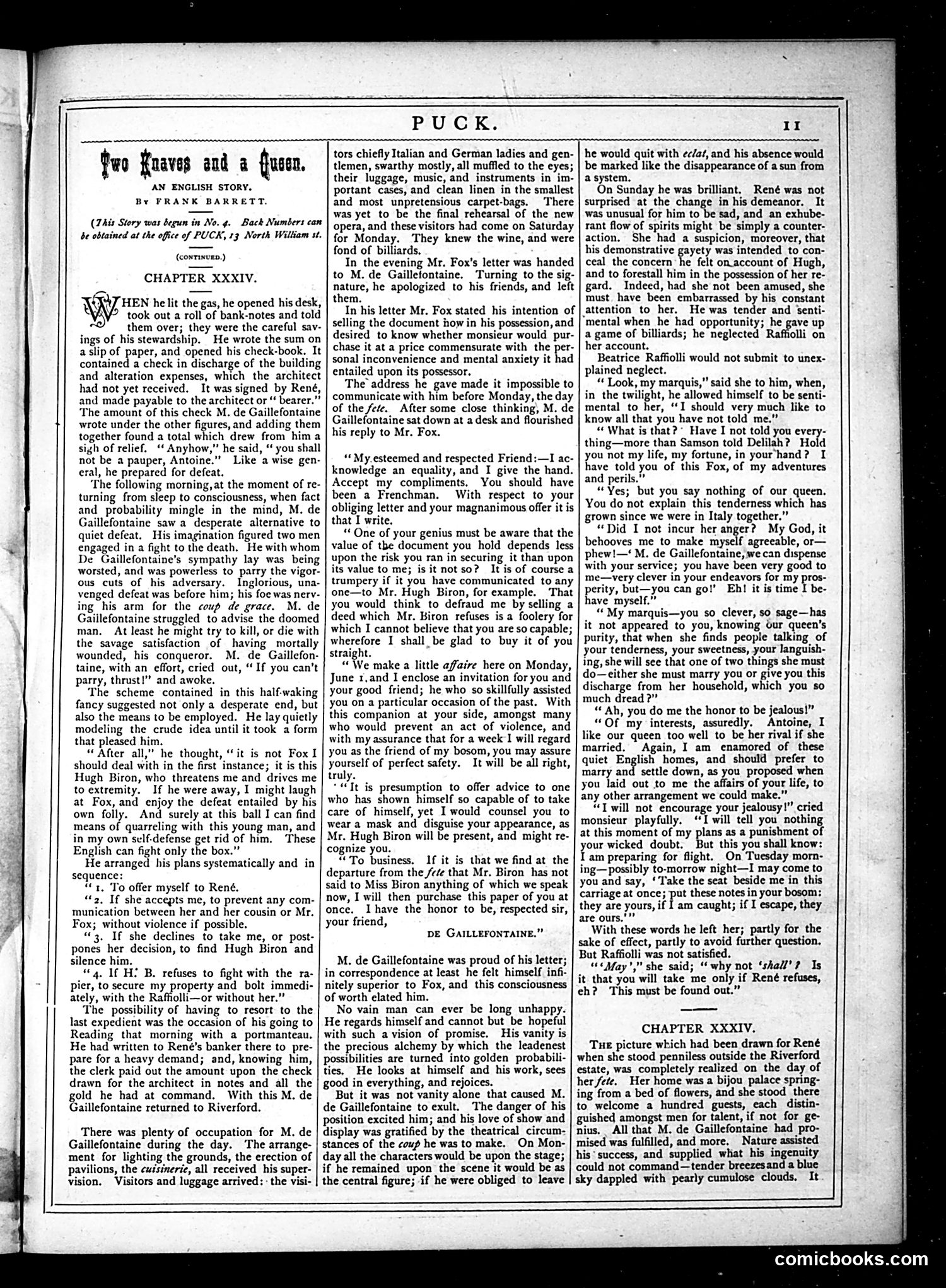
This page is primarily **literary fiction** rather than political satire. It's Chapter XXXIV of "Two Knaves and a Queen," a serialized story by Frank Barrett running in Puck magazine. The text describes a plot involving financial documents, a character named M. de Gaillefontaine managing affairs in Paris, and correspondence between gentlemen regarding money, property, and honor. References to "Hugh Biron" and various letters suggest 19th-century intrigue. **No political cartoon or satirical commentary appears visible on this page.** It's straightforward narrative prose—typical filler content magazines used between humorous sections. The story seems pitched at readers interested in romantic or dramatic fiction rather than contemporary political commentary.
📄 Transcribed text from this page (OCR, searchable)
Machine-transcribed from the original scan — historical spelling and the odd misread are preserved.
PUCK. II feo foaves and a ffueen. AN ENGLISH STORY. By FRANK BARRETT. (This Story was begun in No. ¢. Back Numbers can be obtained at the office of PUCK, 13 North William st. (conrixven.) CHAPTER XXXIV. HEN he lit the gas, he opened his desk, took out a roll of bank-notes and told them over; they were the careful sav- ings of his stewardship. He wrote the sum on a slip of paper, and opened his check-book. It contalaied check in discharge of the building and alteration expenses, which the architect had not yet received. It was signed by René, and made payable to the architect or “‘ bearer.”” The amount of this check M. de Gaillefontaine wrote under the other figures, and adding them together found a total which drew from hima sigh of relief.‘ Anyhow,” he said, “ you shall not be a pauper, Antoine.” Like ‘a wise gen- eral, he prepared for defeat. ‘The following morning, at the moment of re- turning from sleep to consciousness, when fact and probability mingle in the mind, M. de Gaillefontaine saw a desperate alternative to quiet defeat. His imagination figured two men engaged in a fight to the death, He with whom De Gaillefontaine’s sympathy lay was being worsted, and was powerless to parry the vigor- ous cuts of his adversary. Inglorious, una- venged defeat was before him; his foe was nerv- ing his arm for the coup de grace. M. de Gaillefontaine struggled to advise the doomed man. At least he might try to kill, or die with the savage satisfaction of having mortally wounded, his conqueror. M. de Gaillefon- taine, with an effort, cried out, “If you can't parry, thrust!” and awoke. The scheme contained in this half-waking fancy suggested not only a desperate end, but also the means to be employed. He lay quietly modeling the crude idea until it took a form that pleased him. “After all,” he thought, “it is not Fox I should deal with in the first instance; it is this Hugh Biron, who threatens me and drives me toextremity. If he were away, I might laugh at Fox, and enjoy the defeat entailed by his own folly. And surely at this ball I can find means of quarreling with this young man, and in my own self-defense get rid of him. ‘These English can fight only the box.” He arranged his plans systematically and in sequence: ‘1, To offer myself to René. “2, If she accepts me, to prevent any com- munication between her and her cousin or Mr. Fox; without violence if possible. «©3, If she declines to take me, or post- pones her decision, to find Hugh Biron and silence him. “4. If H! B. refuses to fight with the ra- Pier, to secure my property and bolt immedi- ately, with the Rafhiolli—or without her.” The possibility of having to resort to the last expedient was the occasion of his going to Reading that morning with a portmanteau. He had written to René’s banker there to _pre- pare for a heavy demand; and, knowing him, the clerk paid out the amount upon the check drawn for the architect in notes and all the gold he had at command. With this M. de Gaillefontaine returned to Riverford. There was plenty of occupation for M. de Gaillefontaine during the day. ‘The arrange- ment for lighting the grounds, the erection of pavilions, the cuisinerie, all received his super- vision, Visitors and luggage arrived: - the visi- tors chiefly Italian and German ladies and gen- tlemen, swarthy mostly, all muffled to the eyes; their luggage, music, and instruments in im- portant cases, and clean linen in the smallest and most unpretensious carpet-bags. There was yet to be the final rehearsal of the new opera, and these visitors had come on Saturday for Monday. They knew the wine, and were fond of billiards, In the evening Mr. Fox's letter was handed to M. de Gaillefontaine. Turning to the sig- nature, he apologized to his friends, and left them. In his letter Mr. Fox stated his intention of selling the document how in his possession, and desired to know whether monsieur would pur- chase it at a price commensurate with the per- sonal inconvenience and mental anxiety it had entailed upon its possessor. The address he gave made it impossible to communicate with him before Monday, the day of the fete. After some close thinking, M. de Gaillefontaine sat down at a desk and flourished his reply to Mr. Fox. “My.esteemed and respected Friend:—I ac- knowledge an equality, and I give the hand. Accept my compliments. You should have been a Frenchman. With respect to your obliging letter and your magnanimous offer it is that I write. “ One of your genius must be aware that the value of the document you hold depends less upon the risk you ran in securing it than upon its value to me; is it not so? It is of course a trumpery if it you have communicated to any one—to Mr. Hugh Biron, for example. That you would think to defraud me by selling a deed which Mr. Biron refuses is a foolery for which I cannot believe that you are so capable; wherefore I shall be glad to buy it of you straight. «We make a little afaire here on Monday, June 1,and I enclose an invitation for you and your good friend; he who so skillfully assisted you on a particular occasion of the past. With this companion at your side, amongst many who would prevent an act of violence, and with my assurance that for a week I will regard you as the friend of my bosom, you may assure yourself of perfect safety. It will be all right, truly. “Tt is presumption to offer advice to one who has shown himself so capable of to take care of himself, yet I would counsel you to wear a mask and disguise your appearance, as Mr. Hugh Biron will be present, and might re- cognize you. “To business. If it is that we find at the departure from the /e/e that Mr. Biron has not said to Miss Biron anything of which we speak now, I will then purchase this paper of you at once. Ihave the honor to be, respected sir, your friend, DE GAILLEFONTAINE.” M. de Gaillefontaine was proud of his letter; in correspondence at least he felt himself infi- nitely superior to Fox, and this consciousness of worth elated him. No vain man can ever be long unhappy. He regards himself and cannot but be hopeful with such a vision of promise. His vanity is the precious alchemy by which the leadenest possibilities are turned into golden probabili- ties, He looks at himself and his work, sees good in everything, and rejoices. But it was not vanity alone that caused M. de Gaillefontaine to exult. The danger of his position excited him; and his love of show and display was gratified by the theatrical circum- stances of the coup he was to make. On Mon- day all the characters would be upon the stage; if he remained upon the scene it would be as the central figure; if he were obliged he would quit with ec/af, and his absence would be marked like the disappearance of a sun from a system. On Sunday he was brilliant, René was not surprised at the change in his demeanor. It was unusual for him tobe sad, and an exhube- rant flow of spirits might be simply a counter- action, She had a suspicion, moreover, that his demonstrative gayety was intended to con- ceal the concern he felt onaccount of Hugh, and to forestall him in the possession of her re- gard. Indeed, had she not been amused, she must. have been embarrassed by his constant attention to her. He was tender and ‘senti- mental when he had opportunity; he gave up a game of billiards; he neglected Raffolli on her account. Beatrice Raffiolli would not submit to unex- plained neglect. “ Look, my marquis,” said she to him, when, in the twilight, he allowed himself to be senti- mental to her, ‘I should very much like to know all that you have not told me.” “ What is that?” Have I not told you every- thing—more than Samson told Delilah? Hold you not my life, my fortune, in your/hand? I have told you of this Fox, of my adventures and perils.” “Yes; but you say nothing of our queen. You do not explain this tenderness which has grown since we were in Italy together.” “Did I not incur her anger? My God, it behooves me to make myself agreeable, or— phew!—‘ M. de Gaillefontaine, we can dispense with your service; you have been very good to me—very clever in your endeavors for my pros- perity, but—you can go!’ Eh! it is time I be- have myself.” “ My marquis—you so clever, so sage—has it not appeared to you, knowing Our queen’s purity, that when she finds people talking of your tenderness, your sweetness, your languish- ing, she will see that one of two things she must do—either she must marry you or give you this discharge from her household, which you so much dread ?” “ Ah, you do me the honor to be jealous!” “Of my interests, assuredly. Antoine, I like our queen too well to be her rival if she married. Again, I am enamored of these quiet English homes, and should prefer to marry and settle down, as you proposed when you laid out to me the affairs of your life, to any other arrangement we could make.” “Twill not encourage your jealousy!” cried monsieur playfully. ‘I will tell you nothing at this moment of my plans as a punishment of our wicked doubt. But this you shall know: am preparing for flight. On Tuesday morn- ing—possibly to-morrow night—I may come to you and say, ‘Take the seat beside me in this carriage at once; put these notes in your bosom: they are yours, if I am caught; if I escape, they are ours,’”” With these words he left her; partly for the sake of effect, partly to avoid further question. But Raffiolli was not satisfied. “«‘May',” she said; “why not ‘shall’? Is it that you will take me only if René refuses, eh? This must be found out.” CHAPTER XXXIV. Tue picture which had been drawn for René when she stood penniless outside the Riverford estate, was completely realized on the day of her fete, Her home was a bijou palace spring- ing from a bed of flowers, and she stood there to welcome a hundred guests, each distin- guished amongst men for talent, if not for ge- nius, All that M. de Gaillefontaine had pro- mised was fulfilled, and more, Nature assisted his‘ success, and supplied what his ingenuity could not command—tender breezesand a blue to leave | sky dappled with pearly cumulose clouds. It comicbooks.com