
Puck, 1877-11-21 · page 6 of 16
Puck — November 21, 1877 — page 6: what you’re looking at
What you’re looking at
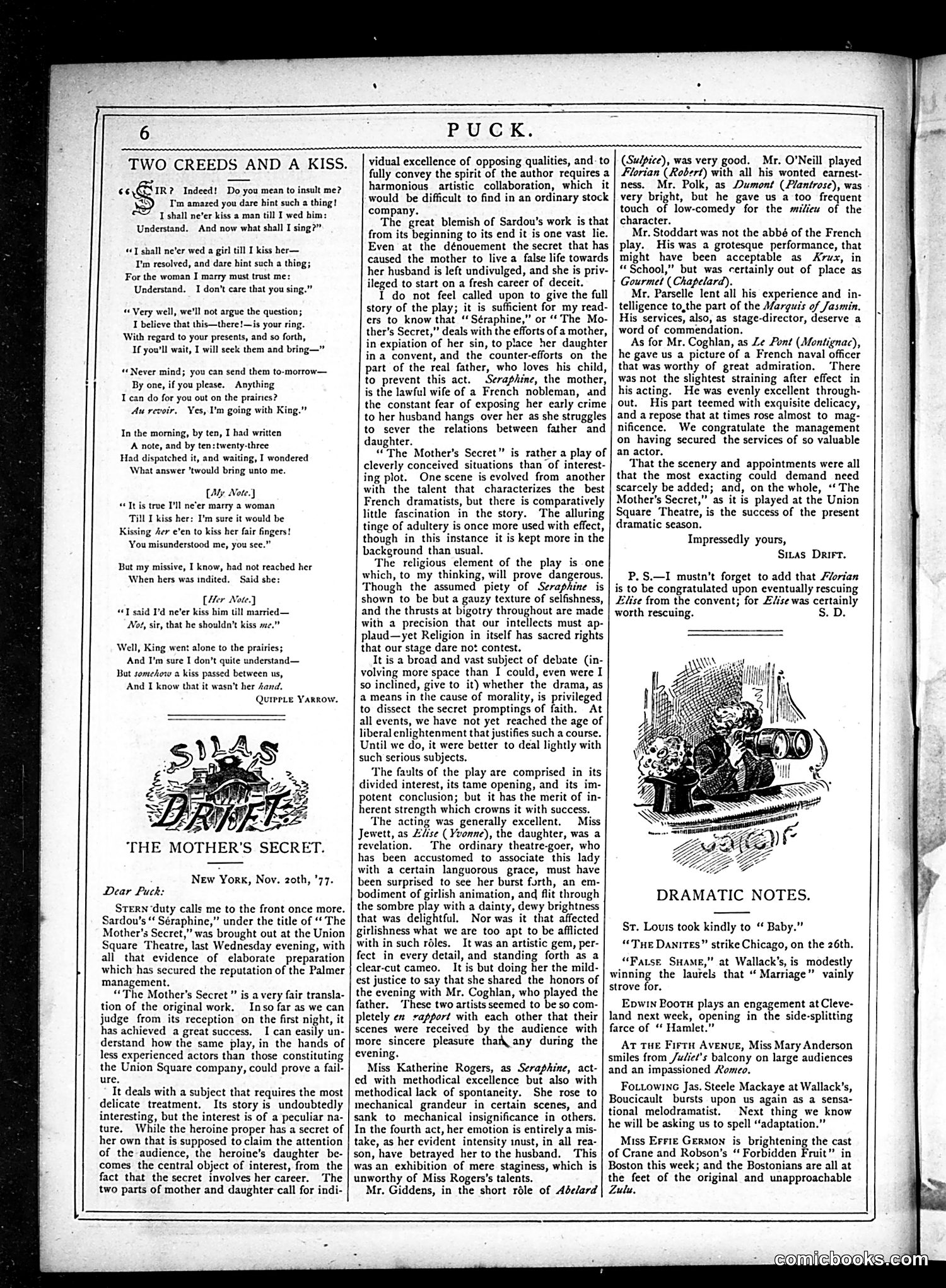
This page from Puck magazine (November 20, 1877) primarily contains **theatrical criticism and letters**, not political satire. The main content reviews "The Mother's Secret," a play at the Union Square Theatre in New York. The small illustration at bottom right appears to be a **theatre-related vignette**—possibly depicting a dramatic scene or character moment from the reviewed play, consistent with Puck's inclusion of entertainment commentary. The page lacks the sharp political or social satire typically associated with Puck's reputation. Instead, it functions as **arts criticism**, evaluating the play's merit, the cast's performances (including Miss Jewett and Miss Katherine Rogers), and theatrical production values. This represents Puck's broader cultural coverage beyond partisan politics.
📄 Transcribed text from this page (OCR, searchable)
Machine-transcribed from the original scan — historical spelling and the odd misread are preserved.
PUCK. TWO CREEDS AND A KISS. 66\G3IR? Indeed! Do you mean to insult me? S) I'm amazed you dare hint such a thing! I shall ne’er kiss a man till I wed him: Understand. And now what shall I sing?” «1 shall ne'er wed a girl till I kiss her— I'm resolved, and dare hint such a thing; For the woman I marry must trust me: Understand. I don’t care that you sing.” “Very well, we'll not argue the question; I believe that this—there!—is your ring. With regard to your presents, and so forth, If you'll wait, I will seek them and bring—” “Never mind; you can send them to-morrow— By one, if you please. Anything I can do for you out on the prairies? ‘Au revoir. Yes, I'm going with King.” In the morning, by ten, I had written A note, and by ten: twenty-three Had dispatched it, and waiting, I wondered What answer "twould bring unto me. [My Note.) «Te is trve I'll ne'er marry a woman Till I kiss her: I'm sure it would be Kissing Aer e'en to kiss her fair fingers! You misunderstood me, you see.” But my missive, I know, had not reached her When hers was indited, Said she: [Her Note] “1 said P'd ne'er kiss him till married— Not, sir, that he shouldn’t kiss me.” Well, King went alone to the prairies; And I'm sure I don’t quite understand— But somehow a kiss passed between us, And I know that it wasn’t her hand. Quirrte Yarrow. THE MOTHER'S SECRET. és New York, Nov. 2oth, '77. Dear Puck: Stern ‘duty calls me to the front once more. Sardou’s ‘¢ Séraphine,” under the title of “ The Mother's Secret,” was brought out at the Union Square ‘Theatre, last Wednesday evening, with all that evidence of elaborate preparation which has secured the reputation of the Palmer management. “The Mother's Secret ” is avery fair transla- tion of the original work. _Inso far as we can judge from its reception on the first night, it has achieved a great success. I can easily un- derstand how the same play, in the hands of less experienced actors than those constituting the Union Square company, could prove a fail- ure, It deals with a subject that requires the most delicate treatment. Its story is undoubtedly interesting, but the interest is of a peculiar na- ture, While the heroine proper has a secret of her own that is supposed to claim the attention of the audience, the heroine’s daughter be- comes the central object of interest, from the fact that the secret involves her career. The two parts of mother and daughter call for indi- vidual excellence of opposing qualities, and- to fully convey the spirit of the author requires a harmonious artistic collaboration, which it would be difficult to find in an ordinary stock company. The great blemish of Sardou’s work is that from its beginning to its end it is one vast lie. Even at the dénouement the secret that has caused the mother to live a false life towards her husband is left undivulged, and she is priv- ileged to start on a fresh career of deceit. I do not feel called upon to give the full story of the play; it is sufficient for my read- ers to know that “ Séraphine,” or “The Mo- ther’s Secret,” deals with the efforts of a mother, in expiation of her sin, to place her daughter in a convent, and the counter-efforts on the part of the real father, who loves his child, to prevent this act. Seraphine, the mother, is the lawful wife of a French nobleman, and the constant fear of exposing her early crime to her husband hangs over her as she struggles to sever the relations between father and daughter. “The Mother's Secret” is rather a play of cleverly conceived situations than of interest- ing plot. One scene is evolved from another with the talent that characterizes the best French dramatists, but there is comparatively little fascination in the story. The alluring tinge of adultery is once more used with effect, though in this instance it is kept more in the background than usual. The religious element of the play is one which, to my thinking, will prove dangerous. Though the assumed piety of Seraphine is shown to be but a gauzy texture of selfishness, and the thrusts at bigotry throughout are made with a precision that our intellects must ap- plaud—yet Religion in itself has sacred rights that our stage dare not contest. It is a broad and vast subject of debate (in- volving more space than I could, even were I so inclined, give to it) whether the drama, as a means in the cause of morality, is privileged to dissect the secret promptings of faith. At all events, we have not yet reached the age of liberal enlightenment that justifies such a course. Until we do, it were better to deal lightly with such serious subjects. ‘The faults of the play are comprised in its divided interest, its tame opening, and its im- potent conclusion; but it has the merit of in- herent strength which crowns it with success. ‘The acting was generally excellent. Miss Jewett, as vise (Yvonne), the daughter, was a revelation. The ordinary theatre-goer, who has been accustomed to associate this lady with a certain languorous grace, must have been surprised to see her burst forth, an em- bodiment of girlish animation, and flit through the sombre play with a dainty, dewy brightness that was delightful. Nor was it that affected girlishness what we are too apt to be afflicted with in such réles. It was an artistic gem, per- fect in every detail, and standing forth as a clear-cut cameo. It is but doing her the mild- est justice to say that she shared the honors of the evening with Mr. Coghlan, who played the father. ‘These two artists seemed to be so com- pletely e rapport with each other that their scenes were received by the audience with more sincere pleasure thaX any during the evening. Miss Katherine Rogers, as Seraphine, act- ed with methodical excellence but also with methodical lack of spontaneity. She rose to mechanical grandeur in certain scenes, and sank to mechanical insignificance in others. In the fourth act, her emotion is entirely a mis- take, as her evident intensity inust, in all rea- son, have betrayed her to the husband. This was an exhibition of mere staginess, which is unworthy of Miss Rogers's talents. Mr. Giddens, in the short réle of Abelard (Sulpice), was very good. Mr. O'Neill played Florian (Robert) with all his wonted earnest- ness. Mr. Polk, as Dumont (Plantrose), was very bright, but he gave us a too frequent touch of low-comedy for the mifiew of the character. Mr. Stoddart was not the abbé of the French play. His was a grotesque performance, that might have been acceptable as Krux, in “School,” but was certainly out of place as Gourmet (Chapelard). Mr. Parselle lent all his experience and in- telligence to,the part of the Marguis of Jasmin, His services, also, as stage-director, deserve a word of commendation. As for Mr. Coghlan, as Le Pont (Montignac), he gave us a picture of a French naval officer that was worthy of great admiration. ‘There was not the slightest straining after effect in his acting. He was evenly excellent through- out. His part teemed with exquisite delicacy, and a repose that at times rose almost to mag- nificence. We congratulate the management on having secured the services of so valuable an actor. ‘That the scenery and appointments were all that the most exacting could demand need scarcely be added; and, on the whole, “ The Mother's Secret,” as it is played at the Union Square Theatre, is the success of the present dramatic season. Impressedly yours, Siras Drirt. P. S.—I mustn’t forget to add that Florian is to be congratulated upon eventually rescuing Elise from the convent; for Zvise was certainly worth rescuing. Ss. D. DRAMATIC NOTES. Sr. Louis took kindly to “ Baby.” “Tue Dantes” strike Chicago, on the 26th. “Fase SHAME,” at Wallack’s, is modestly winning the laurels that “ Marriage” vainly strove for. Epwin Bootu plays an engagement at Cleve- land next week, opening in the side-splitting farce of ‘‘ Hamlet.” AT THE FirtH Avenue, Miss Mary Anderson smiles from /u/iet's balcony on large audiences and an impassioned Romeo. Fottowinc Jas. Steele Mackaye at Wallack’s, Boucicault bursts upon us again as a sensa- tional melodramatist. Next thing we know he will be asking us to spell “adaptation.” Miss Errie Germon is brightening the cast of Crane and Robson's “ Forbidden Fruit” in Boston this week; and the Bostonians are all at the feet of the original and unapproachable Zulu,