A complete issue · 16 pages · 1877
Puck — October 24, 1877
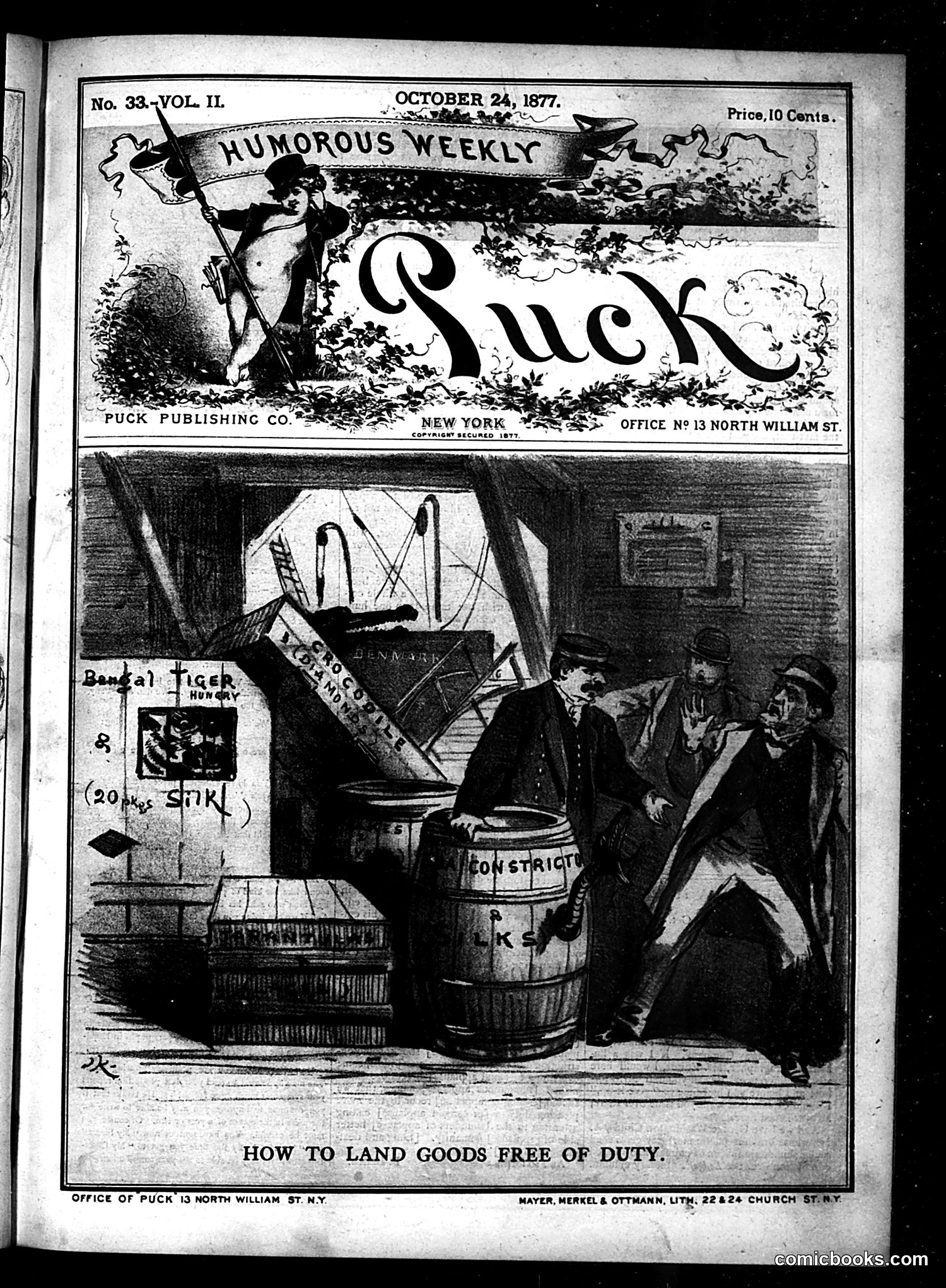
This Puck cartoon satirizes **smuggling and customs evasion** in 1877. The image depicts men unloading contraband cargo from a ship, with boxes labeled "Bengal Tiger" and barrels marked "On Strike" and what appears to be "K" (possibly liquor or other taxable goods). The title's sarcastic caption suggests this depicts an actual method for avoiding tariffs—likely a commentary on widespread smuggling practices or corrupt customs officials. The "Bengal Tiger" reference may allude to exotic luxury goods, while the "On Strike" label possibly references contemporary labor disputes. The cartoon criticizes either smugglers' brazen tactics or government ineffectiveness at preventing duty evasion, a significant economic and political issue during the Gilded Age.
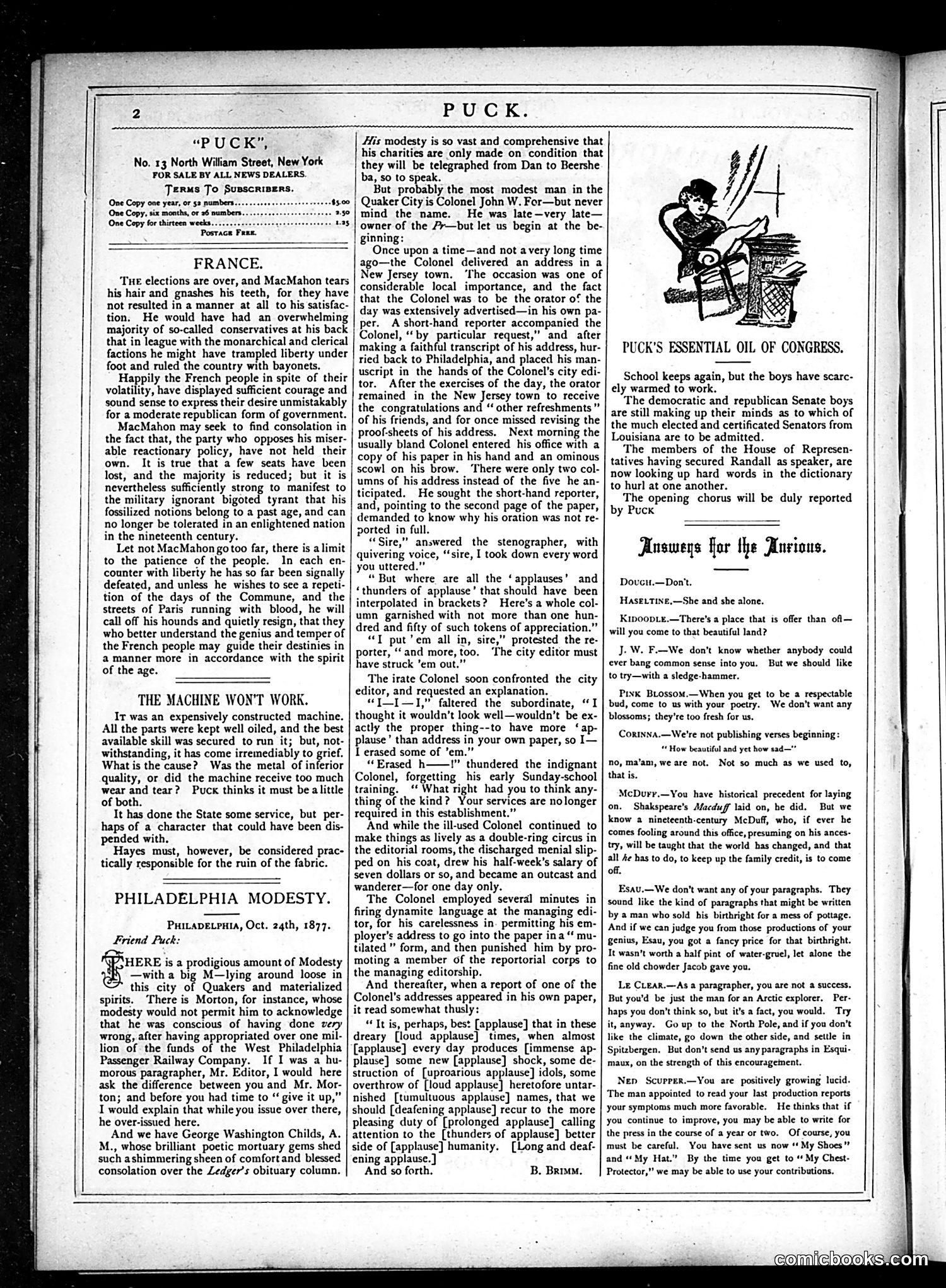
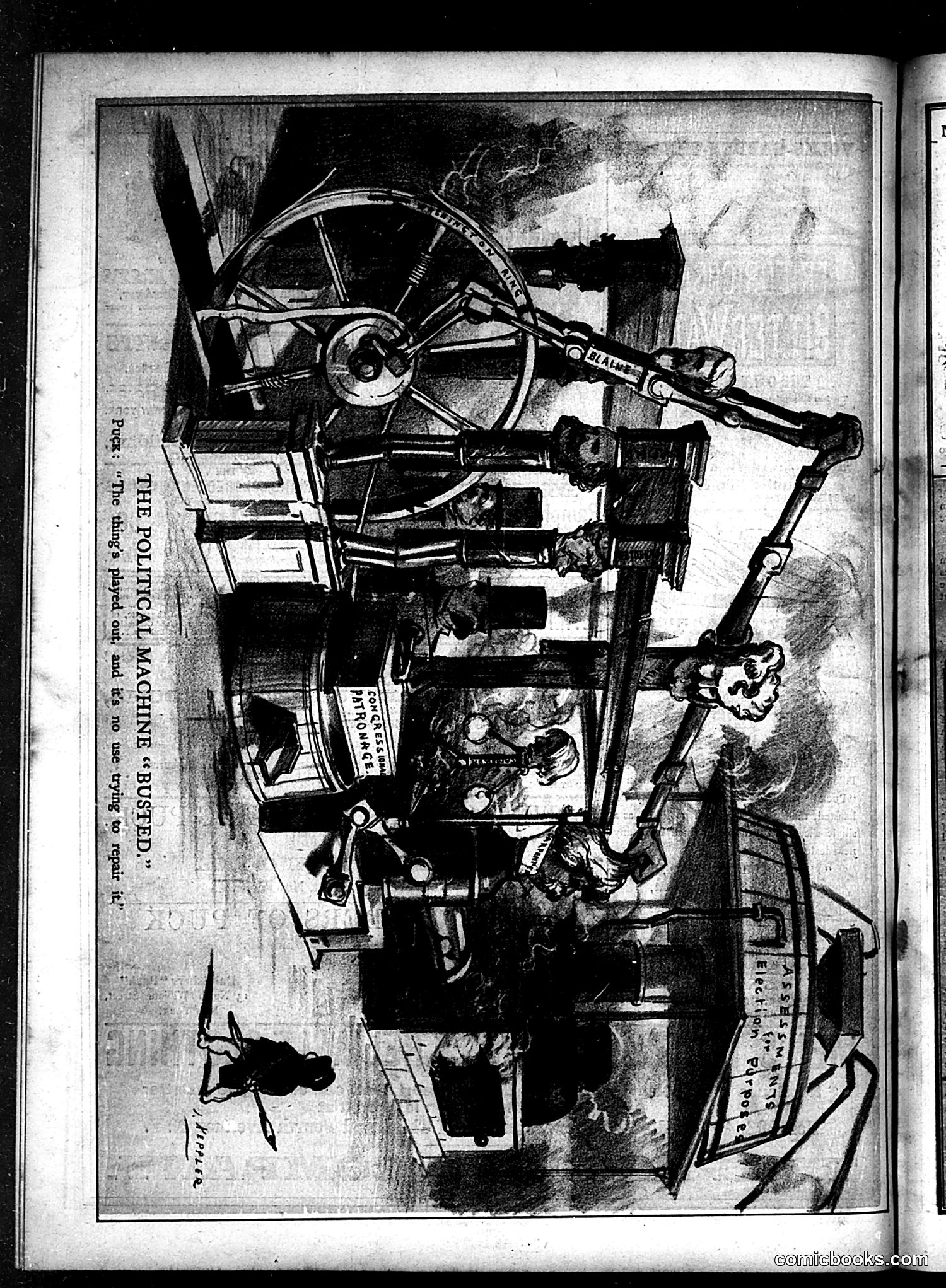
The main cartoon, "Puck's Essential Oil of Congress," depicts a figure (likely representing Congress or a politician) operating what appears to be an oil press or mechanical device. The cartoon satirizes Congress as producing nothing of value—just "essential oil," a useless distillation. The text below discusses Senate members from Louisiana being elected and certificated despite controversy, suggesting congressional dysfunction and corruption. Additional sections address French elections, a malfunctioning machine, and Philadelphia's "modesty" regarding appropriations misuse. The overall message criticizes Congress as ineffective and corrupt, producing only empty rhetoric while important matters languish. The "essential oil" metaphor suggests Congress extracts nothing of substance from its deliberations.
This page contains three distinct pieces of satirical content: 1. **"What Goeth On at Present"** - A commentary on young men courting women, with criticism of their behavior and temperance issues. 2. **"The Story of His Nose"** - A humorous anecdote about a man with a scarred, swollen nose who explains his disfigurement came from a cab accident involving a two-dollar bill. The story mocks both the man's vanity and apparent foolishness. 3. **"Fitznoodle in America"** - A political satire appearing to critique American republicanism and political systems. The text references "Great Britain," suggesting comparison between British and American governance, though the specific targets remain unclear from this excerpt alone. The magazine employs characteristic Puck-style humor: social satire, absurdist scenarios, and political commentary targeting contemporary American institutions and behaviors.
This page from *Puck* presents "Bits of Bouffe"—serialized literary content rather than political cartoons. The content includes: 1. **"Périchole and Piquillo"** — A romantic narrative about a soprano singer and tenor musician in Peru, involving jealousy, love letters, and social complications around their relationship and marriage prospects. 2. **"The Conqueror and the Indian Maid"** — A poem depicting a colonial conquest narrative with romantic elements. The page is primarily **literary/entertainment content** rather than political satire. *Puck* magazines often mixed satirical cartoons with serialized fiction, poetry, and humorous stories. These particular pieces appear to be romantic comedies exploring class differences, artistic life, and relationships—typical light entertainment for the magazine's audience rather than commentary on current events.
This page contains three distinct pieces of literary/humorous content rather than political cartoons: 1. **"That Cow of Mine"** - A satirical story about a woman whose cow causes domestic chaos and social embarrassment. The humor derives from the cow's uncontrollable behavior disrupting polite society. 2. **"An Autumnal Ode (To My Landlady)"** - A poem by R.K. Munkittrick celebrating autumn while subtly mocking the speaker's landlady. 3. **"College Notes" and "Puck's Stage Sketches"** - Brief humorous observations about college life and theater, including commentary on German philosophy and a theatrical review of "The Crushed Tragedian." The page emphasizes **domestic comedy and social satire** rather than political commentary—typical of Puck's lighter editorial content alongside its more pointed political cartoons.
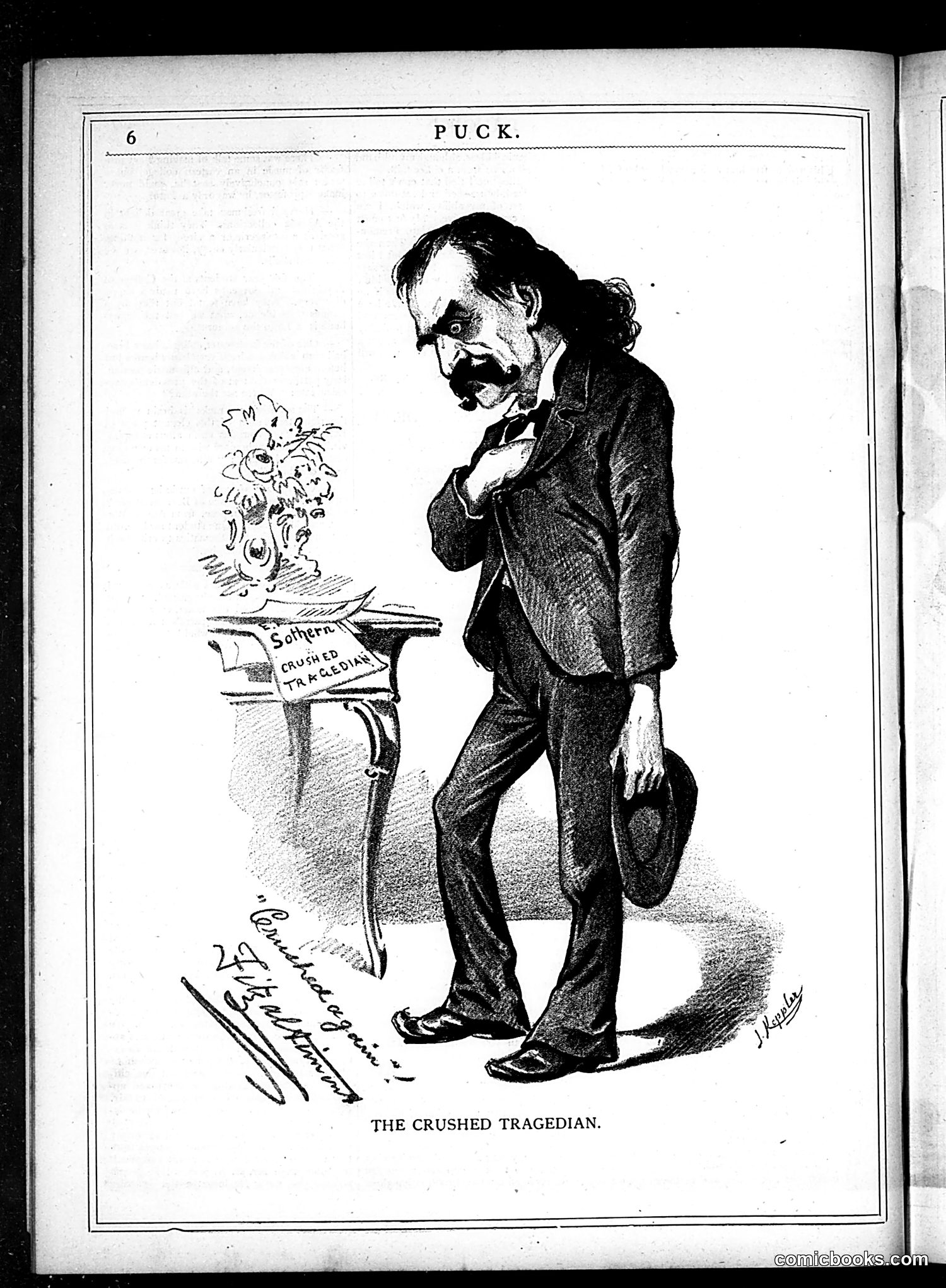
This cartoon depicts a man in formal Victorian dress standing beside an anvil labeled "Southern Crushed Tragedian." The anvil appears to have crushed theatrical masks or dramatic imagery upon it. The figure's exaggerated facial features and posture suggest mockery of someone who presented themselves with theatrical grandeur but has been defeated or humiliated. The "crushed" anvil symbolizes his downfall or ruin. Without additional context, the specific identity of this "tragedian" remains unclear—it likely references a prominent political or cultural figure of Puck's era whose dramatic pretensions were undermined by events. The satirical point appears to be ridiculing someone who styled themselves as important or tragic but was publicly defeated or exposed.
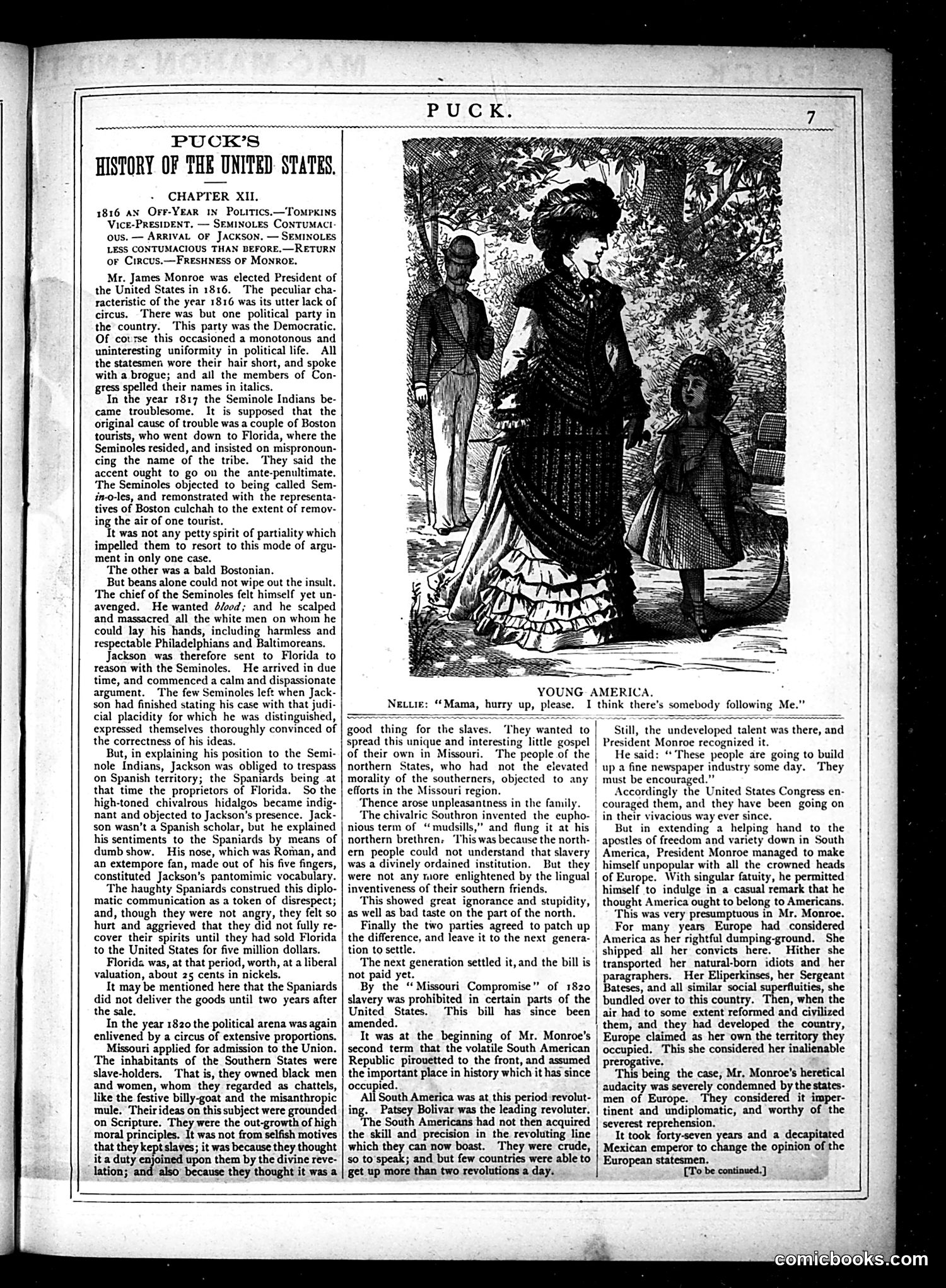
This illustration depicts a young woman labeled "Young America" being followed by a Native American man. The caption reads: "Nellie: 'Mama, hurry up, please. I think there's somebody following Me.'" The cartoon satirizes American expansionism and the treatment of Native Americans during the 1816-1820 period covered in the accompanying text. "Young America" represents the nation's youthful ideals, while the pursuing Native American figure symbolizes the displaced indigenous peoples whose lands were being taken. The satire critiques America's hypocrisy: the nation claims moral superiority and spreads "gospel" to civilize others, yet simultaneously displaces and oppresses Native Americans. The woman's fear reflects anxieties about westward expansion's consequences, suggesting discomfort with America's colonial practices even as they occurred.
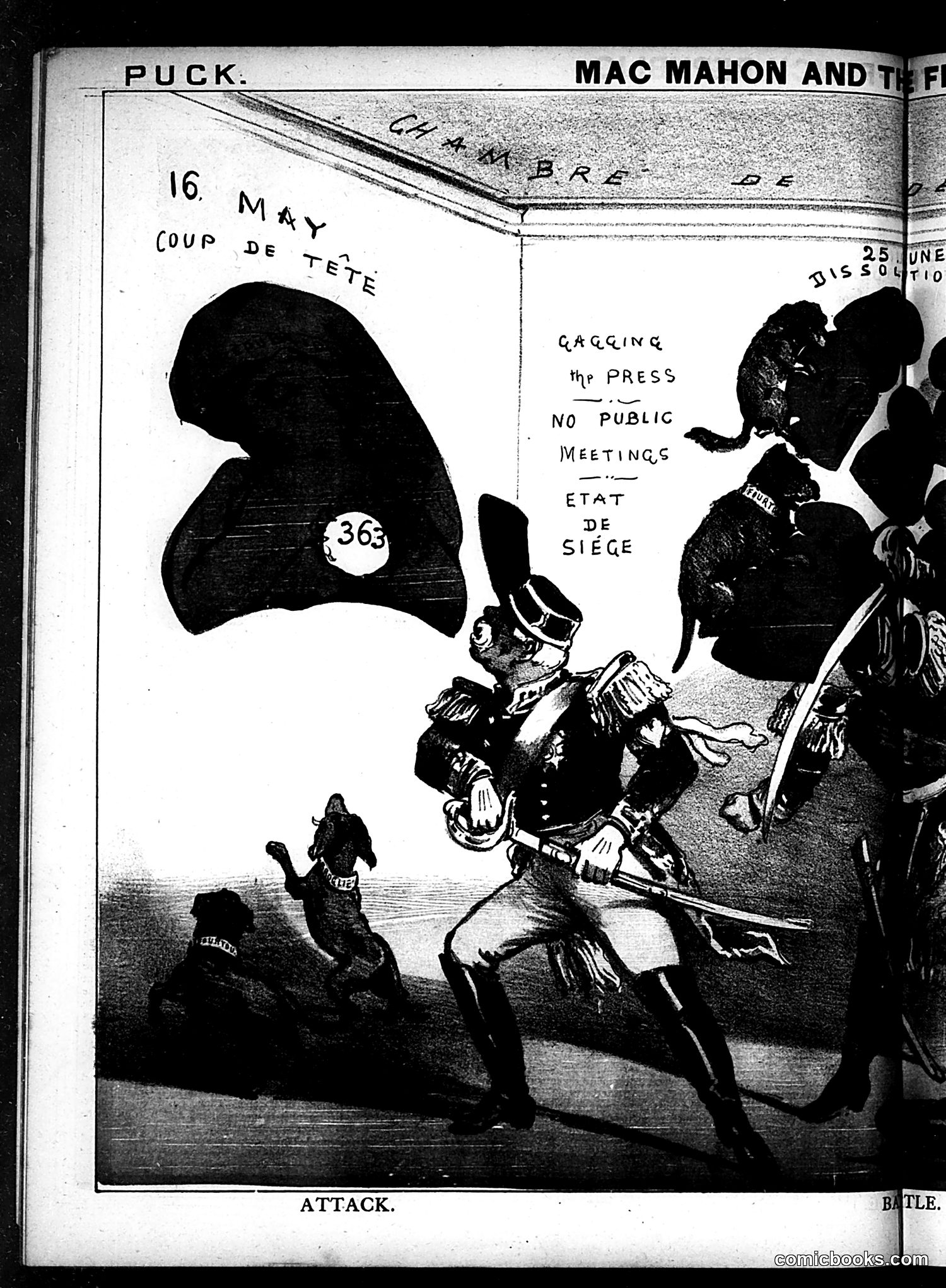
This is a satirical cartoon titled "Attack" (bottom) commenting on military or political conflict. The central figure is a uniformed military officer with epaulettes and a sword, depicted in a classical heroic pose. He's confronted by large, menacing silhouettes labeled with French phrases ("Coup de Tête," "Gagging the Press," "No Public Meetings," "État de Siège"—meaning "state of siege"). The cartoon appears to criticize authoritarian military measures, likely referencing French political turmoil. The officer represents military authority attempting to suppress press freedom and public assembly through martial law declarations. The massive dark figures symbolize the oppressive powers being wielded. The satirical point: military solutions create more problems than they solve.
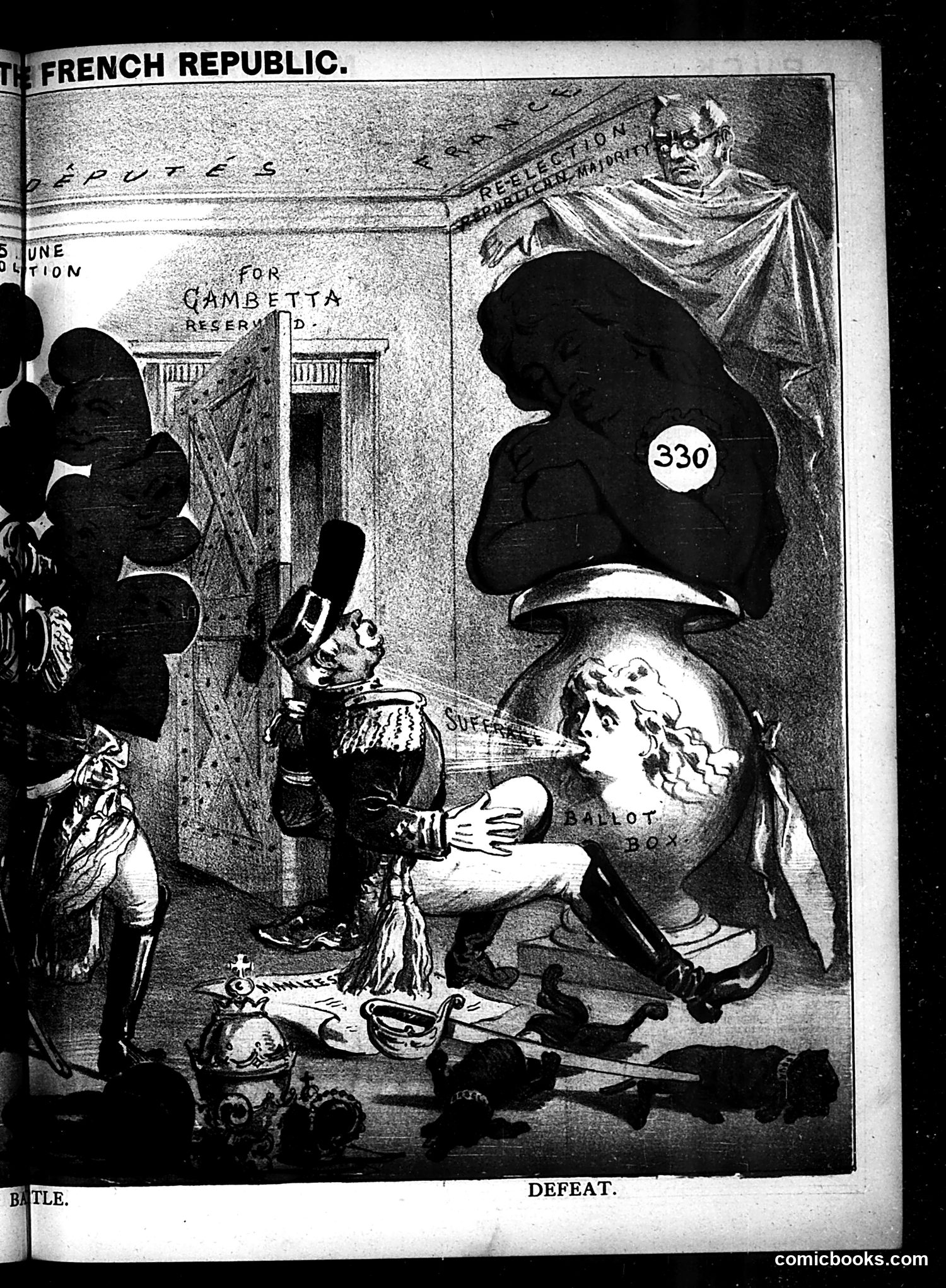
This Puck cartoon satirizes French politics during a period of internal conflict. The page header reads "THE FRENCH REPUBLIC" with subtitle "DISPUTES" and references "GAMBETTA RESERVED." The cartoon depicts a military officer (left) confronting a large personified female figure representing the French Republic. She wears a Phrygian cap (symbol of French liberty) and appears distressed or defeated. The word "DEFEAT" appears at the bottom. The satire likely comments on political tensions between military and republican factions in late 19th-century France, possibly referencing Leon Gambetta's role in republican politics. The officer's aggressive stance toward the Republic figure suggests criticism of militaristic interference in French governance, or conversely, Republican weakness against military power. The exact historical moment remains unclear without additional context.
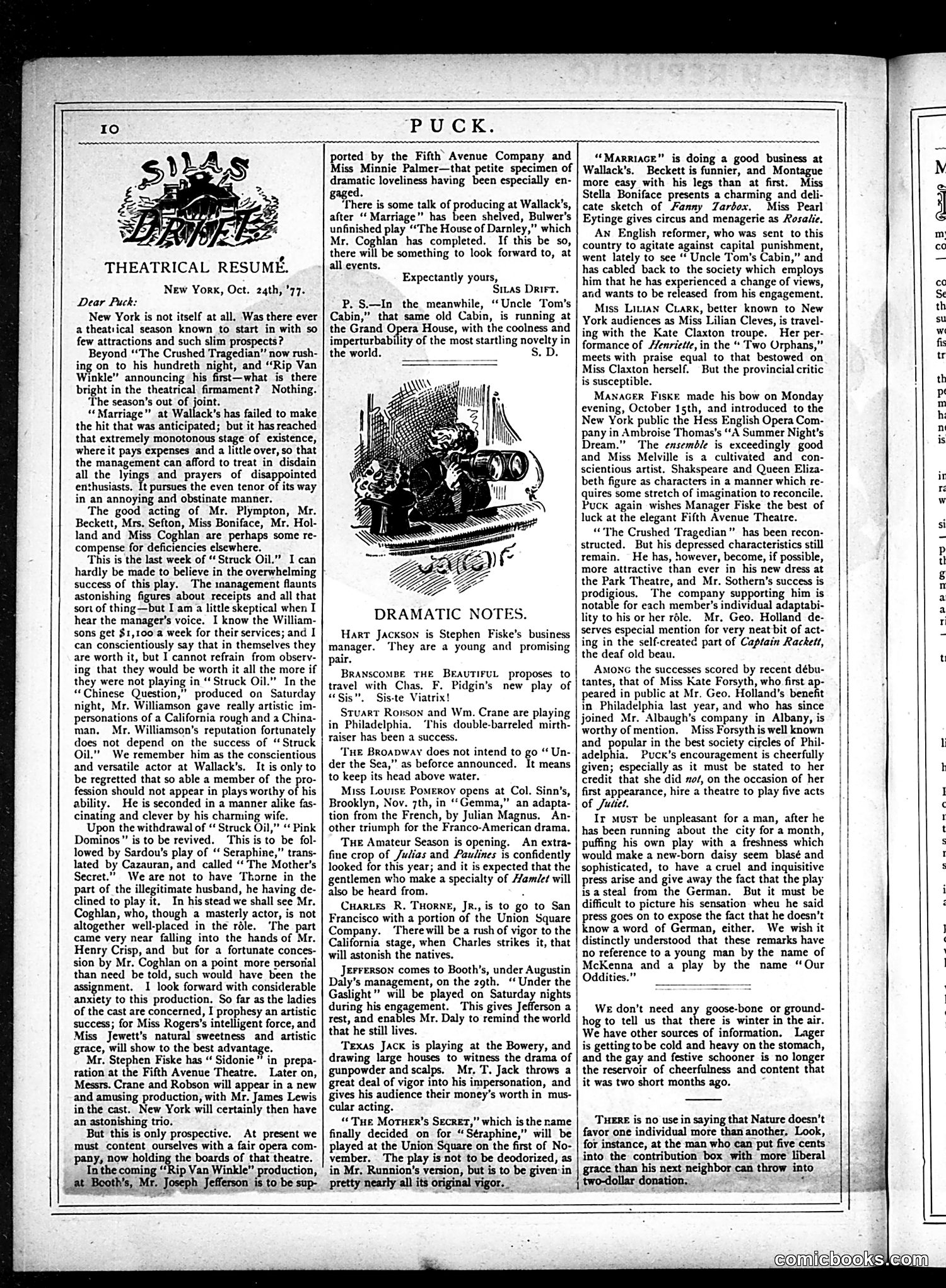
This page contains theatrical reviews and dramatic notes rather than political cartoons. The main illustration shows a caricatured figure in period costume, appearing to satirize theatrical productions of the era. The "Theatrical Résumé" discusses New York theater season openings, reviewing productions like "Marriage" at Wallack's Theatre and "Uncle Tom's Cabin." The text critiques various performances and actors, including comments on Mr. Plympton and Mr. Beckett's acting abilities. The "Dramatic Notes" section provides gossip and commentary on theatrical personnel and upcoming shows. References include debates about whether certain plays should be produced and commentary on actors' relative merits. The satire is primarily theatrical rather than political—mocking pretentious performances and industry gossip rather than addressing broader social issues. Without clearer identification of specific caricatured individuals, the precise satirical targets remain unclear.
This page contains a first-person narrative titled "Memoirs of a Suicide," a satirical piece about a man recounting his repeated failed suicide attempts. The humor derives from the absurdity of each attempt—poisoning, jumping from a bed, drinking acid—all failing comically. The satire appears to mock both romantic melodrama and the desperation of unrequited love in Victorian America. The narrator's repeated suicide attempts over various romantic rejections escalate from serious to ridiculous, particularly his final attempt involving a steam-yacht during a railway excursion. The piece satirizes contemporary attitudes toward love, loss, and masculine despair while employing dark humor typical of Puck's irreverent style. The narrative voice remains deadpan throughout these increasingly absurd scenarios.
This page contains **text only** — specifically Chapter XXIX of a serialized English story titled "Two Knaves and a Queen," credited to Frank Lee Benedict. The narrative concerns aristocratic characters including Renée, M. de Gaillefontaine, and others navigating social propriety, romantic complications, and class tensions in Victorian England. There are **no cartoons or political satire** on this page. It is a work of fiction serialized in Puck magazine (which typically combined humor with literary content). The story itself contains social commentary about English aristocratic hypocrisy and women's constrained agency, but this is literary satire within the narrative rather than visual political cartooning. This appears to be a regular story installment rather than satirical commentary on contemporary events.
This satirical article attacks the telephone as an invasion of privacy and a tool for eavesdropping. The piece argues that despite claims of its innocent purpose, the telephone enables confidential conversations to be intercepted and transmitted without consent—a serious concern for wealthy Providence families and political figures. The satire targets the telephone's potential for abuse: private remarks to Democrats allegedly reaching Republicans; confidential business discussions compromised; and intimate family secrets exposed. The author sardonically notes that while telephone manufacturers promote safety and progress, they ignore the real danger: unchecked surveillance and loss of privacy. The piece reflects late-19th-century anxieties about new technology enabling social control and information gathering by those with access to telephone infrastructure.
This page from *Puck* consists primarily of **"Puck's Jestings"** — a humor column mixing short jokes, anecdotes, and satirical observations about contemporary life. Rather than featuring a prominent political cartoon, it collects brief witticisms on topics like: - Domestic life and marriage - Business and commerce - Social pretensions - Rural versus urban life - Practical jokes and eccentricities The humor targets everyday absurdities: safe burglaries, rheumatism remedies, Long Island foxes, Philadelphia "Drills," and domestic disputes. The column functions as *Puck's* satirical commentary on American social customs and middle-class life, using brevity and wordplay rather than visual caricature. A **compressed yeast advertisement** appears at bottom.
This appears to be a **back page of advertisements** from Puck magazine, not a cartoon or editorial content page. The page is dominated by commercial ads for various 19th-century products and services, including: - Theater listings (Volks-Garden-Theatre) - A German almanac - Hats, portraits, and printing services - Carpet and furniture warehouses - Men's and children's clothing The only editorial content is a brief memorial notice "In Memoriam Brigham Young" (the Mormon leader died in 1877), explaining Puck's cartoon history and promoting back issues. This is primarily a **commercial/business page** with no political satire or caricatures visible—typical of 19th-century magazine back matter used to generate revenue.