
Puck, 1877-10-24 · page 12 of 16
Puck — October 24, 1877 — page 12: what you’re looking at
What you’re looking at
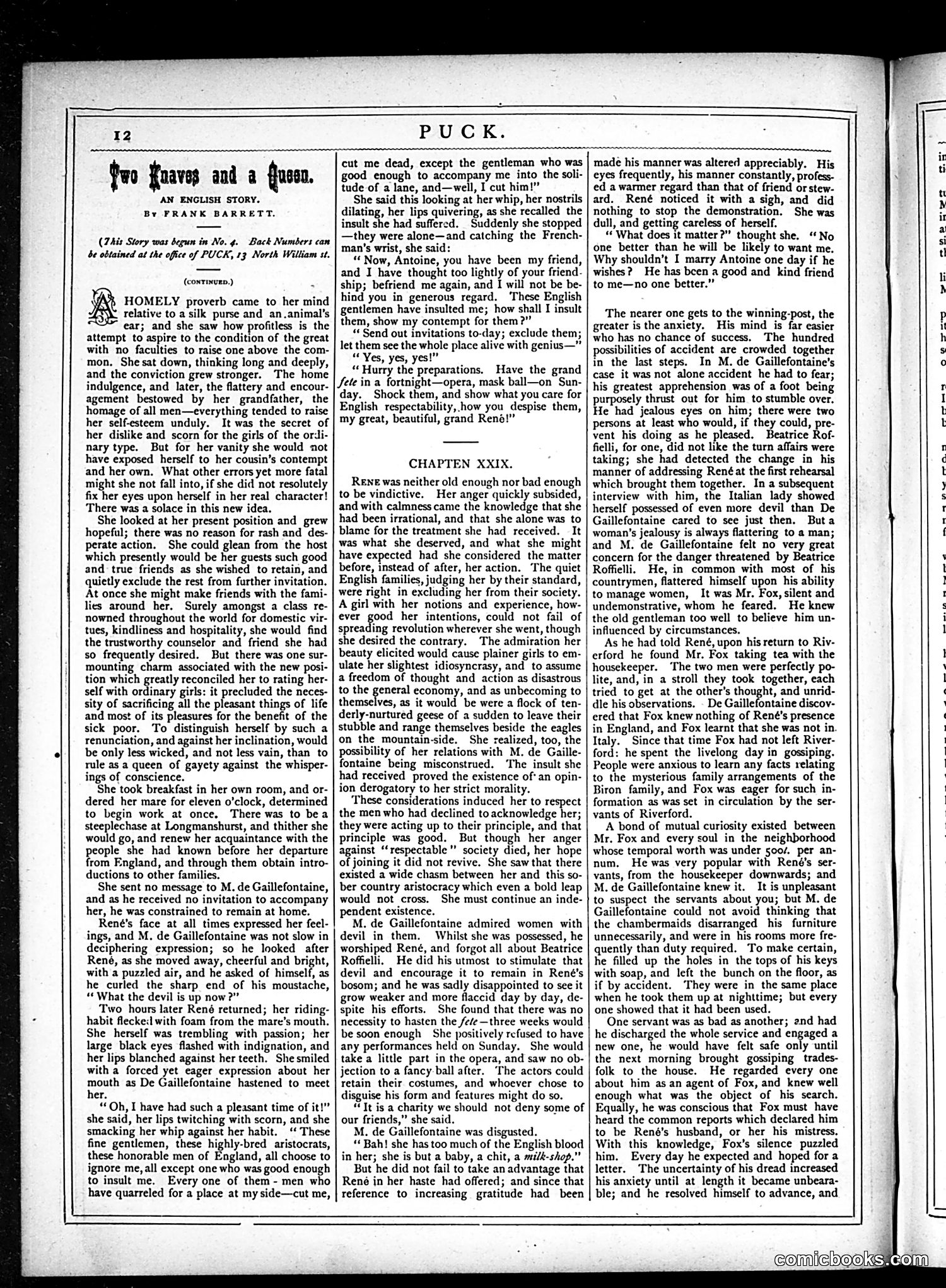
This page contains **text only** — specifically Chapter XXIX of a serialized English story titled "Two Knaves and a Queen," credited to Frank Lee Benedict. The narrative concerns aristocratic characters including Renée, M. de Gaillefontaine, and others navigating social propriety, romantic complications, and class tensions in Victorian England. There are **no cartoons or political satire** on this page. It is a work of fiction serialized in Puck magazine (which typically combined humor with literary content). The story itself contains social commentary about English aristocratic hypocrisy and women's constrained agency, but this is literary satire within the narrative rather than visual political cartooning. This appears to be a regular story installment rather than satirical commentary on contemporary events.
📄 Transcribed text from this page (OCR, searchable)
Machine-transcribed from the original scan — historical spelling and the odd misread are preserved.
12 PUCK. feo faaves and a ffuesn. AN ENGLISH STORY. By FRANK BARRETT. (This Story was begun in No. 4. Back Numbers can be obtained at the office of PUCK, 13 North William st. (continven.) HOMELY proverb came to her mind relative to a silk purse and an.animal’s ear; and she saw how profitless is the attempt to aspire to the condition of the great with no faculties to raise one above the com- mon. She sat down, thinking long and deeply, and the conviction grew stronger. The home indulgence, and later, the flattery and encour- agement bestowed by her grandfather, the homage of all men—everything tended to raise her self-esteem unduly, It was the secret of her dislike and scorn for the girls of the ordi- nary type. But for her vanity she would not have exposed herself to her cousin’s contempt and her own. What other errors yet more fatal might she not fall into, if she did not resolutely fix her eyes upon herself in her real character! There was a solace in this new idea. She looked at her present position and grew hopeful; there was no reason for rash and des- perate action. She could glean from the host which presently would be her guests such good and true friends as she wished to retain, and quietly exclude the rest from further invitation. At once she might make friends with the fami- lies around her. Surely amongst a class re- nowned throughout the world for domestic vir- tues, kindliness and hospitality, she would find the trustworthy counselor and friend she had so frequently desired. But there was one sur- mounting charm associated with the new posi- tion which greatly reconciled her to rating her- self with ordinary girls: it precluded the neces- sity of sacrificing all the pleasant things of life and most of its pleasures for the benefit of the sick poor. To distinguish herself by such a renunciation, and against her inclination, would be only less wicked, and not less vain, than to tule as a queen of gayety against the whisper- ings of conscience. She took breakfast in her own room, and or- dered her mare for eleven o’clock, determined to begin work at once, There was to bea steeplechase at Longmanshurst, and thither she would go, and renew her acquaintance with the people she had known before her departure from England, and through them obtain intro- ductions to other families. She sent no message to M. de Gaillefontaine, and as he received no invitation to accompany her, he was constrained to remain at home. René’s face at all times expressed her feel- ings, and M. de Gaillefontaine was not slow in deciphering expression; so he looked after René, as she moved away, cheerful and bright, with a puzzled air, and he asked of himself, as he curled the sharp end of his moustache, “« What the devil is up now?” Two hours later René returned; her riding- habit flecked with foam from the mare’s mouth. She herself was trembling with passion; her large black eyes flashed with indignation, and her lips blanched against her teeth. She smiled with a forced yet eager expression about her mouth as De Gaillefontaine hastened to meet her. “Oh, I have had such a pleasant time of it!” she said, her lips twitching with scorn, and she smacking her whip against her habit. |“ These fine gentlemen, these highly-bred aristocrats, these honorable men of England, all choose to ignore me, all except one who was good enough | insult me. Every one of them - men who have quarreled for a place at my side—cut me, cut me dead, except the gentleman who was good enough to accompany me into the soli- tude of a lane, and—well, I cut him!” She said this looking at her whip, her nostrils dilating, her lips quivering, as she recalled the insult she had suffered. Suddenly she stopped —they were alone—and catching the French- man's wrist, she said: “Now, Antoine, you have been my friend, and I have thought too lightly of your friend- ship; befriend me again, and I wili not be be- hind you in generous regard. ‘These English gentlemen have insulted me; how shall I insult them, show my contempt for them?” “Send out invitations to-day; exclude them; let them see the whole place alive with genius—" “Yes, yes, yes!” “ Hurry the preparations. Have the grand Sele in a fortnight—opera, mask ball—on Sun- day. Shock them, and show what you care for English respectability, how you despise them, my great, beautiful, grand Rena!” CHAPTEN XXIX. Rene was neither old enough nor bad enough to be vindictive. Her anger quickly subsided, and with calmness came the knowledge that she had been irrational, and that she alone was to blame for the treatment she had received. It was what she deserved, and what she might have expected had she considered the matter before, instead of after, her action. The quiet English families, judging her by their standard, were right in excluding her from their society. A girl with her notions and experience, how- ever good her intentions, could not fail of spreading revolution wherever she went, though she desired the contrary. The admiration her beauty elicited would cause plainer girls to em- ulate her slightest idiosyncrasy, and to assume a freedom of thought and action as disastrous to the general economy, and as unbecoming to themselves, as it would be were a flock of ten- derly-nurtured geese of a sudden to leave their stubble and range themselves beside the eagles on the mountain-side. She sealized, too, the possibility of her relations with M. de Gaille- fontaine being misconstrued. ‘The insult she had received proved the existence of: an opin- ion derogatory to her strict morality. ‘These considerations induced her to respect the men who had declined to acknowledge her; they were acting up to their principle, and that principle was good. But though her anger against ‘respectable society died, her hope of joining it did not revive. She saw that there existed a wide chasm between her and this so- ber country aristocracy which even a bold leap would not cross. She must continue an inde- pendent existence. M. de Gaillefontaine admired women with devil in them. Whilst she was possessed, he worshiped René, and forgot all about Beatrice Roffielli. He did his utmost to stimulate that devil and encourage it to remain in Ren¢’s bosom; and he was sadly disappointed to see it grow weaker and more flaccid day by day, de- spite his efforts. She found that there was no necessity to hasten the fe/e—three weeks would be soon enough She positively refused to have any performances held on Sunday. She would take a little part in the opera, and saw no ob- jection to a fancy-ball after. ‘The actors could retain their costumes, and whoever chose to disguise his form and features might do so. “Tt is a charity we should not deny some of our friends,” she said. M. de Gaillefontaine was disgusted. “Bah! she has too much of the English blood in her; she is but a baby, a chit, a mi/k-shop.” But he did not fail to take an advantage that René in her haste had offered; and since that reference to increasing gratitude had been made his manner was altered appreciably. | eyes frequently, his manner constantly, profess- ed a warmer regard than that of friend or stew- ard. René noticed it with a sigh, and did nothing to stop the demonstration. She was dull, and getting careless of herself. «What does it matter?” thought she. ‘No one better than he will be likely to want me. Why shouldn’t I marry Antoine one day if he wishes? He has been a good and kind friend to me—no one better.” The nearer one gets to the winning-post, the greater is the anxiety. His mind is far easier who no chance of success, The hundred ibilities of accident are crowded together in the last steps. In M. de Gaillefontaine's case it was not alone accident he had to fear; his greatest apprehension was of a foot being purposely thrust out for him to stumble over, He had jealous eyes on him; there were two persons at least who would, if they could, pre- vent his doing as he pleased. Beatrice Rof- fielli, for one, did not like the turn affairs were taking; she had detected the change in his manner of addressing René at the first rehearsal which brought them together. In a subsequent interview with him, the Italian lady showed herself possessed of even more devil than De Gaillefontaine cared to see just then. Buta woman’s jealousy is always flattering to a man; and M. de Gaillefontaine felt no very great concern for the danger threatened by Beatrice Roffielli. He, in common with most of his countrymen, flattered himself upon his ability to manage women, It was Mr. Fox, silent and undemonstrative, whom he feared. He knew the old gentleman too well to believe him un- influenced by circumstances. As he had told René, upon his return to Riv- erford he found Mr. Fox taking tea with the housekeeper. The two men were perfectly po- lite, and, in a stroll they took together, each tried to get at the other's thought, and unrid- dle his observations. - De Gaillefontaine discov- ered that Fox knew nothing of René’s presence in England, and Fox learnt that she was not in. Italy. Since that time Fox had not left River- ford: he spent the livelong day in gossiping. People were anxious to learn any facts relating to the mysterious family arrangements of the Biron family, and Fox was eager for such in- formation as was set in circulation by the ser- vants of Riverford. A bond of mutual curiosity existed between Mr. Fox and every soul in the neighborhood whose temporal worth was under soo/. per an- num, He was very popular with René’s ser- vants, from the housekeeper downwards; and M. de Gaillefontaine knew it. It is unpleasant to suspect the servants about you; but M. de Gaillefontaine could not avoid thinking that the chambermaids disarranged his furniture unnecessarily, and were in his rooms more fre- quently than duty required. To make certain, he filled up the holes in the tops of his keys with soap, and left the bunch on the floor, as if by accident. ‘They were in the same place when he took them up at nighttime; but every one showed that it had been used. One servant was as bad as another; 2nd had he discharged the whole service and engaged a new one, he would have felt safe only until the next morning brought gossiping trades- folk to the house. He regarded every one about him as an agent of Fox, and knew well enough what was the object of his search. Equally, he was conscious that Fox must have heard the common reports which declared him to be René’s husband, or her his mistress. With this knowledge, Fox’s silence puzzled him, Every day he expected and hoped for a letter. The uncertainty of his dread increased his anxiety until at length it became unbeara- ble; and he resolved himself to advance, and a ern em Pee ee