
Puck, 1877-10-24 · page 7 of 16
Puck — October 24, 1877 — page 7: what you’re looking at
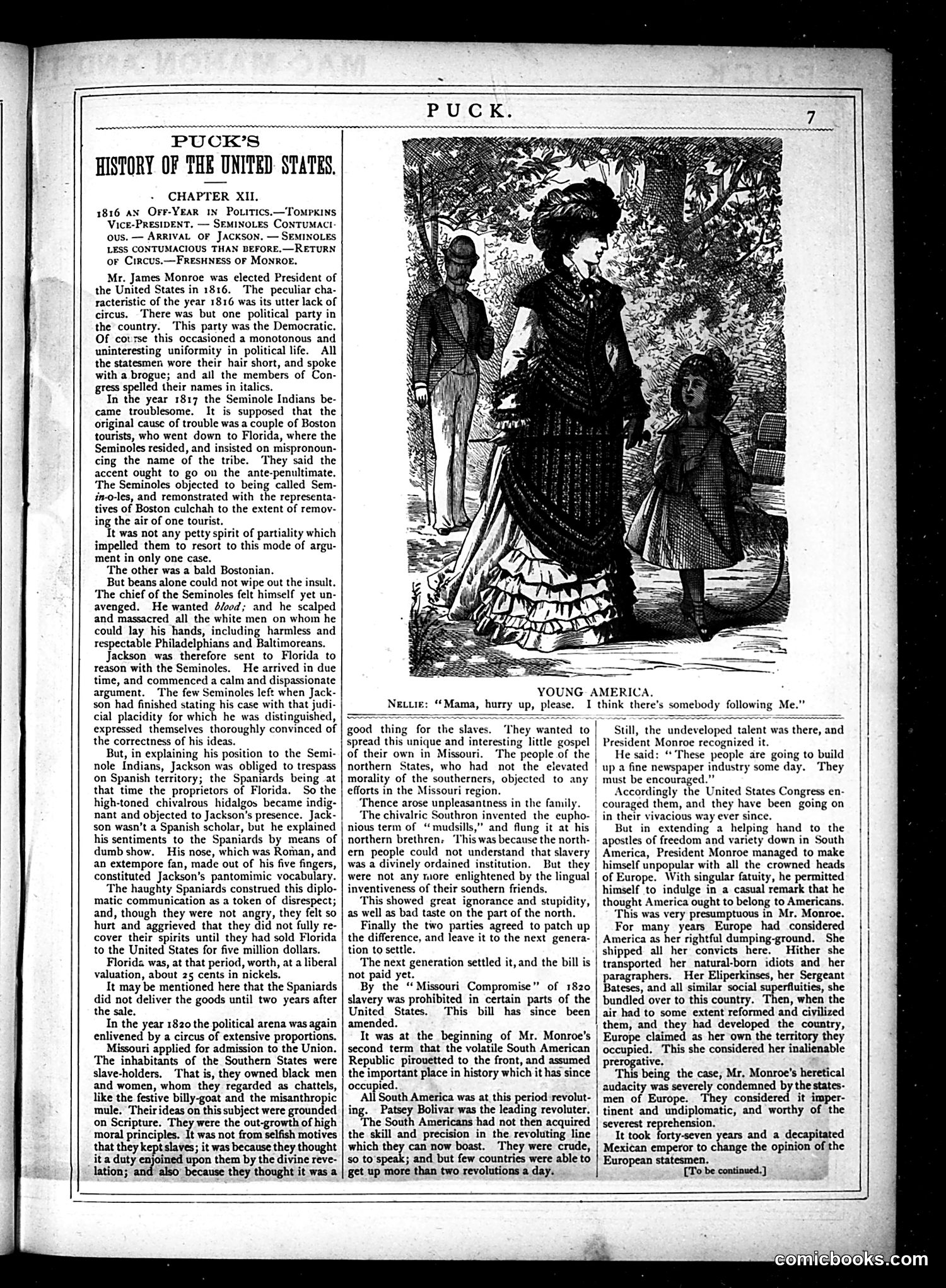
What you’re looking at
This illustration depicts a young woman labeled "Young America" being followed by a Native American man. The caption reads: "Nellie: 'Mama, hurry up, please. I think there's somebody following Me.'" The cartoon satirizes American expansionism and the treatment of Native Americans during the 1816-1820 period covered in the accompanying text. "Young America" represents the nation's youthful ideals, while the pursuing Native American figure symbolizes the displaced indigenous peoples whose lands were being taken. The satire critiques America's hypocrisy: the nation claims moral superiority and spreads "gospel" to civilize others, yet simultaneously displaces and oppresses Native Americans. The woman's fear reflects anxieties about westward expansion's consequences, suggesting discomfort with America's colonial practices even as they occurred.
📄 Transcribed text from this page (OCR, searchable)
Machine-transcribed from the original scan — historical spelling and the odd misread are preserved.
PUCK’S HISTORY OF THE UNITED STATES, CHAPTER XII. 1816 AN Orr-YEAR IN Potitics.—ToMPKins Vice-PRESIDENT. — SEMINOLES CONTUMACI- ous. — ARRIVAL OF JACKSON. — SEMINOLES LESS CONTUMACIOUS THAN BEFORE.—RETURN or Circus.—FRESHNESS OF MONROE. Mr. James Monroe was elected President of the United States in 1816. The peculiar cha- racteristic of the year 1816 was its utter lack of circus. There was but one political party in the country. This party was the Democratic. Of course this occasioned a monotonous and uninteresting uniformity in political life. All the statesmen wore their hair short, and spoke with a brogue; and all the members of Con- gress spelled their names in italics. In the year 1817 the Seminole Indians be- came troublesome. It is supposed that the original cause of trouble was a couple of Boston tourists, who went down to Florida, where the Seminoles resided, and insisted on mispronoun- cing the name of the tribe. ‘They said the accent ought to go on the ante-penultimate, ‘The Seminoles objected to being called Sem- in-o-les, and remonstrated with the representa- tives of Boston culchah to the extent of remov- ing the air of one tourist. It was not any petty spirit of partiality which impelled them to resort to this mode of argu- ment in only one case. The other was a bald Bostonian. But beans alone could not wipe out the insult. The chief of the Seminoles felt himself yet un- avenged. He wanted d/ood; and he scalped and massacred all the white men on whom he could lay his hands, including harmless and respectable Philadelphians and Baltimoreans. Jackson was therefore sent to Florida to reason with the Seminoles. He arrived in due time, and commenced a calm and dispassionate argument. The few Seminoles left when Jack- son had finished stating his case with that judi- cial placidity for which he was distinguished, expressed themselves thoroughly convinced of the correctness of his ideas. But, in explaining his position to the Semi- nole Indians, Jackson was obliged to trespass on Spanish territory; the Spaniards being at that time the proprietors of Florida. So the high-toned chivalrous hidalgos became indig- nant and objected to Jackson's presence. Jack- son wasn’t a Spanish scholar, but he explained his sentiments to the Spaniards by means of dumb show. His nose, which was Roman, and an extempore fan, made out of his five fingers, constituted Jackson's pantomimic vocabulary. ‘The haughty Spaniards construed this diplo- matic communication as a token of disrespect; and, though they were not angry, they felt so hurt and aggrieved that they did not fully re- cover their spirits until they had sold Florida | to the United States for five million dollars. Florida was, at that period, worth, at a liberal valuation, about 25 cents in nickels. It may be mentioned here that the Spaniards did not deliver the goods until two years after the sale. In the year 1820 the political arena was again enlivened by a circus of extensive proportions. Missouri applied for admission to the Union. The inhabitants of the Southern States were slave-holders. That is, they owned black men and women, whom they regarded as chattels, like the festive billy-goat and the misanthropic mule. Their ideas on this subject were grounded on Scripture. They were the out-growth of high moral principles. It was not from selfish motives that they keptslaves; it was because they thought ita duty cojeingd upon them by the divine reve- lation; and also’ because they thought it was a YOUNG AMERICA, NELLIE: “Mama, hurry up, please. 1 think there’s somebody following Me. good thing for the slaves. ‘They wanted to | spread this unique and interesting little gospel of their own in Missouri. ‘The people of the northern States, who had not the elevated morality of the southerners, objected to any efforts in the Missouri region. ‘Thence arose unpleasantness in the family. The chivalric Southron invented the eupho- nious term of “mudsills,” and flung it at his northern brethren. ern people could not understand that slavery was a divinely ordained institution. But they were not any more enlightened by the lingual inventiveness of their southern friends. This showed great ignorance and stupidity, as well as bad taste on the part of the north. Finally the two parties agreed to patch up the difference, and leave it to the next genera- tion to settle. ‘The next generation settled it, and the bill is not paid yet. By the “Missouri Compromise” of 1820 slavery was prohibited in certain parts of the United States. This bill has since been amended. It was at the beginning of Mr. Monroe's second term that the volatile South American Republic pirouetted to the front, and assumed the important place in history which it has since occupied. All South America was at this period revolut- ing. Patsey Bolivar was the leading revoluter. The South Americans had not then acquired the skill and precision in the revoluting line | which they can now boast. They were crude, so to's; ; and but few countries were able to get up more than two revolutions a day. ‘This was because the north- | Still, the undeveloped talent was there, and President Monroe recognized it. He said: “These people are going to build up a fine newspaper industry some day. ‘They must be encouraged.” Accordingly the United States Congress en- couraged them, and they have been going on in their vivacious way ever since. But in extending a helping hand to the apostles of freedom and variety down in South America, President Monroe managed to make himself unpopular with all the crowned heads of Europe. With singular fatuity, he permitted himself to indulge in a casual remark that he thought America ought to belong to Americans. ‘This was very presumptuous in Mr. Monroe. For many years Europe had considered America as her rightful dumping-ground. She shipped all her convicts here. Hither she transported her natural-born idiots and her paragraphers. Her Eliperkinses, her Sergeant Bateses, and all similar social superfluities, she bundled over to this country. Then, when the air had to some extent reformed and civilized ; them, and they had developed the country, Europe claimed as her own the territory they occupied. This she considered her inalienable prerogative, This being the case, Mr. Monroe's heretical audacity was severely condemned by the states- men of Europe. They conside: it imper- tinent and undiplomatic, and worthy of the severest reprehension. It took forty-seven ies and a decapitated Mexican emperor to change the opinion of the European statesmen. [To be continued.}