
Puck, 1877-10-24 · page 11 of 16
Puck — October 24, 1877 — page 11: what you’re looking at
What you’re looking at
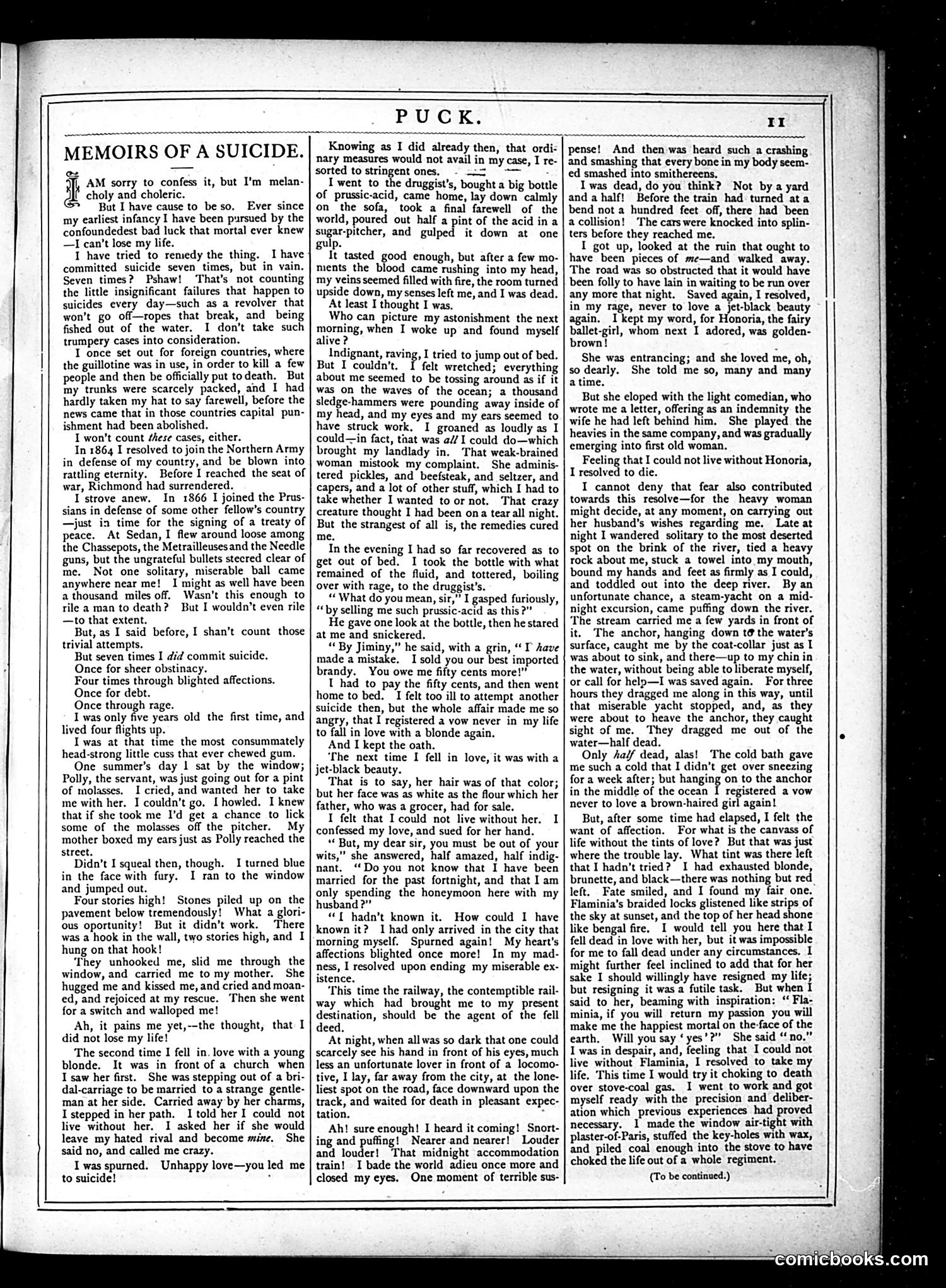
This page contains a first-person narrative titled "Memoirs of a Suicide," a satirical piece about a man recounting his repeated failed suicide attempts. The humor derives from the absurdity of each attempt—poisoning, jumping from a bed, drinking acid—all failing comically. The satire appears to mock both romantic melodrama and the desperation of unrequited love in Victorian America. The narrator's repeated suicide attempts over various romantic rejections escalate from serious to ridiculous, particularly his final attempt involving a steam-yacht during a railway excursion. The piece satirizes contemporary attitudes toward love, loss, and masculine despair while employing dark humor typical of Puck's irreverent style. The narrative voice remains deadpan throughout these increasingly absurd scenarios.
📄 Transcribed text from this page (OCR, searchable)
Machine-transcribed from the original scan — historical spelling and the odd misread are preserved.
MEMOIRS OF A SUICIDE. ee I choly and choleric. But I have cause to be so. Ever since my earliest infancy I have been pursued by the confoundedest bad luck that mortal ever knew —I can’t lose my life. I have tried to remedy the thing. I have committed suicide seven times, but in vain. Seven times? Pshaw! ‘That’s not counting the little insignificant failures that happen to suicides every day—such as a revolver that won't go off—ropes that break, and being fished out of the water. I don’t take such trumpery cases into consideration. I once set out for foreign countries, where the guillotine was in use, in order to kill a few people and then be officially put todeath. But my trunks were scarcely packed, and I had hardly taken my hat to say farewell, before the news came that in those countries capital pun- ishment had been abolished. I won't count ‘hese cases, either. In 1864 I resolved to join the Northern Army in defense of my countzy, and be blown into rattling eternity. Before I reached the seat of war, Richmond had surrendered. I strove anew. In 1866 I joined the Prus- sians in defense of some other fellow’s country —just in time for the signing of a treaty of peace. At Sedan, I flew around loose among the Chassepots, the Metrailleusesand the Needle guns, but the ungrateful bullets stecred clear of me. Not one solitary, miserable ball came anywhere near me! I might as well have been a thousand miles off. Wasn't this enough to rile a man to death? But I wouldn’t even rile —to that extent. But, as I said before, I shan’t count those trivial attempts. But seven times I did commit suicide. Once for sheer obstinacy. Four times through blighted affections. Once for debt. Once through rage. I was only five years old the first time, and lived four flights up. I was at that time the most consummately head-strong little cuss that ever chewed gum. One summer’s day | sat by the window; Polly, the servant, was just going out for a pint of molasses. I cried, and wanted her to take me with her. I couldn’t go, L howled. I knew that if she took me I’d get a chance to lick some of the molasses off the pitcher. My mother boxed my ears just as Polly reached the street. Didn’t I squeal then, though. I turned blue in the face with fury. I ran to the window and jumped out. Four stories high! ‘AM sorry to confess it, but I'm melan- Stones piled up on the pavement below tremendously! What a glori- ous oportunity! But it didn’t work. There was a hook in the wall, two stories high, and I hung on that hook! ‘They unhooked me, slid me through the window, and carried me to my mother. She hugged me and kissed me, and cried and moan- ed, and rejoiced at my rescue. Then she went for a switch and walloped me! Ah, it pains me yet,--the thought, that I did not lose my life! The second time I fell in. love with a young blonde. It was in front of a church when I saw her first. She was stepping out of a bri- dal-carriage to be married to a strange gentle- man at her side. Carried away by her charms, I stepped in her path. I told her I could not live without her. I asked her if she would leave my hated rival and become mine. She said no, and called me crazy. I was spurned. to suicide! Unhappy love—you led me | Knowing as I did already then, that ordi- nary measures would not avail in my case, I re- sorted to stringent ones, coe eae I went to the druggist’s, bought a big bottle of prussic-acid, came home, lay down calmly on the sofa, took a final farewell of the world, poured out half a pint of the acid in a sugar-pitcher, and gulped it down at one ip. It tasted good enough, but after a few mo- ments the blood came rushing into my head, my veins seemed filled with fire, the room turned upside down, my senses left me, and I was dead. At least I thought I was. Who can picture my astonishment the next morning, when I woke up and found myself alive? Indignant, raving, I tried to jump out of bed. But I couldn't. felt wretched; everything about me seemed to be tossing around as if it was on the waves of the ocean; a thousand sledge-hammers were pounding away inside of my head, and my eyes and my ears seemed to have struck work. I groaned as loudly as I could—in fact, that was a//I could do—which brought my landlady in. ‘That weak-brained woman mistook my complaint. She adminis- tered pickles, and beefsteak, and seltzer, and capers, and a lot of other stuff, which I had to take whether I wanted to or not. That crazy creature thought I had been ona tear all night. But the strangest of all is, the remedies cured me, In the evening I had so far recovered as to get out of bed. I took the bottle with what remained of the fluid, and tottered, boiling over with rage, to the druggist’s. “ What do you mean, sir,” I gasped furiously, «by selling me such prussic-acid as this?” He gave one look at the bottle, then he stared at me and snickered. “ By Jiminy,” he said, with a grin, “T° Aave made a mistake. I sold you our best imported brandy. You owe me fifty cents more!” T had to pay the fifty cents, and then went home to bed. I felt too ill to attempt another suicide then, but the whole affair made me so angry, that I registered a vow never in my life to fall in love with a blonde again. And I kept the oath. ‘The next time I fell in love, it was with a jet-black beauty. That is to say, her hair was of that color; but her face was as white as the flour which her father, who was a grocer, had for sale. I felt that I could not live without her. I confessed my love, and sued for her hand. “But, my dear sir, you must be out of your wits,” she answered, half amazed, half indig- nant. ‘Do you not know that I have been married for the past fortnight, and that I am only spending the honeymoon here with my husband ?” “T hadn’t known it. How could I have known it? 1 had only arrived in the city that morning myself. Spurned again! My heart’s affections blighted once more! In my mad- ness, I resolved upon ending my miserable ex- istence. ‘This time the railway, the contemptible rail- way which had brought me to my present destination, should be the agent of the fell deed. At night, when all was so dark that one could scarcely see his hand in front of his eyes, much less an unfortunate lover in front of a locomo- ‘ive, I lay, far away from the city, at the lone- liest spot on the road, face downward upon the track, and waited for death in pleasant expec- tation, . Ah! sure enough! I heard it coming! Snort- ing and puffing! Nearer and nearer! Louder and louder! That midnight accommodation train! I bade the world adieu once more and closed my eyes. One moment of terrible sus- pense! And then was heard such a crashing and smashing that every bone in my body seem- ed smashed into smithereens, Iwas dead, do you think? Not by a yard and a half! Before the train had turned ata bend not a hundred feet off, there had been acollision! The cars were knocked into splin- ters before they reached me. I got up, looked at the ruin that ought to have been pieces of me—and walked away. The road was so obstructed that it would have been folly to have lain in waiting to be run over any more that night. Saved again, I resolved, in my rage, never to love a jet-black beauty ain. I kept my word, for Honoria, the fairy ballet-girl, whom next I adored, was golden- brown! She was entrancing; and she loved me, oh, so dearly, She told me so, many and many atime. But she eloped with the light comedian, who wrote me a letter, offering as an indemnity the wife he had left behind him. She played the heavies in the same company, and was gradually emerging into first old woman, Feeling that I could not live without Honoria, I resolved to die. I cannot deny that fear also contributed towards this resolve—for the heavy woman might decide, at any moment, on carrying out her husband's wishes regarding me. Late at night I wandered solitary to the most deserted spot on the brink of the river, tied a heavy rock about me, stuck a towel into my mouth, bound my hands and feet as firmly as I could, and toddled out into the deep river. By an unfortunate chance, a steam-yacht on a mid- night excursion, came puffing down the river. The stream carried me a few yards in front of it. The anchor, hanging down té the water’s surface, caught me by the coat-collar just as I was about to sink, and there—up to my chin in the water, without being able to liberate myself, or call for help—I was saved again. For three hours they dragged me along in this way, until that miserable yacht stopped, and, as they were about to heave the anchor, they caught sight of me. They dragged me out of the water—half dead. Only hadf dead, alas! The cold bath gave me such a cold that I didn’t get over sneezing for a week after; but hanging on to the anchor in the middle of the ocean I registered a vow never to love a brown-haired girl again! But, after some time had elapsed, I felt the want of affection. For what is the canvass of life without the tints of love? But that was just where the trouble lay. What tint was there left that I hadn’t tried? I had exhausted blonde, brunette, and black—there was nothing but red left. Fate smiled, and I found my fair one. Flaminia’s braided locks glistened like strips of the sky at sunset, and the top of her head shone like bengal fire. I would tell you here that I fell dead in love with her, but it was impossible for me to fall dead under any circumstances. 1 might further feel inclined to add that for her sake I should willingly have resigned my life; but resigning it was a futile task. But when I said to her, beaming with inspiration: “ Fla- minia, if you will return my passion you will make me the happiest mortal on the-face of the earth. Will you say ‘yes’?” She said “no.” I was in despair, and, feeling that I could not live without Flaminia, I resolved to take my life. This time I would try it choking to death over stove-coal gas. I went to work and got myself ready with the precision and deliber- ation which previous experiences had proved necessary. 1 made the window air-tight with plaster-of-Paris, stuffed the key-holes with wax, and piled coal enough into the stove to have choked the life out of a whole regiment. (To be continued.)