
Puck, 1877-10-24 · page 4 of 16
Puck — October 24, 1877 — page 4: what you’re looking at
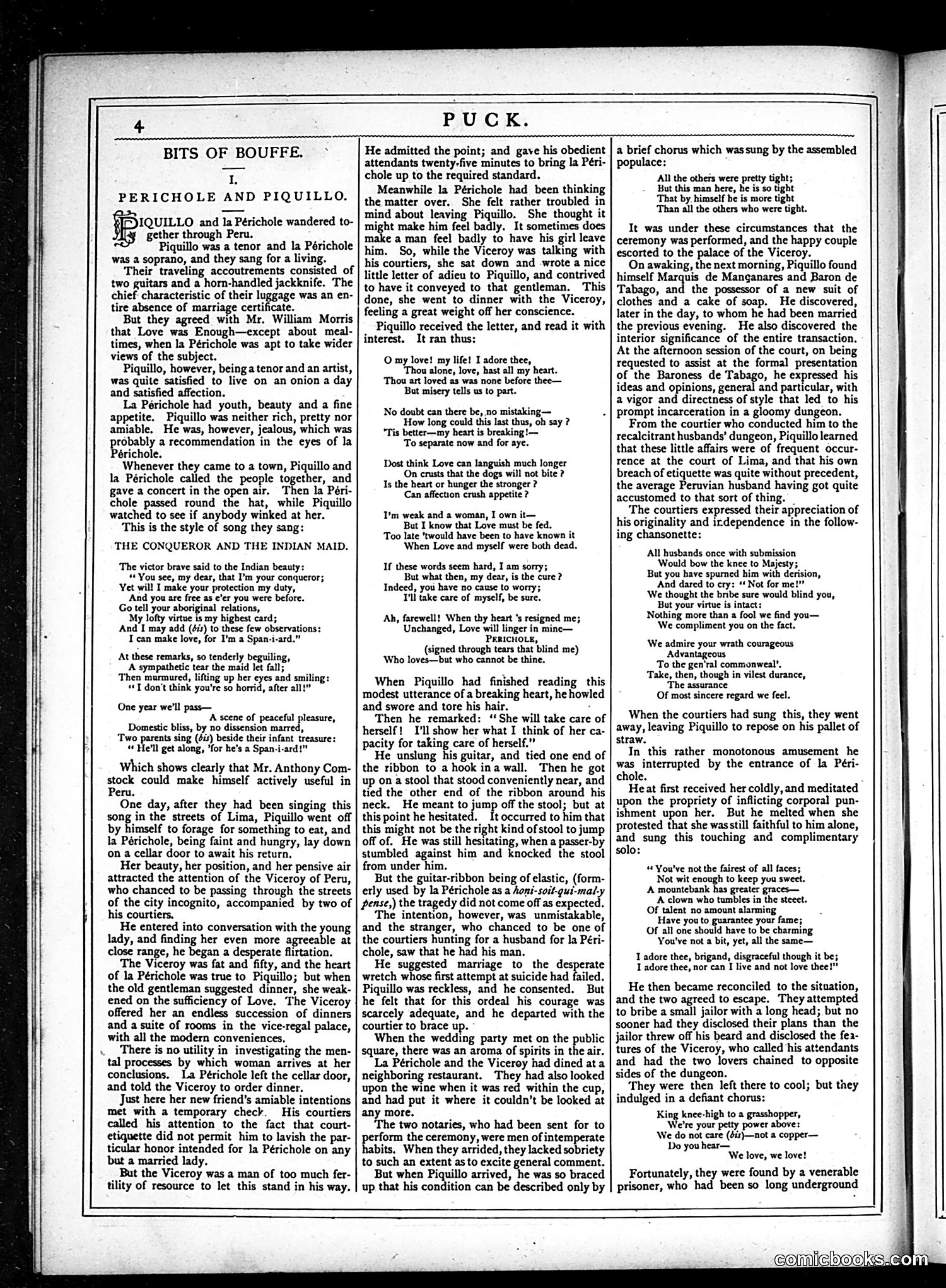
What you’re looking at
This page from *Puck* presents "Bits of Bouffe"—serialized literary content rather than political cartoons. The content includes: 1. **"Périchole and Piquillo"** — A romantic narrative about a soprano singer and tenor musician in Peru, involving jealousy, love letters, and social complications around their relationship and marriage prospects. 2. **"The Conqueror and the Indian Maid"** — A poem depicting a colonial conquest narrative with romantic elements. The page is primarily **literary/entertainment content** rather than political satire. *Puck* magazines often mixed satirical cartoons with serialized fiction, poetry, and humorous stories. These particular pieces appear to be romantic comedies exploring class differences, artistic life, and relationships—typical light entertainment for the magazine's audience rather than commentary on current events.
📄 Transcribed text from this page (OCR, searchable)
Machine-transcribed from the original scan — historical spelling and the odd misread are preserved.
PUCK. BITS OF BOUFFE. 1 PERICHOLE AND PIQUILLO. IQUILLO and la Périchole wandered to- gether through Peru. _ Piquillo was a tenor and la Périchole was a soprano, and they sang for a living. Their traveling accoutrements consisted of two guitars and a horn-handled jackknife. The chief: characteristic of their luggage was an en- tire absence of marriage certificate. But they agreed with Mr. William Morris that Love was Enough—except about meal- times, when la Périchole was apt to take wider views of the subject. Piquillo, however, being a tenor and an artist, was quite satisfied to live on an onion a day and satisfied affection. La Périchole had youth, beauty and a fine appetite. Piquillo was neither rich, pretty nor amiable. He was, however, jealous, which was robably a recommendation in the eyes of la érichole. Whenever they came to a town, Piquillo and la Périchole called the people together, and gave a concert in the open air, Then la Péri- chole passed round the hat, while Piquillo watched to see if anybody winked at her. This is the style of song they sang: THE CONQUEROR AND THE INDIAN MAID. The victor brave said to the Indian beauty: “ You see, my dear, that I’m your conqueror; Yet will I make your protection my duty, ‘And you are free as e’er you were before. Go tell your aboriginal relations, My lofty virtue is my highest card; And I may add (6/4) to these few observations: T can make love, for I'm a Span-i-ard.” At these remarks, so tenderly beguiling, ‘A sympathetic tear the maid let fall; Then murmured, lifting up her eyes and smiling: «T don't think you're so horrid, after all!” One year we'll pass— ‘A scene of peaceful pleasure, Domestic bliss, by no dissension marred, ‘Two parents sing (bis) beside their infant treasure: «He'll get along, “for he's a Span-i-ard!” Which shows clearly that Mr. Anthony Com- stock could make himself actively useful in eru. One day, after they had been singing this song in the streets of Lima, Piquillo went off by himself to forage for something to eat, and la Périchole, being faint and hungry, lay down on a cellar door to await his return. Her beauty, her position, and her pensive air attracted the attention of the Viceroy of Peru, who chanced to be passing through the streets of the city incognito, accompanied by two of his courtiers, He entered into conversation with the young lady, and finding her even more agreeable at close range, he began a desperate flirtation. The Viceroy was fat and fifty, and the heart of la Périchole was true to Piquillo; but when the old gentleman suggested dinner, she weak- ened on the sufficiency of Love. The Viceroy offered her an endless succession of dinners and a suite of rooms in the vice-regal palace, with all the modern conveniences. There is no utility in investigating the men- tal processes by which woman arrives at her conclusions. La Périchole left the cellar door, and told the Viceroy to order dinner. Just here her new friend’s amiable intentions met with a temporary check. His courtiers called his attention to the fact that court- etiquette did not permit him to lavish the par- ticular honor intended for la Périchole on any but a married lady. But the Viceroy was a man of too much fer- tility of resource to let this stand in his way. He admitted the point; and gave his obedient attendants twenty-five minutes to bring la Péri- chole up to the required standard. Meanwhile la Périchole had been thinking the matter over. She felt rather troubled in mind about leaving Piquillo. She thought it might make him feel badly. It sometimes does ¢ aman feel badly to have his girl leave him. So, while the Viceroy was talking with his courtiers, she sat down and wrote a nice little letter of adieu to Piquillo, and contrived to have it conveyed to that gentleman. This done, she went to dinner with the Viceroy, feeling a great weight off her conscience. Piquillo received the letter, and read it with interest. It ran thus: O my love! my life! I adore thee, Thou alone, love, hast all my heart. Thou art loved as was none before thee— Bat misery tells us to part. No doubt can there be, no mistaking— How long could this last thus, oh say ? “Tis better—my heart is breaking !— To separate now and for aye. Dost think Love can languish much longer On crusts that the dogs will not bite ? Is the heart or hunger the stronger ? Can affection crush appetite ? I'm weak and a woman, I own it— But I know that Love must be fed. Too late "twould have been to have known it When Love and myself were both dead. If these words seem hard, I am sorry; But what then, my dear, is the cure? Indeed, you have no cause to worry; Till take care of myself, be sure. Ah, farewell! When thy heart 's resigned me; Unchanged, Love will linger in mine— PRRICHOLE, (signed through tears that blind me) Who loves—but who cannot be thine. When Piquillo had finished reading this modest utterance of a breaking heart, he howled and swore and tore his hair. q Then he remarked: ‘She will take care of herself! I'll show her what I think of her ca- pacity for taking care of herself.” He unslung his guitar, and tied one end of the ribbon to a hook ina wall. Then he got up on a stool that stood conveniently near, and tied the other end of the ribbon around his neck. He meant to jump off the stool; but at this point he hesitated. It occurred to him that this might not be the right kind of stool to jump off of. He was still hesitating, when a passer-by stumbled against him and knocked the stool from under him. But the guitar-ribbon being of elastic, (form- erly used by la Périchole as a hont-soit-gui-mal-y pense,) the tragedy did not come off as expected. The intention, however, was unmistakable, and the stranger, who chanced to be one of the courtiers hunting for a husband for la Péri- chole, saw that he had his man. He suggested marriage to the desperate wretch whose first attempt at suicide had failed. Piquillo was reckless, and he consented. But he felt that for this ordeal his courage was scarcely adequate, and he departed with the courtier to brace up. When the wedding party met on the public square, there was an aroma of spirits in the air. La Périchole and the Viceroy had dined ata neighboring restaurant. They had also looked upon the wine when it was red within the cup, and had put it where it couldn’t be looked at any more. ‘The two notaries, who had been sent for to rform the ceremony, were men of intemperate ‘bits. When they arrided, they lacked sobriety to such an extent as to excite general comment. But when Piquillo arrived, he was so braced up that his condition can be described only by a brief chorus which wassung by the assembled populace: ‘All the others were pretty tight; But this man here, he is so tight That by himself be is more tight Than all the others who were tight. It was under these circumstances that the ceremony was performed, and the happy couple escorted to the palace of the Viceroy. On awaking, the next morning, Piquillo found himself Marc ae de Mansanares and Baron de Tabago, and the possessor of a new suit of clothes and a cake of soap. He discovered, later in the day, to whom he had been married the previous evening. He also discovered the interior significance of the entire transaction. At the afternoon session of the court, on being requested to assist at the formal presentation of the Baroness de Tabago, he expressed his ideas and opinions, general and particular, with a vigor and directness of style that led to his prompt incarceration in a gloomy dungeon. From the courtier who conducted him to the recalcitrant husbands’ dungeon, Piquillo learned that these little affairs were of frequent occur- rence at the court of Lima, and that his own breach of etiquette was quite without precedent, the average Peruvian husband having got quite accustomed to that sort of thing. _ The courtiers expressed their appreciation of his originality and independence in the follow- ing chansonette: All husbands once with submission ‘Would bow the knee to Majesty; But you have spurned him with de: ‘And dared to cry: “ Not for me!” ‘We thought the bribe sure would blind you, But your virtue is intact: Nothing more than a fool we find you— ‘We compliment you on the fact. We admire your wrath courageous Advantageous To the gen'ral commonweal’, Take, then, though in vilest durance, ‘The assurance Of most sincere regard we feel. When the courtiers had sung this, they went away, leaving Piquillo to repose on his pallet of straw. In this rather monotonous amusement he was interrupted by the entrance of la Péri- chole. . Heat first received her coldly, and meditated upon the propriety of inflicting corporal pun- ishment upon her. But he melted when she protested that she wasstill faithful to him alone, and sung this touching and complimentary solo: “ You've not the fairest of all faces; Not wit enough to keep you sweet. ‘A mountebank has greater graces— A clown who tumbles in the steeet. Of talent no amount alarming Have youto intee your fame; Of all one should have to be charming You've not a bit, yet, all the same— T adore thee, brigand, disgraceful though it be; 1 adore thee, nor can I live and not love thee!” He then became reconciled to the situation, and the two agreed to escape. They attempted to bribe a small jailor with a long head; but no sooner had they disclosed their plans than the jailor threw off his beard and disclosed the fea- tures of the Viceroy, who called his attendants and had the two lovers chained to opposite sides of the dungeon. ‘They were then left there to cool; but they indulged in a defiant chorus: King knee-high to a grasshopper, We're your petty power above: We do not care (bis)—not a copper— Do you hear— We love, we love! Fortunately, they were found by a venerable prisoner, who had been so long underground