
Puck, 1877-10-24 · page 3 of 16
Puck — October 24, 1877 — page 3: what you’re looking at
What you’re looking at
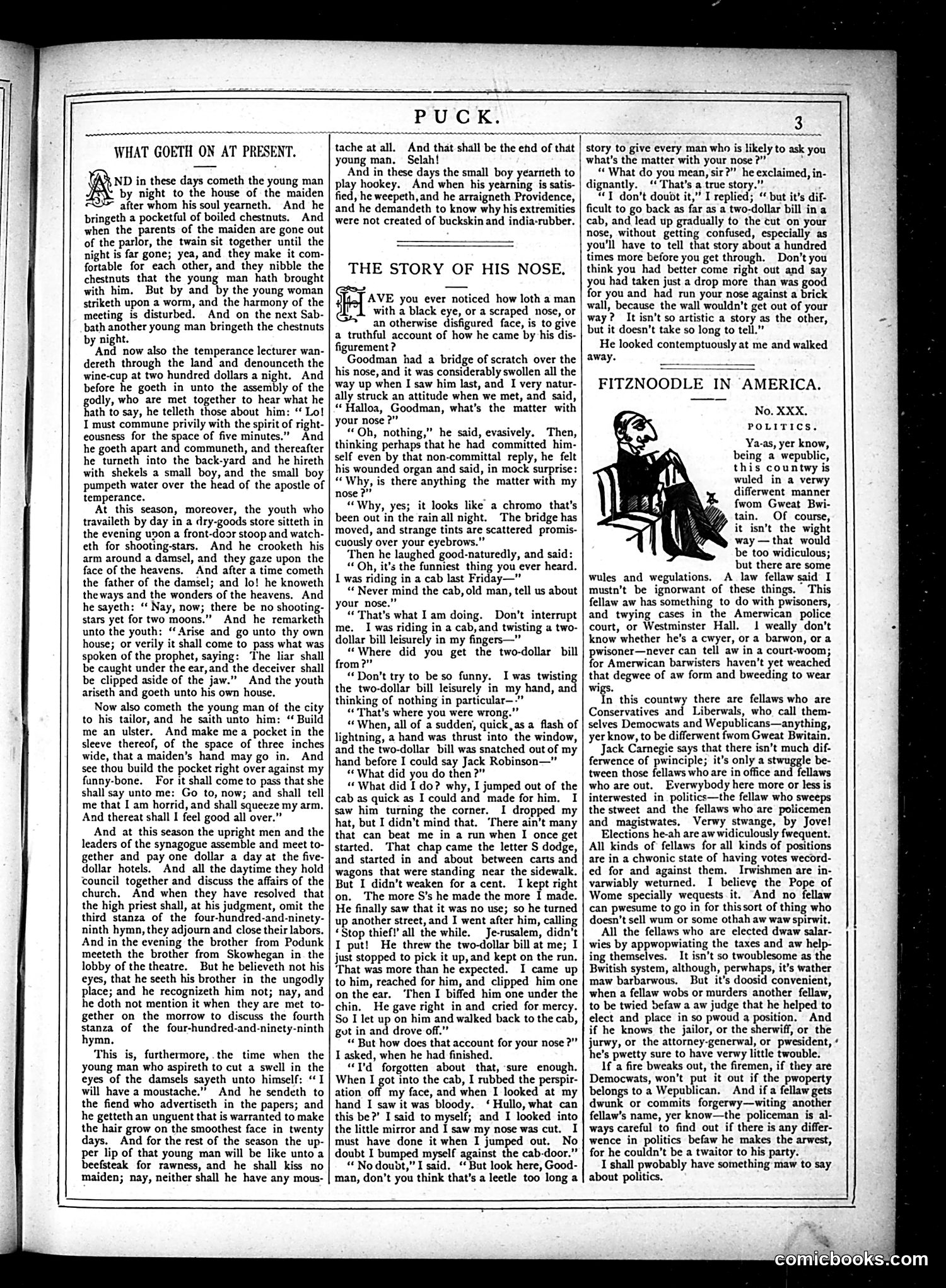
This page contains three distinct pieces of satirical content: 1. **"What Goeth On at Present"** - A commentary on young men courting women, with criticism of their behavior and temperance issues. 2. **"The Story of His Nose"** - A humorous anecdote about a man with a scarred, swollen nose who explains his disfigurement came from a cab accident involving a two-dollar bill. The story mocks both the man's vanity and apparent foolishness. 3. **"Fitznoodle in America"** - A political satire appearing to critique American republicanism and political systems. The text references "Great Britain," suggesting comparison between British and American governance, though the specific targets remain unclear from this excerpt alone. The magazine employs characteristic Puck-style humor: social satire, absurdist scenarios, and political commentary targeting contemporary American institutions and behaviors.
📄 Transcribed text from this page (OCR, searchable)
Machine-transcribed from the original scan — historical spelling and the odd misread are preserved.
WHAT GOETH ON AT PRESENT. ND in these days cometh the young man by night to the house of the maiden after whom his soul yearneth. And he bringeth a pocketful of boiled chestnuts. And when the parents of the maiden are gone out of the parlor, the twain sit together until the night is far gone; yea, and they make it com- fortable for each other, and they nibble the chestnuts that the young man hath brought with him. But by and by the young woman striketh upon a worm, and the harmony of the meeting is disturbed. And on the next Sab- bath another young man bringeth the chestnuts by night. And now also the temperance lecturer wan- dereth through the land and denounceth the wine-cup at two hundred dollars a night. And before he goeth in unto the assembly of the odly, who are met together to hear what he Fath to say, he telleth those about him: “ Lo! I must commune privily with the spirit of right- eousness for the space of five minutes.” And he goeth apart and communeth, and thereafter he turneth into the back-yard and he hireth with shekels a small boy, and the small boy pumpeth water over the head of the apostle of temperance. At this season, moreover, the youth who travaileth by day in a dry-goods store sitteth in the evening upon a front-door stoop and watch- eth for shooting-stars, And he crooketh his arm around a damsel, and they gaze upon the face of the heavens. And after a time cometh the father of the damsel; and lo! he knoweth the ways and the wonders of the heavens. And he sayeth: ‘‘ Nay, now; there be no shooting- stars yet for two moons.” And he remarketh unto the youth: ‘Arise and go unto thy own house; or verily it shall come to pass what was spoken of the prophet, saying: ‘The liar shall be caught under the ear,and the deceiver shall be clipped aside of the jaw.” And the youth ariseth and goeth unto his own house, Now also cometh the young man of the city to his tailor, and he saith unto him: “ Build me an ulster. And make me a pocket in the sleeve thereof, of the space of three inches wide, that a maiden’s hand may go in. And see thou build the pocket right over against my funny-bone. For it shall come to pass that she shall say unto me: Go to, now; and shall tell me that I am horrid, and shall squeeze my arm. And thereat shall I feel good all over.” And at this season the upright men and the leaders of the synagogue assemble and meet to- gether and pay one dollar a day at the five- dollar hotels. And all the daytime they hold council together and discuss the affairs of the church, And when they have resolved that the high priest shall, at his judgment, omit the third stanza of the four-hundred-and-ninety- ninth hymn, they adjourn and close their labors. And in the evening the brother from Podunk meeteth the brother from Skowhegan in the lobby of the theatre. But he believeth not his eyes, that he seeth his brother in the ungodly place; and he recognizeth him not; nay, and he doth not mention it when they are met to- gether on the morrow to discuss the fourth stanza of the four-hundred-and-ninety-ninth hymn, This is, furthermore,.the time when the young man who aspireth to cut a swell in the eyes of the damsels sayeth unto himself: ‘I will have a moustache.” And he sendeth to the fiend who advertiscth in the papers; and he getteth an unguent that is warranted to make the hair grow on the smoothest face in twenty days. And for the rest of the season the up- per lip of that young man will be like unto a beefsteak for rawness, and he shall kiss no maiden; nay, neither shall he have any mous- 3 tache at all. And that shall be the ehd of that young man. Selah! And in these days the small boy yearneth to play hookey. And when his yearning is satis- fied, he weepeth, and he arraigneth Providence, and he demandeth to know why his extremities were not created of buckskin and india-rubber. THE STORY OF HIS NOSE. .VE you ever noticed how loth a man with a black eye, or a scraped nose, or an otherwise disfigured face, is to give a truthful account of how he came by his dis- figurement ? Goodman had a bridge of scratch over the his nose, and it was considerably swollen all the way up when I saw him last, and I very natur- ally struck an attitude when we met, and said, “Halloa, Goodman, what’s the matter with your nose ?”” “Oh, nothing,” he said, evasively, Then, thinking perhaps that he had committed him- self even by that non-committal reply, he felt his wounded organ and said, in mock surprise: “Why, is there anything the matter with my nose ?”” “Why, yes; it looks like a chromo that's been out in the rain all night. The bridge has moved, and strange tints are scattered promis- cuously over your eyebrows.” Then he laughed good-naturedly, and said: “Oh, it’s the funniest thing you ever heard. I was riding in a cab last Friday—” “Never mind the cab, old man, tell us about your nose.” “That's what I am doing. Don’t interrupt me. I was riding in a cab, and twisting a two- dollar bill leisurely in my fingers—" “Where did you get the two-dollar_ bill from?” “Don't try to be so funny, I was twistin; the two-dollar bill leisurely in my hand, anc thinking of nothing in particular—-” “That's where you were wron, “When, all of a sudden, quick,as a flash of lightning, a hand was thrust into the window, and the two-dollar bill was snatched out of my hand before I could say Jack Robinson—"” “What did you do then?” “What did I do? why, I jumped out of the cab as quick as I could and made for him. I saw him turning the corner. I dropped my hat, but I didn’t mind that. ‘There ain’t many that can beat me in a run when I once get started. That chap came the letter S dodge, and started in and about between carts and wagons that were standing near the sidewalk. But I didn’t weaken for acent. I kept right on, The more S’s he made the more I made. He finally saw that it was no use; so he turned up another street, and I went after him, calling ‘Stop thief!’ all the while. _Je-rusalem, didn’t I put! He threw the two-dollar bill at me; I just stopped to pick it up, and kept on the run. ‘That was more than he expected. I came up to him, reached for him, and clipped him one on the ear. ‘Then I biffed him one under the chin, He gave right in and cried for mercy. So I let up on him and walked back to the cab, got in and drove off.” * But how does that account for your nose?” I asked, when he had finished. “I'd forgotten about that, ‘sure enough. When I got into the cab, I rubbed the perspir- ation off my face, and when I looked at my hand I saw it was bloody. ‘ Hullo, what can this be?’ I said to myself; and I looked into the little mirror and I saw my nose was cut. I must have done it when I jumped out. No doubt I bumped myself against the cab-door.”” “No doubt,” I said. ‘But look here, Good- man, don’t you think that’s a leetle too long a story to give every man who is likely to ask you what’s the matter with your nose ?” ; “What do you mean, sir?” he exclaimed, in- dignantly. ‘‘ That’s a true story.’” “T don’t doubt it,” I replied; ‘ but it’s dif- ficult to go back as far as a two-dollar bill in a cab, and lead up gradually to the cut on your nose, without getting confused, especially as you'll have to tell that story about a hundred times more before you get through. Don’t you think you had better come right out and say you had taken just a drop more than was good for you and had run your nose against a brick wall, because the wall wouldn't get out of your way? It isn’t so artistic a story as the other, but it doesn’t take so long to tell.” He looked contemptuously at me and walked away. FITZNOODLE IN AMERICA. No. XXX. POLITICS. Ya-as, yer know, being a wepublic, this countwy is wuled in a verwy differwent manner fwom Gweat Bwi- tain. Of course, it isn’t the wight way — that would be too widiculous; but there are some wules and wegulations. A law fellaw said I mustn’t be ignorwant of these things. This fellaw aw has something to do with pwisoners, and twying cases in the Amerwican police court, or Westminster Hall. 1 weally don’t know whether he’s a cwyer, or a barwon, ora pwisoner—never can tell aw in a court-woom; for Amerwican barwisters haven't yet weached that degwee of aw form and bweeding to wear wigs. fn this countwy there are fellaws who are Conservatives and Liberwals, who call them- selves Democwats and Wepublicans—anything, yer know, to be differwent fwom Gweat Bwitain. Jack Carnegie says that there isn’t much dif- ferwence of pwinciple; it’s only a stwuggle be- tween those fellaws who are in office and fellaws who are out. Everwybody here more or less is interwested in politics—the fellaw who sweeps the stweet and the fellaws who are policemen and magistwates. Verwy stwange, by Jove! Elections he-ah are aw widiculously fwequent. All kinds of fellaws for all kinds of positions are in a chwonic state of having votes wecord- ed for and against them. Irwishmen are in- varwiably weturned. I believe the Pope of Wome specially wequests it. And no fellaw can pwesume to go in for thissort of thing who doesn’t sell wum or some othah aw waw spirwit. All the fellaws who are elected dwaw salar- wies by appwopwiating the taxes and aw help- ing themselves. It isn’t so twoublesome as the Bwitish system, although, perwhaps, it’s wather maw barbarwous. But it’s doosid convenient, when a fellaw wobs or murders another fellaw, to be twied defaw a aw judge that he helped to elect and place in so pwoud a position. And if he knows the jailor, or the sherwiff, or the jurwy, or the attorney-generwal, or pwesident, he’s pwetty sure to have verwy little twouble. If a fire bweaks out, the firemen, if they are Demoewats, won’t put it out if the pwoperty belongs to a Wepublican. And if a fellaw gets dwunk or commits forgerwy—witing another fellaw’s name, yer know—the policeman is al- ways careful to find out if there is any differ- wence in politics befaw he makes the arwest, for he couldn't be a twaitor to his party. I shall pwobably have something maw to say about politics.