
Puck, 1877-10-24 · page 5 of 16
Puck — October 24, 1877 — page 5: what you’re looking at
What you’re looking at
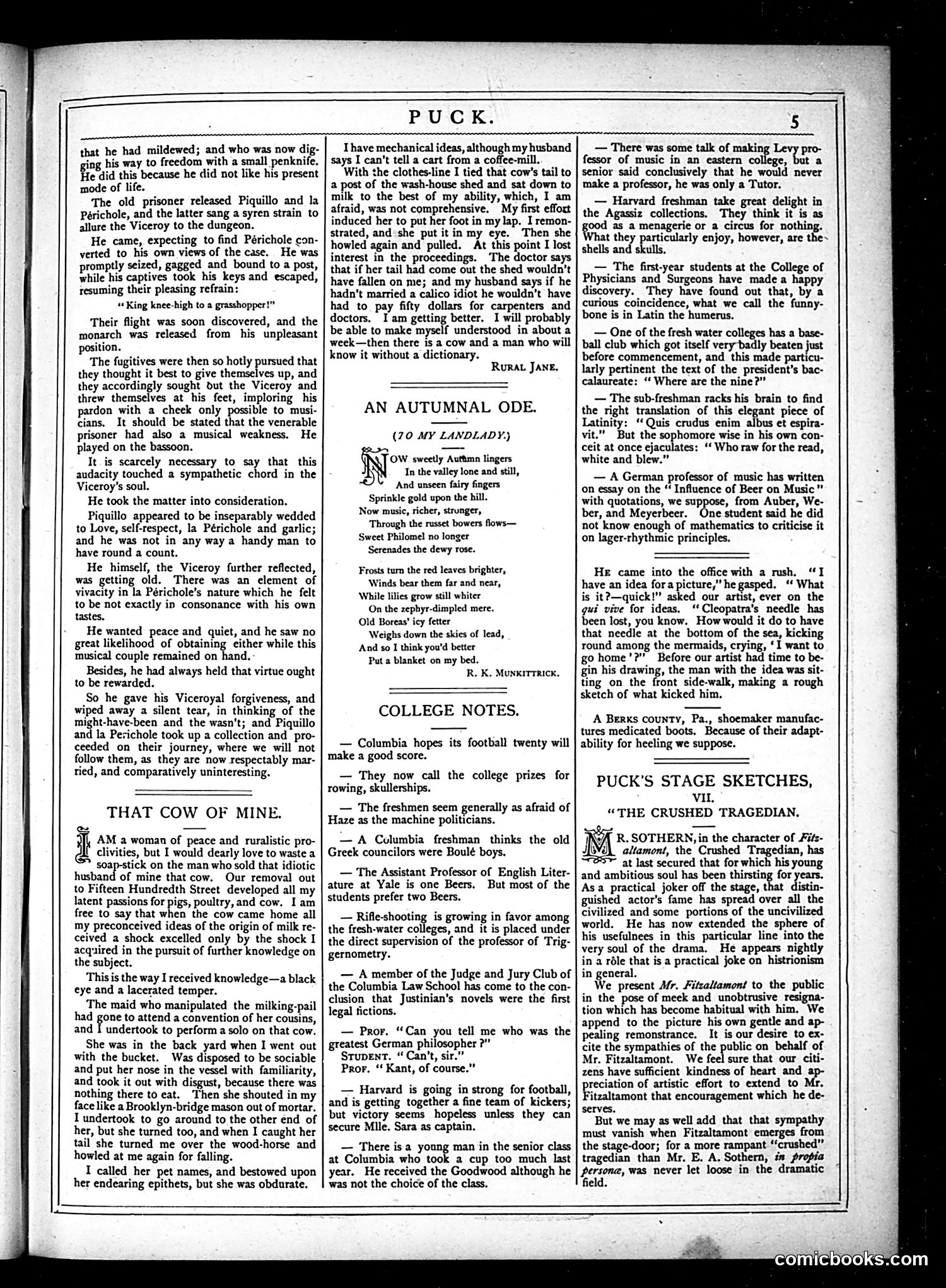
This page contains three distinct pieces of literary/humorous content rather than political cartoons: 1. **"That Cow of Mine"** - A satirical story about a woman whose cow causes domestic chaos and social embarrassment. The humor derives from the cow's uncontrollable behavior disrupting polite society. 2. **"An Autumnal Ode (To My Landlady)"** - A poem by R.K. Munkittrick celebrating autumn while subtly mocking the speaker's landlady. 3. **"College Notes" and "Puck's Stage Sketches"** - Brief humorous observations about college life and theater, including commentary on German philosophy and a theatrical review of "The Crushed Tragedian." The page emphasizes **domestic comedy and social satire** rather than political commentary—typical of Puck's lighter editorial content alongside its more pointed political cartoons.
📄 Transcribed text from this page (OCR, searchable)
Machine-transcribed from the original scan — historical spelling and the odd misread are preserved.
PUCK. 5 that he had mildewed; and who was now dig- ging his way to freedom with a small penknife. He did this because he did not like his present mode of life. The old prisoner released Piquillo and la Périchole, and the latter sang a syren strain to allure the Viceroy to the dungeon. He came, expecting to find Périchole con- verted to his own views of the case. He was promptly seized, gagged and bound to a post, while his captives took his keys and escaped, resuming their pleasing refrain: «King knee-high to a grasshopper Their flight was soon discovered, and the monarch was released from his unpleasant position. The fugitives were then so hotly pursued that they thought it best to give themselves up, and they accordingly sought bdut the Viceroy and threw themselves at his feet, imploring his pardon with a cheek only possible to musi- cians, It should be stated that the venerable prisoner had also a musical weakness. He played on the bassoon. It. is scarcely necessary to say that this audacity touched a sympathetic chord in the Viceroy's soul. He took the matter into consideration. Piquillo appeared to be inseparably wedded to Love, self-respect, la Périchole and garlic; and he was not in any way a handy man to have round a count. He himself, the Viceroy further reflected, was getting old. There was an element of vivacity in la Périchole’s nature which he felt to be not exactly in consonance with his own tastes. He wanted peace and quiet, and he saw no great likelihood of obtaining either while this musical couple remained on hand. Besides, he had always held that virtue ought to be rewarded. So he gave his Viceroyal forgiveness, and wiped away a silent tear, in thinking of the might-have-been and the wasn’t; and Piquillo and la Pezichole took up a collection and_pro- ceeded on their journey, where we will not follow them, as they are now respectably mar- tied, and comparatively uninteresting. THAT COW OF MINE. i AM a woman of peace and ruralistic pro- clivities, but I would dearly love to waste a soap-stick on the man who sold that idiotic husband of mine that cow. Our removal out to Fifteen Hundredth Street developed all my latent passions for pigs, poultry, and cow. I am free to say that when the cow came home all my preconceived ideas of the origin of milk re- ceived a shock excelled only by the shock I acquired in the pursuit of further knowledge on the subject. This is the way I received knowledge—a black eye and a lacerated temper. The maid who manipulated the milking-pail had gone to attend a convention of her cousins, and I undertook to perform a solo on that cow. She was in the back yard when I went out with the bucket. Was disposed to be sociable and put her nose in the vessel with familiarity, and took it out with disgust, because there was nothing there to eat. Then she shouted in my face like a Brooklyn-bridge mason out of mortar. I undertook to go around to the other end of her, but she turned too, and when I caught her tail she turned me over the wood-horse and howled at me again for falling. I called her pet names, and bestowed upon her endearing epithets, but she was obdurate. Ihave mechanical ideas, although my husband says I can't tell a cart from a coffee-mill. With the clothes-line I tied that cow’s tail to a post of the wash-house shed and sat down to milk to the best of my ability, which, I am afraid, was not comprehensive. My first effort induced her to put her foot in my lap. I remon- strated, and’she put it in my eye. Then she howled again and pulled. At this point I lost interest in the proceedings. ‘The doctor says that if her tail had come out the shed wouldn't have fallen on me; and my husband says if he hadn't married a calico idiot he wouldn't have had to pay fifty dollars for carpenters and doctors. Iam getting better. I will probably be able to make myself understood in about a week—then there is a cow and a man who will know it without a dictionary. Rurat JANE. AN AUTUMNAL ODE. (70 MY LANDLADY.} ‘OW sweetly Auttmn lingers In the valley lone and still, And unseen fairy fingers Sprinkle gold upon the hill. Now music, richer, stronger, ‘Through the russet bowers flows— ‘Sweet Philomel no longer Serenades the dewy rose. Frosts turn the red leaves brighter, ‘Winds bear them far and near, While lilies grow still whiter On the zephyr-dimpled mere. Old Boreas’ icy fetter Weighs down the skies of lead, And so I think you'd better Pat a blanket on my bed. R. K. MUNKITTRICK. COLLEGE NOTES. — Columbia hopes its football twenty will make a good score. — They now call the college prizes for rowing, skullerships. — The freshmen seem generally as afraid of Haze as the machine politicians. — A Columbia freshman thinks the old Greek councilors were Boulé boys. — The Assistant Professor of English Liter- ature at Yale is one Beers. But most of the students prefer two Beers. — Rifle-shooting is growing in favor among the fresh-water colleges, and it is placed under the direct supervision of the professor of Trig- gernometry. — A member of the Judge and Jury Club of the Columbia Law School has come to the con- clusion that Justinian’s novels were the first legal fictions. — Pror. “Can you tell me who was the greatest German philosopher ?” Srupent. “Can't, sir.” Pror. “ Kant, of course.” — Harvard is going in strong for football, and is getting together a fine team of kickers; but victory seems hopeless unless they can secure Mlle, Sara as captain. — There is a young man in the senior class at Columbia who took a cup too much last year. He received the Goodwood although he was not the choice of the class, — There was some talk of maki: pro- fessor of music in an eastern college, but a senior said conclusively that he would never make a professor, he was only a Tutor. — Harvard freshman take great delight in the Agassiz collections. They think it is as ood be? a menagerie or a circus for nothing. t they icularly enjoy, however, are the~ shells and skulls : 5 — The first-year students at the College of Physicians and Surgeons have made a happy discovery. They have found out that, by a curious coincidence, what we call the funny- bone is in Latin the humerus. — One of the fresh water colleges has a base- ball club which got itself very badly beaten just before commencement, and this made particu- larly pertinent the text of the president’s bac- calaureate: “ Where are the nine?” — The sub-freshman racks his brain to find the right translation of this elegant piece of Latinity: ‘“ Quis crudus enim albus et espira- vit.” But the sophomore wise in his own con- ceit at once ejaculates: ‘‘ Who raw for the read, white and blew.” — A German professor of music has written on essay on the “ Influence of Beer on Music” with quotations, we sup , from Auber, We- ber, and Meyerbeer. One student said he did not know enough of mathematics to criticise it on lager-rhythmic principles. HE came into the office with a rush, “I have an idea fora picture,” he gasped. ‘‘ What is it?—quick!" asked our artist, ever on the gui vive for ideas. ‘Cleopatra’s needle has been lost, you know. How would it do to have that needle at the bottom of the sea, kicking round among the mermaids, crying, ‘I want to go home’? Before our artist had time to be- gin his drawing, the man with the idea was sit- ting on the front side-walk, making a rough sketch of what kicked him. A Berks county, Pa., shoemaker manufac- tures medicated boots. Because of their adapt- ability for heeling we suppose. PUCK’S STAGE SKETCHES, VIL. “THE CRUSHED TRAGEDIAN. TRY R.SOTHERN, in the character of Fits- J altamont, the Crushed Tragedian, has at last secured that for which his young and ambitious soul has been thirsting for S hevaa? Asa practical joker off the stage, tl istin- guished actor’s fame has spread over all the civilized and some portions of the uncivilized world. He has now extended the sphere of his usefulnees in this particular line into the very soul of the drama. He appears nightly in a réle that is a practical joke on histrionism in general. We present Mr. Fitzaltamont to the public in the pose of meek and unobtrusive resigna- tion which has become habitual with him. We append to the picture his own gentle and ap- pealing remonstrance. It is our desire to ex- cite the sympathies of the public on behalf of Mr. Fitzaltamont. We feel sure that our citi- zens have sufficient kindness of heart and reciation of artistic effort to extend to Mr. ‘itzaltamont that encouragement which he de- serves. But we may as well add that that sympathy must vanish when Fitzaltamont emerges from the stage-door; for a more rampant ‘‘crushed”” tragedian than Mr. E. A. Sothern, in propia persona, was never let loose in the dramatic field.