
Puck, 1877-10-24 · page 13 of 16
Puck — October 24, 1877 — page 13: what you’re looking at
What you’re looking at
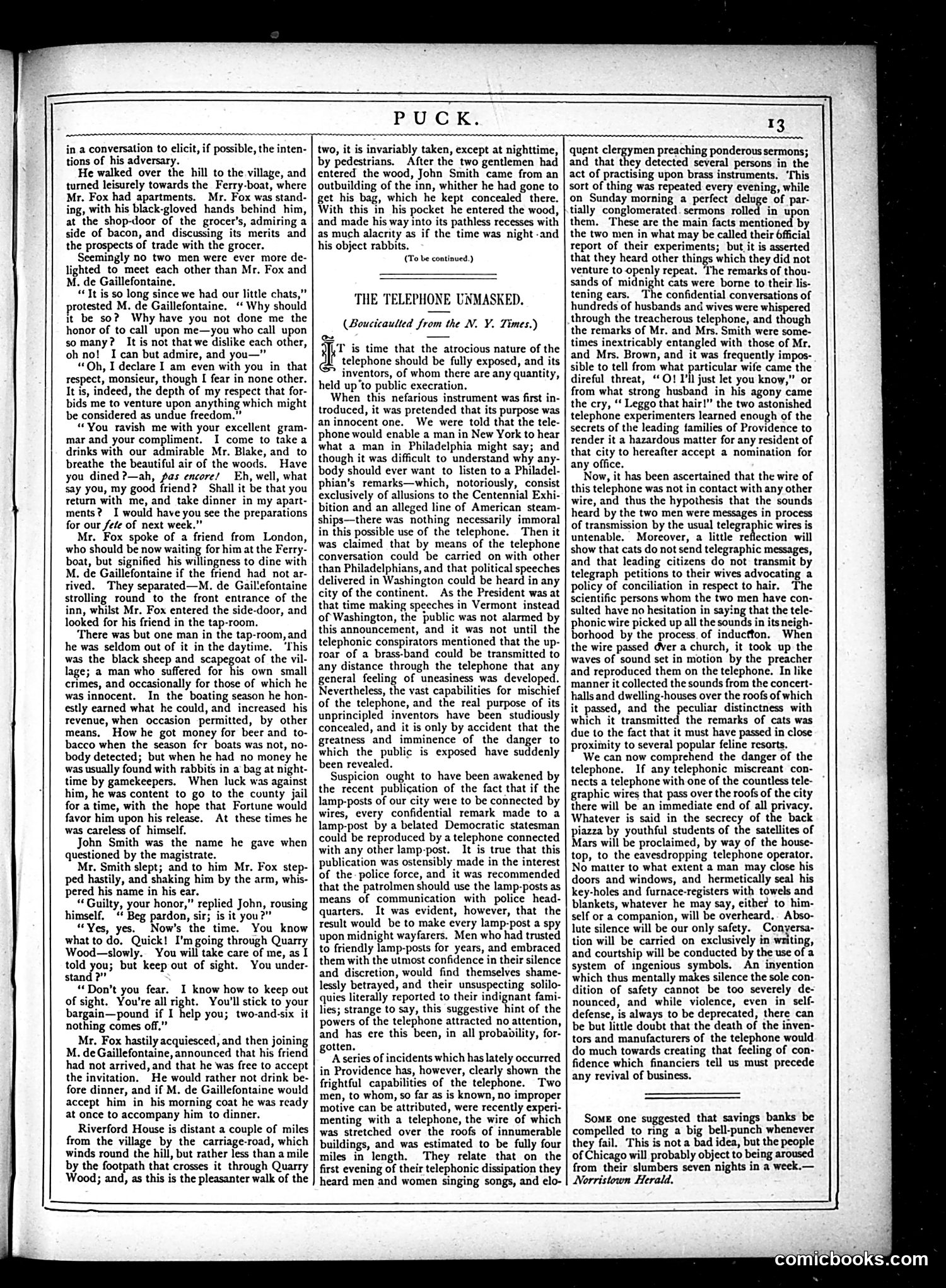
This satirical article attacks the telephone as an invasion of privacy and a tool for eavesdropping. The piece argues that despite claims of its innocent purpose, the telephone enables confidential conversations to be intercepted and transmitted without consent—a serious concern for wealthy Providence families and political figures. The satire targets the telephone's potential for abuse: private remarks to Democrats allegedly reaching Republicans; confidential business discussions compromised; and intimate family secrets exposed. The author sardonically notes that while telephone manufacturers promote safety and progress, they ignore the real danger: unchecked surveillance and loss of privacy. The piece reflects late-19th-century anxieties about new technology enabling social control and information gathering by those with access to telephone infrastructure.
📄 Transcribed text from this page (OCR, searchable)
Machine-transcribed from the original scan — historical spelling and the odd misread are preserved.
PUCK. 13 in a conversation to elicit, if possible, the inten- tions of his adversary. He walked over the hill to the village, and turned leisurely towards the Ferry-boat, where Mr. Fox had apartments. Mr. Fox was stand- ing, with his black-gloved hands behind him, at the shop-door of the grocer’s, admiring a side of bacon, and discussing its merits and the prospects of trade with the grocer. Seemingly no two men were ever more de- lighted to mect each other than Mr. Fox and M. de Gaillefontaine. “Tt is so long since we had our little chats,” protested M. de Gaillefontaine. ‘‘ Why should it be so? Why have you not done me the honor of to call upon me—you who call upon so many? It is not that we dislike each other, oh no! I can but admire, and you—” “Oh, I declare I am even with you in that respect, monsicur, though I fear in none other. It is, indeed, the depth of my respect that for- bids me to venture upon anything which might be considered as undue freedom.” “You ravish me with your excellent gram- mar and your compliment. I come to take a drinks with our admirable Mr. Blake, and to breathe the beautiful air of the woods. Have you dined ?—ah, pas encore! Eh, well, what say you, my good friend? Shall it be that you return with me, and take dinner in my apart- ments? I would have you see the preparations for our fete of next week.” Mr. Fox spoke of a friend from London, who should be now waiting for him at the Ferry: boat, but signified his willingness to dine with M. de Gaillefontaine if the friend had not ar- rived. They separated—M. de Gail‘efontaine strolling round to the front entrance of the inn, whilst Mr. Fox entered the side-door, and looked for his friend in the tap-room. ‘There was but one man in the tap-room, and he was seldom out of it in the daytime. ‘This was the black sheep and scapegoat of the vil- lage; a man who suffered for his own small crimes, and occasionally for those of which he was innocent. In the boating season he hon- estly earned what he could, and increased his revenue, when occasion permitted, by other means, How he got money for beer and to- bacco when the season fer boats was not, no- body detected; but when he had no money he was usually found with rabbits in a’ bag at night- time by gamekeepers. When luck was against him, he was content to go to the county jail for a time, with the hope that Fortune would favor him upon his release. At these times he was careless of himself. John Smith was the name he gave when questioned by the magistrate. Mr. Smith slept; and to him Mr. Fox step- ped hastily, and shaking him by the arm, whis- pered his name in his ear. “Guilty, your honor,” replied John, rousing himself.“ Beg pardon, sir; is it you?” “Yes, yes. Now’s the time. You know what to do. Quick! I'm going through Quarry Wood—slowly. You will take care of me, as I told you; but keep out of sight. You under- stand ?”” “Don’t you fear. I know how to keep out of sight. You're all right. You'll stick to your bargain—pound if I help you; two-and-six it nothing comes off.” Mr. Fox hastily acquiesced, and then joining M. deGaillefontaine, announced that his friend had not arrived, and that he was free to accept the invitation. He would rather not drink be- fore dinner, and if M. de Gaillefontaine would accept him in his morning coat he was ready at once to accompany him to dinner. Riverford House is distant a couple of miles from the village by the carriage-road, which winds round the hill, but rather less than a mile by the footpath that crosses it through Quarry Wood; and, as this is the pleasanter walk of the two, it is invariably taken, except at nighttime, by pedestrians. After the two gentlemen had entered the wood, John Smith came from an outbuilding of the inn, whither he had gone to get his bag, which he kept concealed there. With this in his pocket he entered the wood, and made his way into its pathless recesses with as much alacrity as if the time was night -and his object rabbits. (To be continued.) THE TELEPHONE UNMASKED. (Boucicaulted from the N. Y. Times.) ee it is time that the atrocious nature of the telephone should be fully exposed, and its inventors, of whom there are any quantity, held up‘to public execratiun. When this nefarious instrument was first in- troduced, it was pretended that its purpose was an innocent one. We were told that the tele- phone would enable a man in New York to hear what a man in Philadelphia might say; and though it was difficult to understand why any- body should ever want to listen to a Philadel- phian’s remarks—which, notoriously, consist exclusively of allusions to the Centennial Exhi- bition and an alleged line of American steam- ships—there was nothing necessarily immoral in this possible use of the telephone. Then it was claimed that by means of the telephone conversation could be carried on with other than Philadelphians, and that political speeches delivered in Washington could be heard in any city of the continent. As the President was at that time making speeches in Vermont instead of Washington, the public was not alarmed by this announcement, and it was not until the telephonic conspirators mentioned that the up- roar of a brass-band could be transmitted to any distance through the telephone that any general feeling of uneasiness was developed. Nevertheless, the vast capabilities for mischief of the telephone, and the real purpose of its unprincipled inventors have been studiously concealed, and it is only by accident that the greatness and imminence of the danger to which the public is exposed have suddenly been revealed. Suspicion ought to have been awakened by the recent publication of the fact that if the lamp-posts of our city we1e to be connected by wires, every confidential remark made to a lamp-post by a belated Democratic statesman could be reproduced by a telephone connected with any other lamp-post. It is true that this publication was ostensibly made in the interest of the. police force, and it was recommended that the patrolmen should use the lamp-posts as means of communication with police head- quarters. It was evident, however, that the result would be to make every lamp-post a spy upon midnight wayfarers. Men who had trusted to friendly lamp-posts for years, and embraced them with the utmost confidence in their silence and discretion, would find themselves shame- lessly betrayed, and their unsuspecting solilo- quies literally reported to their indignant fami- lies; strange to say, this suggestive hint of the powers of the telephone attracted no attention, and has ere this been, in all probability, for- gotten. Aseries of incidents which has lately occurred in Providence has, however, clearly shown the frightful capabilities of the telephone. Two men, to whom, so far as is known, no improper motive can be attributed, were recently experi- menting with a telephone, the wire of which was stretched over the roofs of innumerable buildings, and was estimated to be fully four miles in length. They relate that on the first evening of their telephonic dissipation they heard men and women singing songs, and elo- quent clergymen preaching ponderous sermons; and that they detected several persons in the act of practising upon brass instruments. ‘This sort of thing was repeated every evening, while on Sunday morning a perfect deluge of par- tially conglomerated. sermons rolled in. upon them. These are the main facts mentioned by the two men in what may be called their Official report of their experiments; but it is asserted that they heard other things which they did not venture to openly repeat. The remarks of thou- sands of midnight cats were borne to their lis- tening ears. The confidential conversations of hundreds of husbands and wives were whispered through the treacherous telephone, and though the remarks of Mr. and Mrs. Smith were some- times inextricably entangled with those of Mr. and Mrs. Brown, and it was frequently impos- sible to tell from what particular wife came the direful threat, “O! vh just let you know,” or from what strong husband in his agony came the cry, “ Leggo that hair!” the two astonished telephone experimenters learned enough of the secrets of the leading families of Providence to render it a hazardous matter for any resident of that city to hereafter accept a nomination for any office. Now, it has been ascertained that the wire of this telephone was not in contact with any other wire, and thus the hypothesis that the sounds heard by the two men were messages in process of transmission by the usual telegraphic wires is untenable. Moreover, a little reflection will show that cats do not send telegraphic messages, and that leading citizens do not transmit by telegraph petitions to their wives advocating a policy of conciliation in respect to hair. The scientific persons whom the two men have con- sulted have no hesitation in saying that the tele- phonic wire picked up all the sounds in itsneigh- borhood by the process. of inductton. When the wire passed dver a church, it took up the waves of sound set in motion by the preacher and reproduced them on the telephone. In like manner it collected the sounds from the concert- halls and dwelling-houses over the roofs of which it passed, and the peculiar distinctness with which it transmitted the remarks of cats was due to the fact that it must have passed in close proximity to several popular feline resorts. We can now comprehend the danger of the telephone. If any telephonic miscreant con- nects a telephone with one of the countless tele- © graphic wires that pass over the roofs of the city there will be an immediate end of all privacy. Whatever is said in the secrecy of the back piazza by youthful students of the satellites of Mars will be proclaimed, by way of the house- top, to the eavesdropping telephone operator. No matter to what extent a man may close his doors and windows, and_ hermetically seal his key-holes and furnace-registers with towels and blankets, whatever he may say, either to him- self or a companion, will be overheard.. Abso- lute silence will be our only safety. Conyersa- tion will be carried on exclusively in writing, and courtship will be conducted by the use of a system of ingenious symbols. An inyention which thus mentally makes silence the sole con- dition of safety cannot be too severely de- nounced, and while violence, even in self- defense, is always to be deprecated, there can be but little doubt that the death of the inven- tors and manufacturers of the telephone would do much towards creating that feeling of con- fidence which financiers tell us must precede any revival of business. Some one suggested that savings banks be compelled to ring a big bell-punch whenever they fail. ‘This is not a bad idea, but the people of Chicago will probably object to being aroused from their slumbers seven nights in a week.— Norristown Herald,